100% FREE ACCESS
9th Standard CBSE Syllabus & Materials
9th Standard CBSE
CBSE 9th Science Is matter around us pure? - New Model Questions Papers Study Material - QB365 Set A
NEW9th Standard CBSE
CBSE 9th Science Matter in our surroundings - New Model Questions Papers Study Material - QB365 Set A
NEW9th Standard CBSE
CBSE 9th Mathematics Heron's Formula Sample Question Papers Study Material - QB365 Set A
NEW9th Standard CBSE
CBSE 9th Mathematics Circles Sample Question Papers Study Material - QB365 Set A
NEW9th Standard CBSE
CBSE 9th Mathematics Quadrilaterals Sample Question Papers Study Material - QB365 Set A
NEW9th Standard CBSE
CBSE 9th Mathematics Triangles Sample Question Papers Study Material - QB365 Set A

Published on: 29/10/2025
Download CBSE Class 9th Standard CBSE Mathematics question papers, sample papers, important questions, and previous year solved papers in PDF format. Get free study materials, NCERT solutions, and exam preparation resources for Class 9th Standard CBSE Mathematics
Questions + Answers key
Take MCQ Mathematics Test
1.
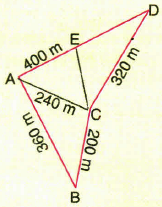
Kamla has a triangular field with sides 240 m, 200 m, 360 m, where she grew wheat. In another triangular field with sides 240 m, 320 m, 400 m adjacent to the previous field, she wanted to grow potatoes and onions. She divided the field in two parts by joining the mid-point of the longest side to the opposite vertex and grew potatoes in one part and onions in the other part. How much area (in hectares) has been used for wheat, potatoes, and onions? (l hectare = 10000 m2).
2.
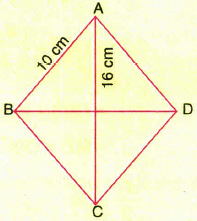
In the given figure AB CD is a rhombus with AC =16 cm and AB = 10 cm. What is the area of the rhombus ABCD?
3.
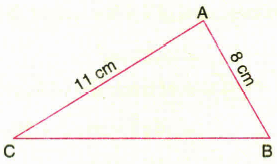
Find the area of a triangle two sides of which are 8 cm and 11 cm and the perimeter is 32 cm.
4.
Find the area of a triangle whose sides are 6.5 cm. 7 cm and 7.5 cm.
5.
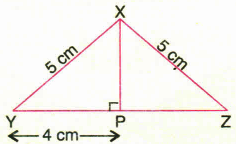
Find the area of an isosceles triangle with two equal sides as 5 cm each and unequal side as 8 cm.
6.
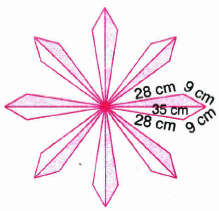
A floral design on a floor is made up of 16 tiles which are triangular, the sides of the triangle being 9 cm, 28 cm, and 35 cm. Find the cost of polishing the tiles at the rate of 50 p per cm2 .
7.
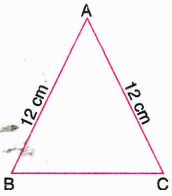
An isosceles triangle has perimeter 30 cm and each of the equal sides is 12 cm. Find the area of the triangle.
8.
Find the area of a triangle two sides of which are 18cm and 10 cm and the perimeter is 42 cm.
9.
The sides of a triangular field are 51 m, 37 m, and 20 m.Find the number of rose beds that can be prepared in the field if each rose bed occupies a space of 6 sq.cm.
10.
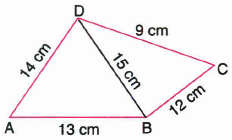
Find the area of a quadrilateral ABCD whose sides AB = 13 cm, BC = 12 cm, CD = 9 cm, DA = 14 cm and diagonal BD = 15 cm.
11.
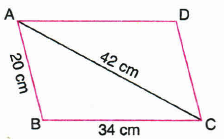
The adjacent sides of a parallelogram ABCD measure 34 cm and 20 cm and the diagonal AC measures 42 cm. Find the area of the parallelogram.
12.
An isosceles triangle has perimeter 30 m and each of the equal sides is 12 cm.Find area of the triangle.
13.
The unequal side of an isosceles \(\Delta \) is 6 cm and its perimeter is 24 cm.Find its area.
14.
Heron's formula is
\(\Delta =\sqrt { s(s+a)(s+b)(s+c) } \)
\(\Delta =\sqrt { s(s-a)(s-b)(s-c) } \)
\(\Delta =\sqrt { s(s-a)(s-b)(s-c) } \), s=a+b+c
\(\Delta =\sqrt { s(s-a)(s-b)(s-c) } \), 2s=a+b+c
15.
The diagonals of a rhombus are 10 cm and 8 cm.Its area is
80 cm2
40 cm2
9 cm2
36 cm2
16.
The area of an equilateral triangle is \(16\sqrt { 3 } \) m2.Its perimeter (in meters) is
12
48
24
306
17.
The side of an isosceles right triangle of hypotenuse \(5\sqrt { 2 } \) cm is
10 cm
8 cm
5 cm
\(3\sqrt { 2 } \) cm
18.
Base of a triangle =
\(\frac { 2\times Area }{ Height } \)
\(\frac { Area }{ Height } \)
\(\frac { Area }{ 2\quad Height } \)
\(\frac { Area }{ 4\quad Height } \)
1.
Let ABC be the field where wheat is grown. Also let ACD be the field which has been divided in two parts by joining C to the mid-point E of AD. For the area of triangle ABC, we have
a = 200 m, b = 240 m, c = 360 m
Therefore, s = \(\frac{200+240+360}{2} \mathrm{~m}=400 \mathrm{~m}\)
So, area for growing wheat
\(=\sqrt{400(400-200)(400-240)(400-360)} \mathrm{m}^{2}\)
\(=\sqrt{400 \times 200 \times 160 \times 40} \mathrm{~m}^{2}\)
\(=16000 \sqrt{2} \mathrm{~m}^{2}=1.6 \times \sqrt{2} \text { hectares }\)
= 2.26 hectares (nearly)
Let us now calculate the area of triangle ACD
Here, we have s \(=\frac{240+320+400}{2} \mathrm{~m}=480 \mathrm{~m}\)
So, area of \(\Delta \mathrm{ACD}=\sqrt{480(480-240)(480-320)(480-400)} \mathrm{m}^{2}\)
\(=\sqrt{480 \times 240 \times 160 \times 80} \mathrm{~m}^{2}=38400 \mathrm{~m}^{2}=3.84 \text { hectares }\)
We notice that the line segment joining the mid-point E of AD to C divides the triangle ACD in two parts equal in area. They have the bases AE and ED equal and, of course, they have the same height.
Therefore, area for growing potatoes = area for growing onions
= (3.84 ÷ 2) hectares = 1.92 hectares.
2.
96 cm2
3.
Here we have perimeter of the triangle = 32 cm, a = 8 cm and b = 11 cm.
Third side c = 32 cm – (8 + 11) cm = 13 cm
So, 2s = 32, i.e., s = 16 cm,
s – a = (16 – 8) cm = 8 cm,
s – b = (16 – 11) cm = 5 cm,
s – c = (16 – 13) cm = 3 cm.
Therefore, area of the triangle = \(\sqrt{s(s-a)(s-b)(s-c)}\)
\(=\sqrt{16 \times 8 \times 5 \times 3} \mathrm{~cm}^{2}=8 \sqrt{30} \mathrm{~cm}^{2}\)
4.
21 cm2
5.
12 cm2
6.
For one tile a = 9 cm, b = 28 cm, c = 35 cm
\(\therefore s=\frac { a+b+c }{ 2 } =\frac { 9+28+35 }{ 2 } =36\) cm
\(\therefore \) Area of one tile \(=\sqrt { s(s-a)(s-b)(s-c) } \)
\(=\sqrt { 36(36-9)(36-28)(36-35) } \)
\(\\ =\sqrt { 36(27)(8)(1) } =\sqrt { 36\left( 9\times 3 \right) \left( 4\times 2 \right) } \)
\(=6\times 3\times 2\sqrt { 6 } =36\sqrt { 6 } \) cm2
\(\therefore \) Area of 16 tiles \(=36\sqrt { 6 } \times 16=576\sqrt { 6 } \)cm2
\(\therefore \) Cost of polishing the tiles at the rate of 50 p per cm2.
\(=576\sqrt { 6 } \times 50\) p = Rs. \(\frac { 576\sqrt { 6 } \times 50 }{ 100 } \)
= Rs. \(288\sqrt { 6 } \) = Rs. 705.60
7.
a = 12 cm, b = 12 cm Perimeter = 30 cm
\(\Rightarrow \) a + b + c = 30
\(\Rightarrow \) 12 + 12 + c = 30
\(\Rightarrow \) 24 + c = 30
\(\Rightarrow \) c = 30 - 24
\(\Rightarrow \) c = 6 cm
\(s=\frac { 30 }{ 2 } \) cm = 15 cm
\(\therefore \) Area of the triangle \(=\sqrt { s(s-a)(s-b)(s-c) } \)
\(=\sqrt { 15(15-12)(15-12)(15-6) } \)
\(=\sqrt { 15(3)(3)(9) } =9\sqrt { 15 } \) cm2.
8.
a = 18 cm, b = 10 cm
Perimeter = 42 cm
\(\Rightarrow a+b+c=42\)
\(\\ \Rightarrow 18+10+c=42\)
\(\\ \Rightarrow 28+c=42\)
\(\\ \Rightarrow c=42-28\)
\(\Rightarrow \ c=14\quad \)cm
\(s=\frac { 42 }{ 2 } =21\)cm
\(\therefore \) Area of the triangle \(=\sqrt { s(s-a)(s-b)(s-c) } \quad \quad \)
\(=\sqrt { 21(21-18)(21-10)(21-14) } \)
\(\\ =\sqrt { 21(3)(11)(7) }\)
\( \\ =\sqrt { (7)(3)(3)(11)(7) } \)
\(=(7)(3)\sqrt { 11 } =21\sqrt { 11 } \)cm2
9.
Let a = 51 m, b = 37 m, and c = 20 m
Then, s= \(\frac { a+b+c }{ 2 } \) = \(\frac { 51+37+20 }{ 2 } =\frac { 108 }{ 2 } \) = 54 m
\(\therefore \) Area of the triangular field = \(\sqrt { s(s-a)(s-b)(s-c) } \)
= \(\sqrt { 54(54-51)(54-37)(54-20) } \)
=\(\sqrt { 54\times 3\times 17\times 34 } =\sqrt { 2\times 3\times 3\times 3\times 3\times 17\times 2\times 17 } \)
= \(2\times 3\times 3\times 17=306\)m2
Space occupied by one rose bed = 6 m2
Number of rose beds that can be prepared in the field = \(\frac { Area\ of\ the\ field }{ Space\ occupied\ by\ one\ rose\ bed } \)
\(=\frac { 306 }{ 6 } =51\)
10.
For \(\Delta \)ABD
a = 13 cm, b = 14 cm, c = 15 cm
\(\therefore s=\frac { a+b+c }{ 2 } s=\frac { 13+14+15 }{ 2 } \) = 21 cm
\(\therefore \) Area = \(=\sqrt { s(s-a)(s-b)(s-c) } \)
\(=\sqrt { 21(21-13)(21-14)(21-15) } \)
\(\sqrt { 21\times 8\times 7\times 6 } =84\) cm2
For\(\Delta \) BCD
1 = 9 cm, b = 12 cm, c = 15 cm
\( \therefore s=\frac { a+b+c }{ 2 } s=\frac { a+12+15 }{ 2 } \)=18 cm
\(\therefore \)Area \(=\sqrt { s(s-a)(s-b)(s-c) } \)
\(=\sqrt {18(18-9)(18-12)(18-15) } \)
\(\sqrt { 18\times 9\times 6\times 3 } =54\) cm2
Now, area of quadrilateral ABCD = Area of \(\Delta \)ABD + Area of \(\Delta \)BCD
= 84 cm2 + 54 cm2 = 138 cm2
11.
For \(\Delta \) ABC
a = 34 cm, b = 42 cm, c = 20 cm
\(\therefore s=\frac { a+b+c }{ 2 } =\frac { 34+42+20 }{ 2 } =48\) cm
\(\therefore \) Area of \(\Delta \) ABC = \(\sqrt { s(s-a)(s-b)(s-c) } \)
\(=\sqrt { 48(48-34)(48-42)(48-20) } \)
\(=\sqrt { 48(14)(6)(28) } =\quad 336\) cm2
\(\therefore \) Area of parallelogram ABCD = 2 area of triangle ABC
= 2\(\times \) 336 cm2 = 672 cm2
12.
Let the third side be x cm. Then, 12 + 12 + x = 30
24 + x = 30
x = 6 cm
So, a = 12 cm, b = 12 cms, c = 6 cm
\(\therefore s=\frac { a+b+c }{ 2 } =\frac { 12+12+6 }{ 2 } \)
= 15 cm
\(\therefore \) Area \(=\sqrt { s(s-a)(s-b)(s-c) } \)
\(=\sqrt { 15(15-12)(15-12)(15-6) } \)
\(=9\sqrt { 15 } \) cm2
13.
b + b + 6 = 24
\(\Rightarrow \) b = 9 cm
\(\therefore \) Area \(=\frac { 9 }{ 4 } \sqrt { 4{ b }^{ 2 }-{ a }^{ 2 } } =\frac { 6 }{ 4 } \sqrt { 4{ (9) }^{ 2 }-{ (6) }^{ 2 } } \)
\(=\frac { 3 }{ 2 } \sqrt { 288 } =\frac { 3 }{ 2 } .12\sqrt { 2 } \)
\( 18\sqrt { 2 } \) cm2
14.
See Hero's formula.
15.
Area = \(\frac { 1 }{ 2 } \times 10\times 8=40\)cm2
16.
\(\frac { \sqrt { 3 } { a }^{ 2 } }{ 4 } =16\sqrt { 3 } \quad \Rightarrow \) a=8
Perimeter 3a = 3 \(\times \) 8 = 24 m
17.
(c)
5 cm
18.
Formula

9th Standard CBSE Syllabus & Materials
9th Standard CBSE
CBSE 9th Mathematics Lines and Angles Sample Question Papers Study Material - QB365 Set A
NEW9th Standard CBSE
CBSE 9th Mathematics Introduction to Euclid's Geometry Sample Question Papers Study Material - QB365 Set A
NEW9th Standard CBSE
CBSE 9th Mathematics Linear Equations in Two Variables Sample Question Papers Study Material - QB365 Set A
NEW9th Standard CBSE
CBSE 9th Mathematics Coordinate Geometry Sample Question Papers Study Material - QB365 Set A



NCERT Books

Syllabus

Exam Pattern

Sample Question Papers

Previous year Question Papers

Important Notes

MCQ Practice test

NCERT Exemplers

Case study Questions

Image Based Questions

Passage based Questions

HOT Questions

Value Based Questions

Model Questions Papers
NCERT ( Book Back ) Questions

Assertion and Reason
Important Questions And Answers

CBSE 9th Standard CBSE Subjects
CBSE Standards