100% FREE ACCESS
9th Standard CBSE Syllabus & Materials
9th Standard CBSE
CBSE 9th Science Is matter around us pure? - New Model Questions Papers Study Material - QB365 Set A
NEW9th Standard CBSE
CBSE 9th Science Matter in our surroundings - New Model Questions Papers Study Material - QB365 Set A
NEW9th Standard CBSE
CBSE 9th Mathematics Heron's Formula Sample Question Papers Study Material - QB365 Set A
NEW9th Standard CBSE
CBSE 9th Mathematics Circles Sample Question Papers Study Material - QB365 Set A
NEW9th Standard CBSE
CBSE 9th Mathematics Quadrilaterals Sample Question Papers Study Material - QB365 Set A
NEW9th Standard CBSE
CBSE 9th Mathematics Triangles Sample Question Papers Study Material - QB365 Set A

Published on: 29/10/2025
Download CBSE Class 9th Standard CBSE Mathematics question papers, sample papers, important questions, and previous year solved papers in PDF format. Get free study materials, NCERT solutions, and exam preparation resources for Class 9th Standard CBSE Mathematics
Questions + Answers key
Take MCQ Mathematics Test
1.
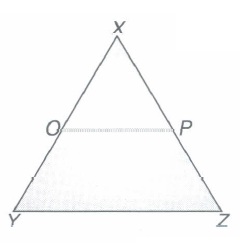
In the given figure, if \(OX=\frac{1}{2}XY, PX=\frac{1}{2}XZ\) and OX = PX, Show that XY = XZ.
2.
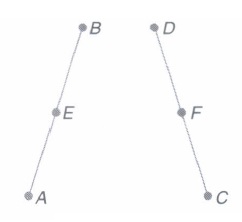
In figure, AE = DF, E is the mid-point of AB and F is the mid-point of DC. Using an Euclid's axiom, show that AB = DC.
3.
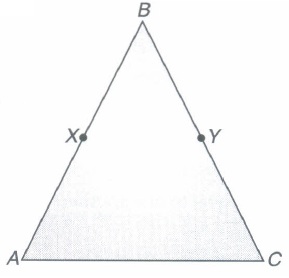
In the given figure, we have AB = BC, BX = BY. Show that AX = CY. State the axiom used.
4.
In the given figure AC = DC, CB = CE, Show that AB = DE.
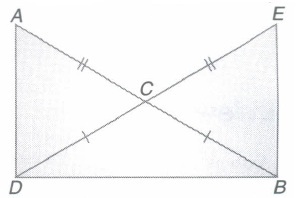
Write Euclid's axiom to support this.
5.
Read the following statements which are taken as axioms.
(i) If a transversal intersects two parallel lines, then corresponding angles are not necessarily equal.
(ii) If a transversal intersects two parallel lines, then alternate interior angles are equal.
Is this system of axioms consistent? Justify your answer.
6.
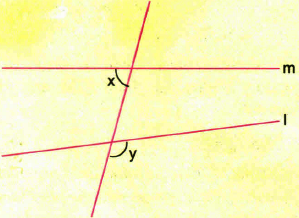
In the given figure x=\(70^{ 0 }\) y=\(120^{ 0 }\) Check whether l || m? Give reason
7.
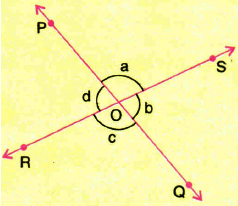
Lines PQ and Rs Intersect each other at O (see figure) If \(\angle \)POR;\(\angle \)ROQ=3:7 Find all the angles a,b,c and d.
8.
(i) In figure ,AO \(\bot \)OB Find \(\angle \)AOC and \(\angle \) BOC
.png)
(ii) In figure,\(\angle \) AOB ;\(\angle \)BOC=2:3
If \(\angle \)AOC=\(75^{ 0 }\) then find the measure of ,\(\angle \) AOB ;\(\angle \)BOC
.png)
9.
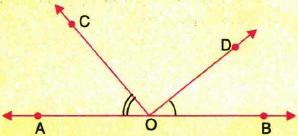
In figure OA ,OB are opposite rays and \(\angle \)AOC +\(\angle \)BOD=\(90^{ 0 }\) Find \(\angle \) COD
10.
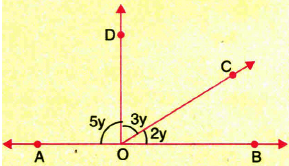
In the given figure if AOB is a line then find the measure of \(\angle \)BOC \(\angle \)COD and \(\angle \)DOA
11.
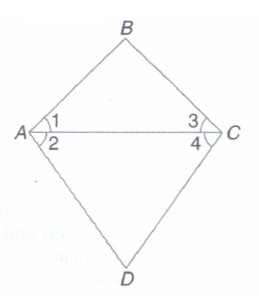
In the given figure, we have \(\angle1=\angle3\) and \(\angle2=\angle4\). Show that, \(\angle A=\angle C.\)
12.
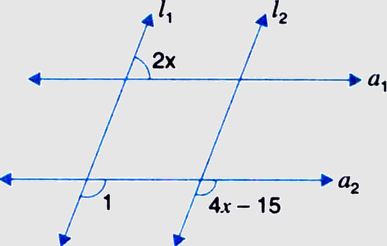
In the given figure, if l1 || l2 and a1 || a2,then find the value of x.
13.
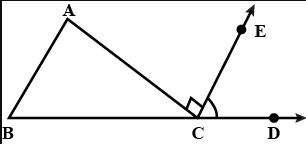
In the given figure, AC 丄 CE and ㄥA: ㄥB: ㄥC = 5:3:2. Find the value of ㄥECD.
14.
If S is a point lies in the interior of ΔPQR such that, ㄥPQR = 80° and ㄥPQS = 35°, determine the measure of ㄥRQS.
15.
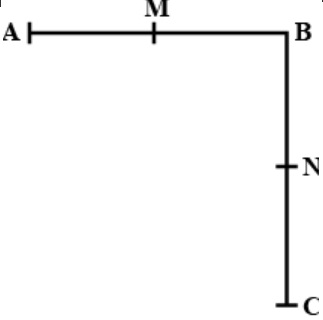
In the figure given below:
(i) If AB = BC, then Mis the midpoint of AB and N is the midpoint of BC. Show that AM = NC.
(ii) If BM = BN, then Mis the midpoint of AB and N is the midpoint of BC. Show that AB = BC.
16.
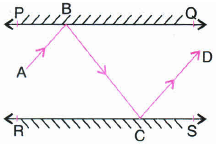
In Figure ,PQ and RS are two mirrors placed parallel to each other An incident ray AB strikes the mirror PQ at B the reflected ray moves along the path BC and strikes the mirror RS at C and again reflects back along CD.Prove that AB|| CD
17.
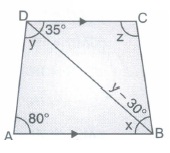
In the given figure, AB||DC, \(\angle BDC=35^o\) and \(\angle BAD=80^o.\) Find x,y,z
18.
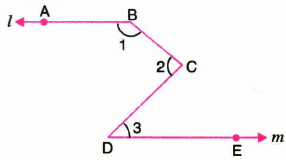
In figure l || m , show that \(\angle 1+\angle 2-\angle 3=180^{ 0 }\)
19.
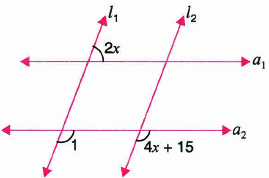
In the figure below \(l_{ 1 }||l_{ 2 }\) and \(a_{ 1 }||a_{ 2 }\) find the value of x.
20.
Two lines are respectively perpendicular to two perpendicular lines then the these two lines to each other are
parallel
perpendicular
inclined at some acute angle
intersecting at \(110^{ 0 }\)
21.
In the figure \(PS\bot L\) and RQ \(\bot \)l the degree measure of y is:
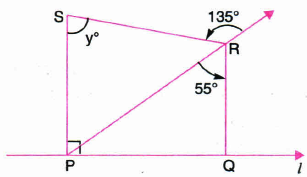
\(55^{ 0 }\)
\(90^{ 0 }\)
\(80^{ 0 }\)
\(135^{ 0 }\)
22.
In the given figure PQ || RS and EF || QS If \(\angle PQS=60^{ 0 }\) then the measure of \(\angle RFE\)
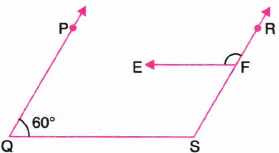
\(115^{ 0 }\)
\(120^{ 0 }\)
\(60^{ 0 }\)
\(180^{ 0 }\)
23.
In figure BC || DE if \(\angle ABC=\angle CDE=90^{ 0 }\) and \(\angle ACB=30^{ 0 }\) then the measure of \(\angle DCE\) is:
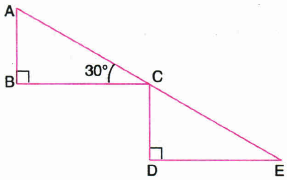
\(30^{ 0 }\)
\(60^{ 0 }\)
\(60^{ 0 }\)
\(180^{ 0 }\)
24.
In figure if m || n and \(\angle a:\angle b=2:3\) then the measure of h is :
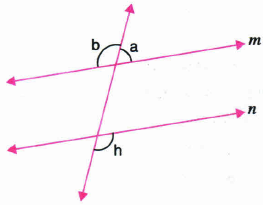
\(72^{ 0 }\)
\(108^{ 0 }\)
\(120^{ 0 }\)
\(150^{ 0 }\)
25.
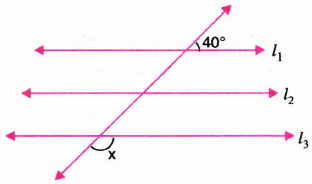
Given lines \(l_{ 1 },l_{ 2}\) and \(l_{ 3 }\) in the figure are parallel the value of x is:
\(40^{ 0 }\)
\(140^{ 0 }\)
\(50^{ 0 }\)
\(80^{ 0 }\)
26.
If two parallel lines are intersected by a transversal then corresponding angles are:
Equal
Complimentary
Supplementary
Sum of the two angles is \(360^{ 0 }\)
27.
If two parallel lines are cut by a transversal then which of the following is not true?
Corresponding angles are equal
Alternate interior angles are equal
Interior angles of the same side of the transversal are supplementary
Interior angles on the same side of the transversal are complimentary
28.
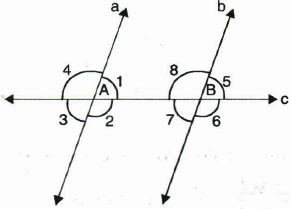
In the following figure a transversal c intersects two parallel lines a and b The angles formed at A and B have been marked.Tell which pair of angles need not be equal?
\(\angle 1,\angle 2\)
\(\angle 1,\angle 3\)
\(\angle 1,\angle 5\)
\(\angle 2,\angle 8\)
29.
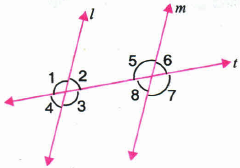
From the given figure , identify the incorrect statement given l || m and t is the transversal:
\(\angle 2\) and \(\angle 5\) are supplementary
\(\angle 2\) and 8 are supplementary
\(\angle 2\) and \(\angle 3\) are supplementary
\(\angle 2\) and \(\angle 1\) are supplementary
1.
Here, \(OX=\frac{1}{2}XY, PX=\frac{1}{2}XZ\)
XY = 2(OX), XZ = 2(PX)
Also. OX = PX(Given)
XY = XZ
(because things which are double of the same things are equal to one another)
2.
AB = 2AE ( E is the mid-point of AB)
CD = 2DF (F is the mid-point of CD)
Also, AE = DF(Given)
Therefore, AB = CD(things which are double of the same things are equal to one another)
3.
Since, AB = BC
AX + BX = BY + CY
Since, BX = BY
AX + BX - BX = BY + CY - BY
AX = CY
Axiom : If equals are subtracted from the equals, the remainders are equal.
4.
AC = DE(Given)
CB = CE
Adding, AC + CB = DC + CE
AB = DE
If equals are added to equals, the wholes are equal.
5.
A system of axiom is called consistent if there is no statement which can be deduced from these axioms such that it contradicts any axiom. We know that if a transversal intersects two parallel lines, then each pair of corresponding angles are equal, which is a theorem. So, statement I is false hence, it is not an axiom.
Also, we know that if a transversal intersects two parallel lines, then each pair of alternate interior angles are equal. It is also a theorem. So, statement II is true, hence it is an axiom. Thus, in given statements, I is false and II is an axiom. Hence, given system of axioms is not consistent.
6.
\(x+y=190^{ 0 }\neq 180^{ 0 }\)
7.
a =\(126^{ 0 }\), b =\(54^{ 0 }\), c =\(126^{ 0 }\), d =\(54^{ 0 }\)
8.
Let \(\angle AOB=2x\) and \(\angle BOC=3x\)
\(\angle AOB+\angle BOC=\angle AOC\)
2x+3x=75o
\(\Rightarrow x=\frac{75^o}{5}=15^o\)
\(\angle AOB=2x=30^o\) and \(\angle BOC=3x=45^o\)
9.
\(90^{ 0 }\)
10.
\(36^{ 0 },54^{ 0 },90^{ 0 }\)
11.
Since \(\angle1=\angle3\ and \ \angle2=\angle4\), therefore adding before equations.
\(\angle1+\angle2=\angle3+\angle4\)
\(\Rightarrow \angle BAD= \angle BCD\)
\(\Rightarrow \angle A= \angle C.\)
12.
x = 32.5°
13.
Let ㄥA = 5x, ㄥB = 3x and ㄥC = 2x.
In ΔABC, we have ㄥA + ㄥB + ㄥC = 180°
⇒ 5x+ 3x+ 2x = 180°
⇒ x=\(\frac{180^{\circ}}{10}\)=18°
ஃ ㄥA=5x=5x18°=90°
ㄥB=3x=3x18°=54°
and ㄥC = 2x = 2 x 18° = 36°
Now, ㄥACD = ㄥBAC + ㄥABC
[ஃ exterior angle = sum of interior opposite angles]
⇒ ㄥACE + ㄥECD = 90° + 54°
ஃ ㄥECD = 54°[∵ ㄥACE = 90°]
14.
45°
15.
Given, AB = BC
Since M is the mid-point of AB.
ஃ AM = MB = \(\frac{1}{2}\) AB
Also, N is the mid-point of BC
ஃ BN = NC = \(\frac{1}{2}\)BC
According to Euclid's axiom 7, things which are halves of the same things are equal to one another.
On multiplying both sides of Eq. (i) by\(\frac{1}{2}\), we get
\(\frac{1}{2}\)AB = \(\frac{1}{2}\)BC ⇒ AM = NC
[from Eqs. (ii) and (iii)]
(ii) Given, BM = BN
Since, M is the mid-point of AB.
ஃ AM = BM =\(\frac{1}{2}\)AB
⇒ 2AM = 2BM = AB
Also, N is the mid-point of BC.
ஃ BN = NC =\(\frac{1}{2}\)BC
⇒ 2BN = 2NC = BC ...(iii)
According to Euclid's axiom 6, things which are double of the same things, are equal to one another.
On multiplying Eq. (i) by 2, we get
2BM = 2BN ⇒AB = BC [from Eqs. (ii) and (iii)]
16.
Construction: Draw ray BL \(\bot \) PQ and ray CM \(\bot \) RS.
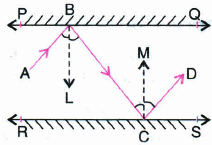
BL \(\bot \) PQ,CM \(\bot \) RS and PQ || RS BL||CM
\(\angle \) LBC=\(\angle \) MCB
|Alternate Interior Angles
\(\angle\)ABL=\(\angle\)LBC
Angle of incidence= Angle of reflection
\(\angle \)MCB=\(\angle \)MCD
Angle of incidence= Angle of reflection
From (1),(2) and (3) we get
\(\angle \)ABL =\(\angle \)MCD
Adding (1) and (4) , we get
\(\angle \) LBC+\(\angle \)ABL =\(\angle \)MCB+\(\angle \)MCD
\(\Rightarrow \) \(\angle \)ABC=\(\angle \)BCD
But these form a pair of equal alternate interior angles
So AB || CD.
17.
AB||DC
\(\angle CDB=\angle ABD\)
=x=35o[alternate angles]
x+y+80o=180o
\(\angle ADB=y=180^o-35^o-80^o\)
=65[angle sum property]
\(\angle DCB=z=180^o-[35^o+35^o]\)
=110o
18.
Given l || m
To prove \(\angle 1+\angle 2-\angle 3=180^{ 0 }\)
Construction : Through C, draw CF || L || M
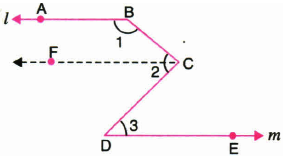
\(\therefore l||CF\) | by construction and a transversal BC intersects then
\(\therefore \angle 1+\angle FCB=180^{ 0 }\)
\(\therefore \)The Sum of consecutive interior angles on the same side of a transversal is \(180^{ 0 }\)
\(\Rightarrow \angle 1+\angle FCD=180^{ 0 }\)
BUT \(\angle FCD=\angle 3\)
| Alternate interior angles
From (1) and (2)
\(\angle 1+\angle 2-\angle 3=180^{ 0 }\)
19.
\(\angle \)1=4x+15 | Corresponding angles
2x=180-\(\angle \)1 |Corresponding angles
\(\Rightarrow \) 2x=\(180^{ 0 }\) -(4x+15)
\(\Rightarrow \) 2x=165-4x
\(\Rightarrow \) 6x=165 \(\Rightarrow \)\(x=\frac { 165 }{ 6 } =27\frac { 1^{ 0 } }{ 2 } \)
20.
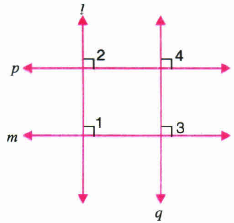
Let \(l\bot m\)
Then \(\angle 1=90^{ 0 }\)
\(P\bot 1\)
Then \(\angle 2=90^{ 0 }\)
21.
\(\therefore PS\bot L\) and RQ \(\bot\) L
PS || PQ
\(y^{ 2 }+\angle SRQ=180^{ 0 }\)
22.
\(\angle PQS+\angle RSQ=180^{ 0 }\)
\(\Rightarrow 60^{ 0 }+\angle RSQ=180^{ 0 }\)
\(\Rightarrow \angle RSQ=120^{ 0 } \)
\(\angle RFE=\angle RSQ=120^{ 0 }\)
23.
\(\angle BC||DE\) and \(\angle CDE=90^{ 0 }\quad \)
\(\therefore \angle BCD=90^{ 0 }\) | Alternate Interior angles
\(\angle CDE=90^{ 0 }\)
\(\therefore \angle DCE=180^{ 0 }-(30^{ 0 }+90^{ 0 })=60^{ 0 }\)
24.
\(\angle a+\angle b=180^{ 0 }\)
2 + 3 = 5
\(\therefore \angle b=\frac { 3 }{ 5 } x180^{ 0 }=108^{ 0 }=\angle h\)
25.
\(x+40^{ 0 }=180^{ 0 }\)
26.
Corresponding angles axiom
27.
The sum of consecutive interior angles on the same side of a transversal is \(180^{ 0 }\)
28.
\(\angle 1\) and \(\angle 2\) are simply adjacent angles
29.
\(\angle 2\) and \(\angle 8\) are alternate interior angles

9th Standard CBSE Syllabus & Materials
9th Standard CBSE
CBSE 9th Mathematics Lines and Angles Sample Question Papers Study Material - QB365 Set A
NEW9th Standard CBSE
CBSE 9th Mathematics Introduction to Euclid's Geometry Sample Question Papers Study Material - QB365 Set A
NEW9th Standard CBSE
CBSE 9th Mathematics Linear Equations in Two Variables Sample Question Papers Study Material - QB365 Set A
NEW9th Standard CBSE
CBSE 9th Mathematics Coordinate Geometry Sample Question Papers Study Material - QB365 Set A



NCERT Books

Syllabus

Exam Pattern

Sample Question Papers

Previous year Question Papers

Important Notes

MCQ Practice test

NCERT Exemplers

Case study Questions

Image Based Questions

Passage based Questions

HOT Questions

Value Based Questions

Model Questions Papers
NCERT ( Book Back ) Questions

Assertion and Reason
Important Questions And Answers

CBSE 9th Standard CBSE Subjects
CBSE Standards