100% FREE ACCESS
9th Standard CBSE Syllabus & Materials
9th Standard CBSE
CBSE 9th Science Is matter around us pure? - New Model Questions Papers Study Material - QB365 Set A
NEW9th Standard CBSE
CBSE 9th Science Matter in our surroundings - New Model Questions Papers Study Material - QB365 Set A
NEW9th Standard CBSE
CBSE 9th Mathematics Heron's Formula Sample Question Papers Study Material - QB365 Set A
NEW9th Standard CBSE
CBSE 9th Mathematics Circles Sample Question Papers Study Material - QB365 Set A
NEW9th Standard CBSE
CBSE 9th Mathematics Quadrilaterals Sample Question Papers Study Material - QB365 Set A
NEW9th Standard CBSE
CBSE 9th Mathematics Triangles Sample Question Papers Study Material - QB365 Set A

Published on: 29/10/2025
Download CBSE Class 9th Standard CBSE Mathematics question papers, sample papers, important questions, and previous year solved papers in PDF format. Get free study materials, NCERT solutions, and exam preparation resources for Class 9th Standard CBSE Mathematics
Questions + Answers key
Take MCQ Mathematics Test
1.
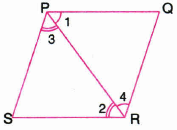
In the given figure, it is given that \(\angle \)1 = \(\angle \)4 and \(\angle \)3 = \(\angle \)2. By which Euclid's axiom, it can be shown that if \(\angle \)2 = \(\angle \)4, then \(\angle \)1 = \(\angle \)3.
2.
Does Euclid s fifth postulate imply the existence of parallel lines? Explain.
3.
In the given figure, if AB = CD, then prove that AC = BD. Also write the Euclid's axiom used for proving it.

4.
In the given figure, we have AB=AD and AC=AD. Prove that AB=AC. State the Euclid's axiom to support this.
5.
Which of the following statements are true?
(i) A line segment has no definite length.
(ii) A line separates a plane into three parts, namely the two half planes and the line itself.
(iii) Three lines are concurrent if they have a common point.
(iv) Two lines are coincident if they have a common point.
6.
What is the difference between a Euclid's Postulates and an axioms?
7.
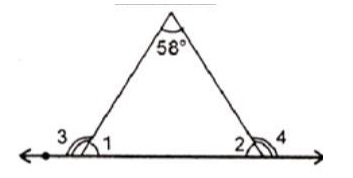
In the given figure, ㄥ2 = ㄥ1 and ㄥ3 = ㄥ4. Find ㄥ\(\theta\) .
8.
In the adjoining figure, if OX = \(\frac{1}{2}\)XY,
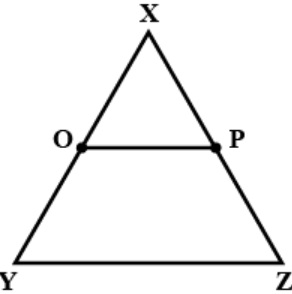
PX = \(\frac{1}{2}\)XZ and OX = PX, then show that XY = XZ.
9.
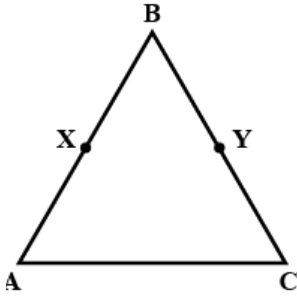
In the given figure, If AB = BC and BX = BY, then show that AX = CY.
10.
In the adjoining figure, name the following:
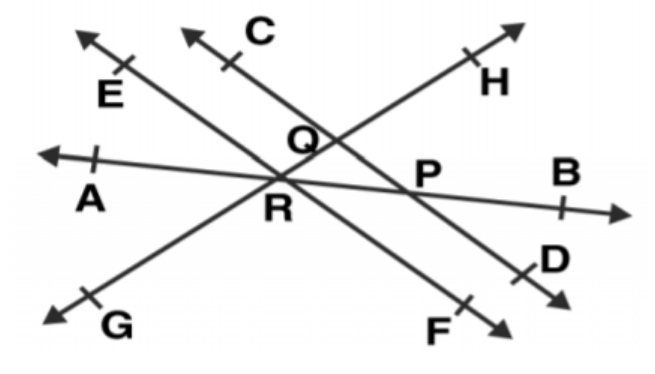
(i) Two pairs of intersecting lines and their corresponding points of intersection.
(ii) Three concurrent lines and their points of intersection
(iii) Three rays
(iv) Two line segments
11.
In the given figure, if A, Band Care three points on a line and B lies between A and C, then prove that AB + BC = AC.

12.
An angle is 25° more than its complement. What is its measure?
13.
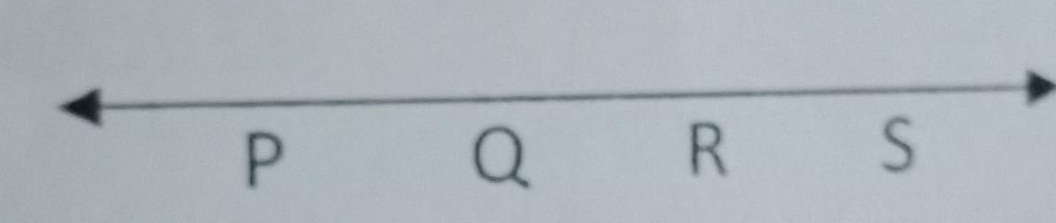
In the adjoining figure, PR = RS and RQ = RT. Show that PQ = and write the Euclid's axiom to support this.
14.
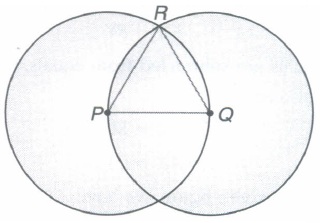
If P and Q are the centres of two intersecting circles, then prove that
PQ = QR = PR.
15.
Prove that the two lines which are parallel to the same line, are parallel to each other.
16.
Fill in the blanks to complete the following axioms:
(i) Things, which are equal to the same things, are ____________ .
(ii) If equals are added to equals, the _____________.
(iii) If equals are subtracted from equals, ___________.
(iv) Things which coicide with one another are ______________ .
(v) The whole is greater than the ____________ .
(vi) Things which are double of the same things are _____________.
(vii) Things which are halves of the same things, are ____________ .
(viii) If equals are multiplied by equals, then their _____________ .
(ix) If equals are divided by equals, then their ____________ .
(x) Of the two quantities of the same kind, the first is greater than, equal to or less than the second. This axiom is called ______________.
17.
Give a definition for each of the following terms. Are there other terms that need to be defined first? What are they, and how might you define them?
(i) parallel lines
(ii) perpendicular lines
(iii) line segment
(iv) radius of a circle
(v) square
18.
Which of the following statements are true and which are false? Give reasons for your answers.
(i) Only one line can pass through a single point.
(ii) There are an infinite number of lines which pass through two distinct points.
(iii) A terminated line can be produced indefinitely on both the sides.
(iv) If two circles are equal, then their radii are equal.
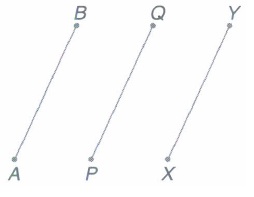
(v) In the following figures. if AB = PQ and PQ = XY. then AB = XY.

19.
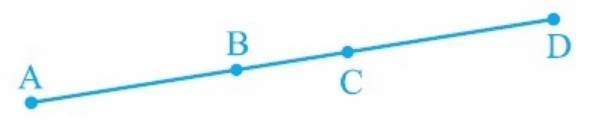
In the given figure, if AC = BD, then prove that AB = CD.
20.
Which of the following statements are true and which are false? Give reason for your answers.
(i) Only one line can pass through a single point.
(ii) There are an infinite number of lines which pass through two distinct points.
(iii) The terminated line can be produced indefinitely on both the sides.
(iv) If two circles are equal, then their radii are equal.
(v) In the given figure, if AB = PO and PO = XY, then AB =XY.
1.
\(\angle \)2 = \(\angle \)4 ,,,,,,,(1) | Given
\(\angle \)1= \(\angle \)4 ........(2) | Given
\(\angle \)3 =\(\angle \)2 .......(3) | Given
From (1), \(\angle \)4 = \(\angle \)2 ......(4)
From (3) and (4),
\(\angle \)3 = \(\angle \)4 .....(5)
I Things which are equal to the same thing are equal to one another
From (2) and (4),
\(\angle \)1 = \(\angle \)3
I Things which are equal to the same thing are equal to one another
2.
Yes, If a straight line 'I' falls on two lines 'm' and 'n' such that sum of the interior angles on one side of I is two right angles, then by Euclid's fifth postulate, the lines will not meet on this side of I. Also we know that the sum of the interior angles on the other side of the line I will be two right angles too. Thus, they will not meet on the other side also.
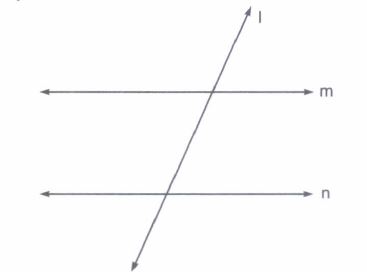
∴ The lines 'rn' and 'n' never meet, i.e., they are parallel.
3.
AB = CD(Given)
\(\Rightarrow\)AB + BC = BC + CD
\(\Rightarrow\)AC = BD
Euclid's axiom used: If equals are added to equals, the wholes are equal.
4.
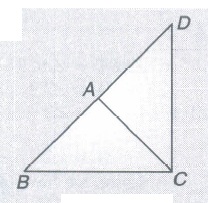
Things which are equal to the same thing are equal to one another.
5.
(i) False
(ii) False
(iii) True
(iv) False
6.
Euclid used the term postulate for the assumptions that were specific to geometry and otherwise called axioms.
7.
Given, ㄥ2 = ㄥ1 and ㄥ3 = ㄥ4 ......(i)
Now, ㄥ2 = ㄥ1
ㄥ2 + ㄥ3 = ㄥ1 + ㄥ3 [if equals are added to equals, then the wholes are equal ]
⇒ ㄥ2 + ㄥ3 = ㄥ2 + ㄥ3 [from Eq. (i)]
⇒ ㄥ2 + ㄥ3 + 30° = ㄥ2 + ㄥ3 + 30° [if equals are added to equals, then the wholes are equal]
⇒ ㄥ2 + ㄥ3 + 30° =ㄥ2 +ㄥ3 + θ ⇒ 30° = θ
[since, if equals are subtracted from equals, then the remainders are equal]
ஃ θ = 30°
8.
Given, QX = \(\frac{1}{2}\) XY ...(i)
PX=\(\frac{1}{2}\)XZ ....(ii)
and QX= PX ......(iii)
From Eqs. (i), (ii) and (iii), we get
\(\frac{1}{2}\)XY =\(\frac{1}{2}\)XZ
ஃ XY = XZ [by axiom 6]
9.
Given, AB = BC
and BX = BY
On subtracting Eq. (ii) from Eq. (i), we get
AB - BX = BC - BY
⇒ AX = CY
10.
(i) \(\overleftrightarrow { EF } ,\overleftrightarrow { GH } ,R\)
(ii) \(\overleftrightarrow { AB } ,\overleftrightarrow { EF } ,\overleftrightarrow { GH } ,R\)
(iii) \(\overrightarrow { RB } ,\overrightarrow { RH } ,\overrightarrow { RG } \)
(iv) \(\overline { RQ } ,\overline { RP } \)
11.
In the given figure, AC coincides with AB + BC.
Also, Euclid's axiom 4 says that things which coincide with one another, are equal to one another. So, it can be deduced that
AB + BC = AC
12.
We know that, two angles are said to be complement of each other, if their sum is 90°. Let the angle be x, then its complement will be (90 ° - x).
According to statement, we get x = 25° + (90°-x)
⇒ x = 115 ° - x
⇒ 2x = 115 ° ⇒ x = \(\frac{115^\circ}{2}=57\frac{1^{\circ}}{2}\)
13.
Euclid's axiom 2
14.
In the given figure,
PR = PQ [radii ofthe same circle] ... (i)
and QP = QR [radii of the same circle] ... (ii)
From Eqs. (i) and (ii), PR = QR [by axiom 1] ... (iii)
From Eqs. (i), (ii) and (iii), PQ = QR = PR [by axiom 1]
Hence proved.
15.
Given Three lines l, m and n, such that l || n and m II n.
To prove l II m
Proof If possible, let l is not parallel to m, then I and m intersect in a unique point, say P. Thus, through a point P outside n, there are two lines I and m, both parallel to n. This is contradiction to the parallel line axiom. So, our supposition is wrong.
ஃ l || m
Hence proved.
16.
(i) equal to one another
(ii) wholes are equal
(iii) the remainders are equal
(iv) equal to one another
(v) part
(vi) equal to one another
(vii) equal to one another
(viii) products are equal
(ix) quotients are equal
(x) 'Trichotomy law'
17.
Yes, we need to have an idea about the terms, point, line, ray, angle, plane, circle and quadrilateral, etc. before defining the required terms.
Point: A small dot made by a sharp pencil on the surface of a paper gives an idea about a point. It has no dimensions. It has only a position.
Line: A line is an idea that it should be straight and that it should extend indefinitely in both the directions. It has no end points and has no definite length.
Note: In geometry a line means "The line in its totality and not a portion of it. Whereas a physical example of a perfect line is not possible. A line extends indefinitely in both directions, so we cannot draw or show it wholly on a paper. That is why we mark arrow heads on its both ends, indicating that it extends indefinitely in both directions.
Ray: A part of line which has only one end point and extends indefinitely in one direction. A ray has no definite length.
Angle: Two rays having a common end-point form an angle.
Plane: Plane is a surface such that every point of the line joining any two points on it, lies on it.
Circle: A circle is the set of all those points in a given plane which are equidistant from a fixed point is the same plane. The fixed point is called the centre of the circle.
Quadrilateral: A closed figure made of four line segments is called a quadrilateral.
Definitions of the required terms are given below:
(i) Parallel Lines: Two lines 'I' and 'm' in a plane are said to be parallel, if they have no common point and we write them as l ‖ m.
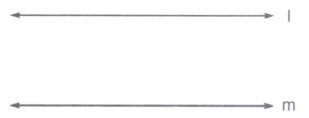
Note: The distance between two parallel lines always remains the same.
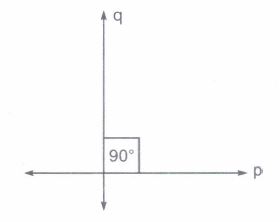
(ii) Perpendicular Lines: Two lines 'p ' and 'q' lying in the same plane are said to be perpendicular if they form a right angle and we write them as p 丄 q.
(iii) Line Segment: A line segment is a part of line having a definite length. It has two end-points. In the figure a line segment is shown having end points 'A' and 'B'. It is written \(\overline{\mathrm{AB}}\) as or \(\overline{\mathrm{BA}}\).

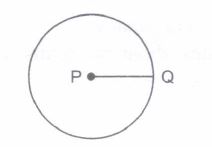
(iv) Radius of a circle: The distance horn the centre to a point on the circle is called the radius of the circle. In the figure, P is centre and Q is a point on the circle, then PQ is the radius.
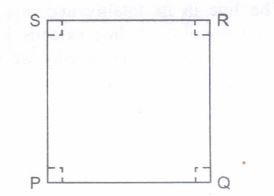
(v) Square: A quadrilateral in which all the four angles are right angles and all the four sides are equal is called a square. In the figure PQRS is a square.
18.
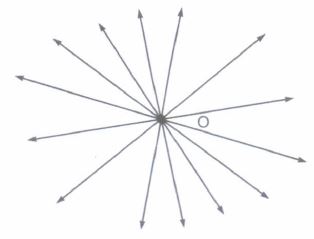
(i) False
[If we mark a point O on the surface of a paper and using pencil and ruler, we can draw indefinite number of straight lines passing through O.]
(ii) False
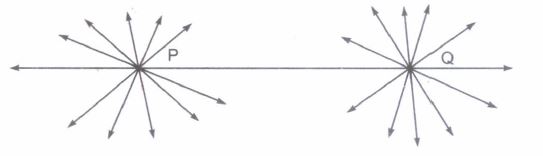
[∵ In the following figure, there are many straight lines passing through 'P'. There are many lines, passing through 'Q'. But there is one and only one line which is passing through 'P' as well as 'Q'.]
(iii) True
[∵ The postulate 2 says that "A terminated line can be produced indefinitely."]
(iv) True
[∵ Superimposing the region of one circle on the other, we find them coinciding. So, their centres and boundaries coincide. Thus, their radii will coincide.]
(v) True
[∵ According to Euclid's axiom, things which are equal to the same thing are equal to one another.]
19.
Given, AC = BD ...(i)
From figure, it is clear that
AC = AB + BC and BD = BC + CD.
On putting these values in Eq. (i), we get
AB + BC = BC + CD
On subtracting BC from both sides, we get
AB + BC - BC = BC + CD - BC
⇒ AB = CD [by axiom 3]
Hence proved
20.
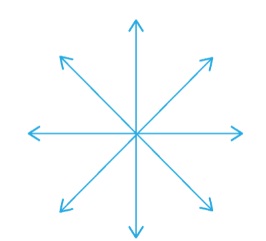
(i) False, because from a single point, infinite number of lines can pass.
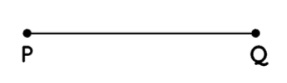
(ii) False, because from two distinct points, only one straight line can pass. [by postulate axiom]
(iii) True, it is Euclid's postulate 2.
(iv) True, because radii of congruent (equal) circles are always equal. In other words, if we superimpose the region bounded by one circle on the other circle, then they coincide. Then, their centres and boundaries also a>incide. Therefore, their radii will be same.
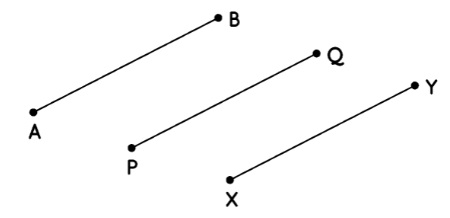
(v) True,given that AB = PQ (i) and PQ = XY (ii)
From Eqs. (i) and (ii), AB = XY

9th Standard CBSE Syllabus & Materials
9th Standard CBSE
CBSE 9th Mathematics Lines and Angles Sample Question Papers Study Material - QB365 Set A
NEW9th Standard CBSE
CBSE 9th Mathematics Introduction to Euclid's Geometry Sample Question Papers Study Material - QB365 Set A
NEW9th Standard CBSE
CBSE 9th Mathematics Linear Equations in Two Variables Sample Question Papers Study Material - QB365 Set A
NEW9th Standard CBSE
CBSE 9th Mathematics Coordinate Geometry Sample Question Papers Study Material - QB365 Set A



NCERT Books

Syllabus

Exam Pattern

Sample Question Papers

Previous year Question Papers

Important Notes

MCQ Practice test

NCERT Exemplers

Case study Questions

Image Based Questions

Passage based Questions

HOT Questions

Value Based Questions

Model Questions Papers
NCERT ( Book Back ) Questions

Assertion and Reason
Important Questions And Answers

CBSE 9th Standard CBSE Subjects
CBSE Standards