100% FREE ACCESS
9th Standard CBSE Syllabus & Materials
9th Standard CBSE
CBSE 9th Science Is matter around us pure? - New Model Questions Papers Study Material - QB365 Set A
NEW9th Standard CBSE
CBSE 9th Science Matter in our surroundings - New Model Questions Papers Study Material - QB365 Set A
NEW9th Standard CBSE
CBSE 9th Mathematics Heron's Formula Sample Question Papers Study Material - QB365 Set A
NEW9th Standard CBSE
CBSE 9th Mathematics Circles Sample Question Papers Study Material - QB365 Set A
NEW9th Standard CBSE
CBSE 9th Mathematics Quadrilaterals Sample Question Papers Study Material - QB365 Set A
NEW9th Standard CBSE
CBSE 9th Mathematics Triangles Sample Question Papers Study Material - QB365 Set A

Published on: 29/10/2025
Download CBSE Class 9th Standard CBSE Mathematics question papers, sample papers, important questions, and previous year solved papers in PDF format. Get free study materials, NCERT solutions, and exam preparation resources for Class 9th Standard CBSE Mathematics
Questions + Answers key
Take MCQ Mathematics Test
1.
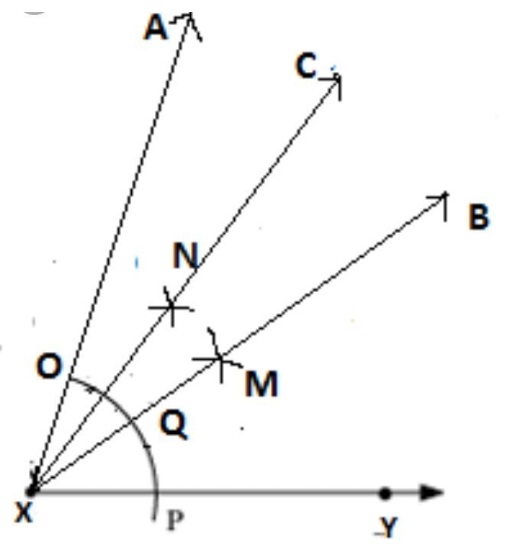
Draw ㄥDEF = 72o ,Construct \(\frac { 3 }{ 4 } \)ㄥDEF using a compass
2.
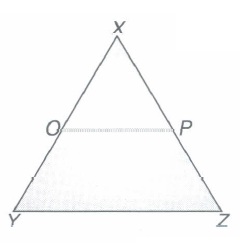
In the given figure, if \(OX=\frac{1}{2}XY, PX=\frac{1}{2}XZ\) and OX = PX, Show that XY = XZ.
3.
A tyre manufacturing company kept a record of the distance covered before a tyre needed to be replaced. The table shows the results of 1000 cases.
| Distance(in km) | less than 400 |
400 to 900 | 900 to 1400 | more than 1400 |
| Frequency | 210 | 325 | 385 | 80 |
If you buy a tyre of this company, what is the probability that:
(i) it will need to be replaced before it has covered 400km?
(ii) it will last more than 900 km?
(iii) it will need to be replaced after it has covered somewhere between 400 km and 1400 km?
(iv) it will not need to be replaced at all?
(v) it will need to be replaced?
4.
The mean of 100 observations is 60. If one observation of 50 is replaced by 110, then what will be the new mean?
5.
Find the area of the triangle whose two sides are of measure 13 cm and 14 cm and perimeter is 42 cm.
6.
Express x in terms of y, it is being given that 7x - 3y = 15: Check if the line represented by the equation intersects the y-axis at y = -5.
7.
The perpendicular distance of a point from the x-axis is 2 units and the perpendicular distance from the y-axis is 5 units.Write the coordinates of such a point if it lies in the:
(i) I quadrant (ii) II quadrant (iii) III quadrant (iv) IV quadrant
8.
Find the degree of the polynomials given below:
\(2-{ y }^{ 2 }-{ y }^{ 3 }+{ 2y }^{ 8 }\)
9.
Simplify: \(\frac { 5+\sqrt { 3 } }{ 7-4\sqrt { 3 } } -\frac { 5-\sqrt { 3 } }{ 7+4\sqrt { 3 } } \)
10.
Marks obtained by 500 students in a test of 100 marks are tabulated as below:
| Marks obtained | No.of students |
| 0-25 | 58 |
| 25-50 | 122 |
| 50-75 | 165 |
| 75-100 | 155 |
If a student is selected at random, the probability that he obtains less than 50% marks is:
\(\frac { 69 }{ 100 } \)
\(\frac { 9 }{ 25 } \)
\(\frac { 33 }{ 100 } \)
\(\frac { 61 }{ 250 } \)
11.
In the distribution, the frequency of the class 3 - 5 is
4,8,3,6,7,2,3,5,9,4,6,5,5.
2
4
5
7.
12.
The dimensions of a box are 1 m, 80 cm and 50 cm. The area of its four walls is
6000 cm2
12000 cm2
18000 cm2
24000 cm2
13.
1 hectare =
10 m2
100 m2
1000 m2
10000 m2
14.
Given a circle with centre O and smallest chord AB is of length 6 cm and the longest chord CD of the circle is of length 10 cm, then the radius of the circle is:
15 cm
6 cm
5 cm
3.5 cm.
15.
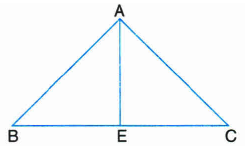
In the figure, BC = 2BE and area (\(\Delta\)ABC) = 60 cm2, then ar (\(\Delta\)AEC) is:
15 cm2
20 cm2
30 cm2
40 cm2
16.
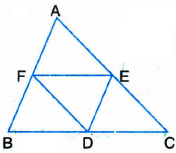
In the following figure, D, E and F are the mid-point of sides BC, CA and AB of a \(\Delta\) ABC. If AB = 3 cm, BC = 4 cm and CA = 4 cm, then the perimeter of \(\Delta\)DEF is
11 cm
8 cm
7 cm
5.5 cm
17.
In ΔABC and ΔPQR, AB = PR and ㄥA = ㄥP. The two triangles will be congruent by SAS axiom if:
BC = QR
AC = PQ
AC = QR
BC = PR
18.
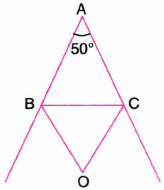
In \(\triangle \) ABC,\(\angle A=50^{ 0 }\) and the external bisectors of \(\angle B\) and \(\angle C\) meet at O as shown in figure The measure of \(\angle BOC\) is:
\(40^{ 0 }\)
\(65^{ 0 }\)
\(115^{ 0 }\)
\(140^{ 0 }\)
19.
The number of lines that can pass through a given point is:
two
none
only one
infinite many
20.
x=4 is a line:
parallel to y=-4
parallel to x-axis
passing through origin
parallel to x=-4
21.
The equation x=7 in two variables can be written as:
1.x+1.y=7
1.x+1.y=3
0.x+1.y=7
0.x+0.y=7
22.
The point whose abscissa and ordinates have different single will lie in:
I and II Quadrants
II and III Quadrants
I and III Quadrants
II and IV Quadrants
23.
Which of the following polynomial has -3 as a zero?
(x-3)
\(x^2-9\)
\(x^2-3x\)
\(x^2+3\)
24.
The decimal form of 56/1000 is
0.56
0.056
0.0056
5.6
25.
A die is thrown 500 times. the frequency of numbers (1,2,3,4,5,6) appearing on the uppermost face are given:
| Outcomes | 1 | 2 | 3 | 4 | 5 | 6 |
| Frequency | 89 | 75 | 78 | 73 | 88 | 97 |
Find the probability of having an outcome
(i) Number 3 on uppermost face
(ii) Number greater than 4
(iii) Number <4
(iv) Number between 1 and 3
26.
PQR is a triangle in which PQ = PR. 5 is any point on the side PQ. Through 5, a line is drawn parallel to QR intersecting PR at T. Prove that PS = PT.
27.
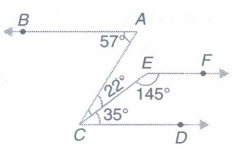
In the figure, prove that AB||EF
28.
If the observations, of 6,7,x-2,x,17,20 are written in ascending order and their median is 16, find the value of 'x'. Using the value of x, also find of given numbers.
29.
It is required to make a closed cylindrical tank of height 1 m and base diameter 140 cm from a metal sheet. How many square meters of the sheet are required for the same?
30.
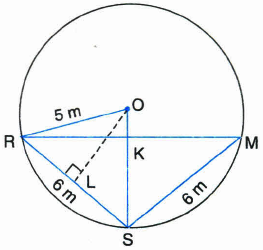
Three girls Reshma, Salma and Mandip are playing a game by standing on a circle of radius 5 m drawn in a park. Reshma throws a ball to Salma, Salma to Mandip, Mandip to Reshma. If the distance between Reshma and Salma and between Salma and Mandip is 6 m each, what is the distance between Reshma and Mandip?
31.
Use suitable identities to find the following products: \(\left( { y }^{ 2 }+\frac { 3 }{ 2 } \right) \left( { y }^{ 2 }-\frac { 3 }{ 2 } \right) \)
32.
Two solid spheres made of the same metal have masses 5920 g of and 740 g respectively. Determine the radius of the larger sphere, if the diameter of the smaller sphere is 5 cm.
33.
For spreading the message "Save Girl Child Save Future" a rally was organized by some students of a school. They were given triangular cardboard piece PQR which they divided in to two parts by drawing the angle bisectors QO and RO of base angles Q and R and wrote a slogan. Prove that \(\angle\)QOR = 90° + \(\frac{1}{2}\)\(\angle\)P. What is the benefit of these types of rallies?
34.
The % of marks obtained by students in the annual examination of a class in mathematics are given below:
| Percentage of marks | No. of students |
|---|---|
| 0-10 | 8 |
| 10-30 | 32 |
| 30-45 | 18 |
| 45-50 | 10 |
(i) How many students get less than 30% of marks?
(ii) Represent the data by histogram.
(iii) Which value is depicted by a student Ram obtaining the highest marks in the interval 45-50?
1.
Steps of construction:
i) Draw ㄥDEF=72o ,using protractor
ii) Bisect it. Let the bisected angle be ㄥDEK
iii) Again bisect ㄥDEK
iv) Now ㄥGEF = \(\frac { 3 }{ 4 } \)ㄥDEF
2.
Here, \(OX=\frac{1}{2}XY, PX=\frac{1}{2}XZ\)
XY = 2(OX), XZ = 2(PX)
Also. OX = PX(Given)
XY = XZ
(because things which are double of the same things are equal to one another)
3.
(i) 0.21
(ii) 0.465
(iii)0.79 (iv)0 (v) 1
4.
60.6
5.
84 cm2
6.
Given 7x-3y=15
\(\Rightarrow x=\frac{15+3y}{7}\)
At y-axis x=0
\(\therefore\) 7(0)-3y=15
\(\Rightarrow\) 0-3y=15
\(\therefore \ y=\frac{15}{-3}=-5\)
Given line intersects the y-axis at y=-5
7.
(i) (5,2) (ii) (-5,2) (iii) (-5,-2) (iv) (5,-2)
8.
8
9.
\(54\sqrt { 3 } \)
10.
Required probability=\(\frac { 58+122 }{ 500 } \)
11.
The item values to be included in 3 - 5 are 4,3,3,4.
12.
(c)
18000 cm2
13.
Formula
14.
A diameter is the largest chord. Diameter\(=2\times \)Radius.
15.
(c)
30 cm2
16.
Perimeter of WEF
=DE + EF + FD
=-AB + \(1\over2\)BC + \(1\over2\)CA = \(1\over2\)(AB+BC+CA)
= \(1\over2\) (3 + 4 + 4) = 5.5 cm.
17.
(b)
AC = PQ
18.
\(\angle A+\angle B+\angle X=180^{ 0 }\)
\(\Rightarrow 50^{ 0 }+\angle B+\angle C=180^{ 0 }\)
\(\Rightarrow \angle B+\angle C=130^{ 0 }\)
\(\angle BOC+\frac { 180^{ 0 }-\angle B }{ 2 } +\frac { 180^{ 0 }-\angle C }{ 2 } =180^{ 0 }\)
\(\Rightarrow \angle BOC=\frac { \angle B+\angle C }{ 2 } =65^{ 0 }\)
19.
(d)
infinite many
20.
x=4 and x=-4 both are parallel to y-axis
21.
Evident
22.
(d)
II and IV Quadrants
23.
\(x^2-9=(x-3)(x+3) \quad |\quad x-(-3)=x+3\)
24.
(b)
0.056
25.
(i) P(Number 3)=\(\frac{78}{500}\)
(ii) P(Number >4)=\(\frac{88+97}{500}=\frac{185}{500}\)
(iii) P(Number <4)=\(\frac{89+57+78}{500}\)
\(=\frac{242}{500}\)
(iv) P(Number between 1 and 3)=\(\frac{75}{500}\)
26.
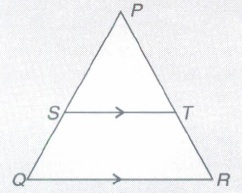
PQ = PR \(\Rightarrow\) \(\angle\)PQR = \(\angle\)PRQ
(Angles opp. to equal sides)
ST II QR \(\Rightarrow\) \(\angle\)PST = \(\angle\)PQR
(Corresponding angles)
\(\Rightarrow\) PTS = \(\Rightarrow\)PRQ
(Corresponding angles)
\(\therefore\) PST = PTS
\(\Rightarrow\) PS = PT.
(Sides opp. to equal angles)
27.
\(\angle A=57^o\)
and \(\angle ACD=22^o+35^o=57^o\)
\(\angle A=\angle ACD\)
But these are alternate angles
AB||CD
Again \(\angle FEC+\angle ECD=145^o+35^o=180^o\)
EF||CD
Now AB||CD and EF||CD
AB||EF
28.
71,13.66
29.
h = 1 m = 100 cm
2r = 140 cm
\(\Rightarrow\) \(r=\frac { 140 }{ 2 } cm=70cm\)
\(\therefore\) Total surface area of the closed cylindrical tank
\(=2\pi r\left( h+r \right) \)
\(\\ =2\times \frac { 22 }{ 7 } \times 70\left( 100+70 \right) \)
\(\\ =74800{ cm }^{ 2 }=\frac { 74800 }{ 100\times 100 } { m }^{ 2 }\)
\(\\ =7.48{ m }^{ 2 }\)
Hence, 7.48 square metres of the sheet are required.
30.
Construction: Draw OL 丄 RS.
Let KR = xm
\(ar\left( \Delta ORS \right) =ar\left( \Delta ORK \right) +ar\left( \Delta SRK \right) \)
\(=\frac { \left( OK \right) \left( KR \right) }{ 2 } +\frac { \left( KS \right) \left( KR \right) }{ 2 }\)
\( \\ =\frac { \left( KR \right) \left( OK+KS \right) }{ 2 } =\frac { \left( KR \right) \left( OS \right) }{ 2 } \)
\(=\frac { \left( x \right) \left( 5 \right) }{ 2 } \ ...........(1)\)
Again, ar \(\left( \Delta ORS \right) \)
\(=\frac { RS\times OL }{ 2 } =\frac { 6\times OL }{ 3 } \)
\(=\frac { 6\times \sqrt { OR^{ 2 }-RL^{ 2 } } }{ 2 } \) I By Pythagoras Theorem
\(=\frac { 6\times \sqrt { 25-9 } }{ 2 } =\frac { 6\times 4 }{ 2 } =12\quad m\) .........(2)
From equations (1) and (2),
\(\frac { \left( x \right) \left( 5 \right) }{ 2 } =12\Rightarrow x=\frac { 12\times 2 }{ 5 } =\frac { 24 }{ 5 } =4.8\quad m\)
⇒ KR = 4.8 m
∴ RM = 2KR = 2 x (4.8) = 9.6 m
Hence, the distance between Reshma and Mandip is 9.6 m.
31.
\(\left( { y }^{ 2 }+\frac { 3 }{ 2 } \right) \left( { y }^{ 2 }-\frac { 3 }{ 2 } \right) \)
\(\left( { y }^{ 2 }+\frac { 3 }{ 2 } \right) \left( { y }^{ 2 }-\frac { 3 }{ 2 } \right) =\left( z+\frac { 3 }{ 2 } \right) \left( z-\frac { 3 }{ 2 } \right) \)| Where \(y^2=z\)
\(={ (z) }^{ 2 }-{ \left( \frac { 3 }{ 2 } \right) }^{ 2 }\) | Using identity III
\(={ z }^{ 2 }-\frac { 9 }{ 4 } ={ ({ y }^{ 2 }) }^{ 2 }-\frac { 9 }{ 4 } \) | Substituting the value of z
\(={ y }^{ 4 }-\frac { 9 }{ 4 } .\)
32.
Let r and R be the radii of the smaller and larger spheres respectively, we have
\(r=\frac { 5 }{ 2 } cm\)
Volume of the smaller sphere \(=\frac { 4 }{ 3 } \pi { r }^{ 3 }=\frac { 4 }{ 3 } \pi { \left( \frac { 5 }{ 2 } \right) }^{ 3 }\)
\(=\frac { 4 }{ 3 } \times \pi \times \frac { 125 }{ 8 } { cm }^{ 3 }\)
Density of metal\(=\frac { mass }{ Valume } \)
\(=\frac { 740 }{ \frac { 4 }{ 3 } \pi \times \frac { 125 }{ 8 } } g\quad { cm }^{ 3 }\) ...........(i)
Volume of larger sphere = \(\frac { 4 }{ 3 } \pi { R }^{ 3 }\)
Density of metal=\(\frac { mass }{ Volume } =\frac { 5920 }{ \frac { 4 }{ 3 } \pi { R }^{ 3 } } \) ......(ii)
From (i) and (ii), we have
\(\frac { 740 }{ \frac { 4 }{ 3 } \pi \times \frac { 125 }{ 8 } } =\frac { 5920 }{ \frac { 4 }{ 3 } \pi { R }^{ 3 } } \)
\(\Rightarrow \quad { R }^{ 3 }=\frac { 5920\times 125 }{ 740\times 8 } \)
= 125
\(\Rightarrow\) R = 5 cm.
33.
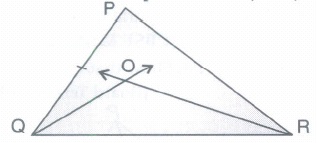
Proof: QO is bisector of \(\angle\)PQR
\(\angle\)OQR = \(\frac{1}{2}\)\(\angle\)PQR = \(\frac{1}{2}\) =\(\angle\)Q
RO is bisector \(\angle\)ORQ
\(\therefore\) \(\angle\)ORQ =\(\frac{1}{2}\) \(\angle\)PRQ = \(\frac{1}{2}\) \(\angle\)R
In \(\angle\)OQR
\(\angle\)QOR + \(\angle\)OQR + \(\angle\)ORQ = 180°
(Angle sum property)
\(\angle\)QOR + \(\frac{1}{2}\) \(\angle\)Q + \(\frac{1}{2}\) \(\angle\)R = 180°
\(\angle\)QOR = 180°- \(\frac{1}{2}\)(\(\angle\)Q + \(\angle\)R)
But in \(\angle\)PQR
\(\angle\)P + \(\angle\)Q + \(\angle\)R = 180°
\(\angle\)Q + \(\angle\)R = 180°- \(\angle\)P
\(\angle\)QOR = 180°- \(\frac{1}{2}\) (180°- \(\angle\)P)
= 180°-90° + \(\frac{1}{2}\)\(\angle\)P
= 90° + \(\angle\)P Hence Proved.
These type of rallies spread awareness among people for not to kill girl child and helping in equalising sex ratio.
34.
(i) Required number of students = 8 + 32 = 40
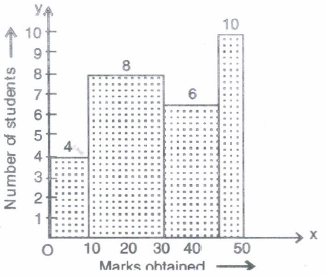
(ii) Here, We notice that classes are continuous but class-size is not the same for all the classes. We notice minimum class-size is of class 45-50, i.e., 5. We will first find proportionate length of rectangle (adjusted frequency) for each class.
Length of rectangle (adjusted frequency) =\(\frac { Frequency\ of\ Class }{ Width\ of\ class } \times Minimum\ class-size\)
| Marks (C.I.) |
Number of students(f) | Width of class (Clss-size) |
Length of rectangle |
|---|---|---|---|
| 0-10 | 8 | 10 | \(\frac{8}{10}\)x 5 = 4 |
| 10-30 | 32 | 20 | \(\frac{32}{20}\) x 5 = 8 |
| 30-45 | 18 | 15 | \(\frac{18}{15}\) x 5 = 6 |
| 45-50 | 10 | 5 | \(\frac{10}{5}\) x 5 = 10 |
Now, we construct rectangles with respective class-intervals as widths and adjusted frequencies as heights.
Histogram representing marks obtained by students in unit test of Mathematics.
(iii) Hardwork and Dilligence.

9th Standard CBSE Syllabus & Materials
9th Standard CBSE
CBSE 9th Mathematics Lines and Angles Sample Question Papers Study Material - QB365 Set A
NEW9th Standard CBSE
CBSE 9th Mathematics Introduction to Euclid's Geometry Sample Question Papers Study Material - QB365 Set A
NEW9th Standard CBSE
CBSE 9th Mathematics Linear Equations in Two Variables Sample Question Papers Study Material - QB365 Set A
NEW9th Standard CBSE
CBSE 9th Mathematics Coordinate Geometry Sample Question Papers Study Material - QB365 Set A



NCERT Books

Syllabus

Exam Pattern

Sample Question Papers

Previous year Question Papers

Important Notes

MCQ Practice test

NCERT Exemplers

Case study Questions

Image Based Questions

Passage based Questions

HOT Questions

Value Based Questions

Model Questions Papers
NCERT ( Book Back ) Questions

Assertion and Reason
Important Questions And Answers

CBSE 9th Standard CBSE Subjects
CBSE Standards