100% FREE ACCESS
9th Standard CBSE Syllabus & Materials
9th Standard CBSE
CBSE 9th Science Is matter around us pure? - New Model Questions Papers Study Material - QB365 Set A
NEW9th Standard CBSE
CBSE 9th Science Matter in our surroundings - New Model Questions Papers Study Material - QB365 Set A
NEW9th Standard CBSE
CBSE 9th Mathematics Heron's Formula Sample Question Papers Study Material - QB365 Set A
NEW9th Standard CBSE
CBSE 9th Mathematics Circles Sample Question Papers Study Material - QB365 Set A
NEW9th Standard CBSE
CBSE 9th Mathematics Quadrilaterals Sample Question Papers Study Material - QB365 Set A
NEW9th Standard CBSE
CBSE 9th Mathematics Triangles Sample Question Papers Study Material - QB365 Set A

Published on: 29/10/2025
Download CBSE Class 9th Standard CBSE Mathematics question papers, sample papers, important questions, and previous year solved papers in PDF format. Get free study materials, NCERT solutions, and exam preparation resources for Class 9th Standard CBSE Mathematics
Questions + Answers key
Take MCQ Mathematics Test
1.
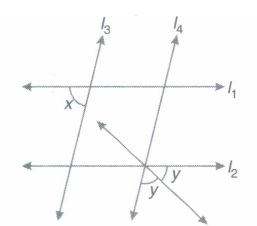
In the given figure, if \(l_1||l_2\) and \(l_3||l_4\), What is y in terms of x?
2.
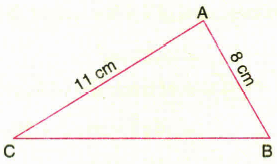
Find the area of a triangle two sides of which are 8 cm and 11 cm and the perimeter is 32 cm.
3.
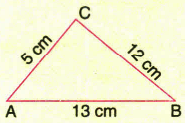
The sides of a right triangle ABC are 5 cm, 12 cm and 13 cm. Find the area of the triangle.
4.
Observe figure and answer the following:
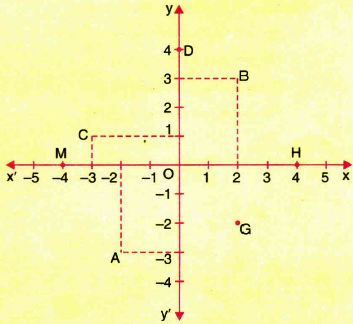
(a) coordinates of B
(b) point identified by the coordinates (-2, -3)
(c) abscissa of point D
(d) ordinate of point H
(e) points with the same abscissa
(f) points with the same ordinate
5.
Factorise \(6x^2+17x+5\) by splitting the middle term and by using the Factor Theorem.
6.
Find three rational numbers between 3/7 and 5/11.How many rational numbers can be determined lying between these numbers?
7.
A transversal intersects two parallel lines. Prove that the bisectors of any pair of cosresponding angles so formed are parallel.
8.
Verify if 1 and -3 are zeroes of the polynomial 3x3+5x2-11x+3. If yes, then factorize the polynomial.
9.
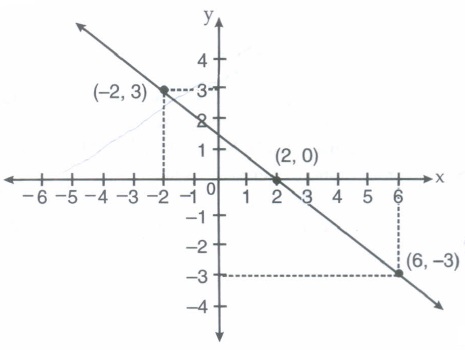
Draw the graph of the linear equation 3x+4y=6. Find the points where the line representing the equation 3x+4y=6 cuts the axes of x and y.
10.
The base of an isosceles triangle measures 24 cm and its area is 60 cm2, Find its perimeter.
11.
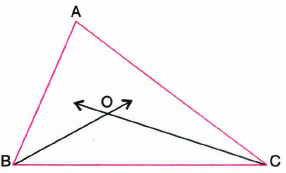
In figure the bisectors of \(\angle ABC\) and \(\angle BCA\) intersect each other at the point O.prove that \(\angle BOC=90^{ 0 }+\frac { 1 }{ 2 }\angle A\)
12.
In which quadrant, can a point have:
(i) abscissa equal to its ordinate
(ii) ordinate equal in magnitude to abscissa
(iii) ordinate equal and opposite of abscissa
(iv) abscissa twice that of the ordinate.
13.
Express \(1.\overline { 32 } +0.\overline { 35 } \) in the form \(\frac { p }{ q } \) , where p and q are integers and \(q\neq 0\)
14.
Find the values of a and b, when a+b√15 = \(\frac { \sqrt { 5 } +\sqrt { 3 } }{ \sqrt { 5 } -\sqrt { 3 } } \)
15.
Sides of a triangle in the ratio 5:12:13 and its perimeter is 120 cm. Find its area.
16.
The sides of a triangular plot are 50 m, 65 m, and 65 m. Find the cost of laying grass in this plot at the rate Rs.7 per m 2.
17.
Give a definition for each of the following terms. Are there other terms that need to be defined first? What are they, and how might you define them?
(i) parallel lines
(ii) perpendicular lines
(iii) line segment
(iv) radius of a circle
(v) square.
18.
Draw the graph of the equations 3x+4y=7 and 3x-2y=1 and find the point of intersection of lines representing the equations.
19.
Express the following linear equation in the form ax+by+c=0 and indicate the values of a, b and c in each case:
2x-5y
20.
(i) Plot the points M(5,-3) and N(-3,-3).
(ii) What is the length of MN?
(iii) Find the coordinates of points A, B and C lying on Mn such that MA=AB=BC=CN
21.
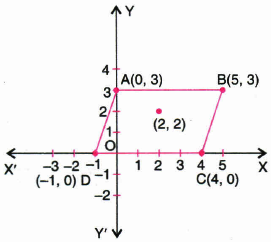
Plot the points A(0,3), B(5,3), C(4,0) and D(-1,0) on the graph paper.Identify the figure ABCD and find whether the point (2,2) lies inside the figure or not?
22.
Verify whether the following are zeroes of the polynomial, indicated against them.
\(p(x)=2x+1,x=\frac { 1 }{ 2 } \)
23.
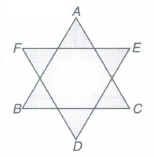
In the figure below, if \(\angle A+\angle B+\angle C+\angle D+\angle E+\angle F=k\) right angles, then what is the value of k?
24.
Two supplementary angles are in ratio 2:7. Find the measure of angles.
25.
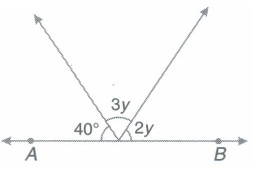
In the figure below, calculate the value of y.
26.
Write the angle which is one-fifth of its complement.
27.
What is the measure of an angle which is complement of itself?
28.
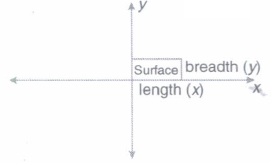
What is a surface?
29.
What is a straight line?
30.
Simplify: \(\left( x+\frac { 1 }{ 2 } \right) \left( x+\frac { 3 }{ 2 } \right) \)
31.
Explain when a system of axioms is called consistent.
32.
Write the factors of polynomial 4x2+y2+4xy+8x+4y+4
33.
Factorize: 6-x+x2.
34.
Find the value of \(\sqrt[3]{625^{-2}}\)
35.
Identify an irrational number among the following numbers: 0.13, \(0.13\overline{15}\) , \(0.\overline{1315}\) , 0.3013001300013...
36.
Write the sum of \(0.\bar{3}\) and \(0.\bar{4}\)
37.
Find the decimal expansion of \(\frac{58}{1000}\)
38.
If -4 is a zero of the polynomial p(x) = x2 + 11x + k, then calculate the value of k.
39.
What is the solution of the equation 3x-y=4?
40.
The equation of a line on which the point (6,2) lies is _______
41.
In a one day cricket match, Raina and Dhoni scored 198 runs. Express this as a linear equation in two carables.
42.
Is ox+oy+c=0, a linear equation?
1.
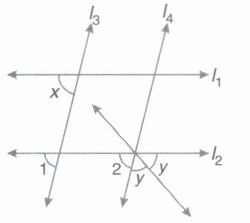
\(x=\angle 1\) (Corresponding angles)
\(\angle 2=\angle 1\) (Corresponding angles)
\(\angle 2+2y=180^o\)
x+2y=180o
2y=180o-x
\(\therefore y=90^o-\frac{x}{2}\)
2.
Here we have perimeter of the triangle = 32 cm, a = 8 cm and b = 11 cm.
Third side c = 32 cm – (8 + 11) cm = 13 cm
So, 2s = 32, i.e., s = 16 cm,
s – a = (16 – 8) cm = 8 cm,
s – b = (16 – 11) cm = 5 cm,
s – c = (16 – 13) cm = 3 cm.
Therefore, area of the triangle = \(\sqrt{s(s-a)(s-b)(s-c)}\)
\(=\sqrt{16 \times 8 \times 5 \times 3} \mathrm{~cm}^{2}=8 \sqrt{30} \mathrm{~cm}^{2}\)
3.
30 cm2.
4.
(a) (2,3)
(b) A
(c) 0
(d) 0
(e) M, O, D, H; B, G
(f) M, H, O
5.
(By splitting method) : If we can find two numbers p and q such that p + q = 17 and pq = 6 x 5 = 30, then we can get the factors.
So, let us look for the pairs of factors of 30. Some are 1 and 30, 2 and 15, 3 and 10, 5 and 6. Of these pairs, 2 and 15 will give us p + q = 17.
So, 6x2 + 17x + 5 = 6x2 + (2 + 15)x + 5
= 6x2 + 2x + 15x + 5
= 2x(3x + 1) + 5(3x + 1)
= (3x + 1) (2x + 5)
6.
331/770, 166/385, 333/770
7.
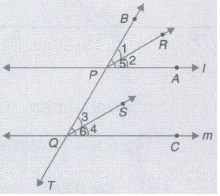
Given : l||m line t is a transversal intersecting them at P and Q respectively.
To prove : PR||QS
Proof: \(\angle 5=\angle 6\) (Corresponding angles and l||m)
\(\Rightarrow \frac{1}{2}\angle5=\frac{1}{2}\angle6\)
\(\Rightarrow \angle 1=\angle3\)
PR||QS
8.
p(x) = 3x3+5x2-11x+3
p(1)=3+5-11+3=0
\(\therefore\) 1 is a zero of p(x)
p(-3)=-81+45+33+3=0
-3 is a zero of p(x)
(x-1)(x+3)=x2+2x-3 is a factor of p(x)
\(\frac { p(x) }{ { x }^{ 2 }+2x-3 } =3x-1,\) when we divide physically
Hence p(x)=(x-1)(x+3)(3x-1)
9.
Given equation is 3x+4y=6
(i) When it cuts x-axis then
put y=0, i.e 3x=6
x=2
Hence point on x-axis is (2,0)
(ii) when it cuts y-axis then
put x=0 i.e., 4y=6
y=3/2
hence point on y-axis is \((0,{3\over2})\)
3x+4y=6
\(\Rightarrow y=\frac{6-3x}{4}\)
| x | 2 | -2 | 6 |
| y | 0 | 3 | -3 |
10.
Area = \(=\frac { a }{ 4 } \sqrt { 4{ b }^{ 2 }-{ a }^{ 2 } } \)
\(\Rightarrow 60=\frac { 24 }{ 4 } \sqrt { 4{ b }^{ 2 }-{ (24) }^{ 2 } } \)
\(\Rightarrow 10=\sqrt { 4{ b }^{ 2 }-576 } \)
\(\Rightarrow 100=4{ b }^{ 2 }-576\) | Squaring
\(\Rightarrow 4{ b }^{ 2 }=676\)
\(\\ \Rightarrow { b }^{ 2 }=\frac { 676 }{ 4 } =169\)
\(\Rightarrow b=\sqrt { 169 } \) = 13 cm
\(\therefore\) Perimeter = a + b + b
= 24 + 13 + 13 = 50 cm
11.
\(\therefore \) BO is the bisector of \(\angle ABC\)
\(\therefore \angle OBC=\frac { 1 }{ 2 } \angle ABC=\frac { 1 }{ 2 } \angle B\)
\(\therefore \) CO is the bisector of \(\angle ACB\)
\(\angle OCB=\frac { 1 }{ 2 } \angle ACB=\frac { 1 }{ 2 } \angle C\)
In OBC ,\(\angle BOC+\angle OBC+\angle OCB=180^{ 0 }\)
| \(\therefore \) The sum of the three angles of a is \(180^{ 0 }\)
\(\Rightarrow \angle BOC+\frac { 1 }{ 2 } \angle B+\angle C)=180^{ 0 }\)
\(\Rightarrow \angle BOC=180^{ 0 }-\frac { 1 }{ 2 } (\angle B+\angle C)\)
In \(\triangle \) ABC
\(\angle A+\angle B+\angle C=180^{ 0 }\)
| The sum of the three angles of a triangle is \(180^{ 0 }\)
\(\Rightarrow \angle B+\angle C=180^{ 0 }-\angle A\)
\(\Rightarrow \frac { 1 }{ 2 } (\angle B+\angle C)=\frac { 180^{ 0 }-\angle A }{ 2 } \)
=\(90^{ 0 }-\frac { 1 }{ 2 } \angle A\)
From (3) and (4) we have
\(\angle BOC=180^{ 0 }-90^{ 0 }-\frac { 1 }{ 2 } \angle A=90^{ 0 }+\frac { 1 }{ 2 } \angle A\)
12.
(i) I, III
(ii) I, II, III, IV
(iii) II, IV
(iv) I, III
13.
Let x = \(1.\overline { 32 } \)
x = 1.3222...
10x = 13.222... ...(1)
100x = 132.222... ....(2)
Subtracting (1) from (2), we get
90x = 119
x = \(\frac { 119 }{ 90 } \) ....(3)
Let x = \(0.\overline { 35 } \)
Then x = 0.35 35 35...(4)
100x = 35.35 35 35...(5)
Subtracting (4) from (5), we get
99x = 35
x = 35/99
\(1.\overline { 32 } +0.\overline { 35 } =\frac { 119 }{ 90 } +\frac { 35 }{ 99 } \)
\(\\ =\frac { 1309+350 }{ 990 } =\frac { 1659 }{ 990 } =\frac { 553 }{ 330 } \)
Here, p = 553, q =3 30(\(\neq 0\))
14.
\(\frac { \sqrt { 5 } +\sqrt { 3 } }{ \sqrt { 5 } -\sqrt { 3 } } =\frac { \sqrt { 5 } +\sqrt { 3 } }{ \sqrt { 5 } -\sqrt { 3 } } \times \frac { \sqrt { 5 } +\sqrt { 3 } }{ \sqrt { 5 } +\sqrt { 3 } } \)
\(=\frac { 8+2\sqrt { 15 } }{ 2 } =4+\sqrt { 15 } \)
\(a+b\sqrt { 15 } =4+\sqrt { 15 } \)
a = 4, b = 1
15.
480 cm2
16.
Rs.10500
17.
(i) Parallel lines. Lines which do not intersect anywhere are called parallel lines.
(ii) Perpendicular lines. Two lines which are at a right angle to each other are called perpendicular lines.
(iii) Line segment. It is a terminated line.
(iv) Radius. The length of the line segment joining the centre of a circle to any point on its circumference is called its radius.
(v) Square. A quadrilateral with all the four sides equal and all the four angles of measure 90° each is called a square.
18.
3x+4y=7
| x | 1 | -3 |
| y | 1 | 4 |
3x-2y=1
| x | 1 | -1 |
| y | 1 | -2 |
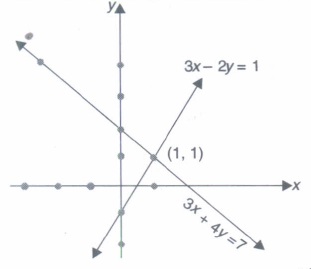
From the graph, point of intersection is (1,1).
19.
2x=-5y
2x+5y+0=0
Comparing with ax+by+c=0, we get
a=2, b=5, c=0
20.
(i)
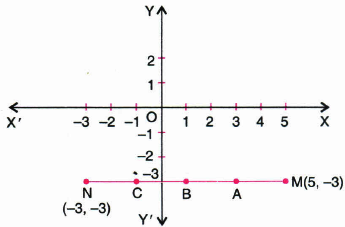
(ii) 8 units
(iii) \(A\rightarrow \left( 3,-3 \right)\)
\(\\ B\rightarrow \left( 1,-3 \right)\)
\(\\ C\rightarrow \left( -1,-3 \right) \)
21.
Parallelogram; yes
22.
\(p\left( \frac { 1 }{ 2 } \right) =2\left( \frac { 1 }{ 2 } \right) +1=1+1=2\neq 0\)
\(\therefore \frac { 1 }{ 2 } \)is not a zero of p(x).
23.
()
In \(\triangle ABC,\)
\(\angle A+\angle B+\angle C=180^o\)
Also, in \(\triangle DEF,\)
\(\angle D+\angle E+\angle F=180^o\)
\(\therefore \angle A+\angle B+\angle C+\angle D+\angle E+\angle F=360^o\)
=4 X 90o
Hence,k=4 right angles.
24.
()
2x+7x=180o\(\Rightarrow\)x=20o
So the angles are
2x=2X20o
=40o
7x=7X20o
=140o
So two angles are 40o and 140o
25.
()
Here, 40o+3y+2y=180o(\(\because\) Straight line makes an angle of 180o)
5y=140o
y=28o
26.
()
Let the angle be x, then
By given condition, \(x=\frac{1}{5}(90^o-x)\Rightarrow6x=90^0\)
\(\Rightarrow x=15^0\)
27.
()
Let the angle be x, then
Angle x= Complement of x
\(\Rightarrow\) x=90o-x\(\Rightarrow\)x=45o
28.
()
A surface is that which has length and breadth.
29.
()
Two planes intersect each other to form a straight line.
30.
()
\(\left( x+\frac { 1 }{ 2 } \right) \left( x+\frac { 3 }{ 2 } \right) \)\(={ x }^{ 2 }+\frac { 3 }{ 2 } x+\frac { 1 }{ 2 } x+\frac { 3 }{ 4 } \)
\(={ x }^{ 2 }+2x+\frac { 3 }{ 4 } \)
31.
()
A system of axioms is called consistent, when it is impossible to deduce from these axioms, a statement that contradicts any axiom or previously proved statement.
32.
()
4x2+y2+4xy+8x+4y+4 = (2x)2+(y)2+(2)2+2\(\times\)2x\(\times\)y+2\(\times\)2x\(\times\)2+2\(\times\)y\(\times\)2
= (2x+y+2)2.
Factor is 2x + y + 2.
33.
()
6x-x-x2 = 6-3x+2x-x2
= 3(2-x)+x(2-x)
= (2-x)(3+x)
34.
()
\(\sqrt[3]{625^{-2}}\) = (625-2)1/4 = (625-2x1/4)
= (625-1/2)
= \((\frac{1}{625})^{1/2}=\frac{1}{25}\)
35.
()
0.13 is a terminating number. So, it is not an irrational number.
\(0.13\overline{15}\) = 0.131515...,15 is representing continuously, so it is not an irrational number.
\(0.\overline{1315}\) = 0.13151315..., is representing continuously, so it is not an irrational number.
0.3013001300013..., non-terminating and non-recurring decimal. Hence, it is an irrational number. So, 0.3013001300013 is an irrational number.
36.
()
\(0.\bar{3}+0.\bar{4}\)=(0.333...) + (0.444...)
= 0.777...
Let x = 0.777...
10x = 7.777...
⇒ 10x - x = (7.777...) - (0.777...)
⇒ 9x = 7.0
⇒ x = \(\frac{7}{9}\)
37.
()
\(\frac{58}{1000}\)= 0.058 (Decimal point is shifted three places to the left)
38.
()
Given, p(x) = x2 + 11x + k
Since -4 is a zero of polynomial
p(-4) = 0
\(\Rightarrow\) (-4)2 + 11 \(\times\) (-4) + k = 0
\(\Rightarrow\) 16 - 44 + k = 0
\(\therefore\) k = 28
39.
()
(1,-1)
40.
()
2x-3y=6
41.
()
Let the runs scored by Raina & Dhoni are x & y respectively then,
x+y=198
42.
()
No(∵ a,b≠0 for a linear equation)

9th Standard CBSE Syllabus & Materials
9th Standard CBSE
CBSE 9th Mathematics Lines and Angles Sample Question Papers Study Material - QB365 Set A
NEW9th Standard CBSE
CBSE 9th Mathematics Introduction to Euclid's Geometry Sample Question Papers Study Material - QB365 Set A
NEW9th Standard CBSE
CBSE 9th Mathematics Linear Equations in Two Variables Sample Question Papers Study Material - QB365 Set A
NEW9th Standard CBSE
CBSE 9th Mathematics Coordinate Geometry Sample Question Papers Study Material - QB365 Set A



NCERT Books

Syllabus

Exam Pattern

Sample Question Papers

Previous year Question Papers

Important Notes

MCQ Practice test

NCERT Exemplers

Case study Questions

Image Based Questions

Passage based Questions

HOT Questions

Value Based Questions

Model Questions Papers
NCERT ( Book Back ) Questions

Assertion and Reason
Important Questions And Answers

CBSE 9th Standard CBSE Subjects
CBSE Standards