100% FREE ACCESS
9th Standard CBSE Syllabus & Materials
9th Standard CBSE
CBSE 9th Science Is matter around us pure? - New Model Questions Papers Study Material - QB365 Set A
NEW9th Standard CBSE
CBSE 9th Science Matter in our surroundings - New Model Questions Papers Study Material - QB365 Set A
NEW9th Standard CBSE
CBSE 9th Mathematics Heron's Formula Sample Question Papers Study Material - QB365 Set A
NEW9th Standard CBSE
CBSE 9th Mathematics Circles Sample Question Papers Study Material - QB365 Set A
NEW9th Standard CBSE
CBSE 9th Mathematics Quadrilaterals Sample Question Papers Study Material - QB365 Set A
NEW9th Standard CBSE
CBSE 9th Mathematics Triangles Sample Question Papers Study Material - QB365 Set A

Published on: 29/10/2025
Download CBSE Class 9th Standard CBSE Mathematics question papers, sample papers, important questions, and previous year solved papers in PDF format. Get free study materials, NCERT solutions, and exam preparation resources for Class 9th Standard CBSE Mathematics
Questions + Answers key
Take MCQ Mathematics Test
1.
Prove that if two line intersect, vertically opposite angles are equal.
2.
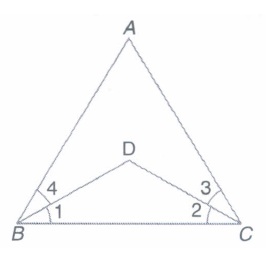
In the given figure, we have \(\angle ABC=\angle ACB, \angle3=\angle4\). Show that \(\angle 1=\angle2.\)
3.
Show that the points A(1,2), B(-1,-16) and C(0,-7) lie on the graph of the linear equation y=9x-7
4.
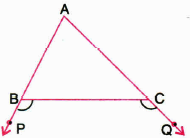
In Fig. sides AB and AC of D ABC are extended to points P and Q respectively. Also, \(\angle\) PBC < \(\)QCB. Show that AC > AB.
5.
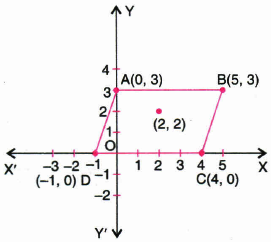
Plot the points A(0,3), B(5,3), C(4,0) and D(-1,0) on the graph paper.Identify the figure ABCD and find whether the point (2,2) lies inside the figure or not?
6.
If \(x+\frac{1}{x}=3\) find \(x^2+\frac{1}{x^2}\)
7.
Simplify: \(3\sqrt { 45 } -\sqrt { 125 } +\sqrt { 200 } -\sqrt { 50 } \)
8.
A blackboard is
a parallelogram
a rhombus
a trapezium
kite.
9.
In ΔABC, if ㄥA > ㄥB > ㄥC then:
AB > AC
AC < BC
AB > BC
AC > BC
10.
The angle which is equal to 8 times its compliment is:
\(80^{ 0 }\)
\(72^{ 0 }\)
\(90^{ 0 }\)
\(88^{ 0 }\)
11.
Euclid stated that all right angles are equal to each other in the form of
an axiom
a definition
a postulate
a proof
12.
The age of a boy is one-third the age of his mother.If the present age of mother is x years, then the age of boy after 12 years will be
\({x\over 3}+12\)
\(x+12\over 3\)
\(x+4\)
\({x\over 12}-12\)
13.
Where do the I and III quadrants meet?
in x - axis
in y - axis
at O
do not intersect
14.
The value of polynomial \(6a^2+7a-3\) when a=1 is:
10
4
-13
-4
15.
A rational number lying between \(\sqrt { 2 } \) and \(\sqrt { 3 } \) is:
\(\frac { \sqrt { 2 } +\sqrt { 3 } }{ 2 } \)
\(\sqrt { 6 } \)
1.6
1.9
16.
Prove that the sum of all the angles of a triangle is 180o . Also, find the angle of a triangle if they are in ratio 5:6:7.
17.
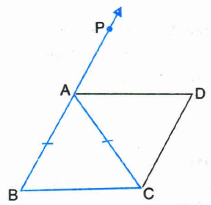
ABC is an isosceles triangle in which AB = AC AD bisects \(\angle \) PAC and CD II AB. Show that
(i) \(\angle \) DAC =\(\angle \) BCA
(ii) ABCD is a parallelogram
18.
If the bisector of the vertical angle of a triangle bisects the base of the triangle, then prove that the triangle is isosceles.
19.
Draw the graph of the equations x = 3 and 4x = 3y in the same graph.Find the area of the triangle formed by these two lines and the x-axis
20.
Express y in terms of x in the equation x+2y=8.Find the points where the line represented by this equation cuts x-axis and y-axis
21.
Simplify: \({ \left( x-\frac { 2 }{ 3 } y \right) }^{ 3 }-{ \left( x+\frac { 2 }{ 3 } y \right) }^{ 3 }\)
22.
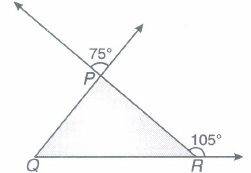
In the given figure, calculate the value of \(\angle PQR\)
23.
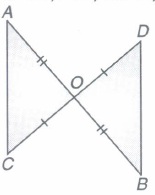
In the figure below, O is the mid-point of AB and CD, Prove that AC = BD.
24.
In the given figure, if AB = CD, then prove that AC = BD. Also write the Euclid's axiom used for proving it.

25.
State any two Eulis's axioms.
26.
Solve the equation 3(x + 2) = 2(2x - 1) and represent the solution:
(i) on the number line
(ii) in the Cartesian plane.
27.
The lengths of perpendiculars PM and PN drawn from a point P, on x-axis and y-axis are of 3 and 2 units respectively.Find the coordinates of points P,M and N.
28.
Is it possible to construct a triangle, when its sides are 5.4 cm, 2.3 cm, 3.1 cm?
29.
The angles of a quadrilateral are in the ratio 2 : 3 : 6 : 7. The largest angle of the quadrilateral is
30.
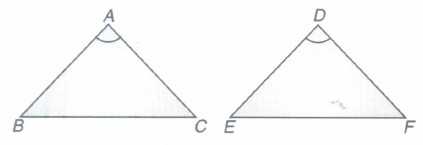
In \(\triangle\)ABC and \(\triangle\)DEF, AB=DE, \(\angle\)A=\(\angle\)D. What will be the condition in which the two triangles will be congruent by SAS axiom?
31.
Two supplementary angles are in ratio 2:7. Find the measure of angles.
32.
What is the measure of an angle which is complement of itself?
33.
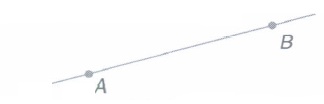
How many lines can be passed through two distinct points?
34.
If (a+b+c)=0, then write the equivalent of a3+b3+c3.
35.
Factorize: 20x2-9x+1.
36.
Write the sum of 2√5 and 3√7.
37.
Any solution of linear equation 2x+0y+9=0 in two variable is ______
38.
Is x=4, y=0, the solution of y-4=0?
1.
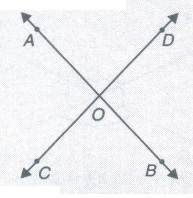
Given Two lines AB and CD.
Intersect at a point O.
To prove
\((i)\angle AOC=\angle BOD\)
\((ii)\angle AOD=\angle BOC\)
Proof Ray OA stand on line CD
\(\therefore \angle AOC+\angle AOD=180^o\) ...(i) [Linear pair]
Again ray OD stand on line AB
\(\therefore \angle AOD+\angle BOD=180^o\) ..(ii) [Linear pair]
from eqn (i) and (ii)
\(\angle AOC+\angle AOD=\angle AOD+\angle BOD\) [Each equal to 180o]
\(\therefore \angle AOC=\angle BOD\)
Similarly \(\angle AOD=\angle BOC\)
2.
Given\(\angle ABC=\angle ACB\)
\(\Rightarrow \angle1+\angle4=\angle2+\angle3\)
\(\Rightarrow \angle1+\angle4-\angle4=\angle2+\angle3-\angle3\)
(As, \(\angle3=\angle4\))
\(\Rightarrow \angle1=\angle2\)
3.
The equation is y=9x-7
A(1,2); 2=9(1)-7
2=2; true
B(-1,-16); -16=9(-1)-7=-9-7
=-16; True
C(0,-7); -7=9(0)-7
=0-7=-7; True
4.
Given: Sides AB and AC of ΔABC are extended to points P and Q respectively.Also, ㄥPBC < ㄥQCB.
To Prove: AC > AB.
Proof: ㄥPBC < ㄥQCB
- ㄥPBC > -ㄥQCB
1800 - ㄥ PBC > 1800- ㄥQCB
ㄥABC > ㄥACB
AC > AB.
5.
Parallelogram; yes
6.
7
7.
\(4\sqrt { 5 } +5\sqrt { 2 } \)
8.
See a blackboard
9.
ㄥA > ㄥB > ㄥC
BC > AC
10.
0=8\((90^{ 0 }-\theta )\)
11.
(a)
an axiom
12.
(a)
\({x\over 3}+12\)
13.
(c)
at O
14.
Value=\(6(1)^2+7(1)-3\)
\(=6+7-3=10\)
15.
(c)
1.6
16.
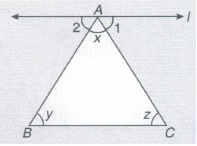
To prove: Sum of all the angles of \(\triangle ABC\) is 180o
Construction : Draw a line l parallel to BC.
Proof: Since \(l||BC\) , we have \(\angle 2=\angle y\) (Alternate angles are equal)...(i)
Similarly, \(l||BC\) \(\angle 1=\angle z\) (Alternate angles are equal)...(ii)
Also, sum of angles at a point A on line l is 180o
\(\therefore \angle 2+\angle x+\angle 1=180^o\) (linear pair)
i.e., \(\angle y+\angle x+\angle z=180^o\) (from (i) and(ii)).
\(\therefore\ \angle x+\angle y+\angle z=180^o\)
Sum of all angles of a \(\triangle \) is 180o
5x+6x+7x=180o
x=10o
Angles are 50o, 60o and 70o respectively.
Hence proved.
17.
Given: ABC is an isosceles triangle in which AB = AC. AD bisects L PAC and CD IIAB.
To Prove:
(i) \(\angle \)DAC =\(\angle \)BCA
Proof:
(i) In \(\Delta \) ABC,
\(\because\) AB = AC
\(\therefore\) \(\angle \)B =\(\angle \)C .......(1) I Angles opposite to equal sides of a triangle are equal
Also, Ext. \(\angle \)PAC =\(\angle \)B +\(\angle \)C
⇒
⇒ 2\(\angle \)CAD = 2\(\angle \)C
⇒ \(\angle \)CAD =\(\angle \)C
\(\therefore\) AD II BC
Also, CD II AB I Given
\(\therefore\) ABCD is a parallelogram IA quadrilateral is a parallelogram if its both the pairs of opposite sides are parallel.
18.
Given: A \(\triangle ABC\) in which the bisector of the vertical angle \(\angle BAC\) bisects the base BC, i.e., BD = CD
To prove: \(\triangle ABC\) is isosceles
Construction: Produce AD to E such thatAD = DE. Join EC.
Proof: In \(\triangle ADB\) and \(\triangle EDC\)
BD = CD
AD = ED
\(\angle ADB=\angle EDC\) | Vertically opposite angles
\(\triangle ADB=\triangle EDC\) | SAS congruence rule
AB = EC ...... (1) | C.P.C.T
\(\angle BAD=\angle CED\) | C.P.C.T
But \(\angle BAD=\angle CAD\)
\(\angle CAD=\angle CED\)
AC = AE ..... (2) | Sides opposite to equal angles of a triangle are equal
From (1) and (2)
AB = AC
\(\triangle ABC\) is isosceles.
19.
x = 3 represents a line parallel to y-axis at a distance of 3 units to the right of the origin.
4x= 3y
\(\Rightarrow\ \ \ y={4x\over 3}\)
Table of solution
| x | 0 | 3 |
|---|---|---|
| y | 0 | 4 |
We plot the points (0,0) and (3, 4) on a graph paper and join the same by a ruler to get the line which is the graph of the equation 4x = 3y.
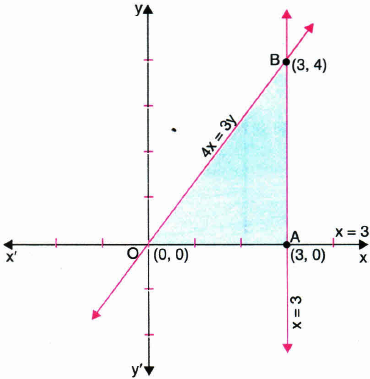
Area of the triangle GAB formed by the given two lines and the x-axis \(={3\times 4\over2}=6\) square units
20.
x+2y=8
2y=8-x
\(y={8-x\over 2}\)
This expresses y in terms of x
This line will intersect x-axis at the point for while y=0.So, put y=0 in (1), we get
x+2(0)=8
x=8
Hence, line(1) intersects x-axis at the point (8, 0).
This line will cut y-axis at the point for which x=0.So, put x=0 in (1), we get
0+2y=8
2y=8
\(y={8\over2}=4\)
Hence, line(1) cuts y-axis at the point (0, 4).
21.
\({ \left( x-\frac { 2 }{ 3 } y \right) }^{ 3 }-{ \left( x+\frac { 2 }{ 3 } y \right) }^{ 3 }\)
\(=\left[ { x }^{ 3 }-{ \left( \frac { 2 }{ 3 } y \right) }^{ 3 }-3(x){ \left( \frac { 2 }{ 3 } y \right) }\left\{ (x)-{ \left( \frac { 2 }{ 3 } \right) } \right\} \right] \)
\(=\left[ { x }^{ 3 }-{ \left( \frac { 2 }{ 3 } y \right) }^{ 3 }-3(x){ \left( \frac { 2 }{ 3 } y \right) }\left\{ (x)+{ \left( \frac { 2 }{ 3 } \right) } \right\} \right] \)
\(=\left[ { x }^{ 3 }-\frac { 8 }{ 27 } { y }^{ 3 }-{ 2x }^{ 2 }y+\frac { 4 }{ 3 } { xy }^{ 2 } \right] -\left[ { x }^{ 3 }+\frac { 8 }{ 27 } { y }^{ 3 }+{ 2x }^{ 2 }y+\frac { 4 }{ 3 } { xy }^{ 2 } \right] \)
\(=-\frac { 16 }{ 27 } { y }^{ 3 }-4{ x }^{ 2 }y \)
22.
\(\angle QPR=75^o\) (Vertically opposite angles)
Again, \(\angle PQR+\angle QPR=105^o\) (Exterior angle)
\(\Rightarrow \angle PQR+75^o=105^o\)
\(\Rightarrow PQR=30^o\)
23.
OA = OB (O is the mid-point of AB)
\(\angle\)AOC = \(\angle\)BOD (Vertically opposite angles)
OC = OD (O is the mid-point of CD)
\(\triangle AOC\cong \triangle BOD\)
\(\Rightarrow\) AC = BD. (By c.p.c.t) Proved.
24.
AB = CD(Given)
\(\Rightarrow\)AB + BC = BC + CD
\(\Rightarrow\)AC = BD
Euclid's axiom used: If equals are added to equals, the wholes are equal.
25.
Euclid's axioms
(i) Things which are equal to the same thing are equal to one another.
(ii) If equals are added to equals, the wholes are equal.
26.
x=8
27.
(2,3), (2,0), (0,3)
28.
()
No, Because, 2.3 + 3.1 = 5.4 cm (third side)
\(\therefore\) Not possible to construct a triangle.
29.
()
Let the angles of the quadrilateral be 2x°, 3x°, 6x°,7x°.
2x°+ 3x°+ 6x°+7x°=360°
[Angle sum property of quadrilateral]
⇒ 18x = 360°
⇒ x=20°
ஃ Largest angle = 7x°= 140°
30.
()
Since AB = DE, \(\angle\)A =\(\angle\)D and \(\triangle\)ABC\(\cong \)\(\triangle\)DEF by SAS.
Therefore AC = DF.
31.
()
2x+7x=180o\(\Rightarrow\)x=20o
So the angles are
2x=2X20o
=40o
7x=7X20o
=140o
So two angles are 40o and 140o
32.
()
Let the angle be x, then
Angle x= Complement of x
\(\Rightarrow\) x=90o-x\(\Rightarrow\)x=45o
33.
()
Only one line passes through two distinct points.
34.
()
a3+b3+c3-3abc
=(a+b+c)(a2+b2+c2-ab-bc-ca)
a3+b3+c3-3abc=0, as a+b+c=0
a3+b3+c3=3abc.
35.
()
20x2-9x+1 = 20x2-5x-4x+1
=5x(4x-1)-1(4x-1)
=(4x-1)(5x-1)
36.
()
Sum of 2√5 and 3√7=2√5+3√7.
37.
()
\(\left( -\frac { 9 }{ 2 } ,m \right) \).
38.
()
No(∵ 0-4≠0)

9th Standard CBSE Syllabus & Materials
9th Standard CBSE
CBSE 9th Mathematics Lines and Angles Sample Question Papers Study Material - QB365 Set A
NEW9th Standard CBSE
CBSE 9th Mathematics Introduction to Euclid's Geometry Sample Question Papers Study Material - QB365 Set A
NEW9th Standard CBSE
CBSE 9th Mathematics Linear Equations in Two Variables Sample Question Papers Study Material - QB365 Set A
NEW9th Standard CBSE
CBSE 9th Mathematics Coordinate Geometry Sample Question Papers Study Material - QB365 Set A



NCERT Books

Syllabus

Exam Pattern

Sample Question Papers

Previous year Question Papers

Important Notes

MCQ Practice test

NCERT Exemplers

Case study Questions

Image Based Questions

Passage based Questions

HOT Questions

Value Based Questions

Model Questions Papers
NCERT ( Book Back ) Questions

Assertion and Reason
Important Questions And Answers

CBSE 9th Standard CBSE Subjects
CBSE Standards