100% FREE ACCESS
9th Standard CBSE Syllabus & Materials
9th Standard CBSE
CBSE 9th Science Is matter around us pure? - New Model Questions Papers Study Material - QB365 Set A
NEW9th Standard CBSE
CBSE 9th Science Matter in our surroundings - New Model Questions Papers Study Material - QB365 Set A
NEW9th Standard CBSE
CBSE 9th Mathematics Heron's Formula Sample Question Papers Study Material - QB365 Set A
NEW9th Standard CBSE
CBSE 9th Mathematics Circles Sample Question Papers Study Material - QB365 Set A
NEW9th Standard CBSE
CBSE 9th Mathematics Quadrilaterals Sample Question Papers Study Material - QB365 Set A
NEW9th Standard CBSE
CBSE 9th Mathematics Triangles Sample Question Papers Study Material - QB365 Set A

Published on: 29/10/2025
Download CBSE Class 9th Standard CBSE Mathematics question papers, sample papers, important questions, and previous year solved papers in PDF format. Get free study materials, NCERT solutions, and exam preparation resources for Class 9th Standard CBSE Mathematics
Questions + Answers key
Take MCQ Mathematics Test
1.
Read the following statement :
"A square is a polygon made up of four line segments, out of which, length of three line segement, out of which length of three line segments are equal to the length of fourth one and all its angles are right angles."
(i) Define the terms used in this definition which you feel necessary. Are there any undefined terms in this? Can you justify that all angles and sides of a square are equal?
(iii) What is its value?
2.
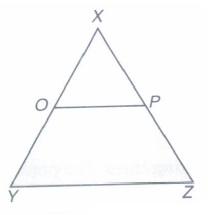
In the fig., if \(OX=\frac{1}{2}XY,\ PX=\frac{1}{2}XZ\) and OX = PX, Show that XY = XZ. State which axiom you use here. Also give two more axioms other than the oxiom used in the above situation.
3.
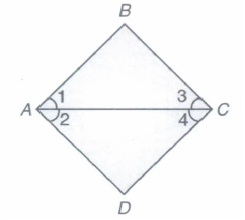
In the fig, we have \(\angle1=\angle3 \ and\ \angle2=\angle4.\) Show that \(\angle A= \angle C.\) State which axiom you use here. Also give two more axioms other than the axioms used in the above situation.
4.
In figure, C is the mid-point of AB and Dis the mid-point of AC. Prove that AD = \(1\over2\) AB.

5.
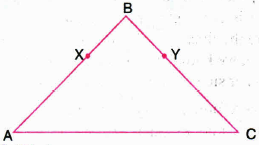
In the given figure AB = BC and BX = BY. Show that AX = CY. State Euclid's Axiom used.
6.
In the given figure, if AB = CD, then prove that AC = BD. Also, write the Euclid's Axiom used for proving it.

1.
(i) The terms need to be defined are:
Polygon: A simple closed figure made up of three or more line segments.
Line segment: part of a line with two end points.
line: undefined term.
Point: undefied term.
Angle: A figure formed by two rays with a common initial point.
Ray: Part of a line with one end point.
Right angle: Angle whose measure is 90o
Undefined terms used are: Line, point
Euclid's fourth postulate says that "all right angles are equal to one another." in a square, all angles are right angles, therefore all angles are equal (From Euclid's fourth postulate)
Three line segments are equal to fourth line segment.
Therefore, all the four sides of a square are equal( by Euclid's first axiom " things which are equal to one another")
(ii) Introduction to Euclid's geometry
(iii) Equality leads to democracy.
2.
Here \(OX=\frac{1}{2}XY\)
\(PX=\frac{1}{2}XZ\)
Also OX = PX
\(\Rightarrow \frac{1}{2}XY=\frac{1}{2}XZ\)
Things equal to half of equals, are equal to one another.
Two other axioms:
Things coincide with one another are equal to one another.
e.g., If \(\overline{AB}\) coincide with \(\overline{XY}\), such that A falls on X and B falls on Y, then \(\overline {AB}=\overline{XY}\)
The whole is greater than the part
e.g., if \(m\angle1=m\angle2+m\angle3,\ then\ m\angle1>m\angle2\ and\ m\angle1>m\angle3\)
3.
Since \(\angle1=\angle3 \ and \ \angle2=\angle4,\) therefore adding both equation
\(\angle1+\angle2=\angle3+\angle4\)
\(\Rightarrow \angle BAD=\angle BCD\)
\(\Rightarrow \angle A=\angle C\)
If equals are added to equal, the wholes are equal
Two more axioms:
Things which are equal to the same thing are equal to one another
e.g., if \(\overline {AB}=\overline{ PQ} \ and\ \overline {PQ}=\overline {XY}, then\ \angle{AB}=\angle{XY}\)
If equals are subtracted from equals, the remainders are equal.
e.g., if \(m\angle1=m\angle2\) then
\(m\angle3=m\angle3\)
\(=m\angle2-m\angle3\)
4.
\(\because\) C is the midpoint of AB
\(\therefore \) AC = CB
AC + AC = CB + AC
| If equals are added to equals, then the wholes are equal (Euclid's Axiom (ii))]
\(\Rightarrow \) 2AC = AB I CB + AC coincides with AB
\(\Rightarrow \) \(1\over2\)(2AC) = \(1\over2\) AB
| Things which are halves of the same thing are equal (Euclid's Axiom (vii»]
\(\Rightarrow \) AC =\(1\over2\)AB
\(\Rightarrow \) \(1\over2\)AC = \(1\over2\)(\(1\over2\)AB)
| Things which are halves of the same thing are equal to one another (Euclid's Axiom (vii))]
\(1\over2\)AC = \(1\over2\)AB
AD = \(1\over4\)AB
\(\because\) D is the mid-point of AC
\(\therefore \)AD = DC =\(1\over2\)AC (as above)
5.
We have
AB = BC
\(\Rightarrow \) AB - BX = BC - BX
|If equals are subtracted from equals, the remainders are equal (Euclid's Axiom (iii))
AB - BX = BC - BY \(|\)\( \because\) BX = BY
AB - BX coincides with AX;
BC - BY coincides with CY
[Things which coincide with one another are equal to one another (Euclid's Axiom (iv))]
6.
We have, AX=CY
AB=CD
\(\Rightarrow \) AB + BC = CD + BC
| If equals are added to equals, the wholes are equal (Euclid's Axiom (ii))
AC= BD
I AB + BC coincides with AC;
CD + BC coincides with BD
[Things which coincide with one another are equal to one another (Euclid's Axiom (iv))]

9th Standard CBSE Syllabus & Materials
9th Standard CBSE
CBSE 9th Mathematics Lines and Angles Sample Question Papers Study Material - QB365 Set A
NEW9th Standard CBSE
CBSE 9th Mathematics Introduction to Euclid's Geometry Sample Question Papers Study Material - QB365 Set A
NEW9th Standard CBSE
CBSE 9th Mathematics Linear Equations in Two Variables Sample Question Papers Study Material - QB365 Set A
NEW9th Standard CBSE
CBSE 9th Mathematics Coordinate Geometry Sample Question Papers Study Material - QB365 Set A



NCERT Books

Syllabus

Exam Pattern

Sample Question Papers

Previous year Question Papers

Important Notes

MCQ Practice test

NCERT Exemplers

Case study Questions

Image Based Questions

Passage based Questions

HOT Questions

Value Based Questions

Model Questions Papers
NCERT ( Book Back ) Questions

Assertion and Reason
Important Questions And Answers

CBSE 9th Standard CBSE Subjects
CBSE Standards