100% FREE ACCESS
9th Standard CBSE Syllabus & Materials
9th Standard CBSE
CBSE 9th Science Is matter around us pure? - New Model Questions Papers Study Material - QB365 Set A
NEW9th Standard CBSE
CBSE 9th Science Matter in our surroundings - New Model Questions Papers Study Material - QB365 Set A
NEW9th Standard CBSE
CBSE 9th Mathematics Heron's Formula Sample Question Papers Study Material - QB365 Set A
NEW9th Standard CBSE
CBSE 9th Mathematics Circles Sample Question Papers Study Material - QB365 Set A
NEW9th Standard CBSE
CBSE 9th Mathematics Quadrilaterals Sample Question Papers Study Material - QB365 Set A
NEW9th Standard CBSE
CBSE 9th Mathematics Triangles Sample Question Papers Study Material - QB365 Set A

Published on: 29/10/2025
Download CBSE Class 9th Standard CBSE Mathematics question papers, sample papers, important questions, and previous year solved papers in PDF format. Get free study materials, NCERT solutions, and exam preparation resources for Class 9th Standard CBSE Mathematics
Questions + Answers key
Take MCQ Mathematics Test
1.
If a transversal intersects two lines such that the bisectos of pair of a pair of corresponding angles are parallel, then prove that the two lines are parallel.
2.
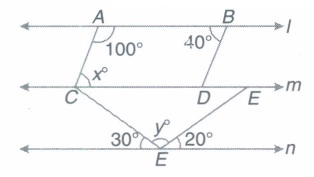
In the given figure, l||m||n. From the figure, find the ratio of (x+y):(y-x).
3.
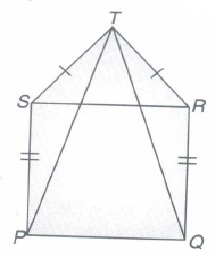
In figure, PQRS is a square and SRT is an equilateral triangle. Prove that:
(i) PT = QT
(ii) \(\angle\) TQR = 15°
4.
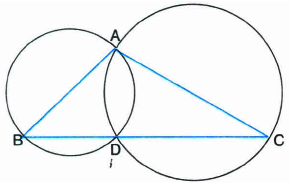
Two circles intersect at two points A and B. AD and AC are diameters to the two circles (see Fig). Prove that B lies on the line segment DC.
5.
if the diagonals of a parallelogram are equal, then show that it is a rectangle.
6.
Find six rational numbers between 3 and 4.
7.
A conical pit of top diameter 7 m is 12 m deep. What is its capacity in litre?
8.
If √2 = 1.414, then, find the value of \(\frac{1}{\sqrt{2}+1}\)
9.
If (2x-3) is a factor of \(2x^4-3x^2+15x-15k,\)find the value of \((3k-\sqrt { 5 } k)\)
10.
For what value of k, (x+1) is a factor of \(p(x)=kx^2-x-4?\)
11.
Polynomials \(kx^3+3x^2-3\) and \(2x^3-5x+k\), when divided by (x-4) leave the same remainder in each case. Find the value of k.
12.
If \(p(x)=x^3+3x^2-2x+4\) then find the value of \(p(2)+p(-2)-p(0).\)
13.
Simplify: \({ \left( 4\sqrt { 3 } -3\sqrt { 5 } \right) }^{ 2 }\)
14.
A die is thrown, what will be the probability of getting an even number?
15.
If the probability of an event is represented by p, then \(0\le p\le1\) is True/False?
16.
The range of the data is: 25,18,20,22,16,6,17,12,30,32,10,19,8,11,20 is:
17.
The radii of two right circular cylinders are in the ratio 2:3 and their heights are in the ratio 5:4, then the ratio of their volumes will be _______________
18.
For the given data: 11,15, 17, y+1, 19, y-2, 3; if the mean is 14, find the value of y.
19.
The number of children in 10 families of a locality are: 2,4,3,4,2,0,3,5,1,6. Find the mean number of children per family.
20.
Compute the curved surface area of a hemishpere whose diameter is 14 cm.
21.
Find the capacity of a tank of demensions 8 am \(\times\)6 cm \(\times\)2.5 cm.
22.
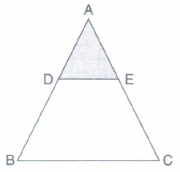
D, E, F are the mid-points of sides BC, CA and AB of ΔABC. If perimeter of ΔABC is 12·8 cm, then perimeter of ΔDEF is: .....
23.
In an equilateral triangle ABC, D and E are the mid-points of sides AB and AC respectively, then length of DE is....
24.
If a transversal intersects two parallel lines, then which of the pairs of angles is equal.
25.
A transversal l intersects two lines m and n such that a pair of alternate interior angles is equal. Then, what can you say about the lines m and n?
26.
Two supplementary angles are in ratio 2:7. Find the measure of angles.
27.
Explain when a system of axioms is called consistent.
28.
Find the value of \(\sqrt[3]{625^{-2}}\)
29.
Is the product of two irrational numbers always an irrational number?
30.
Draw the graph representing the equation of x + y = 0.
31.
The equation of a line parallel to y-axis is
32.
Find the decimal expansion of \(\frac{58}{1000}\)
33.
Any solution of linear equation 2x+0y+9=0 in two variable is ______
34.
Two solid spheres made of the same metal have masses 5920 g of and 740 g respectively. Determine the radius of the larger sphere, if the diameter of the smaller sphere is 5 cm.
35.
Represent the following data by means of a frequency polygon.
| Marks | Frequency |
|---|---|
| 41-45 | 4 |
| 45-49 | 10 |
| 49-53 | 15 |
| 53-57 | 18 |
| 57-61 | 20 |
| 61-65 | 12 |
| 65-69 | 13 |
36.
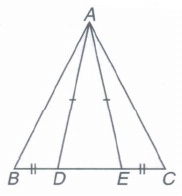
In the figure, AD = AE, BD = EC. Prove that \(\triangle\)ABC is an isosceles triangle.
37.
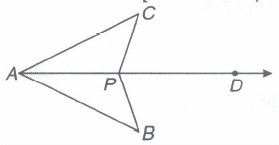
In the given figure, AD is the bisector of \(\angle\)BAC and \(\angle\)CPD = \(\angle\)BPD. Prove that\(\triangle CAP\cong \triangle BAP\) and CP = BP.
38.
Show that: \(\frac { 1 }{ 1+{ x }^{ a-b } } +\frac { 1 }{ 1+{ x }^{ b-a } } =1\)
1.
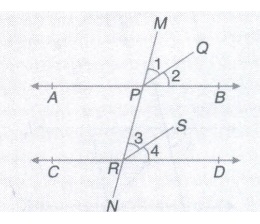
Given PQ||RS
Given \(\angle 1=\angle 2\ and \angle 3 =\angle 4\)
But, \(\angle 1=\angle 3 \) (Corres angles)
\(2\angle 1=2\angle3\)
\(\angle MPB=\angle PRD\)
Hence, AB||CD.
2.
y=180o-(30o+20o)=130o
l||m \(\Rightarrow\)x+100o=180o\(\Rightarrow\)x=80o
x+y=210o,y-x=50o
(x+y):(y-x)=21:5
3.
PQRS is a square. (given)
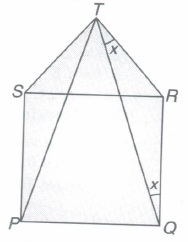
(i) SRT is an equilateral triangle. (given)
\(\therefore\) \(\angle\)PSR = 90°, \(\angle\)TSR = 60°
\(\Rightarrow\) \(\angle\)PSR + \(\angle\)TSR = 150°.
Similarly, \(\angle\)QRT = 150°
In \(\triangle\)PST and \(\triangle\)QRT, we have PS = QR (S)
\(\angle\)PST =\(\angle\)QRT = 150° (A)
and ST = RT (5) Y,
By SAS, \(\triangle PST\cong \triangle QRT\)
\(\Rightarrow\) PT = QT (By c.p.c.t.) Proved.
(ii) In \(\triangle\)TQR, QR = RT
(Square and equilateral 6 on same base) Yz
\(\Rightarrow\) \(\angle\)TQR = \(\angle\)QTR = x
\(\therefore\) x + x + \(\angle\)QRT = 180°
\(\Rightarrow\) 2x + 150° = 180° ~ 2x = 30°
\(\therefore\) x = 15° Proved.
4.
Given: Circles are drawn with sides AB and AC of a triangle ABC as diameters. They intersect at a point D.
To Prove: D lies on the third side BC of \(\Delta \)ABC
Construction: Join AD
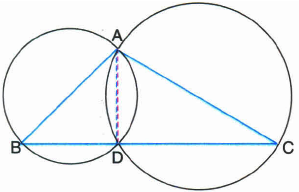
Proof: ∵ Circle drawn on AB as diameter intersects BC in D.
∴ \(\angle ADB=90°\)
| Angle in a semi-circle
But \(\angle ADB+\angle ADC=180°\)
Linear Pair Axiom
∴ \(\angle ADC=90°\)
Hence, the circle described on AC as diameter must pass through D.
Thus, the two circles intersect in D.
Now, \(\angle ADB+\angle ADC=180°\).
∴ Points B, D, C are collinear.
∴ D lies on BC.
5.
Given: In parallelogram ABCD, AC = BD To Prove: ||gm ABCD is a rectangle.
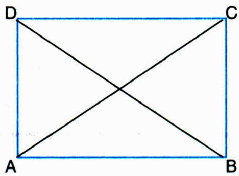
Proof: In \(\Delta\) ACB and \(\Delta\)BDA,
AC = BD I Given
AB = BA I Common
BC = AD I Opposite sides of II gm ABCD
\(\therefore\) \(\Delta\)ACB =\(\Delta\)BDA | SSS Congruence Rule
\(\therefore\) \(\angle ABC=\angle BAD\quad \quad \quad ......(1)\quad C.P.C.T\)
AD || BC | Opp. sides of II gm ABCD
and transversal AB intersects them.
\(\angle BAD+\angle ABC=180°\quad \quad \quad ....(2)\)
|Sum of consecutive interior angles on the same side of a transversal is 180
From (1) and (2),
\(\angle BAD=\angle ABC=90°\)
\(\therefore\)
6.
There can be infinitely many rational numbers between 3 and 4.
\(\frac { 3+4 }{ 2 } =\frac { 7 }{ 2 } \)
\(\\ \frac { 3+\frac { 7 }{ 2 } }{ 2 } =\frac { 13 }{ 4 } \)
\(\\ \frac { 3+\frac { 13 }{ 4 } }{ 2 } =\frac { 25 }{ 8 }\)
\( \\ \frac { 3+\frac { 25 }{ 8 } }{ 2 } =\frac { 49 }{ 16 } =\frac { 3+\frac { 49 }{ 16 } }{ 2 } =\frac { 97 }{ 32 } =\frac { 3+\frac { 97 }{ 32 } }{ 2 } =\frac { 193 }{ 64 } \)
Thus, six rational numbers between 3 and 4
\(\frac { 193 }{ 64 } ,\frac { 97 }{ 32 } ,\frac { 49 }{ 16 } ,\frac { 25 }{ 8 } ,\frac { 13 }{ 4 } \)and \(\frac { 7 }{ 2 } \)
Aliter
\(3=\frac { 3 }{ 1 } =\frac { 3\times 7 }{ 1\times 7 } =\frac { 21 }{ 7 } \)
\(\\ 4=\frac { 4 }{ 1 } =\frac { 4\times 7 }{ 1\times 7 } =\frac { 28 }{ 7 } \)
6 + 1 = 7
the six rational numbers between 3 and 4 can be taken as
\(\frac { 22 }{ 7 } ,\frac { 23 }{ 7 } ,\frac { 24 }{ 7 } ,\frac { 25 }{ 7 } ,\frac { 26 }{ 7 } \) and \(\frac { 27 }{ 7 } \)
7.
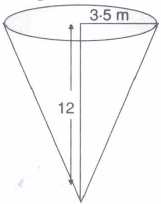
Given, r = 3.5 m, h = 12 m
Capacity V=\(\frac { 1 }{ 3 } \pi { r }^{ 2 }h\)
\(V=\frac { 1 }{ 3 } \times \frac { 22 }{ 7 } \times 3.5\times 3.5\times 12\)
= 154 m3 [1 m3 = 1000 litre]
= 154000 litre.
8.
\(\frac{1}{\sqrt{2}+1}\)=\(\frac { \left( \sqrt { 2 } -1 \right) }{ \left( \sqrt { 2 } -1 \right) } \) = √2-1
= 1.414-1
= 0.414
9.
\(\frac { (3-\sqrt { 5 } )107 }{ 120 } \)
10.
3
11.
1
12.
28
13.
\(93-24\sqrt { 15 } \)
14.
()
Favourable number of outcomes = 3(2,4,6)
Total number of outcomes = 6
Required probability\(=\frac{3}{6}=\frac{1}{2}\)
15.
()
Probability of an event associated with a random experiment lies between 0 and 1 (both included). So given statement is true.
16.
()
26
17.
()
Let radii of cylinders be 2x and 3x and heights be 5y and 3y respectively.
\(\therefore\) Ratio of volumes = \(\frac { \pi { (2x) }^{ 2 }\times 5y }{ \pi { (3x) }^{ 2 }\times 3y } \)
\(=\frac { { 4x }^{ 2 }\times 5 }{ { 9x }^{ 2 }\times 3 } \)
= 20:27.
18.
()
\(14=\frac{11+15+17+y+1+19+y-2+3}{7}\)
⇒ 98 = 64+2y
⇒ 2y = 34
⇒ y = 17
19.
()
Mean number of children per family =\(\frac{2+4+3+4+2+0+3+5+1+6}{10}=\frac{30}{10}\) = 3
20.
()
Given diameter of hemisphere = 14 cm
\(\therefore\) radius = 7 cm
\(\therefore\) Curved surface area = 2\(\pi\)r2
\(=2\times \frac { 22 }{ 7 } \times 7\times 7\)
= 308 cm2
21.
()
Capacity of the tank = 120 cm3
Capacity of the tank = length\(\times\)breadth\(\times\)height
= 8 cm\(\times\)6 cm\(\times\)2.5 cm
= 120 cm3
22.
()
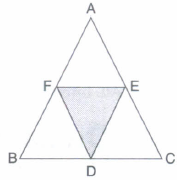
Given, perimeter of ΔABC=12.8 cm
ஃ Perimeter of ΔDEF=\(\frac{12.8}{2}\)=6.4cm
23.
()
Since D and E are mid-points of sides AB and AC respectively, so, by mid-point theorem, DE=\(\frac{1}{2}\)BC.
24.
()
Pair of alternate interior angles.
25.
()
m and n lines are parallel.
26.
()
2x+7x=180o\(\Rightarrow\)x=20o
So the angles are
2x=2X20o
=40o
7x=7X20o
=140o
So two angles are 40o and 140o
27.
()
A system of axioms is called consistent, when it is impossible to deduce from these axioms, a statement that contradicts any axiom or previously proved statement.
28.
()
\(\sqrt[3]{625^{-2}}\) = (625-2)1/4 = (625-2x1/4)
= (625-1/2)
= \((\frac{1}{625})^{1/2}=\frac{1}{25}\)
29.
()
No, it may be rational or irrational.
30.
()
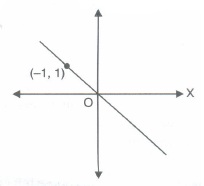
31.
()
x=k
32.
()
\(\frac{58}{1000}\)= 0.058 (Decimal point is shifted three places to the left)
33.
()
\(\left( -\frac { 9 }{ 2 } ,m \right) \).
34.
Let r and R be the radii of the smaller and larger spheres respectively, we have
\(r=\frac { 5 }{ 2 } cm\)
Volume of the smaller sphere \(=\frac { 4 }{ 3 } \pi { r }^{ 3 }=\frac { 4 }{ 3 } \pi { \left( \frac { 5 }{ 2 } \right) }^{ 3 }\)
\(=\frac { 4 }{ 3 } \times \pi \times \frac { 125 }{ 8 } { cm }^{ 3 }\)
Density of metal\(=\frac { mass }{ Valume } \)
\(=\frac { 740 }{ \frac { 4 }{ 3 } \pi \times \frac { 125 }{ 8 } } g\quad { cm }^{ 3 }\) ...........(i)
Volume of larger sphere = \(\frac { 4 }{ 3 } \pi { R }^{ 3 }\)
Density of metal=\(\frac { mass }{ Volume } =\frac { 5920 }{ \frac { 4 }{ 3 } \pi { R }^{ 3 } } \) ......(ii)
From (i) and (ii), we have
\(\frac { 740 }{ \frac { 4 }{ 3 } \pi \times \frac { 125 }{ 8 } } =\frac { 5920 }{ \frac { 4 }{ 3 } \pi { R }^{ 3 } } \)
\(\Rightarrow \quad { R }^{ 3 }=\frac { 5920\times 125 }{ 740\times 8 } \)
= 125
\(\Rightarrow\) R = 5 cm.
35.
| Marks | Frequency | Class Marks |
|---|---|---|
| 37-41 | 0 | 39 |
| 41-45 | 4 | 43 |
| 45-49 | 10 | 47 |
| 49-53 | 15 | 51 |
| 53-57 | 18 | 55 |
| 57-61 | 20 | 59 |
| 61-65 | 12 | 53 |
| 65-69 | 13 | 67 |
| 69-73 | 0 | 71 |
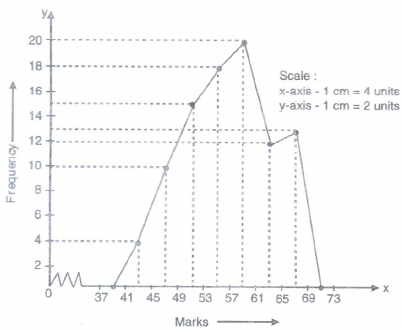
36.
Proof: In \(\triangle\)ADE, we have
AD = AE
\(\angle\)ADE = \(\angle\)AED
180°- \(\angle\)ADE = 180°- \(\angle\)AED
\(\Rightarrow\) \(\angle\)ADB = \(\angle\)AEC
Consider \(\triangle\)ABD and \(\triangle\)ACE
AD =AE
\(\angle\)ADB = \(\angle\)AEC
BD = EC
By SAS congruence,
\(\triangle ADB\cong \triangle AEC\)
By c.p.c.t., AB = AC
\(\therefore\) \(\triangle\)ABC is an isosceles triangle.
37.
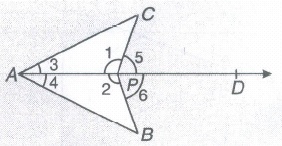
\(\angle\)1 + \(\angle\)5 = 1800 = \(\angle\)2 + \(\angle\)6
(linear pair)
\(\Rightarrow\) \(\angle\)1 =\(\angle\)2 (\(\because\) \(\angle\)5 = \(\angle\)6)
In \(\triangle\)CAP and \(\triangle\)BAP,
\(\angle\)1 = \(\angle\)2 (proved)
\(\angle\)3 = \(\angle\)4
(AD is the bisector of \(\angle\)BAC)
AP =AP
\(\triangle CAP\cong \triangle BAP\) (By SAS)
\(\Rightarrow\) CP = BP (By c.p.c.t.) Proved
38.
\(\frac { 1 }{ 1+{ x }^{ a-b } } +\frac { 1 }{ 1+{ x }^{ b-a } } =\frac { { x }^{ b } }{ { x }^{ b }+{ x }^{ a } } +\frac { { x }^{ a } }{ { x }^{ a }+{ x }^{ b } } \)
\(=\frac { { x }^{ b }+{ x }^{ a } }{ { x }^{ a }+{ x }^{ b } } \)

9th Standard CBSE Syllabus & Materials
9th Standard CBSE
CBSE 9th Mathematics Lines and Angles Sample Question Papers Study Material - QB365 Set A
NEW9th Standard CBSE
CBSE 9th Mathematics Introduction to Euclid's Geometry Sample Question Papers Study Material - QB365 Set A
NEW9th Standard CBSE
CBSE 9th Mathematics Linear Equations in Two Variables Sample Question Papers Study Material - QB365 Set A
NEW9th Standard CBSE
CBSE 9th Mathematics Coordinate Geometry Sample Question Papers Study Material - QB365 Set A



NCERT Books

Syllabus

Exam Pattern

Sample Question Papers

Previous year Question Papers

Important Notes

MCQ Practice test

NCERT Exemplers

Case study Questions

Image Based Questions

Passage based Questions

HOT Questions

Value Based Questions

Model Questions Papers
NCERT ( Book Back ) Questions

Assertion and Reason
Important Questions And Answers

CBSE 9th Standard CBSE Subjects
CBSE Standards