100% FREE ACCESS
9th Standard CBSE Syllabus & Materials
9th Standard CBSE
CBSE 9th Science Is matter around us pure? - New Model Questions Papers Study Material - QB365 Set A
NEW9th Standard CBSE
CBSE 9th Science Matter in our surroundings - New Model Questions Papers Study Material - QB365 Set A
NEW9th Standard CBSE
CBSE 9th Mathematics Heron's Formula Sample Question Papers Study Material - QB365 Set A
NEW9th Standard CBSE
CBSE 9th Mathematics Circles Sample Question Papers Study Material - QB365 Set A
NEW9th Standard CBSE
CBSE 9th Mathematics Quadrilaterals Sample Question Papers Study Material - QB365 Set A
NEW9th Standard CBSE
CBSE 9th Mathematics Triangles Sample Question Papers Study Material - QB365 Set A

Published on: 29/10/2025
Download CBSE Class 9th Standard CBSE Mathematics question papers, sample papers, important questions, and previous year solved papers in PDF format. Get free study materials, NCERT solutions, and exam preparation resources for Class 9th Standard CBSE Mathematics
Questions + Answers key
Take MCQ Mathematics Test
1.
Write each of the following equations in the form ax + by + c = 0 and also write the values of a, b and c in each case:
(i) 2x + 3y = 3.47
(ii) x - 9 = \(\sqrt{3}\)y
(iii) 4 = 5x - 3y
(iv) y = 2x
2.
Solve the equation 2x + 1 = x - 3, and represent the solution(s) on
(i) the number line
(ii) the Cartesian plane
3.
The parking charges of a car on New Delhi Railway Station for first two hours is Rs.50 and Rs.10 for subsequent hours.Write down an equation and draw the graph of this data. Read the charges from the graph:
(i) for one hour
(ii) for three hours
(iii) for six hours.
4.
The taxi fare in a city is as follows: for the first kilometer, the fare is Rs.10 and for the subsequent distance it is Rs.6 per km. Taking the distance covered as x km and total fare as Rs.y, write a linear equation for this information, and draw its graph.
5.
The taxi fare in a city is Rs.8.00 for first kilometer and for the subsequent distance it is Rs 5.00 per km. Write a linear equation to represent this information in two variables taking distance covered as 'x' km and total fare as y (in Rs.) and draw its graph. Find the distance traveled by a person if he spent Rs.63.00.
6.
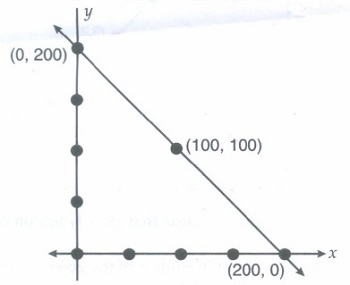
Two friends Sita and Gita, together contributedRs.200 towards Prime Minister's Relief Fund.Write a linear equation which satisfies this data.Draw the graph
7.
The cost of a note book is thrice the cost of a pen.Write a linear equation in two variables to represent this statement.Express it graphically.
8.
Sketch the graph of the equation 3x + 5y = 15.Find the area of the figure formed by this line and the two axes.
9.
Find the value of 'm' if x = 2, y = 1 is a solution of the equation 2x + 3y = m and represent it graphically
10.
Given the point (1, 2), find the equation of a line on which it lies. How many such equations are there?Write the equation in the form ax + by + c = 0.
11.
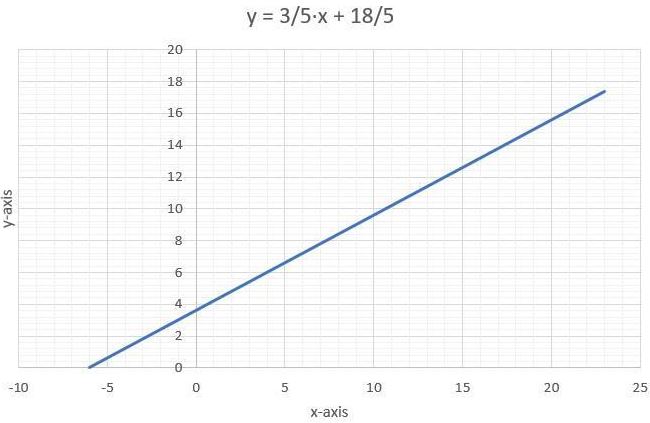
Draw the graph of linear equation 5y = 3x + 18 on Cartesian plane. From the graph check whether (-2,4) is the solution of linear equation or not.
12.
Draw the graph of the linear equation 3x + 2y = 12.Also find the points where this graph cuts x-axis and y-axis.
13.
Draw the graph of x = 3y - 4.Find the
(i) value of y when x = -1
(ii) value of x when y = 5.
14.
Draw a graph of the line x - 2y = 3. From the graph, find the coordinates of the point when
(i) x =-5
(ii) y = 0.
15.
Draw the graph of the linear equation y = m.x + c for m = 2 and c = 1. Read from the graph the value of y when x = \(3\over 2\)
16.
Draw the graph of the linear equation 3x - y = 4.From your graph, find the values of hand k if the graph passes through the points (h, -4) and (3, k).
17.
Draw the graph of x + y = 7.
18.
Give the equation of two lines passing through (3,4). How many more such lines are there and why?
19.
Given the point (1, 2), can you give the equation of a line on which it lies? How many such equations are there?
20.
Find the value of a so that the following equation may have x=1, y=1 as a solution 3x+ay=6
21.
Write six solutions for the equation 2x+y=7
22.
Find four different solutions of the equation x + 2y = 6
23.
Find three different solutions for the equation 6x-8y+32=0
24.
Find three different solutions for the equation 3x-4y=-12
25.
Find two solutions for each of the following equations:
(i)2x-3y=12
(ii)2x-5y=0
(iii)3y-4=0
26.
Write the following equation in the form ax+by+c=0 and find values of a, b and c: 4=3x-5y. Check whether (1, -1) and (3, 1) are solutions of this equation or not.
27.
Write the equation \(y\sqrt{3}=8x+\sqrt{3}\) in the form of ax+by+c=0, Check whether (0,-1) and \((\sqrt{3},9)\) are solution of this equation
28.
Express y in terms of x, it being given that 3x+y-9=0.Check whether the points (3,0) and (2, 2) lie on the equation
29.
Check whether (3, 1), (1, 3) and (0, 8) are the solutions of the equation 3x-y=8
30.
Write the following equations in the form ax+by+c=0 and indicate the values of a, b and c
2x=y
31.
Write the following equations in the form ax+by+c=0 and indicate the values of a, b and c
4=5x-3y
32.
Write the following equations in the form ax+by+c=0 and indicate the values of a, b and c
\(x-4=\sqrt{3}y\)
33.
Write the following equations in the form ax+by+c=0 and indicate the values of a, b and c
2x+3y=4.37
34.
Write the following as an equation in two variables:
y=2
35.
Write the following as an equation in two variables:
x=-5
1.
(i) 2x + 3y - 3.47 = 0; a = 2, b = 3 and c = -3.47
(ii) x - \(\sqrt{3}\)y - 9 = 0; a = I, b = -\(\sqrt{3}\) and c = -9
(iii) -5x + 8y + 4 = 0; a = -5, b = 8 and c = 4
(iv) -2x + y + 0 = 0; a = -2, b = 1 and c = 0
2.
(i)
.png)
(ii)
.png)
3.
y = SO+ lO(x - 2), where x > 2
⇒ y = 30 + lOx, where x > 2
(i) Rs.50 (ii) Rs.60, (iii) Rs.90
4.
y=10+6(x-1) ⇒ y=4+6x
5.
y=8+5(x-1) ⇒ y=5x+3; Rs.318
6.
Let Sita contribute=Rs.x and Gita contribute=Rs.y.
According to the question,
x+y=200
y=200-x
| x | 0 | 200 | 100 |
| y | 200 | 0 | 100 |
7.
y=3x
8.
\(15\over 2\) square units
9.
m=7
10.
x+y=3; infinitely many; x+y-3=0
11.
The point (-2, 4) is not a solution of the linear equation, 5·y = 3·x + 18
Please find attached the required graph of the linear equation 5·y = 3·x + 18 written in the form y = 3/5·x + 18/5
Step-by-step explanation:
The given equation is 5·y = 3·x + 18, from which we have;
y = 3/5·x + 18/5
To draw the graph, we generate for vales of y corresponding to values of x as follows;
| x | y |
| -6 | 0 |
| -5 | 0.6 |
| -4 | 1.2 |
| -3 | 1.8 |
| -2 | 2.4 |
| -1 | 3 |
| 0 | 3.6 |
| 1 | 5.2 |
| 2 | 4.8 |
| 3 | 5.4 |
| 4 | 6 |
| 5 | 6.6 |
| 6 | 7.2 |
| 7 | 7.8 |
| 8 | 8.4 |
| 9 | 9 |
| 10 | 9.6 |
| 11 | 10.2 |
| 12 | 10.8 |
| 13 | 11.4 |
| 14 | 12 |
| 15 | 12.6 |
| 16 | 13.2 |
Therefore, when y = 0, x = -6, when x = 0, y = 3.6, when x = -2, y = 2.4, when y = 4, x = -2, x = 6
Therefore, the point (-2, 4) is not a solution of the linear equation, 5·y = 3·x + 18
12.
(4,0); (0,6)
13.
(i)1
(ii)11
14.
(i)(-5,-4)
(ii)(3,0)
15.
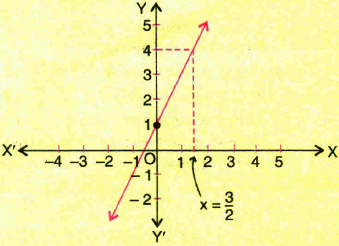
Ans: 4
16.
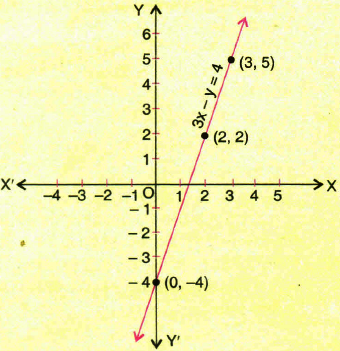
Ans: h=0, k=5
17.
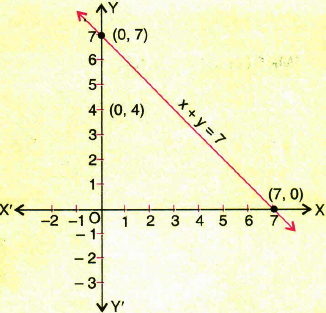
18.
x+y=7; y=x+1; infinitely many
19.
Here (1, 2) is a solution of a linear equation you are looking for. So, you are looking for any line passing through the point (1, 2). One example of such a linear equation is x + y = 3. Others are y – x = 1, y = 2x, since they are also satisfied by the coordinates of the point (1, 2). In fact, there are infinitely many linear equations which are satisfied by the coordinates of the point (1, 2).
20.
3
21.
(0,7), (1,5), (2,3), (3,1), (4, -1), (5,-3)
22.
By inspection, x = 2, y = 2 is a solution because for x = 2, y = 2
x + 2y = 2 + 4 = 6
Now, let us choose x = 0. With this value of x, the given equation reduces to 2y = 6 which has the unique solution y = 3. So x = 0, y = 3 is also a solution of x + 2y = 6. Similarly, taking y = 0, the given equation reduces to x = 6. So, x = 6, y = 0 is a solution of x + 2y = 6 as well. Finally, let us take y = 1. The given equation now reduces to x + 2 = 6, whose solution is given by x = 4. Therefore, (4, 1) is also a solution of the given equation. So four of the infinitely many solutions of the given equation are:
(2, 2), (0, 3), (6, 0) and (4, 1).
23.
(0,3), (4,6), (-4,0)
24.
(0,3), (4, 6), (-4, 0)
25.
(i)(0,-4) and (6, 0)
(ii)(0, 0) and \(\left(1,{2\over 5}\right)\)
(iii)\(\left(0,{4\over 3}\right) and \left(1,{4\over 3}\right) \)
26.
3x-5y-4=0; No; a=3, b=-5, c=-4; Yes
27.
\(y\sqrt{3}=8x+\sqrt{3}\)
\(\Rightarrow\ 8x-y\sqrt{3}+\sqrt{3}=0\)
Putting x=0, y=-1
\(\Rightarrow\ \sqrt3+\sqrt3\ne0\)
\(\therefore(0,-1)\) is not the solution of given equation.
Putting \(x=\sqrt{3},y=9\)
\(\Rightarrow 8\sqrt{3}-9\sqrt{3}+\sqrt{3}=0\)
which is correct.
\(\therefore(\sqrt3,9)\) is a solution of the given equation.
28.
y=9-3x; Yes; No
29.
Yes, no, no
30.
2x-y+0=0; a=2, b=-1 and c=0
31.
-5x+3y+4=0; a=-5, b=3 and c=4
or
5x-3y-4=0; a=5, b=-3 and c=-4
32.
\(x-4=\sqrt{3}y\)=0; a=2, b=\(-\sqrt{3}\), c=-4
33.
2x+3y-4.37=0;
a=2, b=3 and c=-4.37
34.
0x+1y-2=0
35.
1x+0y+5=0

9th Standard CBSE Syllabus & Materials
9th Standard CBSE
CBSE 9th Mathematics Lines and Angles Sample Question Papers Study Material - QB365 Set A
NEW9th Standard CBSE
CBSE 9th Mathematics Introduction to Euclid's Geometry Sample Question Papers Study Material - QB365 Set A
NEW9th Standard CBSE
CBSE 9th Mathematics Linear Equations in Two Variables Sample Question Papers Study Material - QB365 Set A
NEW9th Standard CBSE
CBSE 9th Mathematics Coordinate Geometry Sample Question Papers Study Material - QB365 Set A



NCERT Books

Syllabus

Exam Pattern

Sample Question Papers

Previous year Question Papers

Important Notes

MCQ Practice test

NCERT Exemplers

Case study Questions

Image Based Questions

Passage based Questions

HOT Questions

Value Based Questions

Model Questions Papers
NCERT ( Book Back ) Questions

Assertion and Reason
Important Questions And Answers

CBSE 9th Standard CBSE Subjects
CBSE Standards