100% FREE ACCESS
9th Standard CBSE Syllabus & Materials
9th Standard CBSE
CBSE 9th Science Is matter around us pure? - New Model Questions Papers Study Material - QB365 Set A
NEW9th Standard CBSE
CBSE 9th Science Matter in our surroundings - New Model Questions Papers Study Material - QB365 Set A
NEW9th Standard CBSE
CBSE 9th Mathematics Heron's Formula Sample Question Papers Study Material - QB365 Set A
NEW9th Standard CBSE
CBSE 9th Mathematics Circles Sample Question Papers Study Material - QB365 Set A
NEW9th Standard CBSE
CBSE 9th Mathematics Quadrilaterals Sample Question Papers Study Material - QB365 Set A
NEW9th Standard CBSE
CBSE 9th Mathematics Triangles Sample Question Papers Study Material - QB365 Set A

Published on: 29/10/2025
Download CBSE Class 9th Standard CBSE Mathematics question papers, sample papers, important questions, and previous year solved papers in PDF format. Get free study materials, NCERT solutions, and exam preparation resources for Class 9th Standard CBSE Mathematics
Questions + Answers key
Take MCQ Mathematics Test
1.
In the given figure, name the following:
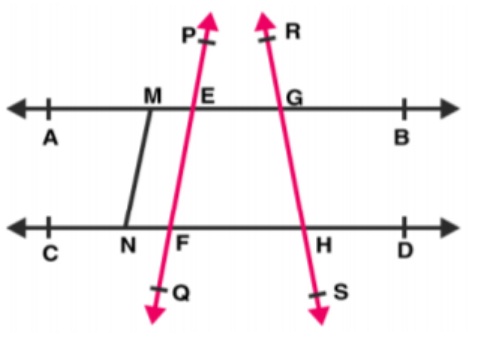
(i) Six points
(ii) Five line segments
(iii) Four collinear points
(iv) Four lines
2.
Read the following axioms.
(i) Things which are equal to the same things are equal to one another.
(ii) If equals are added to equals, then wholes are equal.
(iii) Things which are double of the same things are equal to one another.
Check whether the given system of axioms is consistent or inconsistent
3.
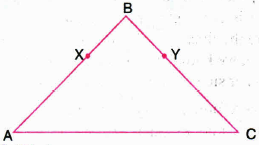
In the given figure AB = BC and BX = BY. Show that AX = CY. State Euclid's Axiom used.
4.
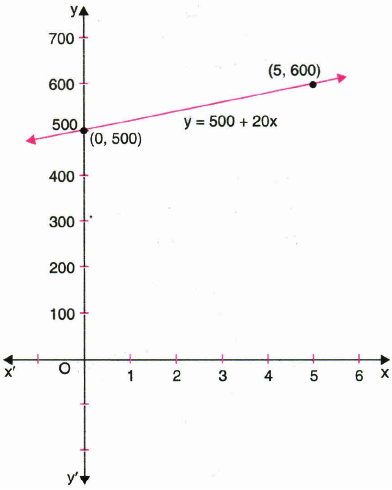
A part of family budget on milk is constant and is fixed at Rs.500, while the other is variable and it depends on the need for milk at the rate of Rs.20 per litre.If extra milk taken is x litre and total expenditure on milk is Rs y, then write a linear equation for this problem. Draw its graph.
5.
Express the following statement as a linear equation in two variables by taking present ages (in years) of father and son as x and y, respectively.Age of father 5 years ago was two years ago was teo years more than 7 times the age of his son at that time.
6.
Write each of the following as an equation in two variables:
(i) x = -5
(ii) Y = 2
(iii) 2x = 3
(iv) 5y = 2
7.
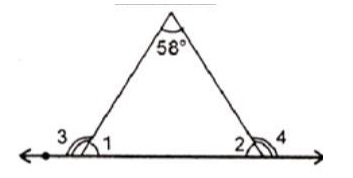
In the given figure, ㄥ2 = ㄥ1 and ㄥ3 = ㄥ4. Find ㄥ\(\theta\) .
8.
In the given figure, if A, Band Care three points on a line and B lies between A and C, then prove that AB + BC = AC.

9.
Draw the graph of x = 3y - 4.Find the
(i) value of y when x = -1
(ii) value of x when y = 5.
10.
Write the following as an equation in two variables:
2x=3
11.
There exists a pair of straight lines that are everywhere equidistant from one another' is a direct consequence of Euclid's
first postulate
second postulate
third postulate
fifth postulate
12.
Select the wrong statement:
only one line can be pass through a single point.
Only one line can pass through two distinct points.
A terminated line can be produced indefinitely on both the sides.
if two circles are equal, then their radii are equal.
13.
The things which coincide with one another are:
equal to one another
un equal
double of same thing
triple of same thing
14.
'Lines are parallel if they do not intersect' is stated in the form of:
an axiom
a definition
a postulate
a proof
15.
In ancient India, the shapes of altars used for household rituals were
squares and circles
triangles and rectangles
trapeziums and phyramids
rectangles and squares
16.
The line y=x passes through
(0,0)
(0,1)
(1,0)
91,-1)
17.
A linear equation in two variables has
a unique solution
no solution
two solution
infinitely many solutions
18.
Write a, b, c for the equation x+y=0
1,1,0
1,-1,0
-1,1,0
1,-1,1
19.
Write a, b, c for the equation 2x=5
2, 0, -5
0,2,-5
0,0,-5
2,0,5
20.
A linear equation in two variables has infinitely many solutions which can be represented on
a number line
a circle
a square
the Cartesian plane
21.
Draw the graph of each of the following linear equations in two variables:
(i) x + y =4
(ii) x - y = 2
(iii) y = 3x
(iv) 3 = 2x + y
22.
If the point (3,4) lies on the graph of the equation 3y = ax + 7, then find the value of a.
23.
How would you rewrite Euclid's fifth postulate, so that it would be easier to understand?
24.
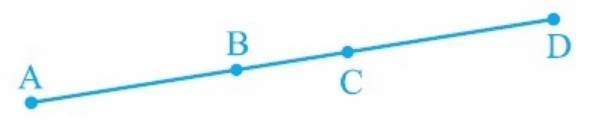
In the given figure, if AC = BD, then prove that AB = CD.
25.
Aditya purchased two types of chocolates A and B at the rate of Rs. x and Rs. y respectively. The total amount spent is Rs. 7. After reaching home, he forms a linear equation in two variables for two types of chocolates. He prepares a table and a graph of the linear equation as shown in adjoining graph:
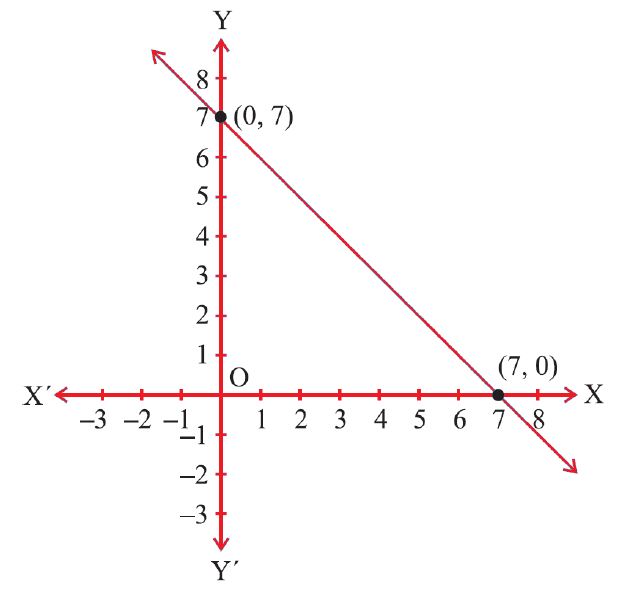
(a) How a represent the above situation in linear equations in two variables?
| (i) 2x + y = 7 | (iii) x + y = 7 |
| (ii) x = 7 | (iv) y = 7 |
(b) If the cost of chocolates A is 5, then find the cost of chocolates B?
| (i) 3 | (iii) 1 |
| (ii) 5 | (iv) 2 |
(c) Which of the follwing point lies on the line x + y = 7?
| (i) (3, 4) | (iii) (1, 5) |
| (ii) (5, 4) | (iv) (2, 6) |
(d) The point where the line x + y = 7 intersect y-axis is
| (i) (0, 4) | (iii) (7, 0) |
| (ii) (0, 6) | (iv) (0, 7) |
(e) For what value of k, x = 2 and y = -1 is a soluation of x + 3y -k = 0.
| (i) 1 | (iii) -1 |
| (ii) -2 | (iv) 2 |
26.
On his birthday, Manoj planned that this time he celebrates his birthday in a small orphanage centre. He bought apples to give to children and adults working there. Manoj donated 2 apples to each children and 3 apples to each adult working there along with birthday cake. He distributed 60 total apples.

(a) How to represent the above situation in linear equations in two variables by taking the number of children as 'x' and the number of adults as 'y'?
| (i) 2x + y = 60 | (iii) 2x + 3y =60 |
| (ii) 3x + 2y = 60 | (iv) 3x + y =60 |
(b) If the number of children is 15, then find the number of adults?
| (i) 10 | (iii) 15 |
| (ii) 25 | (iv) 20 |
(c) If the number of adults is 12, then find the number of children?
| (i) 12 | (iii) 15 |
| (ii) 14 | (iv) 18 |
(d) Find the value of b, if x = 5, y = 0 is a solution of the equation 3x + 5y = b.
| (i) 12 | (iii) 15 |
| (ii) 14 | (iv) 18 |
(e) Which is the standard form of linear equations in two variables: y - x = 5?
| (i) 1.y - 1.x - 5 = 0 | (ii) 1.x - 1.y + 5 = 0 |
| (iii) 1.x + 0.y + 5 = 0 | (iv) 1.x - 1.y -5 = 0 |
27.
Sanjay bought 5 notebooks and 2 pens for Rs. 120. He told to guess the cost of each notebook and pen to his friends Mohan and Anil. Sanjay has given the clue that both the costs are positive integers and divisible by 5 such that the cost of a notebook is greater than that of a pen.
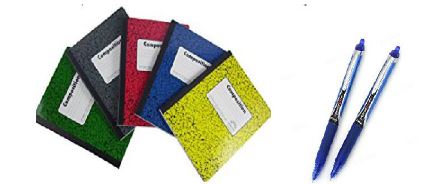
Now, Mohan and Anil tried to guess.
Mohan said that price of each notebook could be Rs. 18. Then five notebooks would cost Rs.90, the two pens would cost Rs.30 and each pen could be for Rs. 15. Anil felt that Rs. 18 for one notebook was too little. It should be at least Rs. 20. Then the price of each pen would also be Rs.10.
(i) Form the linear equations in two variables from this situation by taking cost of one notebook as Rs. x and cost of one pen as Rs. y.
| (a) 2x + 5y = 120 | (b) 5x + y = 120 |
| (c) x + y = 120 | (d) 5x + 2y = 120 |
(ii) Which is the solution of the equations formed in (i)?
| (a) x = 10, y = 20 | (b) x = 20, y = 10 |
| (c) x = 15, y = 15 | (d) none of these |
(c) If the cost of one notebook is Rs. 15 and cost of one pen is 10, then find the total amount.
| (i) Rs. 120 | (ii) Rs. 95 |
| (iii) Rs. 105 | (iv) Rs. 125 |
(d) If the cost of one notebook is twice the cost of one pen, then find the cost of one pen?
| (a) Rs. 20 | (b) Rs. 10 |
| (c) Rs. 5 | (d) Rs. 15 |
(e) Which is the standard form of linear equations y = 4 ?
| (i) y – 4 = 0 | (ii) 1.y + 4 = 0 |
| (iii) 0.x + 1.y + 4 = 0 | (iv) 0.x + 1.y – 4 = 0 |
28.
Deepak bought 3 notebooks and 2 pens for Rs. 80. His friend Ram said that price of each notebook could be Rs. 25. Then three notebooks would cost Rs.75, the two pens would cost Rs.5 and each pen could be for Rs. 2.50. Another friend Ajay felt that Rs. 2.50 for one pen was too little. It should be at least Rs. 16. Then the price of each notebook would also be Rs.16.

Lohith also bought the same types of notebooks and pens as Aditya. He paid 110 for 4 notebooks and 3 pens. Later, Deepak guess the cost of one pen is Rs. 10 and Lohith guess the cost of one notebook is Rs. 30.
(i) Form the pair of linear equations in two variables from this situation by taking cost of one notebook as Rs. x and cost of one pen as Rs. y.
(a) 3x + 2y = 80 and 4x + 3y = 110
(b) 2x + 3y = 80 and 3x + 4y = 110
(c) x + y = 80 and x + y = 110
(d) 3x + 2y = 110 and 4x + 3y = 80
(ii) Which is the solution satisfying both the equations formed in (i)?
| (a) x = 10, y = 20 | (b) x = 20, y = 10 |
| (c) x = 15, y = 15 | (d) none of these |
(iii) Find the cost of one pen?
| (a) Rs. 20 | (b) Rs. 10 | (c) Rs. 5 | (d) Rs. 15 |
(iv) Find the total cost if they will purchase the same type of 15 notebooks and 12 pens.
| (a) Rs. 400 | (b) Rs. 350 | (c) Rs. 450 | (d) Rs. 420 |
(v) Find whose estimation is correct in the given statement.
| (a) Deepak | (b) Lohith | (c) Ram | (d) Ajay |
29.
In the below given layout, the design and measurements has been made such that area of two bedrooms and Kitchen together is 95 sq. m.
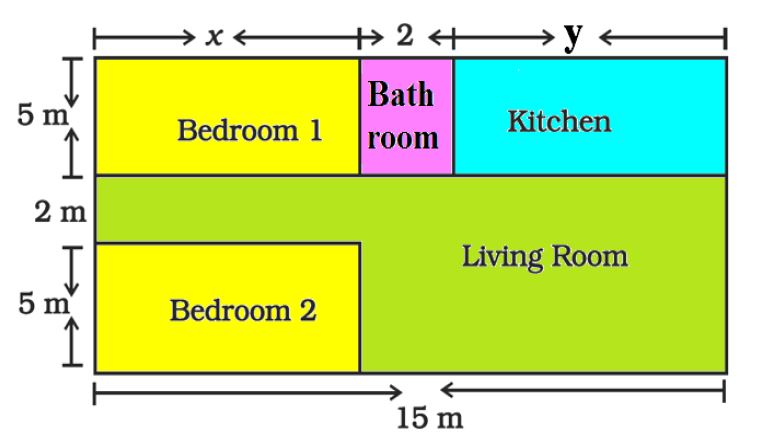
(i) The area of two bedrooms and kitchen are respectively equal to
| (a) 5x, 5y | (b) 10x, 5y |
| (c) 5x, 10y | (c) x, y |
(ii) Find the length of the outer boundary of the layout.
| (a) 27 m | (b) 15 m | (c) 50 m | (d) 54 m |
(iii) The pair of linear equation in two variables formed from the statements are
(a) x + y = 13, x + y = 9
(b) 2x + y = 13, x + y = 9
(c) x + y = 13, 2x + y = 9
(d) None of the above
(iv) Which is the solution satisfying both the equations formed in (iii)?
| (a) x = 7, y = 6 | (b) x = 8, y = 5 |
| (c) x = 6, y = 7 | (d) x = 5, y = 8 |
(v) Find the area of each bedroom.
| (a) 30 sq. m | (b) 35 sq. m |
| (c) 65 sq. m | (d) 42 sq. m |
1.
(i) E,F,G,H,M,N
(ii) \(\overline{EG}\),\(\overline{FH}\),\(\overline{EF}\),\(\overline{GH}\),\(\overline{MN}\)
(iii) M,E,G,B
(iv) \(\overleftrightarrow { AB } ,\overleftrightarrow { CD } ,\overleftrightarrow { PQ } ,\overleftrightarrow { RS } \)
2.
Some of Euclid's axioms are
(i) Things which are equal to the same things, are equal to one another.
(ii) If equals are added to equals, then wholes are equal.
(iii) Things which are double of the same things, are equal to one another.
Thus, given three axioms are Euclid's axioms. So, here we cannot deduce any statement from these axioms which contradicts any axiom. So, given system of axioms is consistent.
3.
We have
AB = BC
\(\Rightarrow \) AB - BX = BC - BX
|If equals are subtracted from equals, the remainders are equal (Euclid's Axiom (iii))
AB - BX = BC - BY \(|\)\( \because\) BX = BY
AB - BX coincides with AX;
BC - BY coincides with CY
[Things which coincide with one another are equal to one another (Euclid's Axiom (iv))]
4.
According to the question, the linear
equation for the given problem is
=> y = 500 + 20x ... (1)
Table of solution
| x | 0 | 5 |
|---|---|---|
| y | 500 | 600 |
We plot the points (0, 500) and (5, 600) on a graph paper and join the same by a ruler to get the line which is the graph of the equation (1).
5.
Let the present ages of father and son be x years and y year respectively.
Then, Age of father 5 years ago =(x-5)years
Age of his son 5 years ago(y-5) years
According to the question,
x-5=7(y-5)+2
x-y=7y-35+2
x-7y+28=0
which is the required linear equation in two variables.
6.
(i) x = –5 can be written as 1.x + 0.y = –5, or 1.x + 0.y + 5 = 0.
(ii) y = 2 can be written as 0.x + 1.y = 2, or 0.x + 1.y – 2 = 0.
(iii) 2x = 3 can be written as 2x + 0.y – 3 = 0.
(iv) 5y = 2 can be written as 0.x + 5y – 2 = 0.
7.
Given, ㄥ2 = ㄥ1 and ㄥ3 = ㄥ4 ......(i)
Now, ㄥ2 = ㄥ1
ㄥ2 + ㄥ3 = ㄥ1 + ㄥ3 [if equals are added to equals, then the wholes are equal ]
⇒ ㄥ2 + ㄥ3 = ㄥ2 + ㄥ3 [from Eq. (i)]
⇒ ㄥ2 + ㄥ3 + 30° = ㄥ2 + ㄥ3 + 30° [if equals are added to equals, then the wholes are equal]
⇒ ㄥ2 + ㄥ3 + 30° =ㄥ2 +ㄥ3 + θ ⇒ 30° = θ
[since, if equals are subtracted from equals, then the remainders are equal]
ஃ θ = 30°
8.
In the given figure, AC coincides with AB + BC.
Also, Euclid's axiom 4 says that things which coincide with one another, are equal to one another. So, it can be deduced that
AB + BC = AC
9.
(i)1
(ii)11
10.
2x+0y-3=0
11.
(d)
fifth postulate
12.
(a)
only one line can be pass through a single point.
13.
(a)
equal to one another
14.
(a)
an axiom
15.
(a)
squares and circles
16.
O(0,0) satisfies y=x
17.
(d)
infinitely many solutions
18.
x+y+0=0
19.
2x+0y-5=0
20.
(d)
the Cartesian plane
21.
Given equation is x + y = 4.
To draw the graph, we need at least two solutions of the equation.
Given equation can be written as y = 4 - x.
When x = 0, then y = 4
When x = 4, then y = 4 - 4 = 0
Thus, we have the following table
So, plot the points A(0,4) and B(4,0) on thegraph paper and join them by a line.

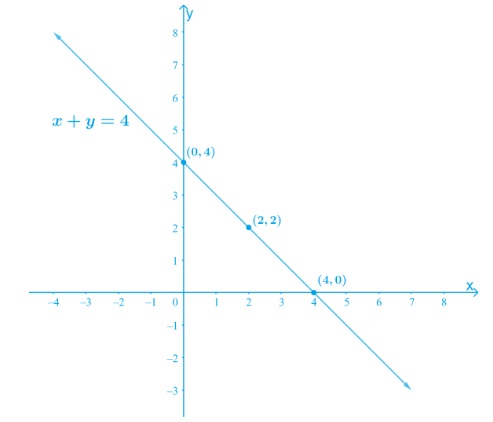
Hence, line AB represents the required graph of given linear equation.
| x | 0 | 0 |
| y | 4 | 0 |
| Points(x,y) | A(0,4) | B(4,0) |
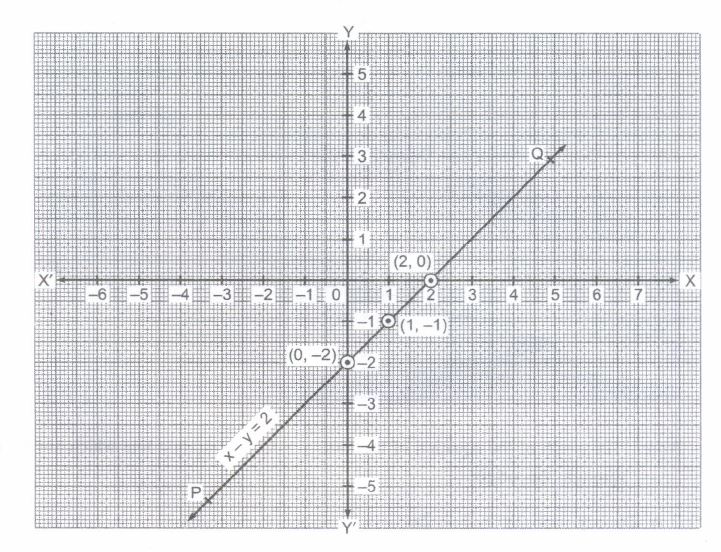
(ii) x - y = 2
⇒ y = x-2
If we have x = 0, then y = 0 -2 = -2
x = 1, then y = 1 - 2 = - 1
x = 2, then y = 2 - 2 = 0
∴ We have the following table:
| x | 0 | 1 | 2 |
| y | -2 | -1 | 0 |
Plot the ordered pairs (0, -2), (1, -1) and (2, 0) on the graph paper. Joining these points, we get a straight line PQ as shown below:
Thus, the line PQ is required graph of x - y = 2.
(iii) y = 3x
If x = 0, then y = 3(0) ⇒ y = 0
x = 1, then y = 3(1) ⇒ y = 3
x = -1, then y = 3(-1) ⇒ y = -3
We get the following table:
| x | 0 | 1 | -1 |
| y | 0 | 3 | -3 |
Plot the ordered pairs (0, 0), (1, 3) and (-1, -3) on the graph paper. Joining these points, we get the straight line LM.
Thus, LM is the required graph of y = 3x.
.JPG)
Note: The graph of the equation of the form y = kx is a straight line which always passes through the origin.
(iv) 3 = 2x + y ⇒ y = 3 - 2x
∴ If x = 0, then y = 3 - 2(0) ⇒ y = 3
If x = 1, then y = 3 - 2(1) ⇒ y = 1
If x = 2, then y = 3 - (2) ⇒ y = -1
| x | 0 | 1 | 2 |
| y | 3 | 1 | -1 |
Plot the ordered pairs (0, 3), (1, 1) and (2, -1) on the graph paper. Joining these points, we get a line CD.
.JPG)
Thus, the line CD is the required graph of 3 = 2x + y
22.
Since, the point (3, 4) lies on the graph, then it will satisfy its equation.
On putting x = 3 and y = 4 in given equation, we get
3(4)=a(3)+7
\(\Rightarrow 13+3a+7\)
\(\Rightarrow 12-7=3a\)
\(\Rightarrow 3a=5\)
\(\Rightarrow a=\frac{5}{3}\)
23.
Two distinct intersecting lines cannot be parallel to the same line.
24.
Given, AC = BD ...(i)
From figure, it is clear that
AC = AB + BC and BD = BC + CD.
On putting these values in Eq. (i), we get
AB + BC = BC + CD
On subtracting BC from both sides, we get
AB + BC - BC = BC + CD - BC
⇒ AB = CD [by axiom 3]
Hence proved
25.
(a) (iii) x + y = 7
(b) (iv) 2
x + y = 7 ⇒ 5 + y = 7
⇒ y = 7 - 5 = 2
(c) (i) (3, 4)
(d) (iv) (0, 7)
(e) (iii) -1
On putting x = 2 and y = -1 in the equation x + 3y - k = 0, we have
2 + 3(-1) - k = 0
⇒ 2 - 3 = k
⇒ k = -1
26.
(a) (iii) 2x + 3y = 60
Let the number of children be x and the number of adults be y then the linear equation in two variable for the given situation is
2x + 3y = 60.
(b) (i) 10
2x + 3y =60 ⇒ 2(15) + 3y = 60
⇒ 3y = 60 - 30 = 30
⇒ y = 10
(c) (i) 12
2x + 3y = 60 ⇒ 2x + 3(12) = 60
⇒ 2x 60 - 36 = 24
⇒ x = 12
(d) (iii) 15
On putting x = 5 and y = 0 in the equation 3x + 5y = b, we have
3 x 5 + 5 x 0 = b
⇒ 15 + 0 = b
⇒ b = 15
(e) (ii) 1.x - 1.y + 5 = 0
y - x = 5 ⇒ y = x + 5
⇒ x - y + 5 = 0
⇒ 1.x - 1.y + 5 = 0
27.
(i) (d) 5x + 2y = 120
Here, the cost of one notebook be Rs. x and that of pen be Rs. y.
According to the statement, we have 5x + 2y = 120
(ii) (b) x = 20, y = 10
5x + 2y = 5(10) + 2(20) = 50 + 40 = 90 ≠ 120
5x + 2y = 5(20) + 2(10) = 100 + 20 = 120
5x + 2y = 5(15) + 2(15) = 75 + 30 = 105 ≠ 120
(c) (ii) Rs. 95
5x + 2y = 5(15) + 2(10) = 75 + 20 = 95
(d) (b) Rs. 10
Here, x = 2y
5(2y) + 2y
= 10y + 2y = 12y = 120
⇒ y = 10
(e) (iv) 0.x + 1.y – 4 = 0
Since, y = 4 ⇒ y – 4 = 0
Thus, standard form of y = 4 is 0.x + 1.y – 4 = 0
28.
(i) (a) 3x + 2y = 80 and 4x + 3y = 110
Here, the cost of one notebook be Rs. x and that of pen be Rs. y.
According to the statement, we have
3x + 2y = 80 and
4x + 3y = 110
(ii) (b) x = 20, y = 10
3x + 2y = 3(20) + 2(10) = 60 + 20 = 80
4x + 3y = 4(20) + 3(10) = 80 + 30 = 110
(b) x = 20, y = 10
(iii) (b) Rs. 10
Cost of 1 pen = Rs. 10
(b) Rs. 10
(iv) (d) Rs. 420
Total cost = Rs. 15 x 20 + Rs. 12 x 10
= 300 + 120
= Rs. 420
(v) (a) Deepak
Ram said that price of each notebook could be Rs. 25.
Ajay felt that Rs. 2.50 for one pen was too little. It should be at least Rs. 16
Deepak guess the cost of one pen is Rs. 10 and
Lohith guess the cost of one notebook is Rs. 30
Therefore, estimation of Deepak is correct
29.
(i) (b) 10x, 5y
Area of one bedroom = 5x sq.m
Area of two bedrooms = 10x sq.m
Area of kitchen = 5y sq. m
(ii) (d) 54 m
Length of outer boundary = 12 + 15 + 12 + 15 = 54 m
(iii) (d) None of the above
Area of two bedrooms = 10x sq.m
Area of kitchen = 5y sq. m
So, 10x + 5y = 95 2x + y = 19
Also, x + 2 + y = 15 x + y = 13
(iv) (c) x = 6, y = 7
x + y = 6 + 7 = 13
2x + y = 2(6) + 7 = 19
x = 6, y = 7
x + y = 6 + 7 = 13
2x + y = 2(6) + 7 = 19
x = 6, y = 7
(v) (a) 30 sq. m
Area of living room = (15 x 7) – 30
= 105 – 30 =75 sq. m

9th Standard CBSE Syllabus & Materials
9th Standard CBSE
CBSE 9th Mathematics Lines and Angles Sample Question Papers Study Material - QB365 Set A
NEW9th Standard CBSE
CBSE 9th Mathematics Introduction to Euclid's Geometry Sample Question Papers Study Material - QB365 Set A
NEW9th Standard CBSE
CBSE 9th Mathematics Linear Equations in Two Variables Sample Question Papers Study Material - QB365 Set A
NEW9th Standard CBSE
CBSE 9th Mathematics Coordinate Geometry Sample Question Papers Study Material - QB365 Set A



NCERT Books

Syllabus

Exam Pattern

Sample Question Papers

Previous year Question Papers

Important Notes

MCQ Practice test

NCERT Exemplers

Case study Questions

Image Based Questions

Passage based Questions

HOT Questions

Value Based Questions

Model Questions Papers
NCERT ( Book Back ) Questions

Assertion and Reason
Important Questions And Answers

CBSE 9th Standard CBSE Subjects
CBSE Standards