100% FREE ACCESS
9th Standard CBSE Syllabus & Materials
9th Standard CBSE
CBSE 9th Science Is matter around us pure? - New Model Questions Papers Study Material - QB365 Set A
NEW9th Standard CBSE
CBSE 9th Science Matter in our surroundings - New Model Questions Papers Study Material - QB365 Set A
NEW9th Standard CBSE
CBSE 9th Mathematics Heron's Formula Sample Question Papers Study Material - QB365 Set A
NEW9th Standard CBSE
CBSE 9th Mathematics Circles Sample Question Papers Study Material - QB365 Set A
NEW9th Standard CBSE
CBSE 9th Mathematics Quadrilaterals Sample Question Papers Study Material - QB365 Set A
NEW9th Standard CBSE
CBSE 9th Mathematics Triangles Sample Question Papers Study Material - QB365 Set A

Published on: 29/10/2025
Download CBSE Class 9th Standard CBSE Mathematics question papers, sample papers, important questions, and previous year solved papers in PDF format. Get free study materials, NCERT solutions, and exam preparation resources for Class 9th Standard CBSE Mathematics
Questions + Answers key
Take MCQ Mathematics Test
1.
The area of the four walls of a room is 300 m2. Its length and height are 15 m and 6 m respectively. Find its breadth.
10 m
5 m
20 m
15 m
2.
The side of an equilateral triangle is 6 cm.The area of the triangle is
\(6\sqrt { 3 } \) cm2
\(9\sqrt { 3 } \) cm2
\(16\sqrt { 3 } \) cm2
\(3\sqrt { 3 } \) cm2
3.
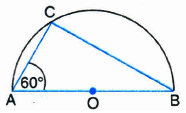
In the figure, AOB is a diameter of the semicircle. If \(\angle A=60°\) , then \(\angle B\) is equal
60°
30°
50°
40°
4.
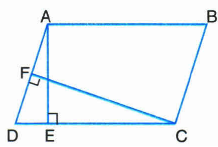
In the following figure, ABCD is a parallelogram, \(AE\bot DC\) and \(CF\bot AD\). If AB = 16 cm, AB = 8 cm and CF = 10 cm, then AD =
16 cm
12.8 cm
8 cm
10 cm
5.
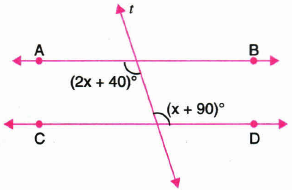
In figure AB || CD and t is a transversal the value of x is equal to:
\(50^{ 0 }\)
\(70^{ 0 }\)
\(35^{ 0 }\)
\(20^{ 0 }\)
6.
In figure, the value of an angle q is
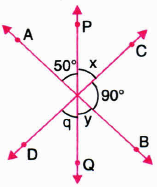
\(60^{ 0 }\)
\(90^{ 0 }\)
\(50^{ 0 }\)
\(40^{ 0 }\)
7.
Where does the line -2x+y-7=0 intersect y-axis?
at (0,7)
at(7,0)
at(7,7)
at(-7,-7)
8.
If (x+2,4)=(5,y-2), then the coordinates (x,y) are:
(7,12)
(6,3)
(3,6)
(2,1)
9.
For what value of b, is the polynomial \(x^3-3x^2+bx-6\) divisible by x-3?
1
2
3
-3
10.
Degree of polynomial \((x^3+5)(4-x^5)\) is:
0
5
3
2
11.
The value of \(\sqrt [ 4 ]{ { \left( 64 \right) }^{ -2 } } \) is
1/8
1/2
8
1/64
12.
\(\sqrt { 12 } \times \sqrt { 18 } \) is equal to:
\(2\sqrt { 6 } \)
\(3\sqrt { 6 } \)
\(4\sqrt { 6 } \)
\(6\sqrt { 6 } \)
13.
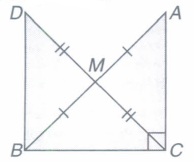
In right triangle ABC, right angled at C, M is the mid-point of hypotenuse AB. C is joined to M and produced to a point D such that DM = CM. Point D is joined to point B. Show that:
(i) \(\triangle AMC\cong \triangle BMD\)
(ii) \(\triangle\)DBC is a right angle
14.
Find a and b, if \(\frac { 2\sqrt { 5 } +\sqrt { 3 } }{ 2\sqrt { 5 } -\sqrt { 3 } } +\frac { 2\sqrt { 5 } -\sqrt { 3 } }{ 2\sqrt { 5 } +\sqrt { 3 } } =a+\sqrt { 15 } b\)
15.
Find the value of p is mean of following distribution is 20.
|
x |
f |
|---|---|
| 15 | 2 |
| 17 | 3 |
| 19 | 4 |
| 20 + p | 5p |
| 23 | 6 |
16.
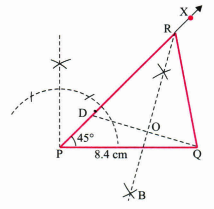
(i) Construct a triangle PQR with base PQ = 8.4 cm, LP = 45° and PR - QR = 2.8 cm.
(ii) Measure PR.
(iii) Measure QR.
(iv) Verify that PR - QR = 2.8 cm.
(v) Gaffar says that L PQR = 85°. Is he correct? Which value is depicted by his statement?
17.
Parallelograms on the same base and between same parallels are equal in area. Prove this.
18.
Let \(R_1\) and \(R_2\)are the remainders when the polynomials \({ x }^{ 3 }+2{ x }^{ 2 }-5ax-7\) and \({ x }^{ 3 }+2{ x }^{ 2 }-5ax-7\) are divided by (x+1) and (x-2) respectively. If 2\(R_1\)+\(R_2\)=6, Find the value of a.
19.
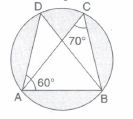
In the adjoining figure if ㄥDAB=60o and ㄥACB=70o, find the measure of ㄥDBA
20.
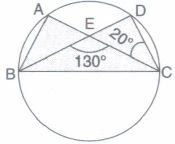
In the given figure, A, B, C and D are four points on a circle. AC and BD intersect at E such that \(\angle\) BEC = 130° and \(\angle\)ECD = 20°. Find \(\angle\)BAC
21.
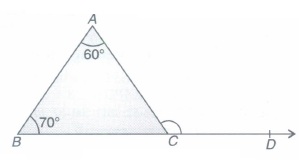
In the given figure, if \(\angle A=60^o\) and \(\angle B=70^o\), then find \(\angle ACD\)
22.
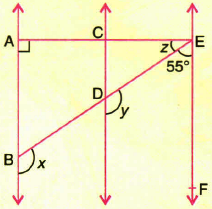
In the figure AB || CD and CD || EF Also \(EA\bot AB\) if \(\angle BEF=55^{ 0 }\) find the values of x,y and z
23.
(i) In figure ,AO \(\bot \)OB Find \(\angle \)AOC and \(\angle \) BOC
.png)
(ii) In figure,\(\angle \) AOB ;\(\angle \)BOC=2:3
If \(\angle \)AOC=\(75^{ 0 }\) then find the measure of ,\(\angle \) AOB ;\(\angle \)BOC
.png)
24.
The polynomials \(kx^3+3x^2-8 \) and \(3x^3-5x+8\) are divided by x+2. If the remainder in each case is the same, find the value of k.
25.
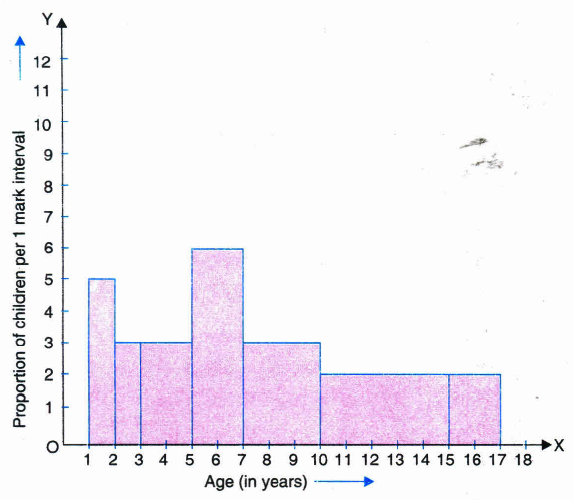
A random survey of the number of children of various age groups playing in a park was found as follows:
| Age (in years) | Number of children |
| 1-2 | 5 |
| 2-3 | 3 |
| 3-5 | 6 |
| 5-7 | 12 |
| 7-10 | 9 |
| 10-15 | 10 |
| 15-17 | 4 |
Draw a histogram to represent the data above.
26.
The diameter of the moon is approximately one fourth of the diameter of the earth. Find the ratio of their surface area.
27.
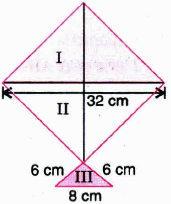
A kite in the shape of a square with a diagonal 32 cm and an isosceles triangle of base 8 cm and side 6cm each is to be made of three different shades as shown in figure. How much paper of each shade has been used in it?
28.
A circular park of radius 20 m is situated in a colony. Three boys Ankur, Syed and David are sitting at equal distance on its boundary each having a toy telephone in his hands to talk each other. Find the length of the string of each phone.
29.
The Auto fare in a city is as follows:
For the first kilometer the fare is Rs.5 and for the successive distance it is Rs.1 per kilometer.Taking a distance covered as x kilometer and total fare as Rs.y, write a linear equation for the above said data and draw its graph
30.
Plot the points A(0,3), B(5,3), C(4,0) and D(-1,0) on the graph paper.Identify the figure ABCD and find whether the point (2,2) lies inside the figure or not?
31.
A die is thrown, what will be the probability of getting an even number?
32.
When a coin tossed, the probability of getting a head is?
33.
The radii of two right circular cylinders are in the ratio 2:3 and their heights are in the ratio 5:4, then the ratio of their volumes will be _______________
34.
For the given data: 11,15, 17, y+1, 19, y-2, 3; if the mean is 14, find the value of y.
35.
Compute the curved surface area of a hemishpere whose diameter is 14 cm.
36.
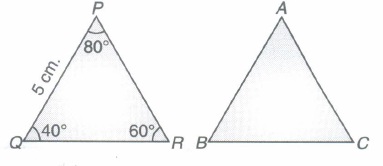
\(\triangle PQR\cong \triangle ABC\), if PQ = 5 cm, \(\angle\)Q = 40° and \(\angle\)P = 80°, calculate the value of \(\angle\)C.
37.
Factorize: 8y3-125x3.
1.
Number of cubes = \(\frac { { \left( 20 \right) }^{ 3 } }{ { \left( 5 \right) }^{ 3 } } =64\)
2.
\(\frac { \sqrt { 3 } }{ 4 } { (6) }^{ 2 }=9\sqrt { 3 }\) cm2.
3.
\(\angle ACB=90°\)
4.
(b)
12.8 cm
5.
\(2x+40^{ 0 }=x+90^{ 0 }\)
6.
\(x+50^{ 0 }\)
\(y+90^{ 0 }+x=180^{ 0 }\quad 50^{ 0 }+90^{ 0 }+x=180^{ 0 }\)
\(\Rightarrow x=40^{ 0 }\)
\(q=x=40^{ 0 }\)
7.
Put x=0 -2(0)+y-7=0 ⇒ y=7
8.
(c)
(3,6)
9.
\(f(x)=x^3+3x^2+bx-6\)
\(f(3)=0\)
\(\Rightarrow \ 3^3-3 \times3^2+b\times 3-6=0\)
\(\Rightarrow\ b=2\)
10.
Highest power of x=3+2=5
11.
(a)
1/8
12.
(c)
\(4\sqrt { 6 } \)
13.
(i) In \(\triangle\) s AMC and \(\triangle\)BMD, we have
AM = BM
(\(\because\) M is the mid-point of AB)
\(\angle\) AMC = \(\angle\)BMD
(Vertically opp. angles)
and CM = MD (Given)
\(\therefore\) By SAS criterion of congruence, we have
\(\therefore \ \triangle AMC\cong \triangle BMD\)
(ii) Now, \(\triangle AMC\cong \triangle BMD\)
\(\therefore\) BD = CA and \(\angle\)BDM = \(\angle\)ACM
(\(\therefore\)Corresponding parts of congruent triangles are equal)
Thus, transversal CD intersects CA and BD at C and D respectively such that the alternate angle \(\angle\)BDM and \(\angle\)ACM are equal. Therefore BD II CA.
\(\therefore\) \(\angle\)CBD + \(\angle\)BCA = 1800
(\(\therefore\) Sum of the interior angles on the same side of transversal = 180°)
\(\angle\)CBD + 90° = 180°
\(\Rightarrow\) DBC=90°.
14.
\(LHS=\frac { { \left( 2\sqrt { 5 } +\sqrt { 3 } \right) }^{ 2 }+{ \left( 2\sqrt { 5 } -\sqrt { 3 } \right) }^{ 2 } }{ \left( 2\sqrt { 5 } -\sqrt { 3 } \right) \left( 2\sqrt { 5 } +\sqrt { 3 } \right) } \)
\(=\frac { 4\times 5+3+2\times 2\sqrt { 5 } \times \sqrt { 3 } +4\times 5+3-2\times 2\sqrt { 5 } \times \sqrt { 3 } }{ { \left( 2\sqrt { 5 } \right) }^{ 2 }-{ \left( \sqrt { 3 } \right) }^{ 2 } } \)
\(=\frac { 20+3+4\sqrt { 15 } +20+3-4\sqrt { 15 } }{ 20-3 } \)
\(=\frac { 46 }{ 17 } =\frac { 46 }{ 17 } +\sqrt { 15 } \times \left( 0 \right) \)
\(\therefore \frac { 46 }{ 17 } +\sqrt { 15 } \times \left( 0 \right) =a\sqrt { 15 } b=RHS\)
Comparing both sides, we get
a=\(\frac{46}{17}\) , b = 0
15.
|
x |
f |
fx |
|---|---|---|
| 15 | 2 | 30 |
| 17 | 3 | 51 |
| 19 | 4 | 76 |
| 20 + p | 5p | 5p(20 + p) |
| 23 | 6 | 138 |
| Total | 5p + 15 | 295 + 100p+5p2 |
Mean \(= \frac {\sum fx}{\sum f}\)
\(\Rightarrow\) \(2= \frac {295 + 100p + 5p^2}{5p+15}\)
\(\Rightarrow\) 20(5p+15) = 295 +100p +5p2
\(\Rightarrow\) 100p + 300 = 295 + 100p + 5p2
\(\Rightarrow\) 5p2 = 5
\(\Rightarrow\) p2 = 1
\(\Rightarrow\) p = 1
16.
(i) Steps of Construction
1. Draw the base PQ = 8.4 cm.
2. At point P make an angle say XPQ=45°.
3. Cut the line segment PD = 2.8 ern from rayPX.
4. Join DQ and draw the perpendicular bisector of DQ.
5. Let it intersect PX at a point R. Join RQ. Then PQR is the required triangle.
(ii) By measurement, PR = 10cm
(iii) By measurement, QR = 7.2cm
(iv) PR - QR = 10-7.2 = 2.8 cm
(v) By measurement,
ㄥPQR = 54°
∴ Gaffar is correct.
∴ The value 'intelligence' is depicted by his statement.
17.
Given: Two parallelograms ABCD and EFCD, on the same base DC and between the same parallels AF and DC.
To Prove: ar(ABCD) = ar(EFCD)
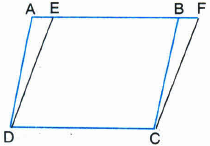
In \(\Delta ADE\) and \(\Delta BCF\)
\(\angle DAE=\angle CBF\quad \quad ...(1)\)
Corresponding angles
(AD || BC and a transversal AF intersects them)
\(\angle AED=\angle BFC\quad \quad ...(2)\)
| Corresponding angles
(ED || FC and a transversal AF intersects them)
\(\angle ADE=\angle BCF\quad \quad ...(2)\)
Angle sum property of a triangle
Also AD+BC
| Opposite sides of the parallelogram ABCD
\(\Delta ADE\cong \Delta BCF\)
| By ASA congruence rule, using (1),(3) and (4)
\(ar(\Delta ADE)=ar(\Delta BCF)\)
|Congruent figures have equal areas
\(\Rightarrow \ ar(\Delta ADE)+ar(EDCB)\)
\(\\ =ar(\Delta BCF)+ar(EDCB)\)
|Adding ar(EDCB) to both sides
\(\Rightarrow \ ar(ABCD)=ar(EDCB)\)
So, parallelograms ABCD and EFCD are eual in area.
18.
Let \(f(x)={ x }^{ 3 }+2{ x }^{ 2 }-5ax-7\)
and \(g(x)={ x }^{ 3 }-a{ x }^{ 2 }-12x+6\)
By remainder theorem,
\(f(-1)={ R }_{ 1 }\ \ \ \ ........(1)\)
\(x+1=0\Rightarrow x=-1\)
\(\Rightarrow { (-1) }^{ 3 }+2{ (-1) }^{ 2 }-5a(-1)-7={ R }_{ 1 }\)
\(\Rightarrow \ -1+2+5a-7={ R }_{ 1 }\)
\(\Rightarrow { R }_{ 1 }=a-6 \ \ ................(2)\)
and \(g(2)={ R }_{ 2 }\ \ ...........(3)\)
\(x-2=0\Rightarrow x=2\)
\(\Rightarrow { (2) }^{ 3 }+a{ (2) }^{ 2 }-12(2)+6={ R }_{ 2 }\)
\(\Rightarrow 8+4a-24+6={ R }_{ 2 }\)
\(\Rightarrow { R }_{ 2 }=4a-10\ \ \ .....(4)\)
According to the question,
\(2{ R }_{ 1 }+{ R }_{ 2 }=6\)
\(\Rightarrow 2(5a-6)+(4a-10)=6\)
\(\Rightarrow -12+4a-10=6\)
\(\Rightarrow 14a=28\)
\(\Rightarrow a=2\)
19.
ㄥACB= 70o
ㄥADB=ㄥACB
⇒ ㄥADB=70o (Angles in the same segment of a circle)
In AB,
ㄥDAB+ㄥADB+ㄥDBA=180o (Angle sum property of triangles)
⇒ 60o+70o+ㄥDBA=180o
⇒ㄥDBA=50o
20.
In \(\Delta\)EDC, \(\angle\)EDC + \(\angle\)ECD = \(\angle\)BEC (exterior angle of a \(\Delta\) is equal to the sum of two opposite angles)
\(\Rightarrow\) \(\angle\)EDC + 20° = 130°
\(\Rightarrow\) \(\angle\)EDC = 110° or \(\angle\)BDC =110°
\(\angle\)BAC = \(\angle\)BDC = 110°. (Angle in the same segment)
21.
\(\angle ACD=\angle A+\angle B\) [Exterior angle is the sum of the two interior opposite angles]
=60+70
\(\angle ACD=130^o\)
22.
Given AB||CD, CD||EF, \(EA\bot AB\)
\(\angle BEF=55^o\)
y = 180o- 55o = 125o(Co-interior angles)
x = y = 125o(Corresponding angles)
\(EA\bot AB\)
\(EA\bot AB\)
Z + 55o = 90o
Z = 90o - 55o
= 35o
23.
Let \(\angle AOB=2x\) and \(\angle BOC=3x\)
\(\angle AOB+\angle BOC=\angle AOC\)
2x+3x=75o
\(\Rightarrow x=\frac{75^o}{5}=15^o\)
\(\angle AOB=2x=30^o\) and \(\angle BOC=3x=45^o\)
24.
\(\frac{5}{4}\)
25.
Modified Table
[Minimum class-size = 1]
| Age (in years) | Number of children (frequency) | Width of the class | Length of the rectangle |
| 1-2 | 5 | 1 | \(\frac {5}{1}\times 1 = 5\) |
| 2-3 | 3 | 1 | \(\frac {3}{1}\times 1 = 3\) |
| 3-5 | 6 | 2 | \(\frac {6}{2}\times 1 = 3\) |
| Age (in years) | Number of children (frequency) | Width of the class | Length of the rectangle |
| 5-7 | 12 | 2 | \(\frac {12}{2}\times 1 = 6\) |
| 7-10 | 9 | 3 | \(\frac {9}{3}\times 1 = 3\) |
| 10-15 | 10 | 5 | \(\frac {10}{5}\times 1 = 2\) |
| 15-17 | 4 | 2 | \(\frac {4}{2}\times 1 = 2\) |
26.
Let the diameter of the earth be 2r.
Then diameter of the moon \(=\frac { 1 }{ 4 } \left( 2r \right) =\frac { r }{ 2 } \)
\(\therefore\) Radius of the earth = \(\frac { 2r }{ 2 } =r\)
and, Radius of the moon \(=\frac { 1 }{ 2 } \left( \frac { r }{ 2 } \right) =\frac { r }{ 4 } \)
\(\therefore\) Surface area of the earth \(=4\pi { r }^{ 2 }\)
and, Surface area of the moon
\(=4\pi { \left( \frac { r }{ 4 } \right) }^{ 2 }=\frac { 1 }{ 4 } \pi { r }^{ 2 }\)
\(\therefore\) Ratio of their surface area
\(=\frac { Surface\ area\ of\ the\ moon }{ Surface\ area\ of\ the\ earth } \)
\(\\ =\frac { \frac { 1 }{ 4 } \pi { r }^{ 2 } }{ 4\pi { r }^{ 2 } } =\frac { 1 }{ 16 } =1:16.\)
27.
Area of paper of shade I \(2\times \left( \frac { 1 }{ 2 } \times 16\times 16 \right) =256\)cm2
Similarly, Area of paper of shade II = 256 cm2
For area of paper of shade III
a = 8 cm, b = 6 cm, c = 6cm
\(\therefore s=\frac { a+b+c }{ 2 } =\frac { 8+6+6 }{ 2 } =10\) cm
\(\therefore \) Area of paper of shade III = \(\sqrt { s(s-a)(s-b)(s-c) } \)
\(=\sqrt { 10(10-8)(10-6)(10-6) } \)
\(=\sqrt { (10)(2)(4)(4) } =8\sqrt { 5 } \)
= 17.89 cm2
28.
Let BD = x m
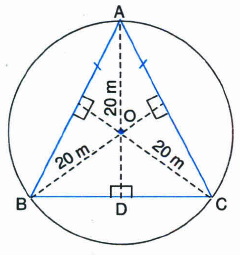
Then in right triangle ODB,
OB2 = OD2 + BD2
By Pythagoras Theorem
⇒ (20)2 = OD2 + x2
⇒ OD2= 400 - x2⇒ OD =\(\sqrt { 400-x^{ 2 } } \)
Again, area of equilateral triangle ABC
= Area of \(\Delta OBC\) + Area of \(\Delta OCA\) + Area of \(\Delta OAB\)
= 3 Area of \(\Delta OBC\)= 3\(\frac { \left( BC \right) \left( OD \right) }{ 2 } \)
\(=3x\sqrt { 400-x^{ 2 } } \) ....(2)
⇒ \(\sqrt { 3 } \sqrt { 400-x^{ 2 } } =x\)
Squaring both sides,
3(400 - x2) = x2
⇒ 1200 - 3x2 = x2
⇒ 4x2 = 1200 ⇒ x2 = 300
⇒ \(x=10\sqrt { 3 } \) ⇒ BD=\(10\sqrt { 3 } \)
⇒ \(2BD=20\sqrt { 3 } \) ⇒ \(BC=20\sqrt { 3 } \)
Hence, the length of string of each phone is \(20\sqrt { 3 } \) m.
29.
y=5+2(x-1) ⇒ y=3+2x
30.
Parallelogram; yes
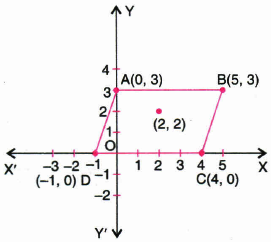
31.
()
Favourable number of outcomes = 3(2,4,6)
Total number of outcomes = 6
Required probability\(=\frac{3}{6}=\frac{1}{2}\)
32.
()
When a coin is tossed, total number of outcomes = 2(Head or Tail)
P(getting a head) = \(\frac{1}{2}\)
33.
()
Let radii of cylinders be 2x and 3x and heights be 5y and 3y respectively.
\(\therefore\) Ratio of volumes = \(\frac { \pi { (2x) }^{ 2 }\times 5y }{ \pi { (3x) }^{ 2 }\times 3y } \)
\(=\frac { { 4x }^{ 2 }\times 5 }{ { 9x }^{ 2 }\times 3 } \)
= 20:27.
34.
()
\(14=\frac{11+15+17+y+1+19+y-2+3}{7}\)
⇒ 98 = 64+2y
⇒ 2y = 34
⇒ y = 17
35.
()
Given diameter of hemisphere = 14 cm
\(\therefore\) radius = 7 cm
\(\therefore\) Curved surface area = 2\(\pi\)r2
\(=2\times \frac { 22 }{ 7 } \times 7\times 7\)
= 308 cm2
36.
()
\(\angle\)R= 180° - 80° - 40° = 60°
\(\triangle PQR\cong \triangle ABC\)
\(\therefore\) \(\angle\)R = \(\angle\)C = 60°
37.
()
8y3-125x3=(2y)3-(5x)3
=(2y - 5x)(4y2+10xy+25x2)

9th Standard CBSE Syllabus & Materials
9th Standard CBSE
CBSE 9th Mathematics Lines and Angles Sample Question Papers Study Material - QB365 Set A
NEW9th Standard CBSE
CBSE 9th Mathematics Introduction to Euclid's Geometry Sample Question Papers Study Material - QB365 Set A
NEW9th Standard CBSE
CBSE 9th Mathematics Linear Equations in Two Variables Sample Question Papers Study Material - QB365 Set A
NEW9th Standard CBSE
CBSE 9th Mathematics Coordinate Geometry Sample Question Papers Study Material - QB365 Set A



NCERT Books

Syllabus

Exam Pattern

Sample Question Papers

Previous year Question Papers

Important Notes

MCQ Practice test

NCERT Exemplers

Case study Questions

Image Based Questions

Passage based Questions

HOT Questions

Value Based Questions

Model Questions Papers
NCERT ( Book Back ) Questions

Assertion and Reason
Important Questions And Answers

CBSE 9th Standard CBSE Subjects
CBSE Standards