100% FREE ACCESS
9th Standard CBSE Syllabus & Materials
9th Standard CBSE
CBSE 9th Science Is matter around us pure? - New Model Questions Papers Study Material - QB365 Set A
NEW9th Standard CBSE
CBSE 9th Science Matter in our surroundings - New Model Questions Papers Study Material - QB365 Set A
NEW9th Standard CBSE
CBSE 9th Mathematics Heron's Formula Sample Question Papers Study Material - QB365 Set A
NEW9th Standard CBSE
CBSE 9th Mathematics Circles Sample Question Papers Study Material - QB365 Set A
NEW9th Standard CBSE
CBSE 9th Mathematics Quadrilaterals Sample Question Papers Study Material - QB365 Set A
NEW9th Standard CBSE
CBSE 9th Mathematics Triangles Sample Question Papers Study Material - QB365 Set A

Published on: 29/10/2025
Download CBSE Class 9th Standard CBSE Mathematics question papers, sample papers, important questions, and previous year solved papers in PDF format. Get free study materials, NCERT solutions, and exam preparation resources for Class 9th Standard CBSE Mathematics
Questions + Answers key
Take MCQ Mathematics Test
1.
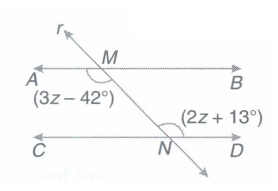
In the figure, AB||CD, find the value if z, \(\angle DNM\) and \(\angle CNM.\)
2.
A die is thrown. Find the probability of getting an odd number.
3.
Factorise \(6x^2+17x+5\) by splitting the middle term and by using the Factor Theorem.
4.
Simplify: 73.93
5.
Sum of probabilities of all events of a trial is:
less than 1
greater than 1
lies between 0 and 1
1
6.
If \(\overset{-}{x}\) is the mean of x1,x2,x,3,....,xn, then, the mean of mx1,mx2,mx3, ...., mxn is
\(\sum _{ i=1 }^{ n }{ m{ x }_{ i }D } \)
\(\sum _{ i=1 }^{ m }{ m{ x }_{ i } } \)
\(m\overset { - }{ x } \)
\(\frac { m }{ n } \overset { - }{ x } .\)
7.
The class mark of the class interval 90 - 120 is:
90
105
115
120
8.
The number of edges of a cube are
6
8
12
16.
9.
The area of \(\triangle \)ABC in which AB = BC = 4 cm and \(\angle B=90°\) is
16 cm2
8 cm2
4 cm2
12 cm2
10.
Area of a triangle =
\(\frac { 1 }{ 2 } \times\) Base \( \times\) Height
Base \( \times\) Height
\(\frac { 1 }{ 3} \times\) Base \( \times\) Height
\(\frac { 1 }{ 4 } \times\) Base \( \times\) Height
11.
In a semi-circle, \(\Delta PQR\) is formed on diameter PQ. If \(\angle RPQ=\angle RQP\), \(\angle PQR\) has measure
30°
45°
60°
75°
12.
In figure, if AD is a median of \(\Delta\)ABC, then

\(ar(\Delta ABD)=ar(\Delta ADC)\)
\(ar(\Delta ABD)>ar(\Delta ADC)\)
\(ar(\Delta ABD)
\(ar(\Delta ABD)=\frac { 1 }{ 3 } ar(\Delta ABC)\)
13.
If one angle of a parallelogram is 900 and all sides are equal, then it is called a
rectangle
square
rhombus
kite
14.
The measure of each angle of an equilateral triangle is
300
450
600
900
15.
An angle which measures between \(0^{ 0 }\) and \(90^{ 0 }\) is called
a straight angle
an acute angle
a right angle
an obtuse angle
16.
Euclid stated that things which are equal to the same thing are equal to one another in the form of:
an axiom
a definition
a postulate
a proof
17.
The pair satisfying 2x+y=6 is
(1,2)
(2,1)
(2,2)
(1,1)
18.
which of the following is a linear equation?
x2+4x-3=-(x2-1)
x2=3x+4
x+\(1\over x\)=5
(x-1)=1-x
19.
In fourth quadrant, x is
+ve
-ve
0
None of these
20.
One of the factors of \((1+3y)^2+ (9y^2-1)\) is:
\((1-3y)\)
\((3-y)\)
\((3y+1)\)
\((y-3)\)
21.
The maximum number of terms in a polynomial of degree 10 is:
9
10
11
1
22.
The value of \(\sqrt { \left( { 3 }^{ -2 } \right) } \)
1/9
9
-3
1/3
23.
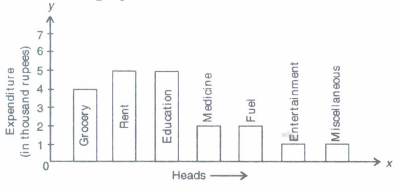
A family with a monthly income of Rs. 20,000 had planned the following expenditure per month under various heads.
| Heads | Expenditure (in thousand rupees) |
| Grocery | 04 |
| Rent | 05 |
| Education | 05 |
| Medicine | 02 |
| Fuel | 02 |
| Entertainment | 01 |
| Miscellaneous | 01 |
Draw a bar graph for the data above
24.
In the figure, AP || BQ || CR. Prove that ar(AQC) = ar(PBR).
25.
Find three rational numbers between \(\frac{5}{7}\) and \(\frac{9}{11}\)
26.
100 surnames were randomly picked up from a local telephone and a frequency distribution of the number of letters in the English alphabet in the surnames was found as follows:
| Number of letters | Number of surnames |
| 1-4 | 6 |
| 4-6 | 30 |
| 6-8 | 44 |
| 8-12 | 16 |
| 12-20 | 4 |
(i) Draw a histogram to depict the given information.
(ii) Write the class interval in which the maximum number of surnames lie.
27.
If the lateral surface of a cylinder is 94.2 cm2 and its height is 5 cm, then find
(i) radius of its base
(ii) its volume.
28.
Find the cost of turfing a triangular field at the rate of Rs.5/m 2 having lengths of its sides as 40 m, 70 m, and 90 m. (Take \(\sqrt { 20 } \) = 4.47).
29.
If the non-parallel sides of a trapezium are equal, prove that it is cyclic.
30.
Write four solutions for each of the following equations:
2x+y=7
31.
Plot the following points, join them and identify the figure thus obtained:
P(-1,0), Q(2,0), R(2,3) and S(-1,5)
32.
See figure and write the following:
(i) The coordinates of B.
(ii) The coordinates of C.
(iii) The point identified by the coordinates (-3,-5)
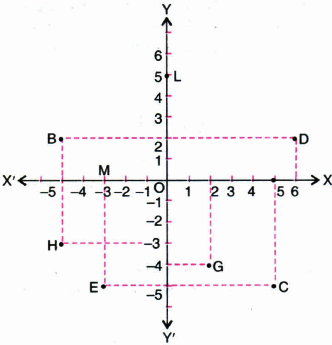
(iv) The point identified by the coordinates (2, - 4).
(v) The abscissa of the point D.
(vi) The ordinate of the point H.
(vii) The coordinates of the point L.
(viii) The coordinates of the point M.
33.
Which of the following expressions are polynomials in one variable and which are not? State reasons for your answer.
\({ x }^{ 10 }+{ y }^{ 3 }+{ t }^{ 50 }\)
34.
Mr. Kakkad's son Cheeku is sufering from a disease for 20 days and is hospitalised. Doctor asks Mr.Kakkad to donate blood in order to fulfill Cheeku's need. A pathologist tests and tells Mr.Kakkad, "Your blood group cannot be given to your son." After this Mr.Kakkad thinks of an idea and uploads a request of blood requirement on Facebook as soon as possible. In a short time, 85 blood of only three of them may be used for Cheeku.
(i) What is the probability that the blood group of a person chosen at random out of the donors cannot be given to Cheeku?
(ii) Which value is depicted by Mr.Kakkad regarding his son?
(iii) Which value (s) is (are) depicted by 85 blood donors?
35.
In class IX of 50 students second language opted by the studnets is as follows:
Sanskrit-14
Japanese- 08
French-12
Urdu-06
Rest of then opted for German.
A student is selected at random. Find the probability that the student.
(a) opts for French
(b) does not opts for Japanese
(c) Either opts for Sanskrit or for German.
36.
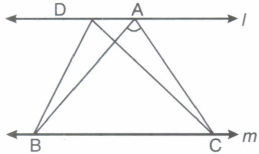
In the given figure, ABC and DBC are triangle on the same base and between the parallel lines l and m. If AB = 3 cm, BC=5 cm, \(\angle \)A=90\(°\), find the area of \(\Delta\)DBC.
37.
In the given figure, PQRST is a pentagon. TX is drawn parallel to SP which meets PQ produced at X. RY drawn parallel to SQ meets PQ produced at Y. Show that ar (PQRST) = ar (ΔSXY).
.png)
38.
Ram is sitting on a chair in a corner of a huge park. His son Ravi is a student of class X. Mr. Ram asks him, "Draw a straight line passing through my feet him, "Draw a straight line passing through my feet and the centre of the park in 2 minutes. Ravi do so.
(i) Find the co-ordinate of the feet of Mr. Ram if the y-coordinate of the feet is -19.5 and the equation of the line x+y=0
(ii) Find the co-ordinate of the feet of mR. Ram if the y-coordinate of the feet is 20.5 and the equation of the line is x=y.
(iii) Which mathematical concept is used in the above problem?
(iv) Which values do you learn from Ravi?
39.
(i) Construct a triangle ABC in which BC = 5 cm, ㄥB = 45°and AB - AC= 2.8cm.
(ii) Measure AB.
(iii) Measure AC
(iv) Verify that AB - AC = 2.8 cm.
(v)Hari comments that ㄥACB = 112°. Is he true? Which value is depicted by comment of Hari?
40.
Prove that the opposite angles of an isosceles trapezium are supplementary.
41.
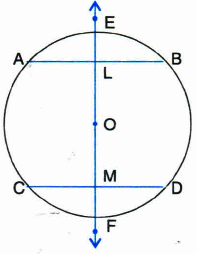
In figure, EF is a line passing through the centre 0 of a circle. If EF bisects chords AB and CD of the circle, prove that AB || CD.
42.
Prove that the medians of an equilateral triangle are equal.
43.
Find the volume of a right circular cone with radius 6 cm and height 7 cm.
44.
Find the mean of first six odd numbers.
45.
What does a theorem require?
46.
Draw the graph representing the equation of x + y = 0.
47.
What is the degree of the polynomial (x3+5) (4-x5)?
48.
State whether the following statements are true or false.Give reason for your answer.
(i) Every whole number is a natural number.
(ii) Zero is neither a negative nor a positive integer.
(iii) There are finitely many rational numbers between any two given rational numbers.
1.
3z-42o=2z+13o (Alternate interior angles)
z=42o+13o
z=55o
\(\angle DNM=2z+13^o=110^o+13^o\)
=123o
\(\angle CNM=180^o-\angle DNM\)(Linear pair)
=180o-123o=57o
2.
\(\frac { 1 }{ 2 } \)
3.
(By splitting method) : If we can find two numbers p and q such that p + q = 17 and pq = 6 x 5 = 30, then we can get the factors.
So, let us look for the pairs of factors of 30. Some are 1 and 30, 2 and 15, 3 and 10, 5 and 6. Of these pairs, 2 and 15 will give us p + q = 17.
So, 6x2 + 17x + 5 = 6x2 + (2 + 15)x + 5
= 6x2 + 2x + 15x + 5
= 2x(3x + 1) + 5(3x + 1)
= (3x + 1) (2x + 5)
4.
633
5.
Required sum of probabilities=1
6.
Mean \(=\frac { { m }x_{ 1 }+{ mx }_{ 2 }+...+{ mx }_{ n } }{ n } \)
\(=m\left( \frac { { x }_{ 1 }+{ x }_{ 2 }+...+{ x }_{ n } }{ n } \right) =m\overset { - }{ x } .\)
7.
Class mark = \(\frac {90+120}{2}=105\)
8.
(c)
12
9.
Area = \(\frac { AB\times BC }{ 2 } =\frac { 4\times 4 }{ 2 } \)= 8 cm2
10.
Formula
11.
\(\angle PQR=90°\)
\(\therefore\angle RPQ+\angle PQR=90°\)
But \(\angle RPQ=\angle PQR\)
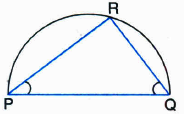
\(\angle PQR=45°\)
12.
A median of a triangle divides it into two triangles of equal areas.
13.
(b)
square
14.
(c)
600
15.
Definition of an acute angle
16.
(a)
an axiom
17.
2(2)+2=6
18.
x-1=1-x ⇒ x=1 so a linear equation
19.
(a)
+ve
20.
\((1+3y)^3+(9y^2-1)\)
\(=(1+3y)^2+(3y+1)(3y-1)\)
\(=(1+3y)(1+3y+3y-1)\)
\(=6(1+3y)y\)
21.
A polynomial of degree n has maximum number of terms as (n+1)
22.
(d)
1/3
23.
24.
Given: BQ||CR
\(\because\) \(\Delta \) BCQ and \(\Delta \)BQR are on the same base BQ and between the same parallel BQ and CR.
\(\therefore\) ar(\(\Delta \)BCQ) = ar (\(\Delta \)BQR) ......(i)
Also, AP||BQ. (Given)
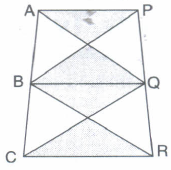
Again, \(\Delta \)ABQ and \(\Delta \)PBQ are on the same base BQ and between the same parallels BQ and AP.
\(\therefore\) ar(\(\Delta \)ABQ) = ar (\(\Delta \)PBQ) .......(ii)
Adding (1) and (2), we get
ar(\(\Delta \)BCQ) + ar(\(\Delta \)ABQ) = ar(\(\Delta \)BQR) + ar(\(\Delta \)PBQ)
ar(\(\Delta \)AQC) = ar(\(\Delta \)PBR).
25.
Since LCM of 7 and 11 is 77,
ஃ \(\frac{5}{7}=\frac{5}{7}=\frac{11}{11}=\frac{55}{77}\)
and \(\frac{5}{7}=\frac{5}{7}=\frac{11}{11}=\frac{55}{77}\)
Hence, three rational numbers between \(\frac{5}{7}\) and \(\frac{9}{11}\) are:
\(\frac{56}{77},\frac{57}{77},\frac{58}{77}\)
26.
Modified Table
[Minumum class-]
| Number of letters | Number of surnames | Width of the class | Length of the rectangle |
| 1-4 | 6 | 3 | \(\frac {6}{3}\times 2 =4\) |
| 4-6 | 30 | 2 | \(\frac {30}{2}\times 2 =30\) |
| 6-8 | 44 | 2 | \(\frac {44}{2}\times 2 =44\) |
| 8-12 | 16 | 4 | \(\frac {16}{4}\times 2 =8\) |
| 12-20 | 4 | 8 | \(\frac {4}{8}\times 2 =1\) |
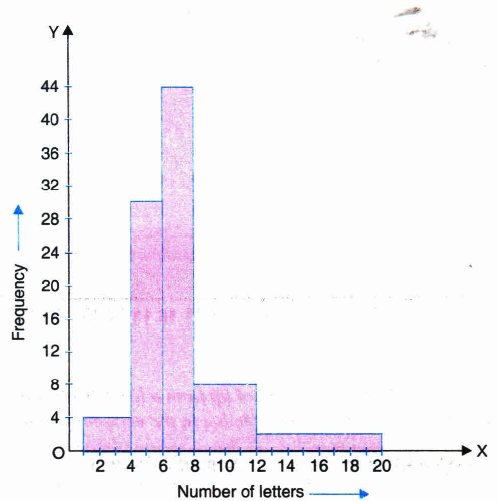
(ii) The class interval in which the maximum number of surname lie is 6-8.
27.
Let the radius of the base of the cylinder be r cm.
= 5 cm
Lateral surface =94.2 cm2
\(\Rightarrow 2\pi rh=94.2\)
\(\Rightarrow 2\times 3.14 \times r\times 5=94.2\)
\(\Rightarrow r=\frac{94.2}{2\times3.14\times5}\)
\(\Rightarrow r=\frac{94.2}{31.4}\)
\(\Rightarrow r=3cm\)
(ii) r = 3cm, h = 5 cm
ஃ Volume of the cylinder =\(\pi r^2h\)
= 3.14 x (3)2 x 5 =141.3 cm3
28.
Rs. 6705
29.
Given: ABCD is a trapezium whose nonparallel sides AD and BC are equal.
To Prove: Trapezium ABCD is cyclic.
Construction: Draw BE 11 AD.
Proof: ∵ AB || DE I Given
and AD || BE I By construction
∴ Quadrilateral ABCD is a parallelogram.
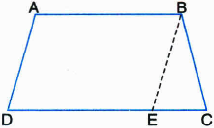
∴ \(\angle BAD=\angle BED\) ....(1)
| Opp.\(\angle \) s of a || gm are equal
and AD = BE ...(2)
Opp. sides of a || gm are equal
But AD = BC ...(3) I Given
From (2) and (3),
BE = BC
∴ \(\angle BEC=\angle BCE\) ....(4)
| Angles opposite to equal sides of a triangle are equal
\(\angle BEC+\angle BED=180°\) | Linear Pair Axiom
⇒ \(\angle BCE+\angle BAD=180°\) I From (4) and (1)
⇒ Trapezium ABCD is cyclic.
I ∵ If the sum of a pair of opposite angles of a quadrilateral is 180°, then the quadrilateral is cyclic
30.
2x+y=7
⇒ y=7-2x
Put x=0, we get y=7-2(0)=7-0=7
Put x=1, we get y=7-2(1)=7-2=5
Put x=2, we get y=7-2(2)=7-4=3
Put x=0, we get y=7-2(3)=7-6=1
Four solutions are (0,7), (1,5), (2,3) and (3, 1)
31.
Trapezium
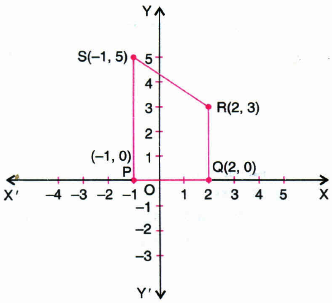
32.
(i) \(B\rightarrow (-5,2)\)
(ii) \(C\rightarrow \left( 5,-5 \right) \)
(iii) E
(iv) G
(v) 6
(vi) -3
(vii) \(L\rightarrow (0,5)\)
(viii) \(M\rightarrow (-3,0)\)
33.
This expression is not a polynomial in one variable because in the expression, three variables (x, y and t) occur.
34.
Total number blood donors = 85
(i) Number of donors whose blood is useful for Cheeku = 3
\(\therefore \) Number of favourable events = 85 - 3 = 82
Now, required probability\(=\frac{82}{85}\)
(ii) Responsible, rationality, love
(iii) Blood donation helps the needy. In fact it is a great act of charity and co-operation.
35.
(a) Probability that a student selected is opts French language = \(\frac{12}{50}=\frac{6}{25}\)
(b) Probability that a student selected does not opt for Japanese = 1-selected student opts Japnese
(c) Probability that selected either opts for Sanskrit or for German = Prob. of student opts Sanskrti+ Prob. of students opts German
\(\therefore \)No of student who opted German
= 5 - (14 + 08 + 12 + 6)
= 50-40
= 10
\(\therefore \)Prob. that selected student either opt for Sanskrit or for German
\(=\frac{14}{50}+\frac{10}{50}\)
\(=\frac{24}{50}=\frac{12}{25}\)
36.
In \(\Delta\)ABC, Ac = \(\sqrt { { BC }^{ 2 }-{ AB }^{ 2 } } \)
\(=\sqrt { { 5 }^{ 2 }-{ 3 }^{ 2 } } =4\quad cm\)
\(ar(\Delta ABC)=\frac { 1 }{ 2 } \times AB\times AC\)
\(=\frac { 1 }{ 2 } \times 3\times 4=6\quad { cm }^{ 2 }\)
ar(\(\Delta\)DBC) = ar(\(\Delta\)ABC) = 6 cm2
(Triangles on the same base and betweeen the same parallels)
37.
ΔPTS and ΔPXS lie on same base and between the same parallels XT and PS
ar (PTS) = ar (PXS) ...(i)
Also, ΔSQR and ΔSQY lie on same base SQ and between the same parallels SQ and RY
ar (SQR) = ar (SQY) ...(ii)
Adding (i) & (ii), we get,
ar (PTS) + ar (SQR) = ar (PXS) + ar (SQY)
.png) ...(iii)
...(iii)
Adding ar (PQS) on both sides of (3), we get
ar (PTS) + ar (PQS) + ar (SQR)
= ar (PXS) + ar (PQS) + ar (SQY)
i.e., ar (PQRST) = ar (SXY)
Hence proved.
38.
(i) According to the questions, the eqiuation of line is
x+y=0..(i)
The line passes through a point whose y-coordinate is -19.5
y=-19.5
Put the value of y in equation (i), we get
x-19.5=0
x=19.5
So the required coordinates are (19.5-19.5)
(ii) According to the question, the equation of line is
x=y...(ii)
The line passes through a point whose x-coordinate is 20.5
x=20.5
Put this value of x in (i), we get
y=20.5
So the required coordinates are(20.5,20.5)
(iii) The coordinates of all the points lying on a line satisfy the equation of the line.
(iv) Obedience and respect for elders or parents.
39.
(i) Steps of Construction
1. Draw the base BC = 5 em.
2. At point B make an angle XBC = 45°.
3. CutthelinesegmentBD=AB-AC(=2.8 cm) from the ray BX.
4. Join DC.
5. Draw the perpendicular bisector, say PQ of DC.
6. Let it intersect BX at a point A.
7. Join AC.
Then, ABC is the required triangle.
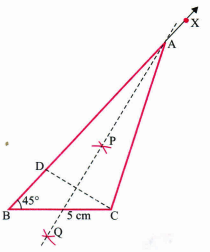
(ii) By measurement, AB = 13cm
(iii) By measurement, AC = 10.2cm
(iv) AB - AC = 13 - 10 .2 = 2.8cm
(v) Yes! Hari is true as by measurement ㄥACB = 112°.
The value 'wise' is depicted by comment of Hari.
40.
Given: ABCD is trapezium in which AD=BC
To prove: Opposite angles of ABCD are supplementary.
Construction: Draw BE || AD
Proof: In quadrilateral ABED,
AB || DE I Given
AD || BE | By construction
∴ Quadrilateral ABED is a parallelogram.
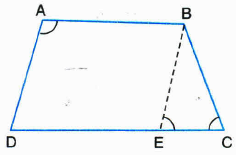
| A quadrilateral is a parallelogram if its both the pairs of opposite sides are parallel.
∴ \(\angle BAD=\angle BED\) ..........(1)
I Opposite angles of a parallelogram are equal
But AD=BC | Given
∴ BE=BC
∴ \(\angle BEC=\angle BCE\) | Angles opposite to equal sides of a triangle are equal
∴ \(\angle BEC=\angle BED=180°\) | Linear pair axiom
\(\Rightarrow \angle BCE+\angle BED=180°\) | From (2)
\(\Rightarrow \angle BCE+\angle BAD=180°\) | From (1)
\(\Rightarrow \angle BCD+\angle BAD=180°\)
\(\Rightarrow \) Opposite angles of ABCD are supplementary.
41.
Given: In figure, EF is a line passing through the centre 0 of a circle. EF bisects chords AB and CD of the circle.
To Prove: AB || CD.
Proof: ∵ EF bisects chord AB
∴ OL bisects chord AB
∴ \(\angle OLB=\angle OLA=90°\) ...(1)
| ∵ The line drawn through the centre of a circle to bisect a chord is perpendicular to the chord
∵ From (1) and (2),
\(\angle OLB=\angle OMC=90°\)
But these angles form a pair of equal alternate interior angles
∴ AB || CD.
42.
Given: ABC is an equilateral triangle whose medians are AD, BE and CF.
To prove: AD = BE = CF
Proof: In \(\triangle ADC\) and \(\triangle BEC\)
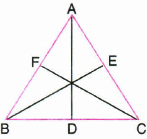
AC = BC
\(\angle ACD=\angle BCE\)
AD is a median DC = DB = 1/2 BC
BE is a median EA = EC = 1/2 AC
AC = BC
DC = EC
\(\triangle ADC\cong \triangle BEC\) | SAS congruence rule
AD = BE | C.P.C.T
Similarly, we can prove that
BF = CF ... (2)
CF = AD ....(3)
From (1), (2) and (3)
AD = BE = CF
43.
()
Volume of right circular cone = \(\frac { 1 }{ 3 } \pi { r }^{ 2 }h\)
\(=\frac { 1 }{ 3 } \times \frac { 22 }{ 7 } \times { (6) }^{ 2 }\times 7=\frac { 1 }{ 3 } \times \frac { 22 }{ 7 } \times 36\times 7\)
= 264 cm3.
44.
()
Mean = \(\frac{1+3+5+7+9+11}{6}\)=\(\frac{36}{6}\)
= 6
45.
()
Theorem requires a proof.
46.
()
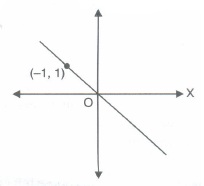
47.
()
Degree of x3+5 = 3
Degree of 4-x5 = 5
Degree of (x3-5) (4-x5) = 3+5 = 8.
48.
()
(i) False, because 0 is not a natural number.
(ii) True, because 0 is non-negative and non-positive integer.
(iii) False, because there are infinitely many rational number between two rational number.

9th Standard CBSE Syllabus & Materials
9th Standard CBSE
CBSE 9th Mathematics Lines and Angles Sample Question Papers Study Material - QB365 Set A
NEW9th Standard CBSE
CBSE 9th Mathematics Introduction to Euclid's Geometry Sample Question Papers Study Material - QB365 Set A
NEW9th Standard CBSE
CBSE 9th Mathematics Linear Equations in Two Variables Sample Question Papers Study Material - QB365 Set A
NEW9th Standard CBSE
CBSE 9th Mathematics Coordinate Geometry Sample Question Papers Study Material - QB365 Set A



NCERT Books

Syllabus

Exam Pattern

Sample Question Papers

Previous year Question Papers

Important Notes

MCQ Practice test

NCERT Exemplers

Case study Questions

Image Based Questions

Passage based Questions

HOT Questions

Value Based Questions

Model Questions Papers
NCERT ( Book Back ) Questions

Assertion and Reason
Important Questions And Answers

CBSE 9th Standard CBSE Subjects
CBSE Standards