100% FREE ACCESS
9th Standard CBSE Syllabus & Materials
9th Standard CBSE
CBSE 9th Science Is matter around us pure? - New Model Questions Papers Study Material - QB365 Set A
NEW9th Standard CBSE
CBSE 9th Science Matter in our surroundings - New Model Questions Papers Study Material - QB365 Set A
NEW9th Standard CBSE
CBSE 9th Mathematics Heron's Formula Sample Question Papers Study Material - QB365 Set A
NEW9th Standard CBSE
CBSE 9th Mathematics Circles Sample Question Papers Study Material - QB365 Set A
NEW9th Standard CBSE
CBSE 9th Mathematics Quadrilaterals Sample Question Papers Study Material - QB365 Set A
NEW9th Standard CBSE
CBSE 9th Mathematics Triangles Sample Question Papers Study Material - QB365 Set A

Published on: 29/10/2025
Download CBSE Class 9th Standard CBSE Mathematics question papers, sample papers, important questions, and previous year solved papers in PDF format. Get free study materials, NCERT solutions, and exam preparation resources for Class 9th Standard CBSE Mathematics
Questions + Answers key
Take MCQ Mathematics Test
1.
Give the geometric representations of y = 3 as an equation
(i) in one variable
(ii) in two variables.
2.
Yamini and Fatima, two students of Class IX of a school, together contributed Rs.100 towards the Prime Minister's Relief Fund to help the earthquake victims.Write a linear equation which satisfies this data. (You may take their contributions as Rs.x and Rs.y) Draw the graph of the same.
3.
Check which of the following are solutions of equation x-2y = 4 and which are not:
(1, 1)
4.
Check which of the following are solutions of equation x-2y = 4 and which are not:
\((\sqrt{2}, 4\sqrt{2})\)
5.
Check which of the following are solutions of equation x - 2y = 4 and which are not:
(4,0)
6.
Check which of the following are solutions of equation x-2y = 4 and which are not:
(2,0)
7.
Which one of the following options is true and why?
y = 3x + 5 hs
(i) a unique solution
(ii) only two solutions
(iii) infinitely many solutions
8.
For each of the graph given in the following figure select the equation whose graph it is from the choices given below:
Fig. (a)
.JPG)
(i) x + y = 0
(ii) x - y = 0
(iii) y = 2x + 4
(iv) y = x - 4
Fig. (b)
.JPG)
(i) x + y = 0
(ii) x - y = 0
(iii) y = 2x + 4
(iv) y = x - 4
Fig. (c)
.JPG)
(i) x + y = 0
(ii) x - y = 0
(iii) y = 2x + 1
(iv) y = 2x - 4
Fig. (d)
.JPG)
(i) x + y = 0
(ii) x - y = 0
(iii) 2x + y = -4
(iv) 2x + y = 4
9.
Force applied on a body is directly proportional to the acceleration produced in the body. Write an equation to express this situation and plot the graph of the equation.
10.
Find two solutions for each of the following equations:
(i) 4x + 3y = 12
(ii) 2x + 5y = 0
(iii) 3y + 4 = 0
11.
Write each of the following equations in the form ax + by + c = 0 and also write the values of a, b and c in each case:
(i) 2x + 3y = 3.47
(ii) x - 9 = \(\sqrt{3}\)y
(iii) 4 = 5x - 3y
(iv) y = 2x
12.
Write each of the following as an equation in two variables:
(i) x = -5
(ii) Y = 2
(iii) 2x = 3
(iv) 5y = 2
13.
Solve the equation 2x + 1 = x - 3, and represent the solution(s) on
(i) the number line
(ii) the Cartesian plane
14.
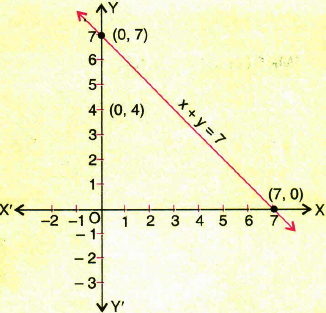
Draw the graph of x + y = 7.
15.
Given the point (1, 2), can you give the equation of a line on which it lies? How many such equations are there?
16.
Find four different solutions of the equation x + 2y = 6
17.
In countries like the USA and Canada, the temperature is measured in Fahrenheit, whereas in countries like India, it is measured in Celsius. Here is a linear equation that converts Fahrenheit to Celsius.
F =\(\left(\frac{9}{5}\right)\)C + 32
(i) Draw the graph of the linear equation above using Celsius for the x-axis and Fahrenheit for the y-axis.
(ii) If the temperature is 30°C, what is the temperature in Fahrenheit?
(iii) If the temperature is 95°F, what is the temperature in Celsius?
(iv) If the temperature is 0°C, what is the temperature in Fahrenheit and if the temperature is 0°F, what is the temperature in Celsius?
(v) Is there a temperature that is numerically the same in both Fahrenheit and Celsius? If yes, find it.
18.
Draw the graph of each of the following linear equations in two variables:
(i) x + y =4
(ii) x - y = 2
(iii) y = 3x
(iv) 3 = 2x + y
19.
Write four solutions for each of the following equations:
(i) 2x + y = 7
(ii) πx + y = 9
(iii) x = 4y
20.
Express the following linear equations in the form ax + by + c = 0 and indicate the values of a, b and c in each case:
(i) 2x + 3y = 9.3\(\overline{5}\)
(ii) x - \(\frac{y}{5}\) - 10 = 0
(iii) -2x + 3y = 6
(iv) x = 3y
(v) 2x = -5y
(vi) 3x + 2 = 0
(vii) Y - 2 = 0
(viii) 5 = 2x
21.
Give the geometric representations of 2x + 9 = 0 as an equation
(i) in one variable.
(ii) in two variables.
22.
If the work done by a body on application of a constant force is directly proportional to the distance travelled by the body, then express this in the form of an equation in two variables and draw the graph of the same by taking the .constant force as 5 units, Also, read from the graph the work done, when the distance travelled by the body is
(i) 2 units
(ii) 0 unit.
23.
From the choices given below, choose the equation whose graphs are given in Fig. (a) and Fig. (b).
.png)
.png)
|
For Fig (a) |
For Fig(b) |
| (i) y = x | (i) y = x + 2 |
| (ii) x + y = 0 | (ii) y = x - 2 |
| (iii) y = 2x | (iii) y = - x + 2 |
| (iv) 2 + 3y = 7x | (iv) x + 2y = 6 |
24.
The cost of a notebook is twice the cost of a pen. Write a linear equation in two variables to represent this statement.
(Take the cost of a notebook to be Rs x and that of a pen to be Rs y)
1.
The given equation is
y=3
(i)In one variable
The representation of y = 3 on the number line is as shown below:
.png)
(ii)In two variables
.png)
It is a linear equation in two variables x and y .This is represented by a line. All the values of x are permissible because O.x is always O.However, y must satisfy the relation y = 3. Hence, two solutions of the given equation are x = 0, y = 3 and x = 2, y = 3.Thus the graph AB is a line parallel to the x-axis at a distance of 3 units above it
2.
Let the contributions ofYarnini and Fatima be Rs.x and Rs.y respectively.
Then according to the question
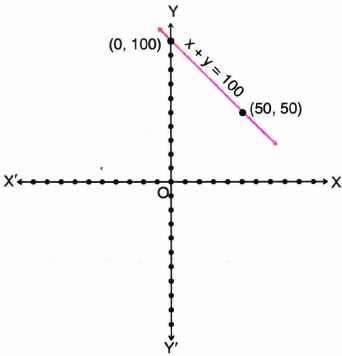
x + y = 100
This is the linear equation which the given data satisfies.
Now, x + y = 100
⇒ y = 100-x
Table of solution
| X | 0 | 50 |
|---|---|---|
| Y | 100 | 50 |
We plot the points (0, 100) and (50, 50) on the graph paper and join the same by a ruler to get the line which is the graph of the equation x + y = 100.
3.
The given equation is x-2y = 4
Put x = 1 and y1 in (1), we get
x - 2y = 1-2(1) = 1-2 = -1, which is not 4.
(1, 1) is not solution of (1).
4.
The given equation is x - 2y = 4
Put \(x=\sqrt{2}\), y=\(4\sqrt{2}\) in (1), we get
x-2y =\(\sqrt{2}-2(4\sqrt{2})\)
\(=\sqrt{2}-8\sqrt{2}=-7\sqrt{2}\) which is not 4.
\((\sqrt{2},\ 4\sqrt{2})\) which is not 4.
\((\sqrt{2}, 4\sqrt{2})\) is not a soluton of (1)
5.
The given equation is x-2y = 4
(4,0)
Put x = 4 and y = 0 in (1) we get
x - 2y = 4 - 2(0) = 4
(4,0) is a solution of (1).
6.
The given equation is x-2y = 4
(2,0)
Put x = 2 and y = 0 in (1), we get
x - 2y = 2 - 2(0) = 2 - 0 = 2, which is not 4.
(2,0) is not a solution of (1)
7.
The true option is (iii) y = 3x + 5 has infinitely many solution
Reason: For every value of x, there is a corresponding value of y and vice-versa.
8.
(a) In Fig, the points on the line are (–1, –2), (0, 0), (1, 2). By inspection, y = 2x is the equation corresponding to this graph. You can find that the y-coordinate in each case is double that of the x-coordinate.
(b) In Fig., the points on the line are (–2, 0), (0, 4), (1, 6). You know that the coordinates of the points of the graph (line) satisfy the equation y = 2x + 4. So, y = 2x + 4 is the equation corresponding to the graph in Fig. 4.5 (ii).
(c) In Fig., the points on the line are (–1, –6), (0, –4), (1, –2), (2, 0). By inspection, you can see that y = 2x – 4 is the equation corresponding to the given graph (line).
9.
Here the variables involved are force and acceleration. Let the force applied be y units and the acceleration produced be x units. From ratio and proportion, you can express this fact as y = kx, where k is a constant. (From your study of science, you know that k is actually the mass of the body.)
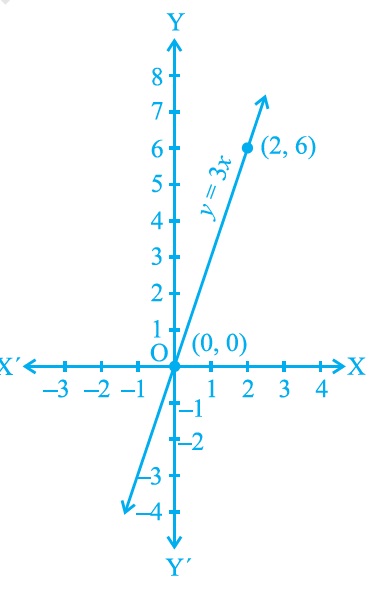
Now, since we do not know what k is, we cannot draw the precise graph of y = kx. However, if we give a certain value to k, then we can draw the graph. Let us take k = 3, i.e., we draw the line representing y = 3x.
For this we find two of its solutions, say (0, 0) and (2, 6)
From the graph, you can see that when the force applied is 3 units, the acceleration produced is 1 unit. Also, note that (0, 0) lies on the graph which means the acceleration produced is 0 units, when the force applied is 0 units.
10.
(i) (0, 4) and (3, 0)
(ii) (0, 0) and (1, \(-\frac{2}{5}\))
(iii) (0, \(\frac{-4}{3}\)) and (1, \(\frac{-5}{3}\))
11.
(i) 2x + 3y - 3.47 = 0; a = 2, b = 3 and c = -3.47
(ii) x - \(\sqrt{3}\)y - 9 = 0; a = I, b = -\(\sqrt{3}\) and c = -9
(iii) -5x + 8y + 4 = 0; a = -5, b = 8 and c = 4
(iv) -2x + y + 0 = 0; a = -2, b = 1 and c = 0
12.
(i) x = –5 can be written as 1.x + 0.y = –5, or 1.x + 0.y + 5 = 0.
(ii) y = 2 can be written as 0.x + 1.y = 2, or 0.x + 1.y – 2 = 0.
(iii) 2x = 3 can be written as 2x + 0.y – 3 = 0.
(iv) 5y = 2 can be written as 0.x + 5y – 2 = 0.
13.
(i)
.png)
(ii)
.png)
14.
15.
Here (1, 2) is a solution of a linear equation you are looking for. So, you are looking for any line passing through the point (1, 2). One example of such a linear equation is x + y = 3. Others are y – x = 1, y = 2x, since they are also satisfied by the coordinates of the point (1, 2). In fact, there are infinitely many linear equations which are satisfied by the coordinates of the point (1, 2).
16.
By inspection, x = 2, y = 2 is a solution because for x = 2, y = 2
x + 2y = 2 + 4 = 6
Now, let us choose x = 0. With this value of x, the given equation reduces to 2y = 6 which has the unique solution y = 3. So x = 0, y = 3 is also a solution of x + 2y = 6. Similarly, taking y = 0, the given equation reduces to x = 6. So, x = 6, y = 0 is a solution of x + 2y = 6 as well. Finally, let us take y = 1. The given equation now reduces to x + 2 = 6, whose solution is given by x = 4. Therefore, (4, 1) is also a solution of the given equation. So four of the infinitely many solutions of the given equation are:
(2, 2), (0, 3), (6, 0) and (4, 1).
17.
(i) We have F = (\(\frac{9}{5}\)) C + 32
When C = 0, F (\(\frac{9}{5}\)) x 0 + 32 = 32
When C = -15, F = \(\frac{9}{5}\) (-15) + 32 = -27 + 32 = 5
When C = -10, F = \(\frac{9}{5}\) (-10) + 32 = 9(-2) + 32 = 14
We have the following table:
| C | 0 | -15 | -10 |
| F | 32 | 5 | 14 |
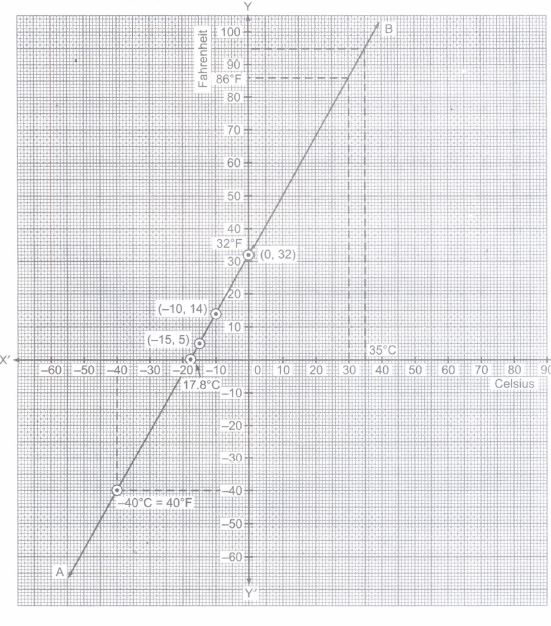
Plot the ordered pairs (0, 32), (-15, 5) and (-10, 14) on a graph paper. Joining these points we get a straight line AB.
(ii) From the graph, we have
86°F corresponds to 30°C
(iii) From the graph, we have
95°F = 35°C
(iv) From the graph, we have
0°C = 32°F
and 0°F = 17.8°C
(v) Yes, from the graph, we have
40°F = -40°C
18.
Given equation is x + y = 4.
To draw the graph, we need at least two solutions of the equation.
Given equation can be written as y = 4 - x.
When x = 0, then y = 4
When x = 4, then y = 4 - 4 = 0
Thus, we have the following table
So, plot the points A(0,4) and B(4,0) on thegraph paper and join them by a line.

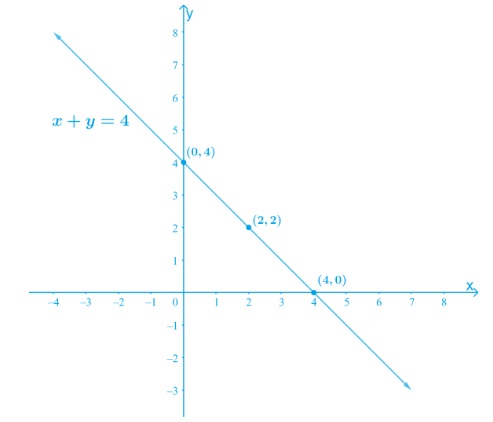
Hence, line AB represents the required graph of given linear equation.
| x | 0 | 0 |
| y | 4 | 0 |
| Points(x,y) | A(0,4) | B(4,0) |
(ii) x - y = 2
⇒ y = x-2
If we have x = 0, then y = 0 -2 = -2
x = 1, then y = 1 - 2 = - 1
x = 2, then y = 2 - 2 = 0
∴ We have the following table:
| x | 0 | 1 | 2 |
| y | -2 | -1 | 0 |
Plot the ordered pairs (0, -2), (1, -1) and (2, 0) on the graph paper. Joining these points, we get a straight line PQ as shown below:
Thus, the line PQ is required graph of x - y = 2.
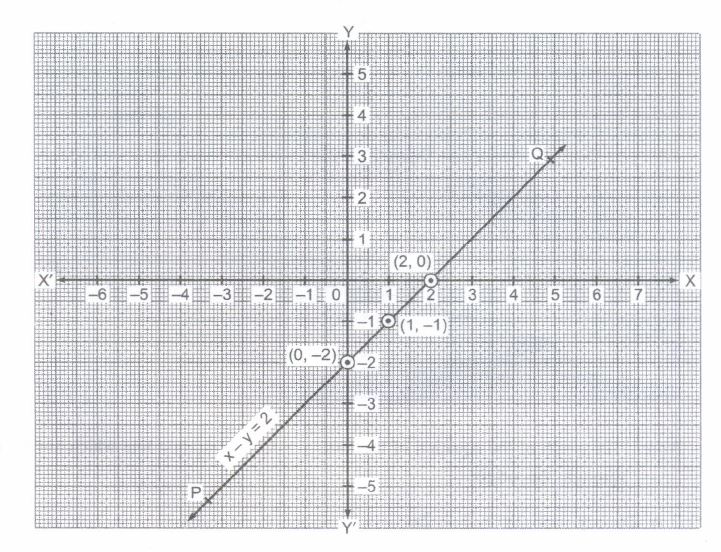
(iii) y = 3x
If x = 0, then y = 3(0) ⇒ y = 0
x = 1, then y = 3(1) ⇒ y = 3
x = -1, then y = 3(-1) ⇒ y = -3
We get the following table:
| x | 0 | 1 | -1 |
| y | 0 | 3 | -3 |
Plot the ordered pairs (0, 0), (1, 3) and (-1, -3) on the graph paper. Joining these points, we get the straight line LM.
Thus, LM is the required graph of y = 3x.
.JPG)
Note: The graph of the equation of the form y = kx is a straight line which always passes through the origin.
(iv) 3 = 2x + y ⇒ y = 3 - 2x
∴ If x = 0, then y = 3 - 2(0) ⇒ y = 3
If x = 1, then y = 3 - 2(1) ⇒ y = 1
If x = 2, then y = 3 - (2) ⇒ y = -1
| x | 0 | 1 | 2 |
| y | 3 | 1 | -1 |
Plot the ordered pairs (0, 3), (1, 1) and (2, -1) on the graph paper. Joining these points, we get a line CD.
.JPG)
Thus, the line CD is the required graph of 3 = 2x + y
19.
(i) 2x + y = 7
When x = 0, 2(0) + y = 7
⇒ 0+ y = 7
⇒ y = 7
∴ Solution is (0, 7).
When x = 1, 2(1) + y = 7
⇒ y = 7 - 2
⇒ y = 5
∴ Solution is (1, 5).
When x = 2, 2(2) + y = 7
⇒ y = 7 - 4
⇒ y = 3
∴ Solution is (2, 3).
When x = 3, 2(3) + y = 7
⇒ y = 7 - 6
⇒ y = 1
∴ Solution is (3, 1).
(ii) πx + y = 9
When x = 0, π(0) + y = 9
⇒ y = 9 - 0
⇒ y = 9
∴ Solution is (0, 9).
When x = 1, π(1) + y = 9
⇒ y =9-π
∴ Solution is {1, (9 - π)}.
When x = 2, π(2) + y = 9
⇒ y = 9 - 2π
∴ Solution is {2, (9 - 2π)}.
When x = -1, π(-1) + y = 9
⇒ -π+ y = 9
⇒ y=9+π
∴ Solution is {-1, (9 + π)}.
(iii) x = 4y
When x = 0, 4y = 0
⇒ y = 0
∴ Solution is (0, 0).
When x = 1, 4y = 1
⇒ y= \(\frac{1}{4}\)
∴ Solution is (1,\(\frac{1}{4}\)).
When x = 4, 4y = 4
⇒ y = \(\frac{4}{4}\) = 1
∴ Solution is (4, 1).
When x =-4, 4y =-4
y = \(\frac{-4}{4}\) =-1
∴ Solution is (-4, -1).
20.
(i) We have 2x + 3y = 9.3\(\overline{5}\)
∴ (2)x + (3)y + (-9.3\(\overline{5}\)) = 0
Comparing it with ax + bx + c = 0, we have a = 2, b = 3 and c = -9.3\(\overline{5}\).
(ii) We have x - \(\frac{y}{5}\)- 10 = 0
or x + \(\left(-\frac{1}{5}\right)\) y + (-10) = 0
Comparing with ax + bx + c = 0, we get
a = 1, b = \(-\frac{1}{5}\) and c = -10
Note: Above equation can also be compared by:
Multiplying throughout by 5,
5(x) - (5x\(\frac{y}{5}\)) - (5 x 10) = 0
or 5x - y - 50 = 0
or 5(x) + (-1)y + (-50) = 0
Comparing with ax + by + c = 0, we get a = 5, b = -1 and c = -50.
(iii) We have -2x + 3y = 6
⇒ -2x + 3y - 6 = 0
⇒ (-2)x + (3)y + (-6) = 0
Comparing with ax + bx + c = 0, we get a = -2, b = 3 and c = -6.
(iv) We have x = 3y
⇒ x - 3y = 0
⇒ (1)x + (-3)y + 0 = 0
Comparing with ax + bx + c = 0, we get a = 1, b = -3 and c = 0.
(v) We have 2x = -5y
⇒ 2x + 5y = 0
⇒ (2)x + (5)y + 0 = 0
Comparing with ax + by + c = 0, we get a = 2, b = 5 and c = 0.
(vi) We have 3x + 2 = 0
⇒ 3x + 2 + 0y = 0
⇒ (3)x + (0)y + (2) = 0
Comparing with ax + by + c = 0, we get a = 3, b = 0 and c = 2.
(vii) We have y - 2 = 0
⇒ (0)x + (1)y + (-2) = 0
Comparing with ax + by + c = 0, we have a = 0, b = 1 and c = -2.
(viii) We have 5 = 2x
⇒ 5 - 2x = 0
⇒ -2x + 0y + 5 = 0
⇒ (-2)x + (0)y + (5) = 0
Comparing with ax + by + c = 0, we get a = -2, b = 0 and c = 5.
21.
Given II'near equatIo..n is 2x + 9 = 0 \(\Rightarrow x=-\frac{9}{2}\) ... (i)
(i) If \(x=-\frac{9}{2}\) is treated as an equation in one variable, then it has a unique solution \(x=-\frac{9}{2}\) So, it is a point on the number line as shown below
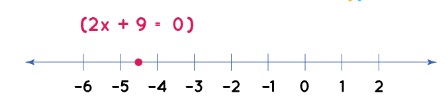
(ii) Given equation 2x + 9 = 0 can be written as 2x + 0·y + 9 = 0, which is a linear equation in two variables x and y.This is represented by a line. Here, all the values of y are permissible, because 0·y is always 0. However, x must satisfy the equation 2x + 9 = 0.
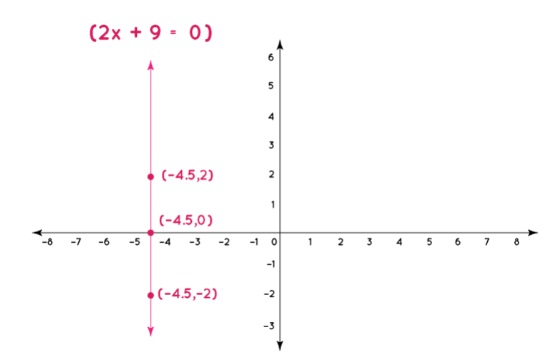
Thus, the graph AB is a line parallel to the Y-axis at a distance of \(\frac{9}{2}=4.5\) units in the direction of negative X-axis.
22.
Given, work done by a body on application of a constant force is directly proportional to the distance travelled by the body,
\(i.e., Work done (W)\propto Distance(s)\)
\(\Rightarrow W=F.s\)
where, P is an arbitrary constant.
Now, let x be the distance and y be the work done.
Then, the equation will e y = Fx.
Which is the required linear equation in two variables x and y.
If the constant force is 5 units, i.e. P = 5, then equation is
y = 5x ... (i)
When x = 0, then y = 0.When x = 1, then y = 5
Thus,we have the following table
| x | y | Points(x,y) |
| 0 | 0 | O(0,0) |
| 1 | 5 | A(1,5) |
Now, plot the points O (0, 0) and A (1, 5) on graph paper and join them to get a line OA which represents the required graph.
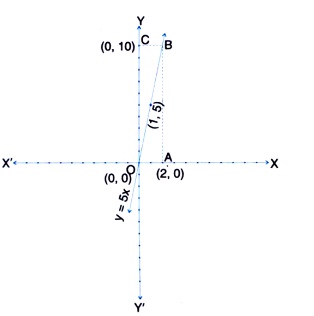
(i) From point D(2, 0), draw a line parallel to OY to cut y = 4x at B and then from B, draw a line parallel to X-axis to intersect the Y-axis at C(O, 10).
Clearly, B represents (2,10). So, work done, when the distance travelled by the body is 2 units, is 10 units.
(ii) Clearly, y = 0, when x = 0, so the work done when the distance travelled by the body is 0 unit, is zero unit.
23.
In Fig. (a), given points are (0,0), (-1, 1) and (1,-1).
So, these points will satisfy the equation of line.
At (-1, 1), x + y = - 1 + 1 = 0
At(0, 0), x + y = 0 +0 = 0
At (1,-1), x + y = 1- 1= 0
i.e. these points satisfy the equation x + y = 0.
Hence, given graph represents the equation x + y = 0.
In Fig. (b), given points are (-1, 3), (0,2) ,and (2, 0).
So, these points will satisfy the equation of line.
At( -1, 3), x + y = - 1 + 3 = 2
At (0, 2), x + y = 0 + 2 = 2
At(2, 0), x,. y = 2 + 0 = 2
i.e. these points satisfy the equation x +y = 2.
Hence, given graph represents the equation x +y = 2,
i.e.y = -x+2.
24.
Let the cost of a notebook = Rs x
and the cost of a pen = Rs y
According to the question,
Cost of a notebook = 2 (Cost of a pen)
\(\Rightarrow\)x = 2y
\(\Rightarrow\) x-2y = 0
which is the required linear equation in two variables.

9th Standard CBSE Syllabus & Materials
9th Standard CBSE
CBSE 9th Mathematics Lines and Angles Sample Question Papers Study Material - QB365 Set A
NEW9th Standard CBSE
CBSE 9th Mathematics Introduction to Euclid's Geometry Sample Question Papers Study Material - QB365 Set A
NEW9th Standard CBSE
CBSE 9th Mathematics Linear Equations in Two Variables Sample Question Papers Study Material - QB365 Set A
NEW9th Standard CBSE
CBSE 9th Mathematics Coordinate Geometry Sample Question Papers Study Material - QB365 Set A



NCERT Books

Syllabus

Exam Pattern

Sample Question Papers

Previous year Question Papers

Important Notes

MCQ Practice test

NCERT Exemplers

Case study Questions

Image Based Questions

Passage based Questions

HOT Questions

Value Based Questions

Model Questions Papers
NCERT ( Book Back ) Questions

Assertion and Reason
Important Questions And Answers

CBSE 9th Standard CBSE Subjects
CBSE Standards