100% FREE ACCESS
9th Standard CBSE Syllabus & Materials
9th Standard CBSE
CBSE 9th Science Is matter around us pure? - New Model Questions Papers Study Material - QB365 Set A
NEW9th Standard CBSE
CBSE 9th Science Matter in our surroundings - New Model Questions Papers Study Material - QB365 Set A
NEW9th Standard CBSE
CBSE 9th Mathematics Heron's Formula Sample Question Papers Study Material - QB365 Set A
NEW9th Standard CBSE
CBSE 9th Mathematics Circles Sample Question Papers Study Material - QB365 Set A
NEW9th Standard CBSE
CBSE 9th Mathematics Quadrilaterals Sample Question Papers Study Material - QB365 Set A
NEW9th Standard CBSE
CBSE 9th Mathematics Triangles Sample Question Papers Study Material - QB365 Set A

Published on: 29/10/2025
Download CBSE Class 9th Standard CBSE Mathematics question papers, sample papers, important questions, and previous year solved papers in PDF format. Get free study materials, NCERT solutions, and exam preparation resources for Class 9th Standard CBSE Mathematics
Questions + Answers key
Take MCQ Mathematics Test
1.
Find the values of a and b in \(\frac { 3-\sqrt { 5 } }{ 3+2\sqrt { 5 } } =a\sqrt { 5 } -\frac { b }{ 11 } \)
2.
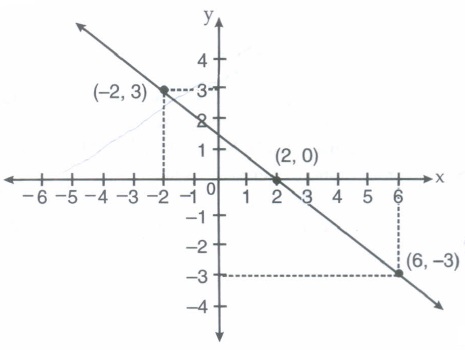
Draw the graph of the linear equation 3x+4y=6. Find the points where the line representing the equation 3x+4y=6 cuts the axes of x and y.
3.
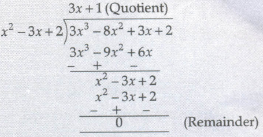
Divide 3x3-8x2+3x+2 by x2-3x+2 and verify the division algorithm.
4.
In figure, C is the mid-point of AB and Dis the mid-point of AC. Prove that AD = \(1\over2\) AB.

5.
Draw the graph of the equations x = 3 and 4x = 3y in the same graph.Find the area of the triangle formed by these two lines and the x-axis
6.
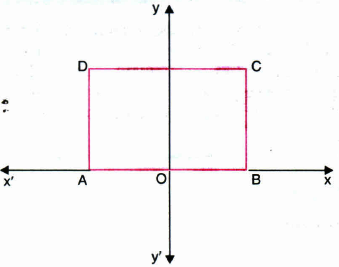
In figure, ABCD is a rectangle with length 6 cm and breadth 3 cm.O is the mid point of AB.Find the coordinates of A, B C and D.
7.
If \(x^2+\frac{1}{x^2}=23,\) then find the value of \(x^3+\frac{1}{x^3}\)
8.
Using suitable identify, find the value of \(\frac{87^3+13^3}{87^2-87\times13+13^3}\)
9.
Find the values of a and b so that (x+1) and (x-1) are factors of \(x^4+ax^3-3x^2+2x+b\)
10.
Write the various coefficients in the following polynomials:
1 - 2y + 3y6
11.
Find the value of 'p' if \({ 5 }^{ p-3 }\times { 3 }^{ 2p-8 }=225\)
12.
(i) express 2.4 \(\overline { 248 } \) in the form of \(p\over q\) where \(p\over q\) is in its lowest form.
(ii) What is the value of p?
(iii) what is the value of q?
(iv) what name can be given to the number p?
(v) what name can be given to the number q?
(vi) Apala declares that p and q are co-prime. IS she correct? If so, which value of Apala is depicted by her declaration?
(vii) Which mathematical concept has been converted in this problem?
(viii) Write the formulae used in the solution.
13.
Express \(0.15\overline { 9 } \) in \(\frac { p }{ q } \) , where p and q are integers and \(q\neq 0\)
14.
Find your rational numbers between \(\frac { 1 }{ 5 } \) and \(\frac { 1 }{ 6 } \)
15.
Find three rational numbers \(\frac { 3 }{ 5 } \) and \(\frac { 7 }{ 8 } \)
1.
\(a\sqrt { 5 } -\frac { b }{ 11 } =\frac { \left( 3-\sqrt { 5 } \right) }{ \left( 3+2\sqrt { 5 } \right) } \times \frac { \left( 3-2\sqrt { 5 } \right) }{ \left( 3-2\sqrt { 5 } \right) } \)
\(=\frac { 9-6\sqrt { 5 } -3\sqrt { 5 } +2\times 5 }{ { \left( 3 \right) }^{ 2 }-{ \left( 2\sqrt { 5 } \right) }^{ 2 } } \)
\(=\frac { 9-9\sqrt { 5 } +10 }{ 9-20 } \)
\(=\frac { 19-9\sqrt { 5 } }{ -11 } \)
\(=\frac { 19 }{ -11 } -\frac { 9\sqrt { 5 } }{ -11 } =\frac { 9\sqrt { 5 } }{ 11 } -\frac { 19 }{ 11 } \)
\(a\sqrt { 5 } -\frac { b }{ 11 } =\frac { -19 }{ 11 } +\frac { 9\sqrt { 5 } }{ 11 } \)
\(\Rightarrow a\sqrt { 5 } -\frac { b }{ 11 } =\frac { 9 }{ 11 } \sqrt { 5 } -\frac { 19 }{ 11 } \)
On comparing both sides, we get
a=\(\frac{9}{11}\) , b = 19
2.
Given equation is 3x+4y=6
(i) When it cuts x-axis then
put y=0, i.e 3x=6
x=2
Hence point on x-axis is (2,0)
(ii) when it cuts y-axis then
put x=0 i.e., 4y=6
y=3/2
hence point on y-axis is \((0,{3\over2})\)
3x+4y=6
\(\Rightarrow y=\frac{6-3x}{4}\)
| x | 2 | -2 | 6 |
| y | 0 | 3 | -3 |
3.
Verification:
Divisor \(\times\) Quotient = (x2-3x+2)(3x+1)+0
= 3x3-8x2+3x+2
\(\therefore\) Dividend = Divisor \(\times\) Quotient + Remainder (Division algorithm)
4.
\(\because\) C is the midpoint of AB
\(\therefore \) AC = CB
AC + AC = CB + AC
| If equals are added to equals, then the wholes are equal (Euclid's Axiom (ii))]
\(\Rightarrow \) 2AC = AB I CB + AC coincides with AB
\(\Rightarrow \) \(1\over2\)(2AC) = \(1\over2\) AB
| Things which are halves of the same thing are equal (Euclid's Axiom (vii»]
\(\Rightarrow \) AC =\(1\over2\)AB
\(\Rightarrow \) \(1\over2\)AC = \(1\over2\)(\(1\over2\)AB)
| Things which are halves of the same thing are equal to one another (Euclid's Axiom (vii))]
\(1\over2\)AC = \(1\over2\)AB
AD = \(1\over4\)AB
\(\because\) D is the mid-point of AC
\(\therefore \)AD = DC =\(1\over2\)AC (as above)
5.
x = 3 represents a line parallel to y-axis at a distance of 3 units to the right of the origin.
4x= 3y
\(\Rightarrow\ \ \ y={4x\over 3}\)
Table of solution
| x | 0 | 3 |
|---|---|---|
| y | 0 | 4 |
We plot the points (0,0) and (3, 4) on a graph paper and join the same by a ruler to get the line which is the graph of the equation 4x = 3y.
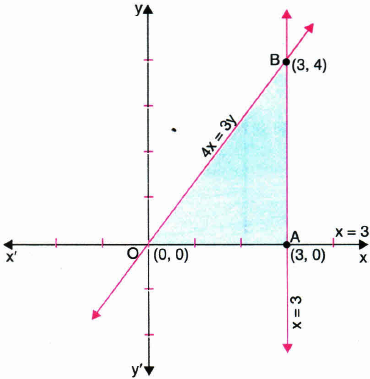
Area of the triangle GAB formed by the given two lines and the x-axis \(={3\times 4\over2}=6\) square units
6.
\(A\rightarrow \left( -3,0 \right)\)
\(\\ B\rightarrow \left( 3,0 \right)\)
\(\\ C\rightarrow \left( 3,3 \right)\)
\(\\ D\rightarrow \left( -3,3 \right) \)
7.
We know that
\((x+\frac{1}{x})^2=x^2+\frac{1}{x^2}+2(x)(\frac{1}{x})\) Using Identity I
\(\Rightarrow\ (x+\frac{1}{x})^2=x^2+\frac{1}{x^2}+2\)
\(\Rightarrow (x+\frac{1}{x})^2=23+2\)
\(\Rightarrow\ = (x+\frac{1}{x})^2=25\)
\(\Rightarrow \ x+\frac{1}{x}=5\) .......(5)
Again, we know that
\((x+\frac{1}{x})^3=x^3+\frac{1}{x^3}+3(x)(\frac{1}{x})(x+\frac{1}{x})\) Using Identity VI
\(\Rightarrow (x+\frac{1}{x})^3=x^3+\frac{1}{x^3}+3(x+\frac{1}{x})\)
\(\Rightarrow (5)^3=x^3+\frac{1}{x^3}+3(5)\)
\(\Rightarrow 125=x^3+\frac{1}{x^3}+15\)
\(\Rightarrow x^3+\frac{1}{x^3}=110\)
8.
\(\frac{87^3+13^3}{87^2-87\times13+13^3}\)
\(=\frac{(87+13(87^2-87\times13+12^2)}{(87^2-87\times13+13^2)}\)
= 87+13=100
9.
Let \(p(x)=x^{ 4 }+ax^{ 3 }-3x^{ 2 }+2x+b\)
If (x+1) and (x-1) are factors of p(x), then by factor theorem,
\(p(-1)=0 \ \ .......(1)\ x+1=0\ \ \ \Rightarrow \ x=-1\)
and \(p(1)=0\ \ \ .......(2)|\ -1=0\Rightarrow x=1\)
Now, \(p(-1)=0\)
\(\Rightarrow (-1)^{ 4 }+a(-1)^{ 3 }-3(-1)^{ 2 }+2(-1)+b=0\)
\(\Rightarrow 1-a-3-2+b=0\)
\(\Rightarrow -a+b=4\ \ .......(3)\)
and \(p(1)=0\)
\(\Rightarrow (1)^{ 4 }+a(1)^{ 3 }-3(1)^{ 2 }+2(1)+b=0\)
\(\Rightarrow 1+a-3+2+b=0\)
\(\Rightarrow a+b=0\ .......(4)\)
Solving (3) from (2), we get
a = -2,b = 2
10.
1, -2, 3
11.
\({ 5 }^{ p-3 }\times { 3 }^{ 2p-8 }=225\)
\(\\ { 5 }^{ p-3 }\times { 3 }^{ 2p-8 }={ 5 }^{ 2 }\times { 3 }^{ 2 }\)
\(\\ p-3=2\)
\(\\ 2p-8=2\)
\(\\ p=5\)
12.
(i) Let x =2.4 \(\overline { 178 } \)
Then x = 2.4178178178...
⇒ 10x = 24.178178178..... . ...(1)
⇒ 10000x = 24178.178178178 ....(2)
Subracting (1) from (2), we get
99990x = 24154
⇒ x = \(24154\over9990\)
⇒ x = \(12077\over4995\)
(ii) p = 12077
(iii) q = 4995
(iv) p is a natural number or a whole number or a positive integer.
(v) q is a natural number or a whole number or a positive integer.
(vi) Let us find out the HCF of p and q
p = 12077 = 13 x 929
q = 4995 = 3 x 3 x 3 x 5 x 37
\(\therefore\) HCF (p,q) = 1
\(\therefore\) p and q are co-prime.
\(\therefore\) Apala is correct.
So, the value 'deductive' is depicted by her declaration.
(vii) The mathematical concept 'Number system' has been converted in this problem.
(viii) The formulae used in the solution are as follows:
1. Method of expressing a recurring and non-terminating decimal in the form of a rational number.
2. Concept of natural numbers or whole numbers or positive integer.
3. reduction of a rational in its lowest terms.
4. Concept of co-prime numbers.
13.
Let x = \(0.15\overline { 9 } \)
x = 0.159999...
100x = 15.9999... ...(1)
1000x = 159.9999... ...(2)
Subtracting (1) from (2), we get
900x = 144
\(x=\frac { 144 }{ 900 } \)
\(\\ x=\frac { 4 }{ 25 } \)
Here, p = 4, q = 25(\(\neq 0\))
14.
\(\frac { 1 }{ 5 } =\frac { 1\times 6 }{ 5\times 6 } =\frac { 6 }{ 30 } =\frac { 6\times 10 }{ 30\times 10 } =\frac { 60 }{ 300 } \)
\(\\ \frac { 1 }{ 6 } =\frac { 1\times 5 }{ 6\times 5 } =\frac { 5 }{ 30 } =\frac { 5\times 30 }{ 30\times 10 } =\frac { 50 }{ 300 }\)
\( \\ \because 50<51<52<53<54<60\)
\(\\ \therefore \frac { 50 }{ 300 } <\frac { 51 }{ 300 } <\frac { 52 }{ 300 } <\frac { 53 }{ 300 } <\frac { 54 }{ 300 } <\frac { 60 }{ 300 } \)
Hence, four rational numbers between \(\frac { 1 }{ 5 } \) and \(\frac { 1 }{ 6 } \) can be taken as
\(\frac { 51 }{ 300 } ,\frac { 52 }{ 300 } ,\frac { 53 }{ 300 } \)and \(\frac { 54 }{ 300 } \)
or \(\frac { 17 }{ 100 } ,\frac { 13 }{ 75 } ,\frac { 53 }{ 300 } \)and \(\frac { 9 }{ 50 } \)
15.
\(\frac { 3 }{ 5 } =\frac { 3\times 8 }{ 5\times 8 } =\frac { 24 }{ 40 } \)
\(\\ \frac { 7 }{ 8 } =\frac { 7\times 5 }{ 8\times 5 } =\frac { 35 }{ 40 } \)
\(\\ \because 24<25<26<27<35\)
\(\\ \therefore \frac { 24 }{ 40 } <\frac { 25 }{ 40 } <\frac { 26 }{ 40 } <\frac { 27 }{ 40 } <\frac { 35 }{ 40 } \)
Hence, three rational numbers between \(\frac { 3 }{ 5 } \) and \(\frac { 7 }{ 8 } \) can be taken as
\(\frac { 25 }{ 40 } ,\frac { 26 }{ 40 } \) and \(\frac { 27 }{ 40 } \)
\(\frac { 5 }{ 8 } ,\frac { 13 }{ 20 } \) and \(\frac { 27 }{ 40 } \)

9th Standard CBSE Syllabus & Materials
9th Standard CBSE
CBSE 9th Mathematics Lines and Angles Sample Question Papers Study Material - QB365 Set A
NEW9th Standard CBSE
CBSE 9th Mathematics Introduction to Euclid's Geometry Sample Question Papers Study Material - QB365 Set A
NEW9th Standard CBSE
CBSE 9th Mathematics Linear Equations in Two Variables Sample Question Papers Study Material - QB365 Set A
NEW9th Standard CBSE
CBSE 9th Mathematics Coordinate Geometry Sample Question Papers Study Material - QB365 Set A



NCERT Books

Syllabus

Exam Pattern

Sample Question Papers

Previous year Question Papers

Important Notes

MCQ Practice test

NCERT Exemplers

Case study Questions

Image Based Questions

Passage based Questions

HOT Questions

Value Based Questions

Model Questions Papers
NCERT ( Book Back ) Questions

Assertion and Reason
Important Questions And Answers

CBSE 9th Standard CBSE Subjects
CBSE Standards