100% FREE ACCESS
9th Standard CBSE Syllabus & Materials
9th Standard CBSE
CBSE 9th Science Is matter around us pure? - New Model Questions Papers Study Material - QB365 Set A
NEW9th Standard CBSE
CBSE 9th Science Matter in our surroundings - New Model Questions Papers Study Material - QB365 Set A
NEW9th Standard CBSE
CBSE 9th Mathematics Heron's Formula Sample Question Papers Study Material - QB365 Set A
NEW9th Standard CBSE
CBSE 9th Mathematics Circles Sample Question Papers Study Material - QB365 Set A
NEW9th Standard CBSE
CBSE 9th Mathematics Quadrilaterals Sample Question Papers Study Material - QB365 Set A
NEW9th Standard CBSE
CBSE 9th Mathematics Triangles Sample Question Papers Study Material - QB365 Set A

Published on: 29/10/2025
Download CBSE Class 9th Standard CBSE Mathematics question papers, sample papers, important questions, and previous year solved papers in PDF format. Get free study materials, NCERT solutions, and exam preparation resources for Class 9th Standard CBSE Mathematics
Questions + Answers key
Take MCQ Mathematics Test
1.
Factorize: 27p3-\(\frac { 1 }{ 216 } -\frac { 9 }{ 2 } { p }^{ 2 }+\frac { 1 }{ 4 } p\)
2.
If √2 = 1.414 and √3 = 1.732, then calculate \(\frac { 4 }{ 3\sqrt { 3 } -2\sqrt { 2 } } +\frac { 3 }{ 3\sqrt { 3 } -2\sqrt { 2 } } \)
3.
If f(x)=x4 -4x3+3x2-2x+1, then find whether f(0) \(\times\) f(-1) = f(2).
4.
Consider the point A(-2, 3)
(I) How many lines can be drawn passing through A?
(ii) Give equation of any two lines passing through A.
(iii) Without actually drawing the graph, find a point, other than A, on each of these two lines.
5.
Check which of the following are solutions of equation x-2y = 4 and which are not:
\((\sqrt{2}, 4\sqrt{2})\)
6.
If the coordinates of a point M are (2,9) which can also be expressed as (1 + x,y2) and y > 0, then find in which quadrant do the following points lie: P(x,y), Q(2,x), R(x2,y-1), S(2x,-3y)
7.
(Street Plan):A city has two main roads cross each other at the centre of the city. These two roads are along the North-South direction and East-West direction.All the other streets of the city run parallel to these roads and are 200 m apart.There are 5 streets in each direction.Using 1 cm = 200 m, draw a model of the city on your notebook.Represent the roads/streets by single line.
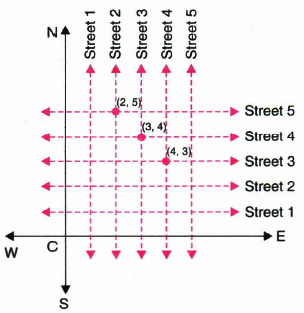
There are many cross-streets in your model.A particular cross-street is made by two streets, one running in the North-South direction and another in the East- West direction.Each cross-street is referred to in the following manner: If the 2nd street running in the North-South direction and 5th in the East-West direction meet at some crossing, then we will call this cross-street (2, 5).Using this convention, find:
(i) how many cross-streets can be referred to as (4,3)?
(ii) how many cross-streets can be referred to as (3,4)?
8.
Use suitable identities to find the following products: \((3x+4)(3x-5)\)
9.
Find p(0), p(1) and p(2) for each of the following polynomials:
p(t) = 2 + t + 2t2 - t3
10.
Express the following in the form p/q, where p and q are integers and \(q\neq 0\)
\(0.\overline { 47 } \)
11.
Find six rational numbers between 3 and 4.
12.
Find the value of K so that x=-1 and y=-1 is a solution of the linear equation 9kx+12ky=63.
13.
Factorize: 8-27a3-36a+54a2.
14.
Draw the graph of x = 3y - 4.Find the
(i) value of y when x = -1
(ii) value of x when y = 5.
15.
Find three different solutions for the equation 3x-4y=-12
16.
What are the coordinates of a point that is:
(i) the mirror image of point (0,4) in x-axis.
(ii) the mirror image of point (-3,-5) in y-axis.
17.
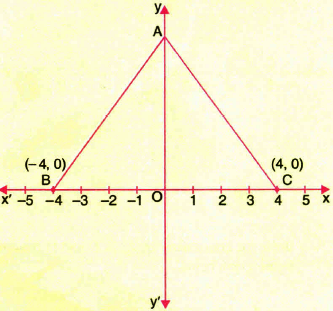
In figure, \(\triangle ABC\) is an equilateral triangle with coordinates of B and C as (-4,0) and (4,0) respectively.Find the coordinates of the vertex.
18.
The lengths of perpendiculars PM and PN drawn from a point P, on x-axis and y-axis are of 3 and 2 units respectively.Find the coordinates of points P,M and N.
19.
In which quadrant do the given point lie? (2,-1)
20.
Prove that \(2x^3+2y^3+2z^3-6xyz=(x+y+z)\) \([(x-y)^2+(y-z)^2+(z-x)^2]\) Hence, evaluate: \(2(13)^3+2(15)^3+2(15)^3-6\times13\times14\times15\)
21.
Find the value of \(x^2+\frac{1}{x^2},\) if \(x-\frac{1}{x}=\sqrt{3}\)
22.
Without finding the cubes, factories and find the value of: \((\frac{1}{4})^3+(\frac{1}{3})^3-(\frac{7}{12})^3\)
23.
Using remainder theorem, factorise: \(6x^3-25x^2+32x-12\)
24.
The polynomials \(kx^3+3x^2-8 \) and \(3x^3-5x+8\) are divided by x+2. If the remainder in each case is the same, find the value of k.
25.
Using long division method divide the polynomial \(3x^4-4x^3-3x-1\) by \(1-x\)
26.
Point out which of the following polynomials are monomials, binomials or trinomials?
\({ x }^{ 3 }+2x-3\)
27.
Find three rational numbers between 3/7 and 5/11.How many rational numbers can be determined lying between these numbers?
28.
Find two rational numbers between 3/4 and 5/9.
29.
The numerator of a fraction is 1 less than the denominator.Write a linear equation in two variables to represent the statement.
x=y-1
x+y=0
x=y
x+y+1=0
30.
\(\sqrt{2}y+ \sqrt{3}=0\) is
a linear equation in one variable
not a linear equation in one variable
a linear equation in two variables
none of these
31.
Mirror image of point (3,9) in x - axis is
(-3,9)
(9,3)
(3,9)
(3,-9)
32.
The co-ordinates of point Q are:
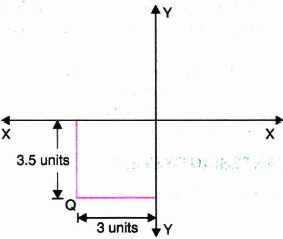
(3,3.5)
(3.5,3)
(-3,3.5)
(-3,-3.5)
33.
The factors of \(a^7+ab^6\) are:
\(a, (a^6+b^6)\)
\(b, (a^6+b^6)\)
\(a^6,(a+b)\)
\(b^6, (a+b)\)
34.
\(y+\frac{1}{y}\) is:
polynomial of degree 1
polynomial of degree 2
polynomial of degree 3
Not a polynomial
35.
Which of the following is an algebraic identity?
\((x+y)^2=x^2+2xy+y^2\) is an algebraic identity
\((x+y)^2=x^2-2xy+y^2\)
\((x+y)^2=x^2+2xy-y^2\)
\((x+y)^2=x^2+2xy+y^2\)
\((x+y)^2=-x^2+2xy+y^2\)
36.
(0.001)1/3 is equal to
0.1
0.001
0.01
0.0001
37.
If \(\sqrt { x } \) is an irrational number, then x is:
rational
irrational
0
real
38.
A rational number lying between -3 and 3 is:
0
-4.3
-3.4
1.101 1001 10001...
39.
If \(x=\frac { \sqrt { 5 } +1 }{ \sqrt { 5 } -1 } \) and \(y=\frac { \sqrt { 5 } -1 }{ \sqrt { 5 } +1 } \) than find the value of x2 +y2
40.
In an election, a good candidate may lose because 40% of voters do not cast their votes due to various reasons. Form an equation and draw the graph with data. Form the graph, Find:
(i) the total number of voters, if 300 voters cast their votes
(ii) the number of votes cast, if the total number of voters are 1000.
(iii) What is its value.
41.
If x is the number of hours a labourer is on work and y his wages in rupees then y = 4x + 3. Draw the work wages graph of this equation. From the graph, find the wages of a labourer who puts in 4 hours of work
42.
Draw the graph of the linear equation \(y={2\over3}x+{1\over3}\).Check from the graph that (7, 5) is a solution of the linear equation
43.
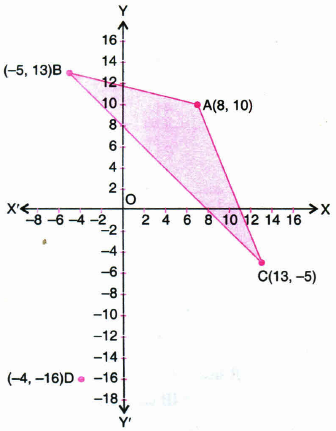
Plot the points A, B, C, D from the table:
| Points | A | B | C | D |
|---|---|---|---|---|
| x | 8 | -5 | 13 | -4 |
| y | 10 | 13 | -5 | -16 |
and answer the following:
(a) Write the coordinates of A, B, C, D.
(b) Shade the triangle ABC.
44.
(i) Plot the points A(2, 3), B(2, 1), C(O, 1) and D(O, 3)
(ii) Join the points.
(iii) Identify the figure obtained.
(iv Find the perimeter of the figure.
(v) Find the area of the figure.
(vi) Apala finds that the length of a diagonal of the figure ABCD is \(2\sqrt { 2 }\) units. Is she correct? How did she find it? Which value of Apala is depicted by her finding?
(vii) Which mathematical concept has been covered in this problem?
45.
Prove that \((a+b)^3+(b+c)^3+(c+a)^3-3(a+b)(b+c)(c+a)\) = \(2(a^3+b^3+c^3-3abc)\)
46.
Using suitable identify, find the value of \(\frac{87^3+13^3}{87^2-87\times13+13^3}\)
47.
Simplify: \(\left( x+\frac { 1 }{ 2 } \right) \left( x+\frac { 3 }{ 2 } \right) \)
48.
Write the rationalizing factor of \(\frac{1}{\sqrt{50}}\) .
49.
Factorize: 8y3-125x3.
50.
Factorize: 12a2b-6ab2.
51.
Find the decimal expansion of \(\frac{58}{1000}\)
52.
What is the solution of the equation 3x-y=4?
53.
Name the degree of the polynomial -3x+2.
54.
In a one day cricket match, Raina and Dhoni scored 198 runs. Express this as a linear equation in two carables.
55.
Is ox+oy+c=0, a linear equation?
56.
State whether the following statements are true or false.Give reason for your answer.
(i) Every whole number is a natural number.
(ii) Zero is neither a negative nor a positive integer.
(iii) There are finitely many rational numbers between any two given rational numbers.
57.
Find the value of \(\frac { 4 }{ { \left( 216 \right) }^{ -\frac { 2 }{ 3 } } } +\frac { 1 }{ { \left( 216 \right) }^{ -\frac { 3 }{ 4 } } } +\frac { 2 }{ { \left( 216 \right) }^{ -\frac { 1 }{ 5 } } } \)
1.
27p3-\(\frac { 1 }{ 216 } -\frac { 9 }{ 2 } { p }^{ 2 }+\frac { 1 }{ 4 } p\)
\(={ (3p) }^{ 3 }-{ \left( \frac { 1 }{ 6 } \right) }^{ 3 }-3.({ 3p) }^{ 2 }\frac { 1 }{ 6 } +3(3p){ \left( \frac { 1 }{ 6 } \right) }^{ 2 }\)
\(={ \left( 3p-\frac { 1 }{ 6 } \right) }^{ 3 }\)
\(=\left( 3p-\frac { 1 }{ 6 } \right) \left( 3p-\frac { 1 }{ 6 } \right) \left( 3p-\frac { 1 }{ 6 } \right) \)
2.
\(\frac { 4 }{ 3\sqrt { 3 } -2\sqrt { 2 } } +\frac { 3 }{ 3\sqrt { 3 } -2\sqrt { 2 } } =\frac { 21\sqrt { 3 } +2\sqrt { 2 } }{ 19 } \)
\(=\frac { 21(1.732)+2(1.414) }{ 19 } \)
\(=\frac { 39.2 }{ 19 } \)
= 2.063
3.
f(x) = x4 - 4x3 + 3x2 - 2x + 1
f(0) = 1
f(-1)=(-1)4-4(-1)3+3(-1)2-2(-1)+1
= 1 + 4 + 3 + 2 + 1 = 11
f(2) = (2)4 - 4(2)3 + 3(2)2 - 2(2) + 1
= 16 - 32 + 12 - 4 + 1
= 29 - 36 = -7
\(\therefore\) f(0) \(\times\) f(-1) = 11 \(\neq \) f(2)
4.
(i)Infinitely many
(ii)x+y1=0, -x+y=5
(iii)(0,-1), (0, 5)
5.
The given equation is x - 2y = 4
Put \(x=\sqrt{2}\), y=\(4\sqrt{2}\) in (1), we get
x-2y =\(\sqrt{2}-2(4\sqrt{2})\)
\(=\sqrt{2}-8\sqrt{2}=-7\sqrt{2}\) which is not 4.
\((\sqrt{2},\ 4\sqrt{2})\) which is not 4.
\((\sqrt{2}, 4\sqrt{2})\) is not a soluton of (1)
6.
\(P\rightarrow I\)
\(\\ Q\rightarrow I\)
\(\\ R\rightarrow I\)
\(\\ S\rightarrow IV\)
7.
Both the cross-streets are marked in the figure given.They are uniquely found because of the two reference lines we have used for locating them.
8.
\((3x+4)(3x-5)\)
\((3x+4)(3x-5)=(3x+4)\{ 3x+(-5)\} \) | Using Identity IV
\({ =(3x) }^{ 2 }+\{ 4+(-5)\} (3x)+(4)(-5)\)
\(={ 9 }x^{ 2 }-3x-20\)
9.
\(\therefore \ p(0)=2+0+2{ (0) }^{ 2 }-{ (0) }^{ 3 }=2\)
\(\\ p(1)=2+1+2{ (1) }^{ 2 }-{ (1) }^{ 3 }\)
\(\\ =2+1+2-1=4\)
and \(p(2)=2+2+2{ (2) }^{ 2 }-{ (2) }^{ 3 }\)
\(\\ =2+2+8-8=4\)
10.
Let x=\(0.\overline { 47 } \) =0.4777....
Multiplying both sides by 10, we get
10x = 9.9999...
10x = 4.7777...
10x = 4.3+0.47777...
10x = 4.3+x
10x - x = 4.3
9x = 4.3
x = 4.3/9 = 43/90
Thus, \(0.\overline { 47 } \) = 43/90
Here p =4 3
q = 90(\(\neq 0\))
11.
There can be infinitely many rational numbers between 3 and 4.
\(\frac { 3+4 }{ 2 } =\frac { 7 }{ 2 } \)
\(\\ \frac { 3+\frac { 7 }{ 2 } }{ 2 } =\frac { 13 }{ 4 } \)
\(\\ \frac { 3+\frac { 13 }{ 4 } }{ 2 } =\frac { 25 }{ 8 }\)
\( \\ \frac { 3+\frac { 25 }{ 8 } }{ 2 } =\frac { 49 }{ 16 } =\frac { 3+\frac { 49 }{ 16 } }{ 2 } =\frac { 97 }{ 32 } =\frac { 3+\frac { 97 }{ 32 } }{ 2 } =\frac { 193 }{ 64 } \)
Thus, six rational numbers between 3 and 4
\(\frac { 193 }{ 64 } ,\frac { 97 }{ 32 } ,\frac { 49 }{ 16 } ,\frac { 25 }{ 8 } ,\frac { 13 }{ 4 } \)and \(\frac { 7 }{ 2 } \)
Aliter
\(3=\frac { 3 }{ 1 } =\frac { 3\times 7 }{ 1\times 7 } =\frac { 21 }{ 7 } \)
\(\\ 4=\frac { 4 }{ 1 } =\frac { 4\times 7 }{ 1\times 7 } =\frac { 28 }{ 7 } \)
6 + 1 = 7
the six rational numbers between 3 and 4 can be taken as
\(\frac { 22 }{ 7 } ,\frac { 23 }{ 7 } ,\frac { 24 }{ 7 } ,\frac { 25 }{ 7 } ,\frac { 26 }{ 7 } \) and \(\frac { 27 }{ 7 } \)
12.
Substituting x=-1 and y=-1 in 9kx+12ky=63, we get
\(\Rightarrow\) 9k(-1)+12k(-1)=63
\(\Rightarrow\) -9k-12k=63
\(\Rightarrow\) -21k=63 k=-3
13.
8-27a3-36a+54a2
=(2)3-(3a)3-18a(2-3a)
=(2)3-(3a)3-3\(\times\)2\(\times\)3a(2-3a)
=(2-3a)3.
14.
(i)1
(ii)11
15.
(0,3), (4, 6), (-4, 0)
16.
(i) (0,-4)
(ii) (3,-5)
17.
\(\left( 0,4\sqrt { 3 } \right) \)
18.
(2,3), (2,0), (0,3)
19.
IV
20.
252
21.
5
22.
\(-\frac{7}{48}\)
23.
(x-2)(2x-3)(3x-2)
24.
\(\frac{5}{4}\)
25.
Quotient =\(3x^3-x^3-x-1\)
Remainder=-5
26.
trinomial
27.
331/770, 166/385, 333/770
28.
101/144, 47/72
29.
(a)
x=y-1
30.
(a)
a linear equation in one variable
31.
(d)
(3,-9)
32.
(d)
(-3,-3.5)
33.
\(a^7+ab^6\)
\(=a(a^6+b^6)\)
34.
\(\frac{1}{y}=y^-1\) has negative exponent so, not a polynomial
35.
(c)
\((x+y)^2=x^2+2xy+y^2\)
36.
(a)
0.1
37.
(d)
real
38.
(a)
0
39.
\(x=\frac { \sqrt { 5 } +1 }{ \sqrt { 5 } -1 } \)
\({ x }^{ 2 }={ \left[ \frac { \sqrt { 5 } +1 }{ \sqrt { 5 } -1 } \right] }^{ 2 }=\frac { 6+2\sqrt { 5 } }{ 6-2\sqrt { 5 } } =\frac { 3+\sqrt { 5 } }{ 3-\sqrt { 5 } } \)
\(y=\frac { \sqrt { 5 } -1 }{ \sqrt { 5 } +1 } \)
\({ y }^{ 2 }={ \left[ \frac { \sqrt { 5 } -1 }{ \sqrt { 5 } +1 } \right] }^{ 2 }=\frac { 6-2\sqrt { 5 } }{ 6+2\sqrt { 5 } } =\frac { 3-\sqrt { 5 } }{ 3+\sqrt { 5 } } \)
\({ x }^{ 2 }+{ y }^{ 2 }=\frac { { \left( 3+\sqrt { 5 } \right) }^{ 2 }+{ \left( 3-\sqrt { 5 } \right) }^{ 2 } }{ \left( 3-\sqrt { 5 } \right) \left( 3+\sqrt { 5 } \right) } \)
\(=\frac { 9+5+6\sqrt { 5 } +9+5-6\sqrt { 5 } }{ 9-5 } \)
\(=\frac { 28 }{ 4 } \)
\({ x }^{ 2 }+{ y }^{ 2 }=7\)
40.
Since total number of voters who do not cast therir cotes=40%
Hence total number of voters who cast their votes =60%
Let the total numbers of voters are x and number of voters who cast their votes is y.
Then according to the question
y=60% of \(x=\frac{60}{100}x\)
Now, when c=100, then
y=60
when x=200, then y=120
when c=300, then y=180
| x | 100 | 200 | 300 |
| y | 60 | 120 | 180 |
By plotting the points (100,60), (200,120) (300,180) on the graph and by joining them, we get the graph of equation (1) as shown in fig. From the graph, we see that
(i) If 300 voters cast their votes, then total number of votes=500
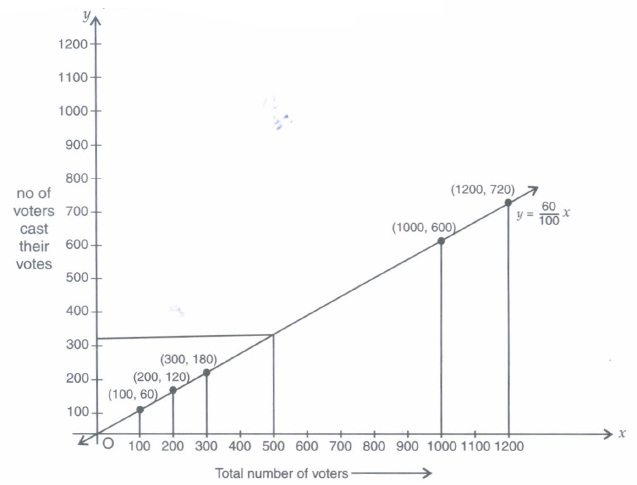
(ii) If the total number of voters are 1000, then number of votes cast=600.
(iii) Everyone should cast his vote to elect an honest candidate.
41.
We have
y=4x+3
Table of solution
| x | 0 | 1 |
|---|---|---|
| y | 3 | 7 |
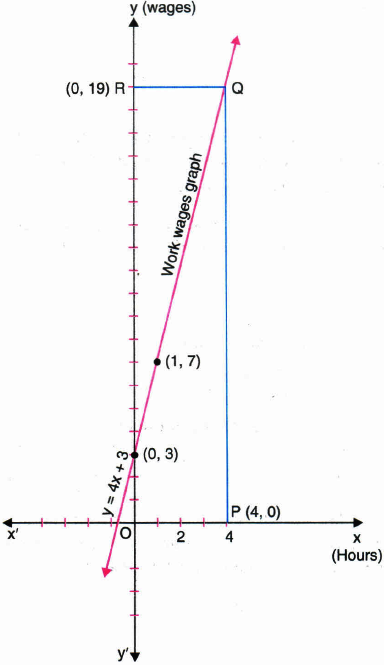
We plot the points (0,3) and (1, 7) on a graph paper and join the same by a ruler to get the line, which is the graph of the equation y = 4x + 3.
This gives the work wages graph of the given equation.
Now, on x-axis, take a point P(4, 0). From P draw a line parallel to y-axis intersecting the work wage graph at Q. From Q, draw a line parallel to x-axis to intersect the y-axis at R. We see that R is (0, 19).
Hence, the wages of a laborer who puts in 4 hours of work is Rs.19.
42.
The given linear equation
\(\Rightarrow\ \ y={2\over3}x+{1\over3}\ \ \ \ . . . .(1)\)
Table of solution
| x | 1 | 4 |
|---|---|---|
| y | 1 | 3 |
We plot the points (1, 1) and (4, 3) on a graph paper and join the same by a ruler to get the line which is the graph of the equation \(y={2\over3}x+{1\over3}\)
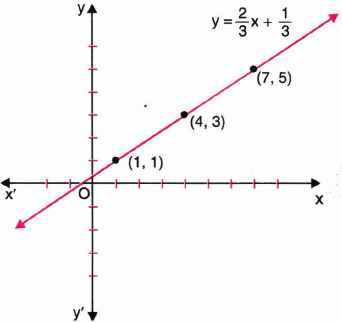
From graph, we see that the point (7, 5) lies on the graph, so it is a solution of the linear equation.
43.
(a) The coordinates A, B, C, D are (8,10), (-5,13), (13,5), (-4,-16) respectively.
(b) The triangle ABC has been shaded.
44.
(i)
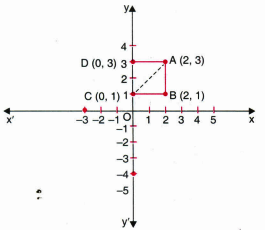
(ii) see above figure
(iii) The figure obtained is a square.
(iv) Perimeter of the figure = 4 x 2 = 8 units
(v) Area of the figure = (2? = 4 square units
(vi) Join AC.
In right triangle ABC,
AC2 =AB2 +BC2 I By Pythagoras Theorem
= 22+22=4+4=8
\(\Rightarrow AC=\sqrt { 8 } =2\sqrt { 2 } \ units\)
Apala is correct.
So, the value 'Excellent Geometrical Knowledge is depicted by her finding.
(vii) The mathematical concept 'Coordinate Geometry' has been covered in this problem.
45.
L.H.S=\((a+b)^3+(b+c)^3+(c+a)^3-3(a+b)(b+c)(c+a)\)
\(=\left\{ (a+b)+(b+c)+(c+a) \right\} [(a+b)^2+(b+c)^2+(c+a)^2-(a+b)(b+c-(b_c)(c+a)-(c+a)(a+b)]\)
\(=2(a+b+c)[a^2+2ab+b^2+b^2+2bc+c^2+c^2+2ca+c^2-ab-ac-b^2-bc-bc-ba-c^2-ca-ca-cb-a^2-ab]\)
Using Identity I
\(=2(a+b+c)(a^2+b^2+c^2-ab-bc-ca)\)
\(=2(a^3+b^3+c^3-3abc)\)Using Identity VIII
46.
\(\frac{87^3+13^3}{87^2-87\times13+13^3}\)
\(=\frac{(87+13(87^2-87\times13+12^2)}{(87^2-87\times13+13^2)}\)
= 87+13=100
47.
()
\(\left( x+\frac { 1 }{ 2 } \right) \left( x+\frac { 3 }{ 2 } \right) \)\(={ x }^{ 2 }+\frac { 3 }{ 2 } x+\frac { 1 }{ 2 } x+\frac { 3 }{ 4 } \)
\(={ x }^{ 2 }+2x+\frac { 3 }{ 4 } \)
48.
()
\(\frac{1}{\sqrt{50}}=\frac{1}{\sqrt{5\times5\times2}}\)
=\(\frac{1}{5\sqrt{2}}\times\frac{\sqrt{2}}{\sqrt{2}}=\frac{\sqrt{2}}{10}\)
So, rationalizing factor is \(\sqrt{2}\)
49.
()
8y3-125x3=(2y)3-(5x)3
=(2y - 5x)(4y2+10xy+25x2)
50.
()
12a2b-6ab2=6ab(2a-b)
51.
()
\(\frac{58}{1000}\)= 0.058 (Decimal point is shifted three places to the left)
52.
()
(1,-1)
53.
()
Linear polynomial.
54.
()
Let the runs scored by Raina & Dhoni are x & y respectively then,
x+y=198
55.
()
No(∵ a,b≠0 for a linear equation)
56.
()
(i) False, because 0 is not a natural number.
(ii) True, because 0 is non-negative and non-positive integer.
(iii) False, because there are infinitely many rational number between two rational number.
57.
\(\frac { 4 }{ { \left( 216 \right) }^{ -\frac { 2 }{ 3 } } } +\frac { 1 }{ { \left( 216 \right) }^{ -\frac { 3 }{ 4 } } } +\frac { 2 }{ { \left( 216 \right) }^{ -\frac { 1 }{ 5 } } } \)
\(=\frac { 4 }{ { \left( { 6 }^{ 3 } \right) }^{ -\frac { 2 }{ 3 } } } +\frac { 1 }{ { \left( { 4 }^{ 4 } \right) }^{ -\frac { 3 }{ 4 } } } +\frac { 2 }{ { \left( { 3 }^{ 5 } \right) }^{ -\frac { 1 }{ 5 } } } \)
\(=\frac { 4 }{ { 6 }^{ -2 } } +\frac { 1 }{ { 4 }^{ -3 } } +\frac { 2 }{ { 3 }^{ -1 } } \)
\(=\frac { 4 }{ { 36 }^{ -1 } } +\frac { 4 }{ { 64 }^{ -1 } } +\frac { 2 }{ { 3 }^{ -1 } } \)
= 4 x 36 + 1 x 64 + 2 x 3
= 214

9th Standard CBSE Syllabus & Materials
9th Standard CBSE
CBSE 9th Mathematics Lines and Angles Sample Question Papers Study Material - QB365 Set A
NEW9th Standard CBSE
CBSE 9th Mathematics Introduction to Euclid's Geometry Sample Question Papers Study Material - QB365 Set A
NEW9th Standard CBSE
CBSE 9th Mathematics Linear Equations in Two Variables Sample Question Papers Study Material - QB365 Set A
NEW9th Standard CBSE
CBSE 9th Mathematics Coordinate Geometry Sample Question Papers Study Material - QB365 Set A



NCERT Books

Syllabus

Exam Pattern

Sample Question Papers

Previous year Question Papers

Important Notes

MCQ Practice test

NCERT Exemplers

Case study Questions

Image Based Questions

Passage based Questions

HOT Questions

Value Based Questions

Model Questions Papers
NCERT ( Book Back ) Questions

Assertion and Reason
Important Questions And Answers

CBSE 9th Standard CBSE Subjects
CBSE Standards