100% FREE ACCESS
9th Standard CBSE Syllabus & Materials
9th Standard CBSE
CBSE 9th Science Is matter around us pure? - New Model Questions Papers Study Material - QB365 Set A
NEW9th Standard CBSE
CBSE 9th Science Matter in our surroundings - New Model Questions Papers Study Material - QB365 Set A
NEW9th Standard CBSE
CBSE 9th Mathematics Heron's Formula Sample Question Papers Study Material - QB365 Set A
NEW9th Standard CBSE
CBSE 9th Mathematics Circles Sample Question Papers Study Material - QB365 Set A
NEW9th Standard CBSE
CBSE 9th Mathematics Quadrilaterals Sample Question Papers Study Material - QB365 Set A
NEW9th Standard CBSE
CBSE 9th Mathematics Triangles Sample Question Papers Study Material - QB365 Set A

Published on: 29/10/2025
Download CBSE Class 9th Standard CBSE Mathematics question papers, sample papers, important questions, and previous year solved papers in PDF format. Get free study materials, NCERT solutions, and exam preparation resources for Class 9th Standard CBSE Mathematics
Questions + Answers key
Take MCQ Mathematics Test
1.
In the adjoining figure AB॥ CD॥ EG, find the value of x.
2.
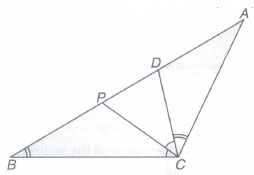
In the given figure, \(\angle ACD=\angle ABC\) CP bisects \(\angle BCD.\) Prove that \(\angle APC=\angle ACP.\)
3.
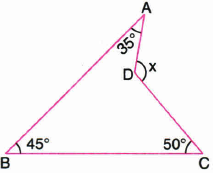
In figure Find the value of x
4.
Prove that if one triangle is equal to the sum of the other two angles the triangle is right angled.
5.
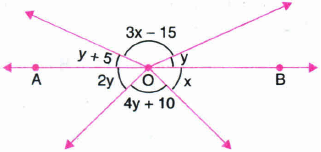
In figure, if y=\(20^{ 0 }\) , prove that the line AOB is a straight line.
6.
In the adjoining figure, if two parallel lines AB and CD are cut by a transversal EF at G and Hand \(\angle\)l and \(\angle\)2 are in the ratio of 3 : 2, then find \(\angle\)5 and \(\angle\)6.
7.
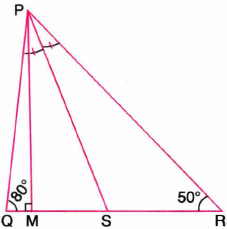
In the given figure \(\angle QPR\quad PM\bot QR\quad find\quad \angle MPS\)
8.
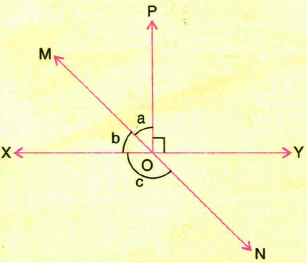
In the figure lines XY and MN Intersect at O if POY = \(90^{ 0 }\) and a:b =3 find the value of c
9.
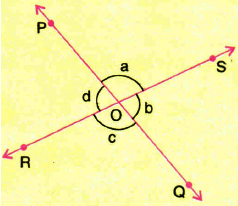
Lines PQ and Rs Intersect each other at O (see figure) If \(\angle \)POR;\(\angle \)ROQ=3:7 Find all the angles a,b,c and d.
10.
If (3x-\(58^{ 0 }\)) and (x+\(38^{ 0 }\)) are supplementary angles,find x and the angles.
11.
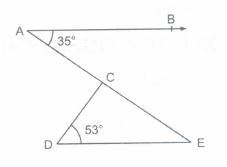
In the following figure, if AB ॥ DE, ∠BAC = 35o and ∠CDE = 53о, find ∠DCE.
12.
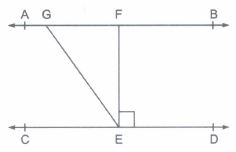
In the following figure, if AB II CD, EF ⊥ CD and ∠GED = 126o find ∠AGE, ∠GEF and ∠FGE.
13.
In the adjoining figure, POQ is a line. Ray OR is perpendicular to line PQ. OS is another ray lying between rays OP and OR. Prove that ∠ROS = \(\frac{1}{2}\) (∠QOS - ∠POS).
14.
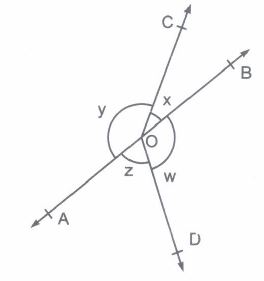
In the following figure, if x + y = w + z, then prove that AOB is a line.
15.
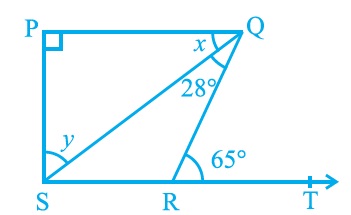
In the given figure, if PQ 丄 PS, PQ || SR, ㄥSQR = 28° and ㄥQRT = 65°, then find the values of x and y.
16.
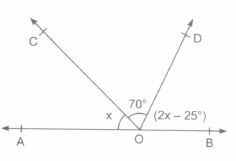
In the adjoining figure, find ∠AOC and ∠BOD.
17.
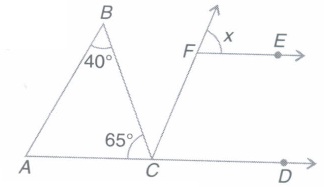
In the figure, if AB||CF and CD||FE, then find the value of x.
18.
In the given figure, if l1 || l2 and a1 || a2,then find the value of x.
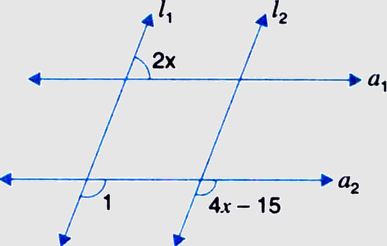
19.
Prove that through a given point, we can draw only one perpendicular to a given line.
20.
Prove that two lines that are respectively perpendicular to two intersecting lines intersect each other.
1.
Through E, let us draw FEG ॥ AB ॥ CD.
Now, since FE॥ AB and BE is a transversal.
∴ ∠ABE + ∠BEF = 180° [Interior opposite angles]
⇒ 127° + ∠BEF = 180°
⇒ ∠BEF = 180° - 127° = 53°
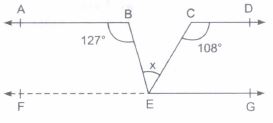
Again, EG ॥ CD and CE is a transversal.
∴ ∠DCE + ∠CEG = 180° [Interior opposite angles]
⇒ 108° + ∠CEG = 180°
⇒ ∠CEG = 180° - 108° = 72°
Since FEG is a straight line, then
⇒ ∠BEF + ∠BEC + ∠CEG = 180° [Sum of angles at a point on the same side of a line = 180°]
⇒ 53° + x + 72° = 180°
⇒ x = 180° - 53° - 72° = 55°
Thus, the required measure of x = 55°.
2.
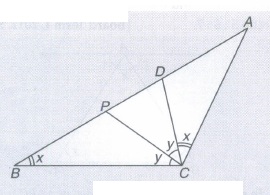
\(\angle ACD=\angle ABC=x\)
\(\angle BCP=\angle DCP=y\)
Ext \(\angle APC=x+y\)
\(\angle ACP=x+y\)
\(\angle ACP=\angle APC\)
3.
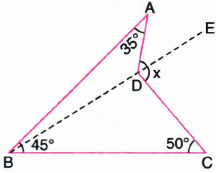
Construction Join BD and extend upto E
\(x=\angle ADC\)
=\(x=\angle ADE+\angle CDE\)
=\(x=\angle DAB+\angle ABD+(\angle DBC+\angle DCB\)
|Exterior Angle Theoram
\(=30^{ 0 }+\angle ABD)+\angle DBC+50^{ 0 }\)
=\(35^{ 0 }+\angle ABD)+\angle DBC+50^{ 0 }\)
= \(35^{ 0 }+45^{ 0 }+50^{ 0 }=130^{ 0 }\)
4.
Let in \(\triangle \)ABC \(\angle A=\angle B+\angle C\)
We know that \(\angle A=\angle B+\angle C=180^{ 0 }\)
The sum of the three angles of a triangle is \(180^{ 0 }\)
\(\Rightarrow \angle A+\angle A=180^{ 0 }\)
\(\Rightarrow 2\angle A=180^{ 0 }\)
\(\Rightarrow \angle A=\frac { 180^{ 0 } }{ 2 } =90^{ 0 }\)
Hence Triangle ABC is a right-angled triangle.
5.
\(\because \) Sum of all the angle round a point is equal to \(360^{ 0 }\)
\(\therefore \) y+(3x-15)+(y+15)+2y+(4y+10)+x=\(360^{ 0 }\)
\(\Rightarrow \) 4x+8y=\(360^{ 0 }\)
\(\Rightarrow \) x+2y=\(90^{ 0 }\)
\(\Rightarrow \) x+2(\(20^{ 0 }\))=\(90^{ 0 }\)
\(\Rightarrow \) x+\(40^{ 0 }\)=\(90^{ 0 }\)
\(\Rightarrow x=50^{ 0 }\)
Now, y+3x-15+y+5=3x+2y-10
= 3(\(50^{ 0 }\))+2(\(20^{ 0 }\))-10
\(=150^{ 0 }+40^{ 0 }-10^{ 0 }\)
= \(180^{ 0 }\)
\(\therefore \) AOB is straight line.
6.
Let \(\angle\)1= 3x and \(\angle\)2 = 2x
\(\because\) 3x + 2x = 180o. \(\Rightarrow\) x = 36o.
\(\angle\)5 = \(\angle\)1= 3 x 36o = 180o
and \(\angle\)6 = \(\angle\)2 = 2 x 36o = 72o
7.
\(15^{ 0 }\)
8.
c=\(126^{ 0 }\)
9.
a =\(126^{ 0 }\), b =\(54^{ 0 }\), c =\(126^{ 0 }\), d =\(54^{ 0 }\)
10.
x=50, \(92^{ 0 }\) and \(88^{ 0 }\)
11.
∵ AB ॥ DE and AE is a transversal. [Given]
∴ ∠BAC = ∠AED [Interior alternate angles]
But ∠BAC = 35° [Given]
∴ ∠AED = 35°
Now, in ΔCDE, we have
∠CDE + ∠DEC + ∠DCE = 180о [Using the angle sum property]
∴ 53o + 35° + ∠DCE = 180° [∵ ∠DEC = ∠AED = 35° and ∠CDE = 53 (Given)]
⇒ ∠DCE = 180° - 53° - 35° = 92°
Thus, DCE = 92°
12.
AB II CD and GE is a transversal.
∴ Interior alternate angles are equal.
∴ ∠AGE = ∠GED
But ∠GED = 126о [Given]
∴ ∠AGE = 126о
Since ∠GED = 126о
∴ GEF + ∠FED = ∠GED
or ∠GEF + 90о = 126о
or ∠GEF = 126 - 90o = 36о
Next, AB II CD and GE is a transversal.
∴ ∠FGE + ∠GED = 180о
or ∠FGE + 126° = 180°
or ∠FGE = 180° - 126° = 54°
Thus, ∠AGE = 126°, ∠GEF = 36° and ∠FGE = 54°
13.
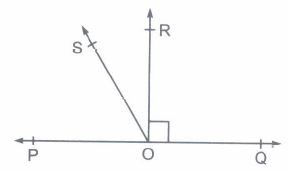
∵ POQ is a straight line. [Given]
∴ ∠POS + ∠ROS + ∠ROQ = 180о
But OR ⊥ PQ
∴ ∠ROQ = 90о
∴ ∠POS + ∠ROS + 90о = 180o
⇒ ∠POS + ∠ROS = 90о
Now, we have ∠ROS + ∠ROQ = ∠QOS ...(1)
⇒ ∠ROS + 90о = ∠QOS ...(2)
From (1) and (2), we have
∠ROS + [∠POS + ∠ROS] = ∠QOS
⇒ 2∠ROS + ∠POS = ∠QOS
⇒ 2∠ROS = [∠QOS - ∠POS]
∴ ∠ROS = \(\frac{1}{2}\)[∠QOS - ∠POS]
14.
∵ Sum of all the angles at a point = 360о
∴ x + y + z + w = 360o
or (x + y) + (z + w) = 360о
But (x + y) = (z + w) [Given]
∴ (x + y) + (x + y) = 360o
or 2(x + y) = 360о
or (x + y) = \(\frac{360^{\circ}}{2}\) = 180o
∴ AOB is a straight line.
15.
For ΔQSR, ㄥQRT is an exterior angle.
So, ㄥQRT = ㄥSQR + ㄥQSR
[ஃ exterior angle = sum of interior opposite angles]
⇒ 65° = 28° + ㄥQSR
[ஃ ㄥQRT = 65° and ㄥSQR = 28°, given]
⇒ ㄥQSR = 65° - 28°⇒ ㄥQSR = 37°
Given, PQ II SR and SQ is the transversal which intersects PQ and ST at Q and 5, respectively.
ஃ ㄥQSR = ㄥPQS [alternate interior angles]
⇒ x = 37°
Now, in ΔPQS, ㄥSPQ +ㄥPQS + ㄥPSQ = 180°
[since, sum of all the angles of a triangle is 180°]
⇒ 90° + 37° + y = 180° [ஃ PQ 丄 PS ⇒ ㄥSPQ = 90°]
⇒ 127°+ y = 180° ⇒ y = 180° -127° = 53°
Hence, x = 37° and y = 53°.
16.
∵ AOB is a straight line, then
∠AOC + ∠COD + ∠DOB =180°
⇒ x + 70° + (2x - 25°) = 180°
⇒ x + 2x = 180° + 25° - 70°
⇒ 3x = 205° - 70° = 135°
⇒ x = \(\frac{135^{\circ}}{3}\) = 45о
∴ ∠AOC = 45°
⇒ ∠BOD = 2x - 25° = 2(45°) - 25°
= 90° - 25° = 65°
17.
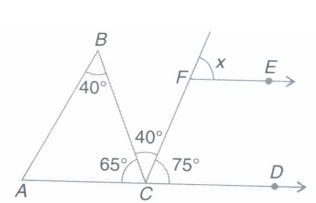
AB||CF
\(\therefore \angle ABC=\angle BCF\)(Alt Int. \(\angle's\))
\(40=\angle BCF\)
Now, \(\angle ACB+\angle BCF+\angle FCD\)
=180o(Linear pair)
\(65^0+40^o+\angle FCD=180^o\)
\(\Rightarrow \angle FCD=180^o-105^o\)
\(\Rightarrow \angle FCD=75^o\)
Now, FE||CD
\(\therefore \angle FCD=\angle x\)(Corresponding angles)
\(\angle x=75^o\)
18.
x = 32.5°
19.
Consider a line l and a point P.
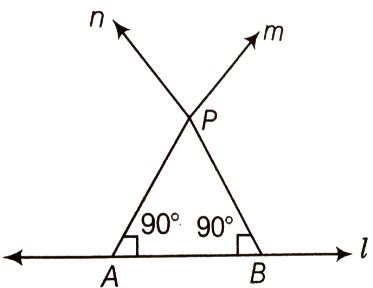
To prove Only one perpendicular line can be drawn through a given point, i.e. to prove ㄥP = 0°.
Proof Suppose there are two intersecting lines passing through the point P which are perpendicular to l.
In ΔAPB, ㄥA + ㄥP +ㄥB =180°
[by angle sum property of a triangle]
⇒ 90° + ㄥP + 90° = 180°
⇒ ㄥP = 180° - 180°
ஃ ㄥP=0°
So, lines n and m coincide.
Hence, only one perpendicular line can be drawn through a given point.
20.
Consider lines I and m be two intersecting lines. Again, let n and p be another two lines which are perpendicular to the intersecting lines and meet each other at point D.
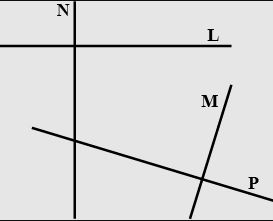
To prove Two perpendicular lines n and p drawn on two intersecting line meets at a point D.
Proof Suppose we consider lines n and p are not intersecting, then it means they are parallel to each other. i.e.
n || P ... (i)
Since, lines n and p are perpendicular to m and I, respectively.
But from Eq. (i), n || p, which implies that l || m.
This is a contradiction.
Thus, our assumption is wrong.
Hence, two perpendicular lines n and p drawn on two intersecting line meets at a point D.

9th Standard CBSE Syllabus & Materials
9th Standard CBSE
CBSE 9th Mathematics Lines and Angles Sample Question Papers Study Material - QB365 Set A
NEW9th Standard CBSE
CBSE 9th Mathematics Introduction to Euclid's Geometry Sample Question Papers Study Material - QB365 Set A
NEW9th Standard CBSE
CBSE 9th Mathematics Linear Equations in Two Variables Sample Question Papers Study Material - QB365 Set A
NEW9th Standard CBSE
CBSE 9th Mathematics Coordinate Geometry Sample Question Papers Study Material - QB365 Set A



NCERT Books

Syllabus

Exam Pattern

Sample Question Papers

Previous year Question Papers

Important Notes

MCQ Practice test

NCERT Exemplers

Case study Questions

Image Based Questions

Passage based Questions

HOT Questions

Value Based Questions

Model Questions Papers
NCERT ( Book Back ) Questions

Assertion and Reason
Important Questions And Answers

CBSE 9th Standard CBSE Subjects
CBSE Standards