100% FREE ACCESS
9th Standard CBSE Syllabus & Materials
9th Standard CBSE
CBSE 9th Science Is matter around us pure? - New Model Questions Papers Study Material - QB365 Set A
NEW9th Standard CBSE
CBSE 9th Science Matter in our surroundings - New Model Questions Papers Study Material - QB365 Set A
NEW9th Standard CBSE
CBSE 9th Mathematics Heron's Formula Sample Question Papers Study Material - QB365 Set A
NEW9th Standard CBSE
CBSE 9th Mathematics Circles Sample Question Papers Study Material - QB365 Set A
NEW9th Standard CBSE
CBSE 9th Mathematics Quadrilaterals Sample Question Papers Study Material - QB365 Set A
NEW9th Standard CBSE
CBSE 9th Mathematics Triangles Sample Question Papers Study Material - QB365 Set A

Published on: 29/10/2025
Download CBSE Class 9th Standard CBSE Mathematics question papers, sample papers, important questions, and previous year solved papers in PDF format. Get free study materials, NCERT solutions, and exam preparation resources for Class 9th Standard CBSE Mathematics
Questions + Answers key
Take MCQ Mathematics Test
1.
In a ΔDEF, ∠F > ∠E then which of the following is true?
EF > DF
DE > DF
DE < DF
EF < DF
2.
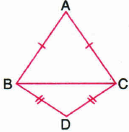
In figure, if AB = AC and BD = DC, ΔABD and ΔACD are congruent by which criterion.
SSS
ASA
SAS
RHS
3.
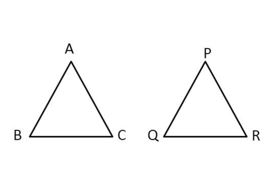
If AB = QR, BC = PR and CA = PQ then:
ΔABC ≅ ΔPQR
ΔCBA ≅ ΔPRQ
ΔBAC ≅ ΔRPQ
ΔPQR ≅ ΔBCA
4.
In ΔPQR, PQ = PR and ㄥQ = 650, then ㄥP is :
550
1300
650
500
5.
In two triangles ABC and DEF, ㄥA = ㄥD, ㄥB = ㄥE and AB = EF, then are the two triangles congruent? If yes, by which congruency rule?
yes, by AA
NO
yes, by ASA
Yes, by RHS
6.
The side of an equilateral triangle is 4cm.An equilateral triangle, congruent to it, has the side length
1 cm
2 cm
3 cm
4 cm
7.
Each angle of an equilateral triangle is :
\(50^{ 0 }\)
\(90^{ 0 }\)
\(80^{ 0 }\)
\(60^{ 0 }\)
8.
A pair of angles is called linear pair if the sum of two adjacent angles is:
\(90^{ 0 }\)
\(180^{ 0 }\)
\(230^{ 0 }\)
\(360^{ 0 }\)
9.
The compliment of (\(90^{ 0 }\)-\(a^{ 0 }\)) is
\(-a^{ 0 }\)
\(90^{ 0 }\)+\(a^{ 0 }\)
\(90^{ 0 }\)-\(a^{ 0 }\)
\(a^{ 0 }\)
10.
A reflex angle
is greater than \(180^{ 0 }\) but less than \(360^{ 0 }\)
is exactly equal to \(180^{ 0 }\)
is exactly equal to \(90^{ 0 }\)
is greater than \(90^{ 0 }\) but less than \(180^{ 0 }\)
11.
The minimum number of points required to draw a line is
1
2
3
4
12.
If the point P lies in between M and N, and C is mid point of MP, then:
MC + PN + = MN
MP + CP = MN
MC + CN + MN
CP + CN = MN
13.
How many numbers of lines do pass through two distinct points?
1
2
3
4
14.
Pythagoras was a student of
Thales
Euclid
both (a) and (b)
Archimedes
15.
In Indus Valley Civilisation (about 300 b.C), The brick used for construction work were having dimension in the ration
1 : 3 : 4
4 : 2 : 1
4 : 4 : 1
4 : 3 : 2
16.
If x=3-3y and y=-2 is a solution of the equation 4px-3y=12, then the value of p is:
0
\(1\over2\)
2
3
17.
Straight line passing through the points (-1, 1), (0,0) and (1, -1) has equation:
y=x
x+y=0
y=2x
2+3y=7x
18.
The equation whose graph is
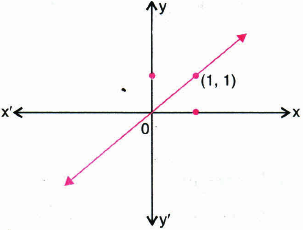
y=x
x+y=0
x+y=1
y-x=1
19.
The equation of y-axis is
x=0
y=0
x=1
y=1
20.
The line y=mx+c
passes through origin
does not pass through origin
is parallel to x-axis
is parallel to y-axis
21.
The distance of a point (0,-3) from the origin is:
1
0
-1
None of these
22.
If the point A(0,2), B(0,-6) aand C(a,3) lie on y - axis, then the value of a is:
0
2
3
-6
23.
In which quadrant does the point (-1,-1) lie?
I
II
III
IV
24.
The line of intersection of IV and I quadrants is
x - axis
y - axis
vertical axis
None of these
25.
The line of intersection of III and IV quadrants is
y - axis
x - axis
horizontal axis
None of these
26.
Sanjay bought 5 notebooks and 2 pens for Rs. 120. He told to guess the cost of each notebook and pen to his friends Mohan and Anil. Sanjay has given the clue that both the costs are positive integers and divisible by 5 such that the cost of a notebook is greater than that of a pen.
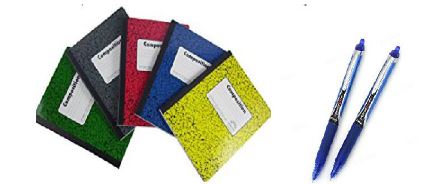
Now, Mohan and Anil tried to guess.
Mohan said that price of each notebook could be Rs. 18. Then five notebooks would cost Rs.90, the two pens would cost Rs.30 and each pen could be for Rs. 15. Anil felt that Rs. 18 for one notebook was too little. It should be at least Rs. 20. Then the price of each pen would also be Rs.10.
(i) Form the linear equations in two variables from this situation by taking cost of one notebook as Rs. x and cost of one pen as Rs. y.
| (a) 2x + 5y = 120 | (b) 5x + y = 120 |
| (c) x + y = 120 | (d) 5x + 2y = 120 |
(ii) Which is the solution of the equations formed in (i)?
| (a) x = 10, y = 20 | (b) x = 20, y = 10 |
| (c) x = 15, y = 15 | (d) none of these |
(c) If the cost of one notebook is Rs. 15 and cost of one pen is 10, then find the total amount.
| (i) Rs. 120 | (ii) Rs. 95 |
| (iii) Rs. 105 | (iv) Rs. 125 |
(d) If the cost of one notebook is twice the cost of one pen, then find the cost of one pen?
| (a) Rs. 20 | (b) Rs. 10 |
| (c) Rs. 5 | (d) Rs. 15 |
(e) Which is the standard form of linear equations y = 4 ?
| (i) y – 4 = 0 | (ii) 1.y + 4 = 0 |
| (iii) 0.x + 1.y + 4 = 0 | (iv) 0.x + 1.y – 4 = 0 |
27.
Aditya is a Class IX student residing in a village. One day, he went to a city Hospital along with his grandfather for general checkup. From there he visited three places - School, Library and Police Station. After returning to his village, he plotted a graph by taking Hospital as origin and marked three places on the graph as per his direction of movement and distance. The graph is shown below:
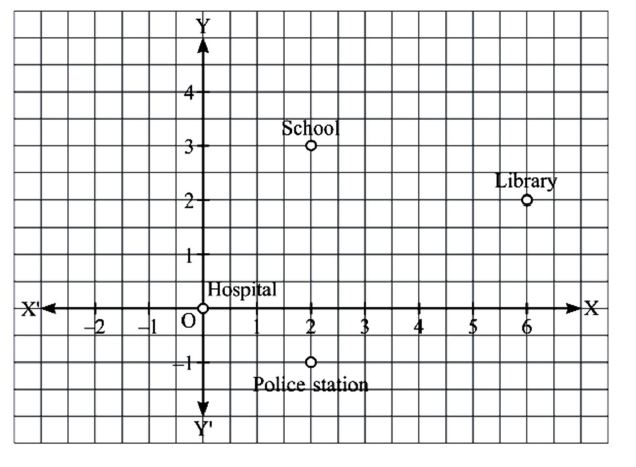
(i) What are the coordinates of School?
| (a) (3, 2) | (b) (2, 3) |
| (c) (3, 5) | (d) (5, 3) |
(ii) What are the coordinates of Police Station?
| (a) (2, -1) | (b) (2, 1) |
| (c) (-2, -1) | (d) (-2, 1) |
(iii) Distance between school and police station:
| (a) 4 | (b) 3 | (c) 2 | (d) 1 |
(iv) What are the coordinates of Library?
| (a) (2, 6) | (b) (2, -6) |
| (c) (6, -2) | (d) (6, 2) |
(v) In which quadrant the point (-1, 4) lies?
| (a) I | (b) II |
| (c) III | (d) IV |
28.
Students of a school are standing in rows and columns in their playground for a drill practice. A, B, C and D are the positions of four students as shown in the figure.
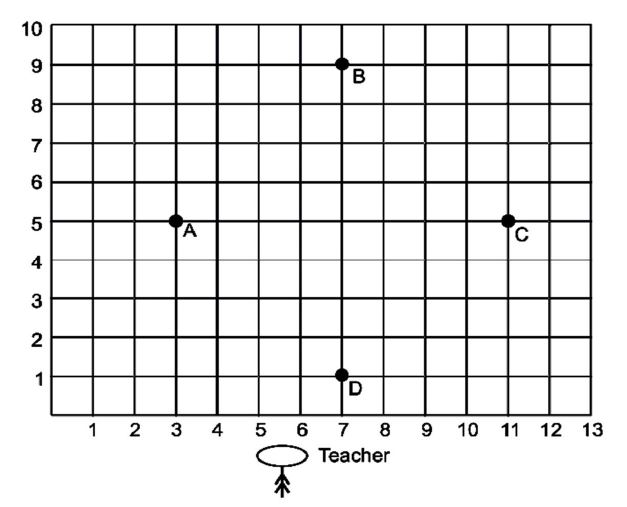
(a) What are the coordinates of A and B respectively?
| (i) A(3, 5); B(7, 8) | (ii) A(5, 3); B(8, 7) |
| (iii) A(3, 5); B(7, 9) | (iv) A(5, 3); B(9, 7) |
(b) What are the coordinates of C and D respectively?
| (i) C(11, 5); D(7, 1) | (ii) C(5, 11); D(1, 7) |
| (iii) C(5, 11); D(7, 1) | (iv) C(5, 11); D(-1, 7) |
(c) What is the distance between B and D?
| (i) 5 units | (ii) 14 units |
| (iii) 8 units | (iv) 10 units |
(d) What is the distance between A and C?
| (i) 5 units | (ii) 14 units |
| (iii) 8 units | (iv) 10 units |
(e) What are the coordinates of the point of intersection of AC and BD?
| (i) (7, 5) | (ii) (5, 7) |
| (iii) (7, 7) | (iv) (5, 5) |
29.
In the below given layout, the design and measurements has been made such that area of two bedrooms and Kitchen together is 95 sq. m.
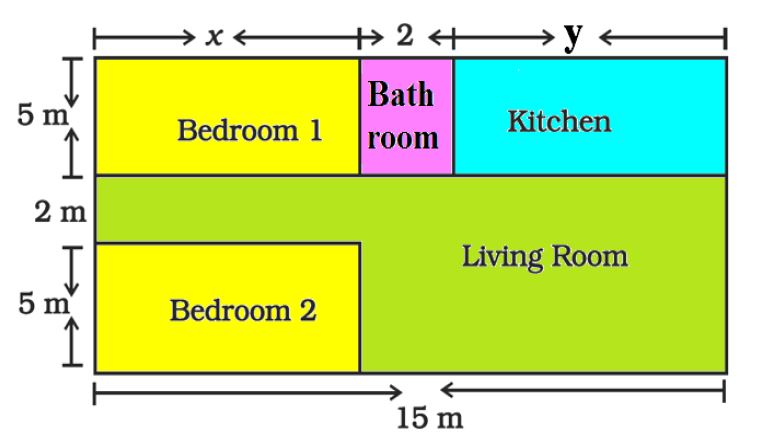
(i) The area of two bedrooms and kitchen are respectively equal to
| (a) 5x, 5y | (b) 10x, 5y |
| (c) 5x, 10y | (c) x, y |
(ii) Find the length of the outer boundary of the layout.
| (a) 27 m | (b) 15 m | (c) 50 m | (d) 54 m |
(iii) The pair of linear equation in two variables formed from the statements are
(a) x + y = 13, x + y = 9
(b) 2x + y = 13, x + y = 9
(c) x + y = 13, 2x + y = 9
(d) None of the above
(iv) Which is the solution satisfying both the equations formed in (iii)?
| (a) x = 7, y = 6 | (b) x = 8, y = 5 |
| (c) x = 6, y = 7 | (d) x = 5, y = 8 |
(v) Find the area of each bedroom.
| (a) 30 sq. m | (b) 35 sq. m |
| (c) 65 sq. m | (d) 42 sq. m |
30.
Assertion : In ∆ABC and ∆PQR, AB = PQ, AC = PR and ∠BAC = ∠QPR then ∆ABC ≅ ∆PQR
Reason : Both the triangles are congruent by SSS congruence.
Codes:
(a) Both assertion (A) and reason (R) are true and reason (R) is the correct explanation of assertion (A). (b)Both assertion (A) and reason (R) are true but reason (R) is not the correct explanation of assertion (A).
(c) Assertion (A) is true but reason (R) is false.
(d)Assertion (A) is false but reason (R) is true.
31.
Assertion : Angles opposite to equal sides of a triangle are not equal.
Reason : Sides opposite to equal angles of a triangle are equal.
Codes:
(a) Both assertion (A) and reason (R) are true and reason (R) is the correct explanation of assertion (A).
(b) Both assertion (A) and reason (R) are true but reason (R) is not the correct explanation of assertion (A)
(c) Assertion (A) is true but reason (R) is false.
(d)Assertion (A) is false but reason (R) is true.
32.
Assertion : In ∆ABC, D is the midpoint of BC. If DL ⊥ AB and DM ⊥ AC such that DL = DM, then BL = CM
Reason : If two angles and the included side of one triangle are equal to two angles and the included side of the other triangle, then the two triangles are congruent.
33.
Assertion : The angles of a triangle are in the ration 3 : 5 : 7. The triangle is acute- angled
Reason : The sum of angles that are formed on a straight line is equal to 180°.
Codes
(a) Both assertion (A) and reason (R) are true and reason (R) is the correct explanation of assertion (A).
(b) Both assertion (A) and reason (R) are true but reason (R) is not the correct explanation of assertion (A).
(c) Assertion (A) is true but reason (R) is false.
(d) Assertion (A) is false but reason (R) is true.
34.
Assertion : If two interior angles on the same side of a transversal intersecting two parallel lines are in the ratio 5 : 4, then the greater of the two angles is 100о.
Reason : If a transversal intersects two parallel lines, then the sum of the interior angles on the same side of the transversal is 180о.
Codes
(a) Both assertion (A) and reason (R) are true and reason (R) is the correct explanation of assertion (A).
(b) Both assertion (A) and reason (R) are true but reason (R) is not the correct explanation of assertion (A).
(c) Assertion (A) is true but reason (R) is false.
(d) Assertion (A) is false but reason (R) is true.
35.
Assertion : The graph of the linear equation 2x – y = 1 passes through the point (2, 3).
Reason : Every point lying on graph is not a solution of 2x – y = 1.
Codes:
(a) Both assertion (A) and reason (R) are true and reason (R) is the correct explanation of assertion (A).
(b) Both assertion (A) and reason (R) are true but reason (R) is not the correct explanation of assertion (A).
(c) Assertion (A) is true but reason (R) is false.
(d) Assertion (A) is false but reason (R) is true.
36.
Assertion : There are infinite number of lines which passes through (3, 2).
Reason : A linear equation in two variables has infinitely many solutions.
Codes:
(a) Both assertion (A) and reason (R) are true and reason (R) is the correct explanation of assertion (A).
(b) Both assertion (A) and reason (R) are true but reason (R) is not the correct explanation of assertion (A).
(c) Assertion (A) is true but reason (R) is false.
(d) Assertion (A) is false but reason (R) is true.
37.
Assertion : The points (-1, 2) and (2,- 1) are at different positions in the coordinate plane.
Reason : Point (-1, 2) lies in II-quadrant and (2,- 1) lies in IV quadrant
Codes:
(a) Both assertion (A) and reason (R) are true and reason (R) is the correct explanation of assertion (A).
(b) Both assertion (A) and reason (R) are true but reason (R) is not the correct explanation of assertion (A).
(c) Assertion (A) is true but reason (R) is false.
(d) Assertion (A) is false but reason (R) is true.
38.
Assertion: Point (4, -2) lies in IV quadrant.
Reason: The perpendicular distance of a point from y-axis is called its abscissa.
Codes:
(a) Both assertion (A) and reason (R) are true and reason (R) is the correct explanation of assertion (A).
(b) Both assertion (A) and reason (R) are true but reason (R) is not the correct explanation of assertion (A).
(c) Assertion (A) is true but reason (R) is false.
(d) Assertion (A) is false but reason (R) is true.
1.
(b)
DE > DF
2.
AB=AC
BD=CD
AD=AD
ΔABD ≅ ΔACD
3.
AB=QR
BC=PR=RP
CA=PQ
∴ A ↔ Q
B ↔ R
C ↔ P
∴ ΔCBA ≅ ΔPRQ
4.
(d)
500
5.
(c)
yes, by ASA
6.
Two equilateral triangles of the same side length are congruent
7.
\(\angle A+\angle B+\angle C\)
\(\therefore \angle A=\angle B=\angle C=60^{ 0 }\)
8.
Linear Pair Axiom
9.
Complement of (\(90^{ 0 }\)-\(a^{ 0 }\))
=\(90^{ 0 }\)-(\(90^{ 0 }\)-\(a^{ 0 }\))=\(a^{ 0 }\)
10.
Definition of a reflex angle
11.
(b)
2
12.
(c)
MC + CN + MN
13.
(a)
1
14.
(a)
Thales
15.
(b)
4 : 2 : 1
16.
4p(3)-3(-2)=12 ⇒ \(p={1\over2}\)
17.
All the points satisfy x+y=0
18.
(1,1) satisfies y=x
19.
(a)
x=0
20.
O(0,0) does not satisfy y=mx+c
21.
(a)
1
22.
(a)
0
23.
(c)
III
24.
(a)
x - axis
25.
(a)
y - axis
26.
(i) (d) 5x + 2y = 120
Here, the cost of one notebook be Rs. x and that of pen be Rs. y.
According to the statement, we have 5x + 2y = 120
(ii) (b) x = 20, y = 10
5x + 2y = 5(10) + 2(20) = 50 + 40 = 90 ≠ 120
5x + 2y = 5(20) + 2(10) = 100 + 20 = 120
5x + 2y = 5(15) + 2(15) = 75 + 30 = 105 ≠ 120
(c) (ii) Rs. 95
5x + 2y = 5(15) + 2(10) = 75 + 20 = 95
(d) (b) Rs. 10
Here, x = 2y
5(2y) + 2y
= 10y + 2y = 12y = 120
⇒ y = 10
(e) (iv) 0.x + 1.y – 4 = 0
Since, y = 4 ⇒ y – 4 = 0
Thus, standard form of y = 4 is 0.x + 1.y – 4 = 0
27.
(i) (b) (2, 3)
(ii) (a) (2, -1)
(iii) (a) 4
(iv) (d) (6, 2)
(v) (b) II
28.
(a) (iii) A(3, 5); B(7, 9)
(b) (i) C(11, 5); D(7, 1)
(c) (iii) 8 units
(d) (iii) 8 units
(e) (i) (7, 5)
29.
(i) (b) 10x, 5y
Area of one bedroom = 5x sq.m
Area of two bedrooms = 10x sq.m
Area of kitchen = 5y sq. m
(ii) (d) 54 m
Length of outer boundary = 12 + 15 + 12 + 15 = 54 m
(iii) (d) None of the above
Area of two bedrooms = 10x sq.m
Area of kitchen = 5y sq. m
So, 10x + 5y = 95 2x + y = 19
Also, x + 2 + y = 15 x + y = 13
(iv) (c) x = 6, y = 7
x + y = 6 + 7 = 13
2x + y = 2(6) + 7 = 19
x = 6, y = 7
x + y = 6 + 7 = 13
2x + y = 2(6) + 7 = 19
x = 6, y = 7
(v) (a) 30 sq. m
Area of living room = (15 x 7) – 30
= 105 – 30 =75 sq. m
30.
In ∆ABC and ∆PQR,
AB = PQ, AC = PR and ∠BAC = ∠QPR (Given)
then ∆ABC ≅ ∆PQR by ASA Congruence Rule So, Assertion (A) is true.
But Reason (R) is false.
Correct option is (c) Assertion (A) is true but reason (R) is false.
31.
We know that Angles opposite to equal sides of a triangle are equal.
So, Assertion is not correct.
Also, we know that Sides opposite to equal angles of a triangle are equal.
So, Reason is correct.
Correct option is (d) Assertion (A) is false but reason (R) is true.
32.
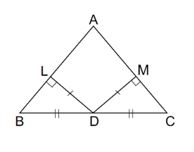
We know that “If two angles and the included side of one triangle are equal to two angles and the included side of the other triangle, then triangles are congruent.” - This is ASA Congruence Rule.
So, Reason is correct.
In △BDL and △CDM, we have
BD = CD (D is midpoint)
DL = DM (Given)
and ∠BLD = ∠CMD (90° each)
∴ △BDL ≅ △CDM (RHS criterion)
⇒ BL = CM (CPCT)
So, Assertion is also correct
Correct option is (b) Both assertion (A) and reason (R) are true and reason (R) is not the correct explanation of assertion (A).
33.
We know that the sum of angles that are formed on a straight line is equal to 180°.
So, Reason is correct
Also, the sum of all the interior angles of a triangle is 1800 Let the angles measure (3x)°, (5x)° and (7x)°.
Then,3x + 5x + 7x = 180° ⇒15x = 180° ⇒x = 12°
Therefore, the angles are 3(12)°=36°, 5(12)°=60° and 7(12)° = 84°. Hence, the triangle is acute-angled.
So, Assertion (A) is also true.
But reason (R) is not the correct explanation of assertion (A). Correct option is (b) Both assertion (A) and reason (R) are true and reason (R) is not the correct explanation of assertion (A).
34.
We know If a transversal intersects two parallel lines, then the sum of the interior angles on the same side of the transversal is 180о
hat the solution of the line will satisfy the equation of the line. So, Reason is correct.
Let the angles be 5x and 4x
Since, these two angles are co-interior angles. So, we
have 5x + 4x = 180о
⇒ 9x = 180о ⇒ x = 20о
Hence, greater angle = 5x = 5 x 200 = 100о
So, Assertion is also correct
Correct option is (a) Both assertion (A) and reason (R) are true and reason (R) is the correct explanation of assertion (A).
35.
For Assertion: The given linear equation is 2x – y = 1
Substituting x = 2 and y = 3, we get
LHS = 2 x 2 – 3 = 4 – 3 = 1 = RHS
Since (3, 0) satisfies the equation 4x + 3y = 12, therefore graph of the linear equation 2x – y = 1 passes through the point (2, 3).
So, Assertion is correct.
But Reason is not correct as every point lying on graph is a solution of 2x – y = 1.
Correct option is (c) Assertion (A) is true but reason (R) is false.
36.
We know that a linear equation in two variables has infinitely many solutions. So, Reason is correct.
Through a point infinite lines can be drawn.
Through (3, 2) infinite number of lines can be drawn.
Hence, Assertion is also correct.
But reason (R) is not the correct explanation of assertion (A).
Correct option is (b) Both assertion (A) and reason (R) are true and reason (R) is not the correct explanation of assertion (A).
37.
We know that Point (-1, 2) lies in II-quadrant and (2,- 1) lies in IV quadrant
So, Reason is correct.
Hence the points (-1, 2) and (2,- 1) are at different positions in the coordinate plane.
So, Assertion is also correct
Correct option is (a) Both assertion (A) and reason (R) are true and reason (R) is the correct explanation of assertion (A).
38.
We know that the perpendicular distance of a point from y-axis is called its x-coordinate or abscissa.
So, Reason is correct.
Point (4, -2) lies in IV quadrant.
So, Assertion is also correct but Reason is not the correct explanation of Assertion.
Correct option is (b) Both assertion (A) and reason (R) are true and reason (R) is not the correct explanation of assertion (A).

9th Standard CBSE Syllabus & Materials
9th Standard CBSE
CBSE 9th Mathematics Lines and Angles Sample Question Papers Study Material - QB365 Set A
NEW9th Standard CBSE
CBSE 9th Mathematics Introduction to Euclid's Geometry Sample Question Papers Study Material - QB365 Set A
NEW9th Standard CBSE
CBSE 9th Mathematics Linear Equations in Two Variables Sample Question Papers Study Material - QB365 Set A
NEW9th Standard CBSE
CBSE 9th Mathematics Coordinate Geometry Sample Question Papers Study Material - QB365 Set A



NCERT Books

Syllabus

Exam Pattern

Sample Question Papers

Previous year Question Papers

Important Notes

MCQ Practice test

NCERT Exemplers

Case study Questions

Image Based Questions

Passage based Questions

HOT Questions

Value Based Questions

Model Questions Papers
NCERT ( Book Back ) Questions

Assertion and Reason
Important Questions And Answers

CBSE 9th Standard CBSE Subjects
CBSE Standards