100% FREE ACCESS
9th Standard CBSE Syllabus & Materials
9th Standard CBSE
CBSE 9th Science Is matter around us pure? - New Model Questions Papers Study Material - QB365 Set A
NEW9th Standard CBSE
CBSE 9th Science Matter in our surroundings - New Model Questions Papers Study Material - QB365 Set A
NEW9th Standard CBSE
CBSE 9th Mathematics Heron's Formula Sample Question Papers Study Material - QB365 Set A
NEW9th Standard CBSE
CBSE 9th Mathematics Circles Sample Question Papers Study Material - QB365 Set A
NEW9th Standard CBSE
CBSE 9th Mathematics Quadrilaterals Sample Question Papers Study Material - QB365 Set A
NEW9th Standard CBSE
CBSE 9th Mathematics Triangles Sample Question Papers Study Material - QB365 Set A

Published on: 29/10/2025
Download CBSE Class 9th Standard CBSE Mathematics question papers, sample papers, important questions, and previous year solved papers in PDF format. Get free study materials, NCERT solutions, and exam preparation resources for Class 9th Standard CBSE Mathematics
Questions + Answers key
Take MCQ Mathematics Test
1.
In figure \(\angle PQR\) is
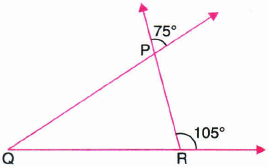
\(40^{ 0 }\)
\(50^{ 0 }\)
\(30^{ 0 }\)
\(105^{ 0 }\)
2.
The sum of all the interior angles of a pentagon is
\(900^{ 0 }\)
\(360^{ 0 }\)
\(540^{ 0 }\)
\(1080^{ 0 }\)
3.
In figure BC || DE if \(\angle ABC=\angle CDE=90^{ 0 }\) and \(\angle ACB=30^{ 0 }\) then the measure of \(\angle DCE\) is:
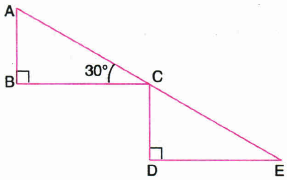
\(30^{ 0 }\)
\(60^{ 0 }\)
\(60^{ 0 }\)
\(180^{ 0 }\)
4.
If two parallel lines are cut by a transversal then which of the following is not true?
Corresponding angles are equal
Alternate interior angles are equal
Interior angles of the same side of the transversal are supplementary
Interior angles on the same side of the transversal are complimentary
5.
In the following figure two straight lines AB and CD intersect each other at O and angles formed at O are marked Here \(\angle x-\angle y\) has value
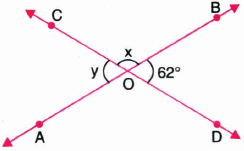
\(56^{ 0 }\)
\(118^{ 0 }\)
\(62^{ 0 }\)
\(180^{ 0 }\)
6.
In figure the value of y is:
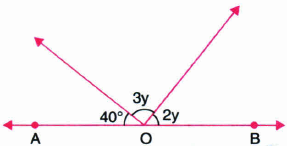
\(28^{ 0 }\)
\(32^{ 0 }\)
\(36^{ 0 }\)
\(44^{ 0 }\)
7.
A pair of angles is called linear pair if the sum of two adjacent angles is:
\(90^{ 0 }\)
\(180^{ 0 }\)
\(230^{ 0 }\)
\(360^{ 0 }\)
8.
We can draw two different lines in
Only one way
two different ways
three different ways
None of these
9.
The angle supplementary to \(60^{ 0 }\) is
\(30^{ 0 }\)
\(120^{ 0 }\)
\(45^{ 0 }\)
\(300^{ 0 }\)
10.
The angles whose sum is \(180^{ 0 }\) are called
supplementary angles
complementary angles
alternate angles
corresponding angles
11.
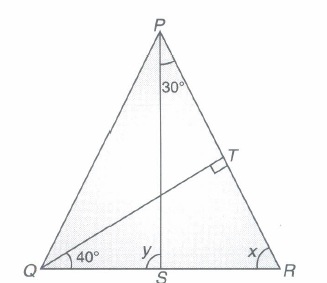
In the given figure QT 丄 PR, ㄥTQR = 40° and ㄥSPR= 30°, then find x and y.
12.
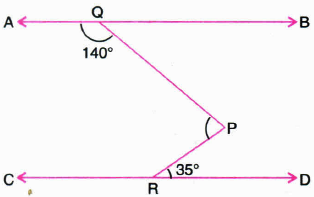
In the given figure ,AB || CD ,\(\angle AQP=140^{ 0 }\) \(\angle PRD=35^{ 0 }\) Find \(\angle QPR\) and reflex \(\angle QPR\)
13.
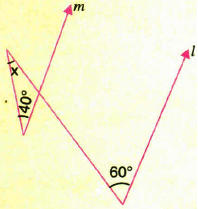
In the given figure if l || m then find the value of x.
14.
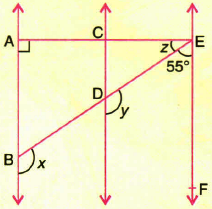
In the figure AB || CD and CD || EF Also \(EA\bot AB\) if \(\angle BEF=55^{ 0 }\) find the values of x,y and z
15.
(i) In figure ,AO \(\bot \)OB Find \(\angle \)AOC and \(\angle \) BOC
.png)
(ii) In figure,\(\angle \) AOB ;\(\angle \)BOC=2:3
If \(\angle \)AOC=\(75^{ 0 }\) then find the measure of ,\(\angle \) AOB ;\(\angle \)BOC
.png)
16.
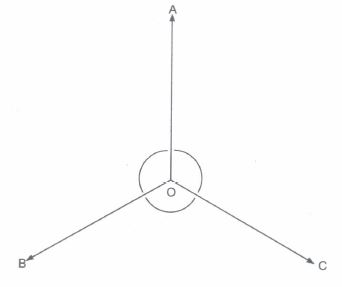
Three friends plan to help flood-victims. They move away from a point in three different directions such that the direction of each is equally inclined to those of the other two:
(i) Find the angles their directions
(ii) Which mathematical concept is used in the above problem?
(iii) By helping the flood-victims, which value is depicted by the teachers and students?
17.
The angles of a triangle are in the ratio 2 : 3 : 5. Find the measure of each angle of the triangle.
18.
Prove that the sum of the angles of a triangle is 180°.
19.
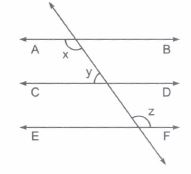
In the following Figure, if AB II CD, CD ll EF and y : z = 3 : 7, find x.
20.
In the following figure, lines AB and CD intersect at O. If ∠AOC + ∠BOE = 70° and ∠BOD = 40o find ∠BOE and reflex ∠COE.
21.
Assertion : The angles of a triangle are in the ration 3 : 5 : 7. The triangle is acute- angled
Reason : The sum of angles that are formed on a straight line is equal to 180°.
Codes
(a) Both assertion (A) and reason (R) are true and reason (R) is the correct explanation of assertion (A).
(b) Both assertion (A) and reason (R) are true but reason (R) is not the correct explanation of assertion (A).
(c) Assertion (A) is true but reason (R) is false.
(d) Assertion (A) is false but reason (R) is true.
22.
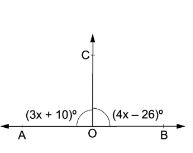
Assertion: In the given figure, AOB is a straight line. ∠AOC = (3x + 10)° and ∠BOC (4x − 26)°, then ∠BOC = 86°
Reason: The sum of angles that are formed on a straight line is equal to 180°.
Codes
(a) Both assertion (A) and reason (R) are true and reason (R) is the correct explanation of assertion (A).
(b) Both assertion (A) and reason (R) are true but reason (R) is not the correct explanation of assertion (A).
(c) Assertion (A) is true but reason (R) is false.
(d) Assertion (A) is false but reason (R) is true.
23.
Assertion : A triangle can have two obtuse angles.
Reason : The sum of all the interior angles of a triangle is 1800
Codes
(a)Both assertion (A) and reason (R) are true and reason (R) is the correct explanation of assertion (A).
(b)Both assertion (A) and reason (R) are true but reason (R) is not the correct explanation of assertion (A).
(c) Assertion (A) is true but reason (R) is false.
(d)Assertion (A) is false but reason (R) is true
24.
Assertion : Supplement of angle is one fourth of itself. The measure of the angle is 144о.
Reason : Two angles are said to be supplementary if their sum of measure of angles is 180о.
Codes
(a) Both assertion (A) and reason (R) are true and reason (R) is the correct explanation of assertion (A).
(b) Both assertion (A) and reason (R) are true but reason (R) is not the correct explanation of assertion (A).
(c) Assertion (A) is true but reason (R) is false.
(d) Assertion (A) is false but reason (R) is true.
25.
Assertion : If angles ‘a ’ and ‘b’ form a linear pair of angles and a = 40о, then b = 150о.
Reason : Sum of linear pair of angles is always 180о.
Codes
(a) Both assertion (A) and reason (R) are true and reason (R) is the correct explanation of assertion (A).
(b) Both assertion (A) and reason (R) are true but reason (R) is not the correct explanation of assertion (A).
(c) Assertion (A) is true but reason (R) is false.
(d) Assertion (A) is false but reason (R) is true.
1.
\(\angle QPR=75^{ 0 }\)
\(\angle PQR+\angle QPR=105^{ 0 }\)
2.
n=5
2n-4=2x5-4=6
3.
\(\angle BC||DE\) and \(\angle CDE=90^{ 0 }\quad \)
\(\therefore \angle BCD=90^{ 0 }\) | Alternate Interior angles
\(\angle CDE=90^{ 0 }\)
\(\therefore \angle DCE=180^{ 0 }-(30^{ 0 }+90^{ 0 })=60^{ 0 }\)
4.
The sum of consecutive interior angles on the same side of a transversal is \(180^{ 0 }\)
5.
\(y=62^{ 0 }\)
\(x+62^{ 0 }=180^{ 0 }\Rightarrow x=118^{ 0 }\)
\(\therefore \angle x-\angle y=118^{ 0 }-62^{ 0 }=56^{ 0 }\)
6.
\(40^{ 0 }+3y+2y=180^{ 0 }\)
7.
Linear Pair Axiom
8.
(b)
two different ways
9.
Required angle=\(180^{ 0 }\)-\(60^{ 0 }\)=\(120^{ 0 }\)
10.
Definition of complementary angles
11.
Given,OT 丄 PR, ㄥTQR = 40° and ㄥSPR= 30°,
In ΔTQR, ㄥTQR + ㄥQTR + ㄥTRQ = 180° [by angle sum property of a triangle]
⇒ 40° + 90° + x = 180° ⇒ 130° + x = 180°
⇒ x =180°-130° ⇒ x = 500
Now, ㄥPSQ is an exterior angle for ΔPSR.
ஃ ㄥPSQ = ㄥSPR + ㄥSRP [by theorem 2]
⇒ y = 30° + x ⇒ y = 30° + 50° [ஃ x = 50°]
⇒ y = 80°
Hence, x = 50° and y = 80°
12.
\(75^{ 0 },285^{ 0 }\)
13.
\(20^{ 0 }\)
14.
Given AB||CD, CD||EF, \(EA\bot AB\)
\(\angle BEF=55^o\)
y = 180o- 55o = 125o(Co-interior angles)
x = y = 125o(Corresponding angles)
\(EA\bot AB\)
\(EA\bot AB\)
Z + 55o = 90o
Z = 90o - 55o
= 35o
15.
Let \(\angle AOB=2x\) and \(\angle BOC=3x\)
\(\angle AOB+\angle BOC=\angle AOC\)
2x+3x=75o
\(\Rightarrow x=\frac{75^o}{5}=15^o\)
\(\angle AOB=2x=30^o\) and \(\angle BOC=3x=45^o\)
16.
(i) Let 'O' be the point from where the three friend move to the points A, Band C, such that OA makes equal angles with OB and OC such that
∠AOB= ∠AOC ...(i)
Also, OB makes equal angles with OA and OC
Such that
∠AOB= ∠BOC ...(ii)
From (i) and (ii), we get
∠AOB = ∠BOC = ∠AOC ...(iii)
Since, sum of all angles around a point = 360о
⇒ ∠AOB + ∠BOC + ∠AOC = 360о
⇒ ∠AOB + ∠AOB + ∠AOB = 360o [from iii]
⇒ 3 ∠AOB = 360о
⇒ ∠AOB = \(\frac{360^{\circ}}{3}\) = 120o
∴ From (iii), we have:
∠BOC = 120o and ∠AOC = 120o
(ii) Lines and Angles (Geometry)
(iii) Helping attitude towards disastrous victims.
17.
Let the angles of the given triangle measure (2x )o, (3x)o and (5x)o.
∵ Sum of the angles of a triangle is 180°.
∴ (2x)о + (3x)o + (5x)o = 180o
⇒ 10x = 180°
or x = \(\frac{180^{\circ}}{10}\) = 18°
∴ 2x = 2 x 18 = 36°
3x = 3 x 18 = 54°
5x = 5 x 18 = 90°
∴ The measures of the angles of the given triangle are 36°, 54° and 90°.
18.
Let us consider ΔABC and through A draw DE ॥ BC.
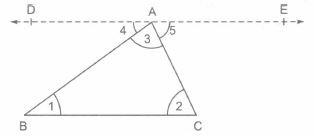
∵ BC ॥ DE and AB is a transversal.
∠4 = ∠1 [Interior alternate angles] ... (1)
Again, BC ‖ DF and AC is a transversal.
∴ ∠5 = ∠2 [Interior alternate angles] ... (2)
Adding (1) and (2), we have
∠4 + ∠5 = ∠1 + ∠2
Adding ∠3 on both sides, we have
∠4 + ∠5 + ∠3 = ∠1 + ∠2 + ∠3
Since, DAF is a straight line,
∴ ∠4 + ∠3 + ∠5 = 180°
∠1 + ∠2 + ∠3 = 180°
i.e. ∠ABC + ∠BCA + ∠BAC = 180°
∴ The sum of angles of a triangle is 180°.
19.
∵ \(\left.\begin{array}{l} \mathrm{AB} \| \mathrm{CD} \\ \mathrm{EF} \| \mathrm{CD} \end{array}\right\}\) (given)
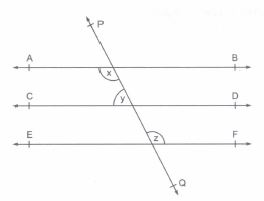
∴ AB II EF and PQ is a transversal.
∴ Interior alternate angles are equal.
∴ ∠x = ∠y ...(1)
Again, AB II CD,
∴ Interior opposite angles are supplementary,
⇒ y + z = 180o
But y : z = 3 : 7
∴ y = \(\frac{180^{\circ}}{(y+z)}\) x 3 = \(\left[\frac{180^{\circ}}{(3+7)}\right]\) x 3 = \(\frac{180^{\circ}}{10}\) x 3 = 54о
and z = \(\frac{180^{\circ}}{(y+z)}\) x 7 = \(\left[\frac{180^{\circ}}{(3+7)}\right]\) x 7 = \(\frac{180^{\circ}}{10}\) x 7 = 126о ...(2)
From (1) and (2), we have
x = 126о
20.
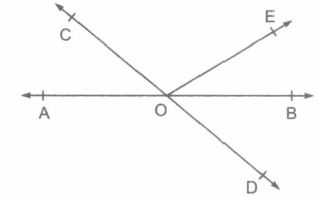
Since AB is a straight line,
∴ ∠AOC + ∠COE + ∠EOB = 180о
or (∠AOC + ∠BOE) + ∠COE = 180о
or 70о + ∠COE = 180о [∴ ∠AOC + ∠BOC = 70o (Given)]
or ∠COE 180o - 70о = 110o
∴ Reflex ∠COE = 360° - 110° = 250°
∵ AB and CD intersect at O.
∴ ∠COA = ∠BOD [Vertically opposite angles]
But ∠BOD = 40° [Given]
∴ ∠COA = 40°
Also ∠AOC + ∠BOE = 70°
∴ 40° + ∠BOE = 70°
or ∠BOE = 70° - 40° = 30°
Thus, ∠BOE = 30° and reflex ∠COE = 250.
21.
We know that the sum of angles that are formed on a straight line is equal to 180°.
So, Reason is correct
Also, the sum of all the interior angles of a triangle is 1800 Let the angles measure (3x)°, (5x)° and (7x)°.
Then,3x + 5x + 7x = 180° ⇒15x = 180° ⇒x = 12°
Therefore, the angles are 3(12)°=36°, 5(12)°=60° and 7(12)° = 84°. Hence, the triangle is acute-angled.
So, Assertion (A) is also true.
But reason (R) is not the correct explanation of assertion (A). Correct option is (b) Both assertion (A) and reason (R) are true and reason (R) is not the correct explanation of assertion (A).
22.
We know that the sum of angles that are formed on a straight line is equal to 180°.
So, Reason is correct
We have : ∠AOC+∠BOC=180° [Since AOB is a straight line ]
⇒3x + 10 + 4x − 26 = 180°
⇒7x = 196°
⇒x = 28°
∴∠BOC = [4 × 28 − 26]°
⇒∠BOC=86°.
So, Assertion (A) is also true.
Correct option is (a) Both assertion (A) and reason (R) are true and reason (R) is the correct explanation of assertion (A).
23.
We know that the sum of all the interior angles of a triangle is 1800. So, Reason (R) is true.
Since the Sum of two obtuse angles will be more than 1800. So, Assertion (A) is false.
Correct option is (d) Assertion (A) is false but reason (R) is true.
24.
We know that two angles are said to be supplementary if their sum of measure of angles is 180о.
So, Reason is correct.
Let the angle be x . Supplement of x = \(\frac{1}{4}\)x
So, x + \(\frac{1}{4}\)x = 180о ⇒ \(\frac{5}{4}\)x = 180о ⇒ x = 144о
So, Assertion is also correct
Also, reason (R) is the correct explanation of assertion (A).
Correct option is (a) Both assertion (A) and reason (R) are true and reason (R) is the correct explanation of assertion (A).
25.
We know that the sum of linear pair of angles is always 1800.
So, Reason is correct.
Now, a + b = 40о + 150о = 190о ≠180о
Hence, Assertion is not correct
Correct option is (d) Assertion (A) is false but reason (R) is true.

9th Standard CBSE Syllabus & Materials
9th Standard CBSE
CBSE 9th Mathematics Lines and Angles Sample Question Papers Study Material - QB365 Set A
NEW9th Standard CBSE
CBSE 9th Mathematics Introduction to Euclid's Geometry Sample Question Papers Study Material - QB365 Set A
NEW9th Standard CBSE
CBSE 9th Mathematics Linear Equations in Two Variables Sample Question Papers Study Material - QB365 Set A
NEW9th Standard CBSE
CBSE 9th Mathematics Coordinate Geometry Sample Question Papers Study Material - QB365 Set A



NCERT Books

Syllabus

Exam Pattern

Sample Question Papers

Previous year Question Papers

Important Notes

MCQ Practice test

NCERT Exemplers

Case study Questions

Image Based Questions

Passage based Questions

HOT Questions

Value Based Questions

Model Questions Papers
NCERT ( Book Back ) Questions

Assertion and Reason
Important Questions And Answers

CBSE 9th Standard CBSE Subjects
CBSE Standards