100% FREE ACCESS
9th Standard CBSE Syllabus & Materials
9th Standard CBSE
CBSE 9th Science Is matter around us pure? - New Model Questions Papers Study Material - QB365 Set A
NEW9th Standard CBSE
CBSE 9th Science Matter in our surroundings - New Model Questions Papers Study Material - QB365 Set A
NEW9th Standard CBSE
CBSE 9th Mathematics Heron's Formula Sample Question Papers Study Material - QB365 Set A
NEW9th Standard CBSE
CBSE 9th Mathematics Circles Sample Question Papers Study Material - QB365 Set A
NEW9th Standard CBSE
CBSE 9th Mathematics Quadrilaterals Sample Question Papers Study Material - QB365 Set A
NEW9th Standard CBSE
CBSE 9th Mathematics Triangles Sample Question Papers Study Material - QB365 Set A

Published on: 29/10/2025
Download CBSE Class 9th Standard CBSE Mathematics question papers, sample papers, important questions, and previous year solved papers in PDF format. Get free study materials, NCERT solutions, and exam preparation resources for Class 9th Standard CBSE Mathematics
Questions + Answers key
Take MCQ Mathematics Test
1.
In a survey, out of all students, 15% said 'no', 57% said 'yes' and the remaining said 'They could not decide'. If a student is chosen at random, what is the chance that the student did not say 'yes'?
15%
43%
57%
100%
2.
The area of the four walls of a room is 300 m2. Its length and height are 15 m and 6 m respectively. Find its breadth.
10 m
5 m
20 m
15 m
3.
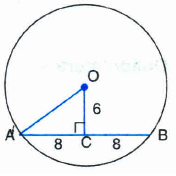
The length of a chord of a circle is 16 cm and its distance from the centre is 6 cm. The measure of the radius of the circle is
6 cm
8 cm
10 cm
12 cm.
4.
In ΔABC and ΔDEF, AB = DF and ㄥA = ㄥD.The two triangles will be congruent by SAS axiom if:
BC = EF
AC = DE
DC = DE
AC = EF
5.
If two interior angles on the same side of a transversal intersecting two parallel lines are in the ratio 2:3 then the smaller of two angles
\(72^{ 0 }\)
\(108^{ 0 }\)
\(54^{ 0 }\)
\(36^{ 0 }\)
6.
Equation of a line passing through origin is:
x+y=1
x=2y-4
x+y=0
y=x-1
7.
If (x+2,4)=(5,y-2), then the coordinates (x,y) are:
(7,12)
(6,3)
(3,6)
(2,1)
8.
Abscissa of all the points on y - axis is:
1
any number
0
-1
9.
The value of \(\sqrt [ 4 ]{ \sqrt [ 3 ]{ { 2 }^{ 2 } } } \) is equal to:
\({ 2 }^{ -\frac { 1 }{ 6 } }\)
\({ 2 }^{ -6 }\)
\({ 2 }^{ \frac { 1 }{ 6 } }\)
\({ 2 }^{ 6 }\)
10.
Which of the following is a rational number?
\(1+\sqrt { 3 } \)
\(\pi \)
\(2\sqrt { 3 } \)
0
11.
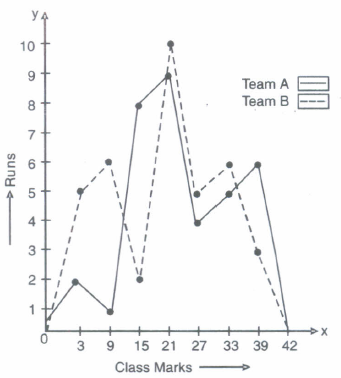
The runs scored by two teams A and B on the first 42 balls in a cricket match are given below. Draw the frequency polygon on the same graph paper.
| Number of balls | Team A | Team B |
|---|---|---|
| 0-6 | 2 | 5 |
| 6-12 | 1 | 6 |
| 12-18 | 8 | 2 |
| 18-24 | 9 | 10 |
| 24-30 | 4 | 5 |
| 30-36 | 5 | 6 |
| 36-42 | 6 | 3 |
12.
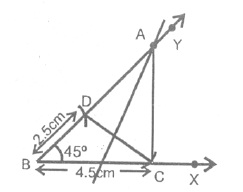
Construct a ΔABC in which BC = 4.7 cm,ㄥB = 45o and AB - AC = 2cm
13.
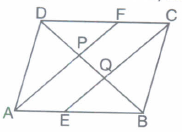
In the figure, ABCD is a parallelogram. E and F are the mid-points of sides AB and CD respectively. Show that the line segments AF and EC trisect the diagonal BD.
14.
Without actual division, show that f(x)=2x4-6x3+3x2+3x-2 is exactly divisible by x2-3x+2.
15.
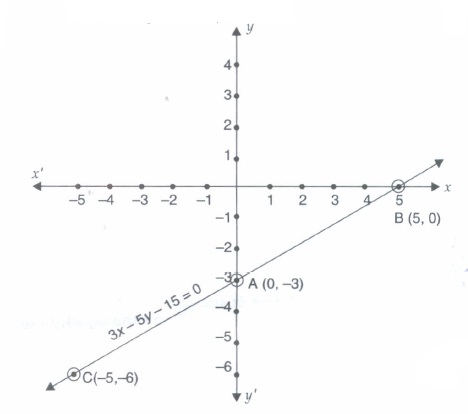
Draw the graph of the equation 3x-5y-15=0. Write the coordinates of the point where the line intersects the two axes.
16.
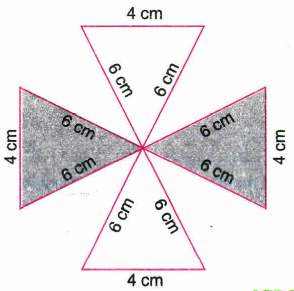
Black and white coloured triangular sheets are used to make a toy as shown in figure. Find the total area of black and white colour sheets used for making the toy.
17.
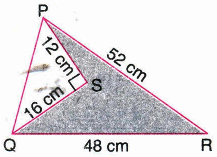
In the following figure, calculate the area of the shaded portion:
18.
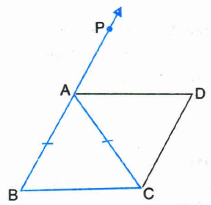
ABC is an isosceles triangle in which AB = AC AD bisects \(\angle \) PAC and CD II AB. Show that
(i) \(\angle \) DAC =\(\angle \) BCA
(ii) ABCD is a parallelogram
19.
The polynomial \(p(x)=2{ x }^{ 3 }-3{ x }^{ 2 }+ax-3a+9\)when divided by x+1, leaves the remainder 16. Find the value of a. Also, find the remainder when p(x) is divided by x+2.
20.
Find the mean of first ten multiples of 3.
21.
A military tent is in the form of a circular cone of vertical height 6 m, the diameter of the base being 7 m. If 12 soldiers can sleep in it, find the average cubic metre of air space required per soldier.
22.
Three cubes are placed adjacent to each other in a row. Find the ratio of the total surface area of the cuboid so formed and that of anyone of these cubes.
23.
In a parallelogram PQRS, if \(\angle \)QRS=2x, \(\angle \)PQS=4x, and \(\angle \)PSQ=4x, find the angles of the parallelogram.
24.
Factorise: \(16x^3-2y^3\)
25.
Find the remainder, when \(x^3-3x^2+3x-1\) is divided by(x-1)
26.
Fifty seeds were selected at random from each of 5 bags of seeds and were kept under standardised conditions favourable to germination. After 20 days, the number of seed germinated were counted and recorded as follows:
| Bag | 1 | 2 | 3 | 4 | 5 |
| Number of seeds germinated | 42 | 45 | 48 | 41 | 38 |
What is the probability of germination of:
(i) more than 40 seeds in a bag?
(ii) 49 seeds in a bag?
(iii) less than 40 seeds in a bag?
27.
In \(\triangle\)PQR, if S is any point on the side QR. Show that PQ + QR + RP > 2PS.
.jpg)
28.
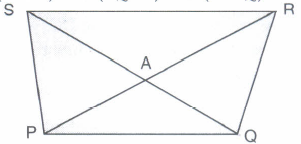
Diagonals PR and QS of quarilateral PQRS intersect each other at A.Show that: ar(\(\Delta\)PSA)\(\times\)ar(\(\Delta\)QAR) = ar(\(\Delta\)PAQ)\(\times\)ar(\(\Delta\)SAR)
29.
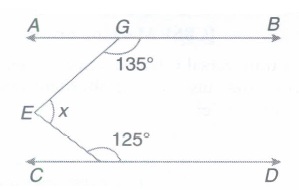
In figure, AB||CD, then find x.
30.
If \(\frac { 30 }{ 4\sqrt { 3 } +3\sqrt { 2 } } =4\sqrt { 3 } -a\sqrt { 2 } \) find the value of a.
31.
A bus stop is barricaded from the remaining part of the road, by using 50 hollow cones made of recycled cardboard. Each cone has a base diameter of 40 cm and height 1 m. If the outer side of each of the cones is to be painted and the cost of painting is Rs12 per m2, what will be the cost of painting all these cones? (Use \(\pi =3.14\) and take \(\sqrt { 1.04 } =1.02\))
32.
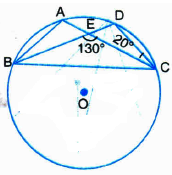
In the above figure, chords BD and AC intersect at the point E such that \(\angle BEC=130°\) and \(\angle ECD=20°\). Find the measure of \(\angle BAC\).
33.
ABCD is a quadrilateral in which AD = BC and \(\angle DAB=\angle CBA\) (see fihure).Prove that:
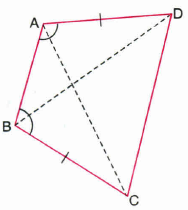
(i) \(\triangle ABD\cong \triangle BAC\)
(ii) BD = AC
(iii) \(\angle ABD=\angle BAC\)
34.
Prove that \(2x^3+2y^3+2z^3-6xyz=(x+y+z)[(x-y)^2+(y-z)^2+(z-x)^2]\) Hence evaluate \(2(7)^3+2(9)^3+2(13)^3-6(7)(9)(13)\)
35.
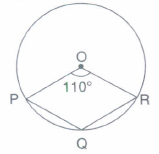
In the given figure, if ㄥPOR is 110, then find the value of ㄥPQR.
36.
If the probability of an event is represented by p, then \(0\le p\le1\) is True/False?
37.
The range of the data is: 25,18,20,22,16,6,17,12,30,32,10,19,8,11,20 is:
38.
The radii of two right circular cylinders are in the ratio 2:3 and their heights are in the ratio 5:4, then the ratio of their volumes will be _______________
39.
Find the volume of a right circular cone with radius 6 cm and height 7 cm.
40.
For the given data: 11,15, 17, y+1, 19, y-2, 3; if the mean is 14, find the value of y.
41.
The diameter of a football is five times the diameter of a criket ball. Ratio of surface areas of football and criket ball is _____________
42.
Compute the curved surface area of a hemishpere whose diameter is 14 cm.
43.
Simplify: [7(811/4+ 2561/4)1/4]4
44.
The graph of the linear equation 4x - 3y = 12 cuts y-axis at _____
45.
Write the sum of \(0.\bar{3}\) and \(0.\bar{4}\)
46.
The equation x=7 in two variables can be written as _______
1.
(b)
43%
2.
Number of cubes = \(\frac { { \left( 20 \right) }^{ 3 } }{ { \left( 5 \right) }^{ 3 } } =64\)
3.
\(AC=CB=\frac { 1 }{ 2 } AB=\frac { 1 }{ 2 } \times 16=8\quad cm\)
\(OA=\sqrt { OC^{ 2 }+AC^{ 2 } }\)
\(=\sqrt { 6^{ 2 }+8^{ 2 } } =10\quad cm\)
4.
(b)
AC = DE
5.
2+3=5
Required angle =\(\frac { 2 }{ 5 } x180^{ 0 }\)
6.
O(0,0) satisfies x+y=0
7.
(c)
(3,6)
8.
(c)
0
9.
(c)
\({ 2 }^{ \frac { 1 }{ 6 } }\)
10.
(d)
0
11.
12.
Steps of construction:
i) Draw a line segment BC = 4.7 cm. and at point B construct an angle of 45o i.e ㄥXBC=45o
ii) Cut the line segment BD = 2 cm (equal to AB-AC)on ray BX
iii) Join DC and draw the perpendicular bisector PQ of DC
iv) The perpendicular bisector intersects BXat point A. Jon AC ΔABC is the required triangle.
13.
According to the question, E and F are the midpoints of sides AB and CD.
ஃ AE=\(\frac{1}{2}\)AB
CF=\(\frac{1}{2}\)CD
ஃ In the parallelogram opposite sides are equal, so AB=CD
ஃ AE=CF
Again, AB||CD
So, AE||FC
Hence AECF is a parallelogram.
In ΔABP,
E is the mid-point of AB.EQ || AP
ஃ Q is the mid-point of BP
Similarly, P is the mid-point of DQ
DP= PQ= QB
ஃ Line segments AF and EC trisect the diagonal BD.
14.
Let, g(x)=x2-3x+2
=x2-2x-x+2
=x(x-2)-1(x-2)
=(x-2)(x-1)
Zero of x-2 is 2, as x-2=0\(\Rightarrow \)x=2
Zero of x-1 is 1, as x-1=0\(\Rightarrow \)x=1
Now, f(x)=2x4-6x3+3x2+3x-2
f(2)=2(24)-6(23)+3(22)+3(2)-2
=32-48+12+6-2=0
f(1)=2(1)4-6(1)2+3(1)2+3(1)-2
=2-6+3+3-2=0
\(\Rightarrow \) (x-1) and (x-2) are the factors of f(x).
\(\therefore\) f(x) is exactly divisible by g(x).
15.
Given equation
3x-5y-15=0
5y=3x-15
\(\Rightarrow y=\frac{3x-15}{5}\)
\(\Rightarrow y=\frac{3}{5}(x-5)\)
put x=0, then y=-3
put x=5, then y=0
put x=-5, then y=-6
| A | B | C | |
| x | 0 | 5 | -5 |
| y | -3 | 0 | -6 |
To plot these points on graph paper, join these points. The graph of the line intersects x-axis at (5,0) and y-axis at (0,-3).
16.
For one black colour sheet a= 4 cm, b = 6 cm
\(\therefore \) Area \(=\frac { a }{ 4 } \sqrt { 4{ b }^{ 2 }-{ a }^{ 2 } } \) | Sheet is an isosceles triangle
\(=\frac { 4 }{ 4 } \sqrt { 4{ (6) }^{ 2 }-4^{ 2 } } \) \(=\sqrt { 128 } =8\sqrt { 2 } \) cm2
\(\therefore \) Area of 2 black colour sheets = 2\(\times 8\sqrt { 2 } \) = \( 16\sqrt { 2 } \) cm2
Similarly, area of 2 white colour sheets = \( 16\sqrt { 2 } \) cm2
\(\therefore \) Total area of black and white colour sheets = \( 16\sqrt { 2 } \) + \( 16\sqrt { 2 } \) = \( 32\sqrt { 2 } \) cm2
17.
In right triangle PSQ, PQ\(\frac { 1 }{ 2 } \)2 = PS2 + QS2 |By Pythagoras Theorem
= (12)2 + (16)2
= 144 + 256 =400
\(\Rightarrow \) PQ = \(\sqrt { 400 } \) = 20 cm
Now, for \(\Delta \)PQR
a = 20cm, b = 48cm, c = 52cm
\(\therefore s=\frac { a+b+c }{ 2 } =\frac { 20+48+52 }{ 2 } =60\) cm
\(\therefore \) Area of \(\Delta \)PQR \(=\sqrt { s(s-a)(s-b)(s-c) } \)
\(=\sqrt { 60(60-20)(60-48)(60-52) }\)
\( \\ =\sqrt { (60)(40)(12)(8) } \)
\(=\sqrt { \left( 6\times 10 \right) \left( 4\times 10 \right) \left( 6\times 2 \right) \left( 8 \right) } \)
\(=6\times 10\times 8=480\) cm2
Area of \(\Delta \) PSQ = \(\frac { 1 }{ 2 } \)\(\times \)Base\(\times \)Altitude
=\(\frac { 1 }{ 2 } \)\(\times \)16\(\times \)12=96 cm2
\(\therefore \) Area of the shaded portion =Area of \(\Delta \)PQR - Area of \(\Delta \)PSQ
= 480 - 96 = 384 cm2
18.
Given: ABC is an isosceles triangle in which AB = AC. AD bisects L PAC and CD IIAB.
To Prove:
(i) \(\angle \)DAC =\(\angle \)BCA
Proof:
(i) In \(\Delta \) ABC,
\(\because\) AB = AC
\(\therefore\) \(\angle \)B =\(\angle \)C .......(1) I Angles opposite to equal sides of a triangle are equal
Also, Ext. \(\angle \)PAC =\(\angle \)B +\(\angle \)C
⇒
⇒ 2\(\angle \)CAD = 2\(\angle \)C
⇒ \(\angle \)CAD =\(\angle \)C
\(\therefore\) AD II BC
Also, CD II AB I Given
\(\therefore\) ABCD is a parallelogram IA quadrilateral is a parallelogram if its both the pairs of opposite sides are parallel.
19.
\(p(x)=2{ x }^{ 3 }-3{ x }^{ 2 }+ax-3a+9\)
By remainder theorem,
\(p(-1)=16\ x+1=0\quad \Rightarrow x=-1\)
\(\Rightarrow 2{ (-1) }^{ 3 }-3{ (-1) }^{ 2 }+a(-1)-3a+9=16\)
\(\Rightarrow -2-3-a-3a+9=16\)
\(\Rightarrow 4a=-12\)
\(\Rightarrow a=-3\)
\(\therefore p(x)=2{ x }^{ 3 }-3{ x }^{ 2 }-3x-3 \times(-3)+9\)
\(={ 2x }^{ 3 }-3{ x }^{ 2 }-3x+18\)
\(\therefore \) Remainder when p(x) is divided by x+2 =p(-2)
By remainder theorem: \(x+2=0\Rightarrow x=-2\)
\(={ 2(-2) }^{ 3 }-3{ (-2) }^{ 2 }-3(-2)+18\)
\(=-16-12+6+18=-4\)
20.
16.5
21.
\(\frac { 77 }{ 12 } { m }^{ 3 }\)
22.
7 : 3
23.
\(36°\),\(144°\),\(36°\), \(144°\)
24.
\(2(2x-y)(4x^2+2xy+y^2)\)
25.
0
26.
(i) There are 4 bags in which seeds are more than 40.
P(more than 40 seeds in a bag)\(=\frac{4}{5}\)
(ii) There is no bag of 49 seeds.
P(49 seeds in a bag) = 0
(iii) There is only one bag out of 5 in which seeds are less than 40.
P(less than 40 seeds in a bag)\(=\frac{1}{5}\)
27.
In \(\triangle\)PQS,
PQ + QS > PS ...(1)
(Sum of any two sides is greater than the third side)
In \(\triangle\)PSR,
PR + SR > PS ...(2)
Adding (1) & (2),
PQ + QS + PR + SR >2 PS (\(\because\) QR=QS+SR)
PQ + QR + RP > 2PS.
28.
Construction: Draw PM \(\bot \)QS and RN \(\bot \) QS
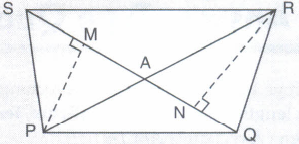
\(ar(\Delta PSA)\times ar(\Delta QAR)\)
\(=\left( \frac { 1 }{ 2 } \times AS\times PM \right) \times \left( \frac { 1 }{ 2 } \times AQ\times RN \right) \)
\(=\left( \frac { 1 }{ 2 } \times RN\times AS \right) \times \left( \frac { 1 }{ 2 } \times PM\times AQ \right) \)
\(=ar\left( \Delta SAR \right) \times ar\left( \Delta PAQ \right) \)
Hence Proved.
29.
Draw, EH||AB
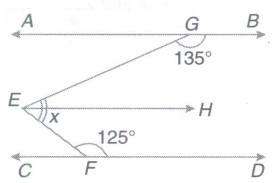
Now, EH||AB and AB||CD,
Therefore, EH||CD
Now, \(\angle BGE+\angle GEH=180^o\) (Co-interior \(\angle S)\)
(AB||EH, Co-interior angles)
\(135^o+\angle GEH=180^o\)
\(\angle GEH=180^o-135^o=45^o...(1)\)
Again, \(\angle DFE+\angle FEH=180^o\)
(CD||EH, Co-interior angles)
\(\Rightarrow 125^o+\angle FEH=180^o\)
\(\Rightarrow \angle FEH=180^o-125^o\)
=55o
Adding (1) and (2), we get
\(\angle GEH+\angle FEH=45^o+55^o\)
x=100o
30.
\(\frac { 30 }{ 4\sqrt { 3 } +3\sqrt { 2 } } =4\sqrt { 3 } -a\sqrt { 2 } \)
\(\Rightarrow \frac { 30 }{ 4\sqrt { 3 } +3\sqrt { 2 } } \times \frac { 4\sqrt { 3 } -3\sqrt { 2 } }{ 4\sqrt { 3 } -3\sqrt { 2 } } =4\sqrt { 3 } -a\sqrt { 2 } \)
\(\Rightarrow \frac { 30\left( 4\sqrt { 3 } -3\sqrt { 2 } \right) }{ 30 } =4\sqrt { 3 } -a\sqrt { 2 } \)
\(4\sqrt { 3 } -3\sqrt { 2 } =4\sqrt { 3 } -a\sqrt { 2 } \)
On comparing a = 3
31.
Base diameter = 40 cm
\(\therefore\) Base radius (r) = \(\frac { 40 }{ 2 } cm=20cm\)
\(=\frac { 20 }{ 100 } m=0.2m\)
Height (h) = 1 m
\(\therefore l=\sqrt { { r }^{ 2 }+{ h }^{ 2 } } \)
\(\\ =\sqrt { { \left( 0.2 \right) }^{ 2 }+{ \left( 1 \right) }^{ 2 } } =\sqrt { 0.04+1 } \)
\(\\ =\sqrt { 1.04 } =1.02m\)
\(\therefore\) Curved surface area = \(\pi rl\)
= 3.14 \(\times\) 0.2 \(\times\) 1.02
= 0.64056 m2
\(\therefore\) Curved surface area of 50 cones
= 0.64056 \(\times\) 50 m2
= 32.028 m2
\(\therefore\) Cost of painting all these cones
= 32.028 \(\times\) 12
= 384.336 = Rs 384.34 (approximately).
32.
110°
33.
Given ABCD is a quadrilateral in which AD=BC and \(\angle DAB=\angle CBA\)
To prove: (i) \(\triangle ABD\cong \triangle BAC\)
(ii) BD = AC
(iii) \(\angle ABD=\angle BAC\)
Proof: (i) In \(\triangle ABD\) and \(\triangle BAC\)
AD = BC
AB = BA
\(\angle DAB=\angle CBA\)
\(\triangle ABD\cong \triangle BAC\) |SAS Rule
(ii) \(\triangle ADB\cong \triangle BAC\) |Proved in (i)
BD = AC | C.P.C.T
(iii) \(\triangle ABD\cong \triangle BAC\) |Proved in (i)
\(\angle ABD=\angle BAC\) | C.P.C.T
34.
1624
35.
()
Reflex angle PQR = 360° - 110°
= 360° - 110°
= 250°
By degree measure theorem,
ㄥPQR=\(\frac{1}{2}\)(reflex angle POR)
=\(\frac{1}{2}\)(250°)
=125°
36.
()
Probability of an event associated with a random experiment lies between 0 and 1 (both included). So given statement is true.
37.
()
26
38.
()
Let radii of cylinders be 2x and 3x and heights be 5y and 3y respectively.
\(\therefore\) Ratio of volumes = \(\frac { \pi { (2x) }^{ 2 }\times 5y }{ \pi { (3x) }^{ 2 }\times 3y } \)
\(=\frac { { 4x }^{ 2 }\times 5 }{ { 9x }^{ 2 }\times 3 } \)
= 20:27.
39.
()
Volume of right circular cone = \(\frac { 1 }{ 3 } \pi { r }^{ 2 }h\)
\(=\frac { 1 }{ 3 } \times \frac { 22 }{ 7 } \times { (6) }^{ 2 }\times 7=\frac { 1 }{ 3 } \times \frac { 22 }{ 7 } \times 36\times 7\)
= 264 cm3.
40.
()
\(14=\frac{11+15+17+y+1+19+y-2+3}{7}\)
⇒ 98 = 64+2y
⇒ 2y = 34
⇒ y = 17
41.
()
Given, diameter of football = 5 \(\times\) diameter of cricket ball
If r denotes radius of a football and r' that of a criket ball, then we have
2r = 5\(\times\)(2r')
\(\frac { 2r }{ 2r' } =5\)
or \(\frac { r }{ r' } =5\)
Now, ratio of surface areas\(=\frac { 4\pi { r }^{ 2 } }{ 4\pi { (r') }^{ 2 } } ={ \left( \frac { r }{ r' } \right) }^{ 2 }=\frac { 25 }{ 1 } \)
= 25 : 1
42.
()
Given diameter of hemisphere = 14 cm
\(\therefore\) radius = 7 cm
\(\therefore\) Curved surface area = 2\(\pi\)r2
\(=2\times \frac { 22 }{ 7 } \times 7\times 7\)
= 308 cm2
43.
()
[7(811/4+2561/4)1/4]4 = [7(3+4)1/4]4
= [7(3 + 4)1/4]4
= [7.71/4]4
= [75/4]4=75
44.
()
(0,-4)
45.
()
\(0.\bar{3}+0.\bar{4}\)=(0.333...) + (0.444...)
= 0.777...
Let x = 0.777...
10x = 7.777...
⇒ 10x - x = (7.777...) - (0.777...)
⇒ 9x = 7.0
⇒ x = \(\frac{7}{9}\)
46.
()
1.x+0.y=7

9th Standard CBSE Syllabus & Materials
9th Standard CBSE
CBSE 9th Mathematics Lines and Angles Sample Question Papers Study Material - QB365 Set A
NEW9th Standard CBSE
CBSE 9th Mathematics Introduction to Euclid's Geometry Sample Question Papers Study Material - QB365 Set A
NEW9th Standard CBSE
CBSE 9th Mathematics Linear Equations in Two Variables Sample Question Papers Study Material - QB365 Set A
NEW9th Standard CBSE
CBSE 9th Mathematics Coordinate Geometry Sample Question Papers Study Material - QB365 Set A



NCERT Books

Syllabus

Exam Pattern

Sample Question Papers

Previous year Question Papers

Important Notes

MCQ Practice test

NCERT Exemplers

Case study Questions

Image Based Questions

Passage based Questions

HOT Questions

Value Based Questions

Model Questions Papers
NCERT ( Book Back ) Questions

Assertion and Reason
Important Questions And Answers

CBSE 9th Standard CBSE Subjects
CBSE Standards