100% FREE ACCESS
9th Standard CBSE Syllabus & Materials
9th Standard CBSE
CBSE 9th Science Is matter around us pure? - New Model Questions Papers Study Material - QB365 Set A
NEW9th Standard CBSE
CBSE 9th Science Matter in our surroundings - New Model Questions Papers Study Material - QB365 Set A
NEW9th Standard CBSE
CBSE 9th Mathematics Heron's Formula Sample Question Papers Study Material - QB365 Set A
NEW9th Standard CBSE
CBSE 9th Mathematics Circles Sample Question Papers Study Material - QB365 Set A
NEW9th Standard CBSE
CBSE 9th Mathematics Quadrilaterals Sample Question Papers Study Material - QB365 Set A
NEW9th Standard CBSE
CBSE 9th Mathematics Triangles Sample Question Papers Study Material - QB365 Set A

Published on: 29/10/2025
Download CBSE Class 9th Standard CBSE Mathematics question papers, sample papers, important questions, and previous year solved papers in PDF format. Get free study materials, NCERT solutions, and exam preparation resources for Class 9th Standard CBSE Mathematics
Questions + Answers key
Take MCQ Mathematics Test
1.
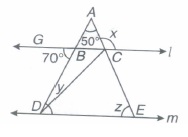
In the figure, \(\angle BAC=50^o, \angle GBD=70^o\) and l and m are parallel lines. Find x,y, and z.
2.
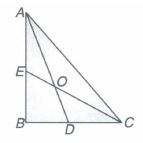
In \(\triangle ABC,\) AD and CE are the bisectors of \(\angle A\) and \(\angle C\) respectively. If \(\angle ABC=90^o\), then find \(\angle AOC.\)
3.
Simplify: \(\frac { 5+\sqrt { 3 } }{ 7-4\sqrt { 3 } } -\frac { 5+\sqrt { 3 } }{ 4+4\sqrt { 3 } } \)
4.
A field is in the shape of a trapezium whose parallel sides are 25 m and 10 m. The non-parallel sides are 14 m and 13 m. Find the area of the field.
5.
Draw the graph of the following linear equations in two variables:
3=2x+y
6.
Locate and write the coordinates of a point:
(a) above x-axis lying on y-axis at a distance of 5 units from origin.
(b) below x-axis lying on y-axis at a distance of 3 units from origin.
(e) lying on x-axis to the right of origin at a distance of 5 units.
(d) lying on x-axis to the left of origin at a distance of 2 units.
7.
See figure and write the following:
(i) The coordinates of B.
(ii) The coordinates of C.
(iii) The point identified by the coordinates (-3,-5)
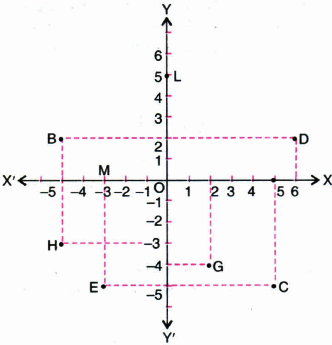
(iv) The point identified by the coordinates (2, - 4).
(v) The abscissa of the point D.
(vi) The ordinate of the point H.
(vii) The coordinates of the point L.
(viii) The coordinates of the point M.
8.
Verify: \(x^3-y^3=(x+y)(x^2+xy+y^2)\)
9.
Which of the following expressions are polynomials in one variable and which are not? State reasons for your answer.
\({ x }^{ 10 }+{ y }^{ 3 }+{ t }^{ 50 }\)
10.
Is zero a rational number?can you write it in the form \(\frac { p }{ q } \),where p and q are integers and \(q\neq 0\)?
11.
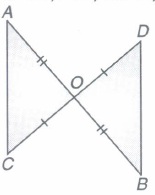
In the figure below, O is the mid-point of AB and CD, Prove that AC = BD.
12.
Find the point at which the equation 3x-2y=6 meets the x-axis.
13.
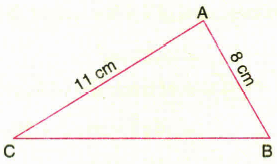
Find the area of a triangle two sides of which are 8 cm and 11 cm and the perimeter is 32 cm.
14.
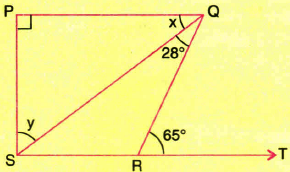
In the given figure if \(PQ\bot PS,PQ||SR,\angle SQR=28^{ 0 }\) and \(\angle QRT=65^{ 0 }\). Find the values of X and y.
15.
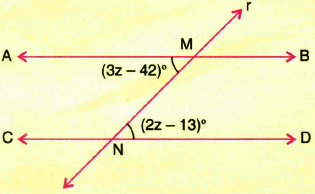
In the figure AB || CD ,find the value of z,\(\angle DNM\) and \(\angle CNM\quad \)
16.
Draw the graph of the linear equation 3x + 2y = 12.Also find the points where this graph cuts x-axis and y-axis.
17.
(i) Plot the points M(4,3), N(4,0), O(0,0), P90,3).
(ii) Name the figure obtained by joining MNOP.
(iii) Find the perimeter of the figure.
18.
Plot the points on graph (-2,8), (-1,7), (0,-3), (1,3), (3,-1).
19.
Using remainder theorem, factorise: \(2x^3-13x^2+26x-15\)
20.
Check whether polynomially \(p(x)=3x^4+4x^3-10x^2-5x-30\)
is a multiple of (x-2) and (x+3).
21.
If \({ \left( \frac { 3 }{ 4 } \right) }^{ 6 }\times { \left( \frac { 16 }{ 9 } \right) }^{ 5 }={ \left( \frac { 4 }{ 3 } \right) }^{ x+2 }\) , find the value of x.
22.
Find three rational numbers between -5/6 and 3/8.
23.
Find what must be subtracted from the polynomial 4y4+12y3+6y2+50y+26 so that the obtained polynomial is exactly divisible by y2+4y+2.
24.
Find the area of a quadrilateral ABCD whose sides AB = 13 cm, BC = 12 cm, CD = 9 cm, DA = 14 cm and diagonal BD = 15 cm.
25.
In Δ Abc, D is the mid-point of BC The perpendiculars from D to AB and AC are equal.Prove that ΔABC is isosceles.
26.
Express y in terms of x in the equation x+2y=8.Find the points where the line represented by this equation cuts x-axis and y-axis
27.
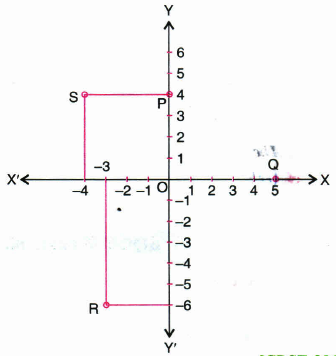
See figure and write the following:
(i) Coordinates of point P
(ii) Abscissa of point Q
(iii) The point identified by the coordinates (-4,4)
(iv) The point identified by the coordinates (-3,-6)
28.
Evaluate: \({ \left( \sqrt { 2 } +\sqrt { 3 } \right) }^{ 2 }-{ \left( \sqrt { 5 } +\sqrt { 2 } \right) }^{ 2 }\)
29.
Area of a rhombus =
\(\frac { 1 }{ 2 } \times \) product of diagonals
product of diagonals
\(\frac { 1 }{ 3 } \times \) product of diagonals
\(\frac { 1 }{ 4 } \times \) product of diagonals
30.
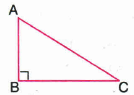
If ΔABC is right angled at B, then:
AB = AC
AC < AB
AB=BC
AC > Ab
31.
In figure, ABCD is a quadrilateral in which AB = BC and AD = DC.Measure of ㄥBCD is:
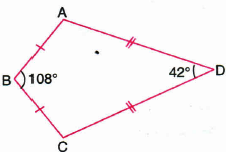
1500
300
1050
720
32.
In the given figure the measure of \(\angle ABC\) is
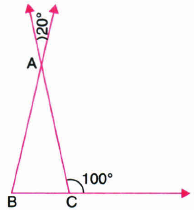
\(80^{ 0 }\)
\(20^{ 0 }\)
\(100^{ 0 }\)
\(60^{ 0 }\)
33.
The angle complementary to \(90^{ 0 }\)-\(9^{ 0 }\) is
\(90^{ 0 }\)+\(9^{ 0 }\)
\(9^{ 0 }\)
\(180^{ 0 }\)-\(9^{ 0 }\)
\(360^{ 0 }\)-\(9^{ 0 }\)
34.
The point of intersection of the lines represented by the equations 3x=2y+1 and 2x=3y-1 is:
(2,3)
(3,2)
(1,1)
(0,0)
35.
Cost of book (x) exceeds twice the cost of pen (y) by Rs,10.This statement can be expressed as linear equation:
x-2y-10=0
2x-y-10=0
2x+y-10=0
x-2y+10=0
36.
In which quadrant does the point (-1,2) lie?
I
II
III
IV
37.
Where do the I and III quadrants meet?
in x - axis
in y - axis
at O
do not intersect
38.
Zero of the zero polynomial is:
0
1
Any real number
Not defined
39.
The degree of the polynomial \((x^3+5)(4-x^5)\) is:
5
3
8
2
40.
If \(x=\frac { \sqrt { 7 } }{ 5 } \) and \(\frac { 5 }{ x } =p\sqrt { 7 } \) , then the value of p is:
\(\frac { 5 }{ \sqrt { 7 } } \)
\(\frac { 25 }{ 7 } \)
\(\frac { 7 }{ 25 } \)
\(\frac { \sqrt { 7 } }{ 5 } \)
41.
The decimal expansion of \(\sqrt { 2 } \) is
finite decimal
1.4121
non-terminating recurring
non-terminating non-recurring
42.
In the figure below, if x,y and z are exterior angles of \(\triangle ABC\), then calculate the value of x+y+z.
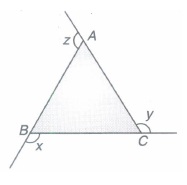
43.
What is the value of x in the figure given below?
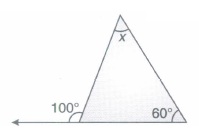
44.
In given fig., AD = BC and \(\angle\)BAD =\(\angle\)ABC, then prove that \(\angle\)ACB = \(\angle\)BDA.
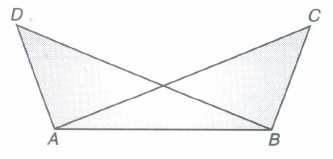
45.
\(\triangle ABC\cong \triangle PQR,\) AB=PQ. Which statement has been followed in this?
46.
Find the value of m, if x+4 is a factor of the polynomial x2+3x+m.
47.
Calculate the value of \({ \left[ { \left\{ { \left( 81 \right) }^{ \frac { -1 }{ 2 } } \right\} }^{ \frac { -1 }{ 4 } } \right] }^{ 2 }\)
48.
Write the simplest form of a rational number \(\frac{177}{413}\)
49.
Any solution of linear equation 2x+0y+9=0 in two variable is ______
50.
The equation of a line on which the point (6,2) lies is _______
51.
What is x+\(\frac { 1 }{ x } \)?
52.
AD and BC are equal perpendiculars to a line segment AB (see figure).
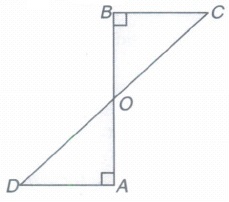
(i) Show that CD bisects AB.
(ii) Which mathematical concept is used in this problem?
(iii) What is its value?
53.
I and m are two parallel equal lines intersected by another pair of parallel lines p and q (see figure) :
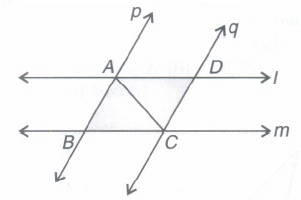
(i) Show that \(\triangle ABC\cong \triangle CDA\)
(ii) Which mathematical concept is used in this problem?
(iii) What is its value?
54.
For spreading the message "Save Girl Child Save Future" a rally was organized by some students of a school. They were given triangular cardboard piece PQR which they divided in to two parts by drawing the angle bisectors QO and RO of base angles Q and R and wrote a slogan. Prove that \(\angle\)QOR = 90° + \(\frac{1}{2}\)\(\angle\)P. What is the benefit of these types of rallies?
55.
In \(\triangle\)ABC, if AB is the greatest side, then prove that LC > 60°.
56.
In figure, PQ = PR. Show that PS > PQ.
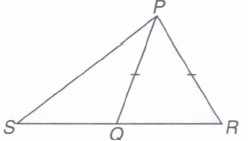
57.
In the figure, AD = AE, BD = EC. Prove that \(\triangle\)ABC is an isosceles triangle.
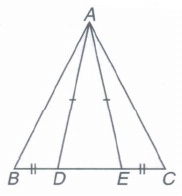
58.
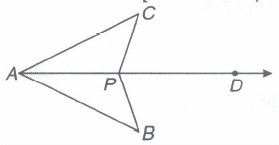
In the given figure, AD is the bisector of \(\angle\)BAC and \(\angle\)CPD = \(\angle\)BPD. Prove that\(\triangle CAP\cong \triangle BAP\) and CP = BP.
59.
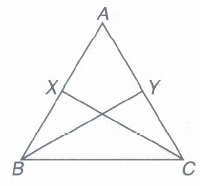
In the figure below, ABC is a triangle in which AB = AC. X and Yare points on AB and AC such that AX = AY. Prove that \(\triangle ABY\cong \triangle ACX\) .
60.
Geetha told her classmate Radha that "\(\sqrt { \frac { \left( \sqrt { 2 } -1 \right) }{ \left( \sqrt { 2 } +1 \right) } } \) is an irrational number." Radha replied that "you are wrong" and further claimed that "If there is a number 'x' such that x3 is an irrational number, then x5 is also irrational". Geetha said, "No Radha, you are wrong". Radha took some time and after verification accepted her mistakes and thanked Geetha for pointing out these mistakes.
(i) Justify both the statements.
(ii) What value is depicted from this question?
1.
\(\angle ABC=\angle GBD=70^o\) (Vertically opp. angle)
\(x=\angle ABC+\angle CAB\) (Exterior angle)
=50o+70o=120o
\(y=\angle GBD=70^o\) (Alternate angles)
\(z=180^o-\angle EAD-y\) (Angle sum property)
=180o-50o-70o
=60o
2.
In \(\triangle ABC,\)
\(\angle A+\angle B+\angle C=180^o\) (Angle sum prop. of \(\triangle)\)
\(\angle A+\angle C=180^o-90^o=90^o\)
\(\frac{1}{2}(\angle A+\angle C)=45^o\)
In \(\triangle AOC,\)
\(\frac{1}{2}\angle A+\frac{1}{2}\angle C+\angle AOC=180^o\)
\(\angle AOC=180^o-45^o=135^o\)
3.
\(\frac { 5+\sqrt { 3 } }{ 7-4\sqrt { 3 } } \times \frac { 7+4\sqrt { 3 } }{ 7+4\sqrt { 3 } } =\frac { 35+20\sqrt { 3 } +7\sqrt { 3 } +12 }{ 49-48 } \)
\(=\frac { 47+27\sqrt { 3 } }{ 1 } \)
and \(\frac { 5+\sqrt { 3 } }{ 4+4\sqrt { 3 } } =\frac { \left( 5+\sqrt { 3 } \right) \left( 7-4\sqrt { 3 } \right) }{ \left( 7+4\sqrt { 3 } \right) \left( 7-4\sqrt { 3 } \right) } \)
\(=\frac { 23-13\sqrt { 3 } }{ 1 } \)
ஃ \(\frac { 5+\sqrt { 3 } }{ 7-4\sqrt { 3 } } -\frac { 5+\sqrt { 3 } }{ 4+4\sqrt { 3 } } =(47+27\sqrt { 3 } )-(23-13\sqrt { 3 } )\)
= 24 + 40√3
= 8(3 + 5√3)
4.
Let the given field be in the shape of a trapezium ABCD in which AB=25 m, CD= 10 m, BC = 13 m and AD = 14 m.
From D, draw DE 11 BC meeting AB at E. Also, draw DF \(\bot \) AB.
\(\therefore \) DE = BC =13 m
AE = AB - EB = AB - DC
= 25 - 10 = 15 m
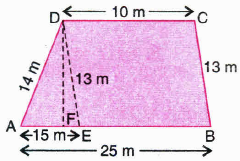
For AED
a = 14 m, b = 13 m, c= 15 m
\(\therefore s=\frac { a+b+c }{ 2 } =\frac { 14+13+15 }{ 2 } =\frac { 42 }{ 2 } =21\) m
\(\therefore \) Area of the \(\Delta \)AED \(=\sqrt { s(s-a)(s-b)(s-c) } \)
\(=\sqrt { 21(21-14)(21-13)(21-15) }\)
\( \\ =\sqrt { 21(7)(8)(6) } =\sqrt { \left( 7\times 3 \right) (7)\left( 4\times 2 \right) \left( 2\times 3 \right) } \)
\(=7\times 3\times 2\times 2=84\) m2
\(\Rightarrow \frac { 1 }{ 2 } \times \)AE\(\times \)DE = 84
\(\Rightarrow \ \frac { 1 }{ 2 } \times \)15\(\times \)DF = 84
\(\Rightarrow \) DF = \(\frac { 84\times 2 }{ 15 } \)
\(\Rightarrow \) DF= \(\frac { 56 }{ 5 } \) m = 11.2 m
\(\Rightarrow\) Height of the trapezium is 11.2 m.
\(\therefore \) Area of parallelogram EBCD = Base \(\times \) Height
= EB\(\times \) DF = 10 \(\times \)\(\frac { 56 }{ 5 } \) = 112 m2
\(\therefore \) Area of the field = Area of AED + Area of parallelogram EBCD = 84 m2 + 112 m2 = 196 m2.
5.
3=2x+y
⇒ y=3-2x
Table of solutions
| x | 1 | 0 |
|---|---|---|
| Y | 1 | 3 |
We plot the points (0, 3) and (1, 1) on the graph paper and join the.same by a ruler to get the line which is the graph of the equation 3 = 2x + y.
6.
(a) (0,5)
(b) (0,-3)
(c) (5,0)
(d) (-2,0)
7.
(i) \(B\rightarrow (-5,2)\)
(ii) \(C\rightarrow \left( 5,-5 \right) \)
(iii) E
(iv) G
(v) 6
(vi) -3
(vii) \(L\rightarrow (0,5)\)
(viii) \(M\rightarrow (-3,0)\)
8.
We know that
\(x^3-y^3=(x+y)(x^2+xy+y^2)\)
Using Identity VII
\(\Rightarrow\ x^3-y^3=(x-y)^3+3xy(x-y)\)
\(\Rightarrow\ x^3-y^3=(x-y){(x-y^2+3xy)}\)
\(\Rightarrow\ x^3-y^3=(x-y)(x^2-2xy+y^2+3xy)\) Using Identity IV
\(\Rightarrow x^3-y^3=(x-y)(x-y)(x^2+xy+y^2)\)
9.
This expression is not a polynomial in one variable because in the expression, three variables (x, y and t) occur.
10.
Yes! zero is a rational number.We can write zero in the form \(\frac { p }{ q } \),where p and q are integers and \(q\neq 0\)as follows:
\(0=\frac { 0 }{ 1 } =\frac { 0 }{ 2 } =\frac { 0 }{ 3 } \)etc.
11.
OA = OB (O is the mid-point of AB)
\(\angle\)AOC = \(\angle\)BOD (Vertically opposite angles)
OC = OD (O is the mid-point of CD)
\(\triangle AOC\cong \triangle BOD\)
\(\Rightarrow\) AC = BD. (By c.p.c.t) Proved.
12.
On x-axis, y co-ordinates is zero,
So put y=0 in 3x-2y=6, we get
3x-0=6
\(\Rightarrow x=\frac{6}{3}=2\)
3x-2y=6 meets the x-axis at (2,0)
13.
Here we have perimeter of the triangle = 32 cm, a = 8 cm and b = 11 cm.
Third side c = 32 cm – (8 + 11) cm = 13 cm
So, 2s = 32, i.e., s = 16 cm,
s – a = (16 – 8) cm = 8 cm,
s – b = (16 – 11) cm = 5 cm,
s – c = (16 – 13) cm = 3 cm.
Therefore, area of the triangle = \(\sqrt{s(s-a)(s-b)(s-c)}\)
\(=\sqrt{16 \times 8 \times 5 \times 3} \mathrm{~cm}^{2}=8 \sqrt{30} \mathrm{~cm}^{2}\)
14.
\(x=37^{ 0 },y=33^{ 0 }\)
15.
\(z=29^{ 0 },\angle DNM=45^{ 0 },\angle CNM=135^{ 0 }\)
16.
(4,0); (0,6)
17.
(i)
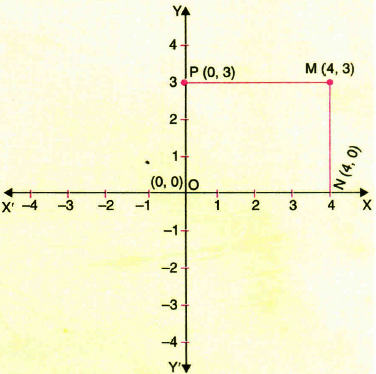
(ii) Rectangle
(iii) 14 units
18.
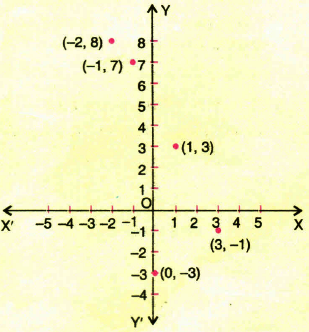
19.
(x-1)(x-3)(2x-5)
20.
Yes, No
21.
2
22.
-11/48, 7/96, 43/192
23.
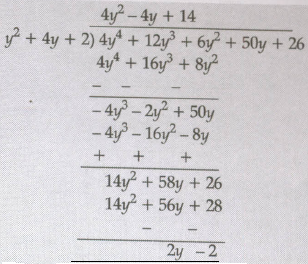
So, 2y-2 must be subtracted.
24.
For \(\Delta \)ABD
a = 13 cm, b = 14 cm, c = 15 cm
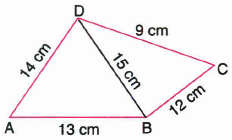
\(\therefore s=\frac { a+b+c }{ 2 } s=\frac { 13+14+15 }{ 2 } \) = 21 cm
\(\therefore \) Area = \(=\sqrt { s(s-a)(s-b)(s-c) } \)
\(=\sqrt { 21(21-13)(21-14)(21-15) } \)
\(\sqrt { 21\times 8\times 7\times 6 } =84\) cm2
For\(\Delta \) BCD
1 = 9 cm, b = 12 cm, c = 15 cm
\( \therefore s=\frac { a+b+c }{ 2 } s=\frac { a+12+15 }{ 2 } \)=18 cm
\(\therefore \)Area \(=\sqrt { s(s-a)(s-b)(s-c) } \)
\(=\sqrt {18(18-9)(18-12)(18-15) } \)
\(\sqrt { 18\times 9\times 6\times 3 } =54\) cm2
Now, area of quadrilateral ABCD = Area of \(\Delta \)ABD + Area of \(\Delta \)BCD
= 84 cm2 + 54 cm2 = 138 cm2
25.
Given: In ΔABC, D is the mid-point of BC The perpendiculars from D to AB and AC are equal.
To Prove: ΔABC is isosceles.
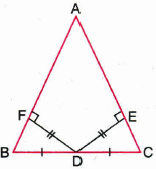
Proof: In righ~ triangles DEC and DFB, Hyp. DC = Hyp. DB
| D is the mid-point of BC
Side DE = Side DF IGiven
∴ ΔDEC ≌ ΔDFB I RHS congruence rule
∴ ㄥDCE = ㄥDBF
∴ ㄥBCA = ㄥCBA
∴ AB = AC
|Sides opposite to equal angles of a triangle are equal
26.
x+2y=8
2y=8-x
\(y={8-x\over 2}\)
This expresses y in terms of x
This line will intersect x-axis at the point for while y=0.So, put y=0 in (1), we get
x+2(0)=8
x=8
Hence, line(1) intersects x-axis at the point (8, 0).
This line will cut y-axis at the point for which x=0.So, put x=0 in (1), we get
0+2y=8
2y=8
\(y={8\over2}=4\)
Hence, line(1) cuts y-axis at the point (0, 4).
27.
(i) Coordinates of point P are (0,4)
(ii) Abscissae of point Q is 5.
(iii) The point identified by the coordinates (-4,4) is S.
(iv) The point identified by the coordinates (-3,-6) is R.
28.
\(2(\sqrt { 10 } +\sqrt { 6 } -1)\)
29.
Formula
30.
ㄥB > ㄥC
∴ AC > AB
31.
(c)
1050
32.
\(\angle BAC=20^{ 0 }\)
\(\angle ABC+\angle BAC=100^{ 0 }\)
33.
Required angle=\(180^{ 0 }\)-(\(90^{ 0 }\)+\(9^{ 0 }\)) = \(90^{ 0 }\)+\(9^{ 0 }\)
34.
(1, 1) satisfies 3x=2y+1 and 2x=3y-1 both
35.
x=2y+10 ⇒ x-2y-10=0
36.
(b)
II
37.
(c)
at O
38.
By convention
39.
\((x^3+5)(4-x^5)\)\(=4x^3-x^8+20-5x^5\)
40.
(b)
\(\frac { 25 }{ 7 } \)
41.
(d)
non-terminating non-recurring
42.
()
Since sum of all the exterior angles formed by producing the sides of a polygon is 360o
xo+yo+zo=360o
43.
()
We know that x+60o=100o (Exterior angle os the sum of the two interior opposite angles)
x=40o
44.
()
AD = BC (Given)
\(\angle\)BAD =\(\angle\)ABC (Given)
AB = AB (Common)
\(\triangle DAB\cong \triangle CBA\) (By SAS)
\(\angle\)BDA =\(\angle\)ACB (By c.p.ct)
45.
()
If two triangles are congruent, then one side of a triangle is equal to the corresponding side of the other triangle.
Hence, AB=PQ
46.
()
x+4 is a factor of x2+3x+m=p(x)
\(\Rightarrow\) p(-4) = 0
\(\Rightarrow\) 16-12+m = 0
\(\Rightarrow\) m = -4
47.
()
\({ \left[ { \left\{ { \left( 81 \right) }^{ \frac { -1 }{ 2 } } \right\} }^{ \frac { -1 }{ 4 } } \right] }^{ 2 }\)= {(81)-1/2}-1/2
= (81)1/4 = (34)1/4
= 3
48.
()
\(\frac{177}{413}\)= \(\frac{59\times3}{59\times7}=\frac{3}{7}\)
49.
()
\(\left( -\frac { 9 }{ 2 } ,m \right) \).
50.
()
2x-3y=6
51.
()
Not a polynomial.
52.
(i) AB and CD intersect atO0
\(\therefore\) \(\angle\)AOD = \(\angle\)BOC
(Vertically opp. angles) ...(i)
In \(\triangle\)AOD and \(\triangle\)BOC, we have
\(\angle\)AOD = \(\angle\)BOC ...(ii)
\(\angle\)DAO = \(\angle\)CBO = 90° (Given)
and AD = BC (Given)
\(\triangle AOD\cong \triangle BOC\)
(By AAS congruence criterion)
\(\Rightarrow\) OA = OB (By c.p.c.t.)
i.e., O is the mid-point of AB
Hence, CD bisects AB.
(ii) Congruency of triangles.
(iii) Equality is the sign of democracy.
53.
(i) I and m are two parallel lines intersected byanother pair of parallel lines p and q.
AD II BC
and AB II CD.
\(\Rightarrow\) ABCD is a parallelogram.
i.e., AB = CD
and BC = AD
Now in \(\triangle\)ABC and \(\triangle\)CDA,we have
AB = CD (Prop. of IIgm)
BC =AD
and AC = AC (Common)
\(\therefore\) \(\triangle ABC\cong \triangle CDA\)
(By SSS criterion of congruence)
(ii) Congruency of triangles.
(iii) Equality is the sign of democracy.
54.
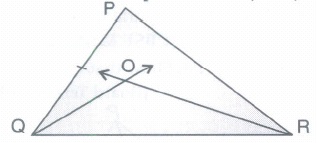
Proof: QO is bisector of \(\angle\)PQR
\(\angle\)OQR = \(\frac{1}{2}\)\(\angle\)PQR = \(\frac{1}{2}\) =\(\angle\)Q
RO is bisector \(\angle\)ORQ
\(\therefore\) \(\angle\)ORQ =\(\frac{1}{2}\) \(\angle\)PRQ = \(\frac{1}{2}\) \(\angle\)R
In \(\angle\)OQR
\(\angle\)QOR + \(\angle\)OQR + \(\angle\)ORQ = 180°
(Angle sum property)
\(\angle\)QOR + \(\frac{1}{2}\) \(\angle\)Q + \(\frac{1}{2}\) \(\angle\)R = 180°
\(\angle\)QOR = 180°- \(\frac{1}{2}\)(\(\angle\)Q + \(\angle\)R)
But in \(\angle\)PQR
\(\angle\)P + \(\angle\)Q + \(\angle\)R = 180°
\(\angle\)Q + \(\angle\)R = 180°- \(\angle\)P
\(\angle\)QOR = 180°- \(\frac{1}{2}\) (180°- \(\angle\)P)
= 180°-90° + \(\frac{1}{2}\)\(\angle\)P
= 90° + \(\angle\)P Hence Proved.
These type of rallies spread awareness among people for not to kill girl child and helping in equalising sex ratio.
55.
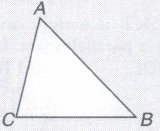
In \(\triangle\)ABC, as AB is the greatest side
\(\Rightarrow\) AB > BC \(\Rightarrow\) \(\angle\)C > \(\angle\)A
AB > AC \(\Rightarrow\) \(\angle\)C > \(\angle\)B
On adding (1) and (2), we get
2\(\angle\)C > \(\angle\)A + \(\angle\)B
\(\Rightarrow\) 2\(\angle\)C + \(\angle\)C > \(\angle\)A + \(\angle\)B + \(\angle\)C
\(\Rightarrow\) 3\(\angle\)C > 180°
\(\therefore\) \(\angle\)C > 60°.
56.
Proof: In \(\triangle\) PQR,
PQ =PR
\(\angle\) PQR = \(\angle\)PRQ
(Angles opp. to equal sides are equal) ...(i)
In \(\triangle\)PQS, \(\angle\)PQR > \(\angle\)PSQ
(Ext. angle of a 6 is greater than each of interior opp. angle)
\(\angle\)PRQ > \(\angle\)PSQ, using (i)
\(\Rightarrow\) \(\angle\)PRS >\(\angle\)PSR \(\Rightarrow\) PS > PR
PS>PQ (\(\because\) PR = PQ)
(Side opp. to greater angle is larger)
57.
Proof: In \(\triangle\)ADE, we have
AD = AE
\(\angle\)ADE = \(\angle\)AED
180°- \(\angle\)ADE = 180°- \(\angle\)AED
\(\Rightarrow\) \(\angle\)ADB = \(\angle\)AEC
Consider \(\triangle\)ABD and \(\triangle\)ACE
AD =AE
\(\angle\)ADB = \(\angle\)AEC
BD = EC
By SAS congruence,
\(\triangle ADB\cong \triangle AEC\)
By c.p.c.t., AB = AC
\(\therefore\) \(\triangle\)ABC is an isosceles triangle.
58.
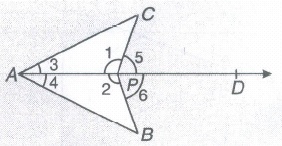
\(\angle\)1 + \(\angle\)5 = 1800 = \(\angle\)2 + \(\angle\)6
(linear pair)
\(\Rightarrow\) \(\angle\)1 =\(\angle\)2 (\(\because\) \(\angle\)5 = \(\angle\)6)
In \(\triangle\)CAP and \(\triangle\)BAP,
\(\angle\)1 = \(\angle\)2 (proved)
\(\angle\)3 = \(\angle\)4
(AD is the bisector of \(\angle\)BAC)
AP =AP
\(\triangle CAP\cong \triangle BAP\) (By SAS)
\(\Rightarrow\) CP = BP (By c.p.c.t.) Proved
59.
In \(\triangle\)ABY and \(\triangle\)ACX,
AB = AC (Given)
AY = AX (Given)
\(\angle\)A =\(\angle\)A (Common)
\(\therefore\) By SAS, \(\triangle ABY\cong \triangle ACX\)
60.
\(\sqrt { \frac { \left( \sqrt { 2 } -1 \right) }{ \left( \sqrt { 2 } +1 \right) } } \)is an irrational number.
\(\sqrt { \frac { \left( \sqrt { 2 } -1 \right) }{ \left( \sqrt { 2 } +1 \right) } } =\sqrt { \frac { \left( \sqrt { 2 } -1 \right) }{ \left( \sqrt { 2 } +1 \right) } \times \frac { \left( \sqrt { 2 } -1 \right) }{ \left( \sqrt { 2 } -1 \right) } } \)
\(=\sqrt { \frac { { \left( \sqrt { 2 } -1 \right) }^{ 2 } }{ 2-1 } } \)
\(=\sqrt { \frac { { \left( \sqrt { 2 } -1 \right) }^{ 2 } }{ 1 } } =\sqrt { 2 } -1\)
which is an irrational number.
Let, there is a number x such that x3 is an irrational number but x5 is a rational number.
Let, x =\(\sqrt[5]{7}\) be the number.
⇒ x3 = (5√7)3 = (7)3/5
is an irrational number.
But x5 = (\(\sqrt[5]{7}\))5=(7)5/5 = 7
=7 is a rational number.
(ii) Accepting own mistakes gracefully, co-operative learning among the classmates.

9th Standard CBSE Syllabus & Materials
9th Standard CBSE
CBSE 9th Mathematics Lines and Angles Sample Question Papers Study Material - QB365 Set A
NEW9th Standard CBSE
CBSE 9th Mathematics Introduction to Euclid's Geometry Sample Question Papers Study Material - QB365 Set A
NEW9th Standard CBSE
CBSE 9th Mathematics Linear Equations in Two Variables Sample Question Papers Study Material - QB365 Set A
NEW9th Standard CBSE
CBSE 9th Mathematics Coordinate Geometry Sample Question Papers Study Material - QB365 Set A



NCERT Books

Syllabus

Exam Pattern

Sample Question Papers

Previous year Question Papers

Important Notes

MCQ Practice test

NCERT Exemplers

Case study Questions

Image Based Questions

Passage based Questions

HOT Questions

Value Based Questions

Model Questions Papers
NCERT ( Book Back ) Questions

Assertion and Reason
Important Questions And Answers

CBSE 9th Standard CBSE Subjects
CBSE Standards