100% FREE ACCESS
9th Standard CBSE Syllabus & Materials
9th Standard CBSE
CBSE 9th Science Is matter around us pure? - New Model Questions Papers Study Material - QB365 Set A
NEW9th Standard CBSE
CBSE 9th Science Matter in our surroundings - New Model Questions Papers Study Material - QB365 Set A
NEW9th Standard CBSE
CBSE 9th Mathematics Heron's Formula Sample Question Papers Study Material - QB365 Set A
NEW9th Standard CBSE
CBSE 9th Mathematics Circles Sample Question Papers Study Material - QB365 Set A
NEW9th Standard CBSE
CBSE 9th Mathematics Quadrilaterals Sample Question Papers Study Material - QB365 Set A
NEW9th Standard CBSE
CBSE 9th Mathematics Triangles Sample Question Papers Study Material - QB365 Set A

Published on: 29/10/2025
Download CBSE Class 9th Standard CBSE Mathematics question papers, sample papers, important questions, and previous year solved papers in PDF format. Get free study materials, NCERT solutions, and exam preparation resources for Class 9th Standard CBSE Mathematics
Questions + Answers key
Take MCQ Mathematics Test
1.
Which of the following are not the angles of a traingle?
\(45^{ 0 },45^{ 0 },90^{ 0 }\)
\(60^{ 0 },30^{ 0 },90^{ 0 }\)
\(40^{ 0 },50^{ 0 },100^{ 0 }\)
\(60^{ 0 },60^{ 0 },60^{ 0 }\)
2.
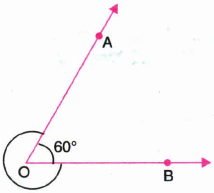
In the following figure, the reflex angle AOB is equal to
\(60^{ 0 },\)
\(120^{ 0 },\)
\(300^{ 0 },\)
\(360^{ 0 },\)
3.
Find the measure of the angle which is supplement of itself
\(30^{ 0 }\)
\(90^{ 0 }\)
\(45^{ 0 }\)
\(180^{ 0 }\)
4.
An angle which is greater than \(90^{ 0 }\) and less than \(180^{ 0 }\) is called
a right angle
a straight angle
an acute angle
an obtuse angle
5.
The complement of an angle m is:
m
\(90^{ 0 }\)+m
\(90^{ 0 }\)-m
mx\(90^{ 0 }\)
6.
How many types of angles are formed between the edges of plane surfaces?
Of different types
Of only one type
Of only two types
of only three types
7.
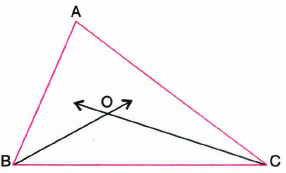
In figure the bisectors of \(\angle ABC\) and \(\angle BCA\) intersect each other at the point O.prove that \(\angle BOC=90^{ 0 }+\frac { 1 }{ 2 }\angle A\)
8.
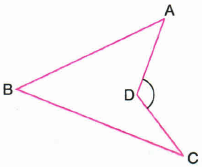
In the given figure prove that \(\angle ADC=\angle A+\angle B+\angle C\)
9.
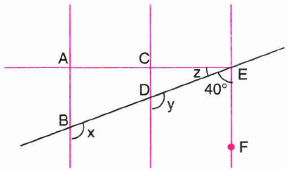
In figure AB || CD and CD || EF Also EA \(\bot \) AB if \(\angle BEF=40^{ 0 }\) , then find x,y,z
10.
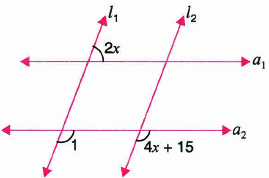
In the figure below \(l_{ 1 }||l_{ 2 }\) and \(a_{ 1 }||a_{ 2 }\) find the value of x.
11.
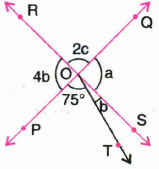
In the given figure , two straight lines PQ and RS intersect each other at O
If \(\angle \)POT =\(75^{ 0 }\) Find the values of a,b,c
12.
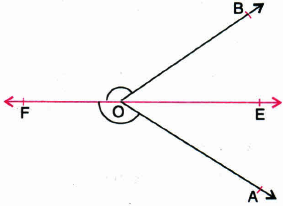
Ray OE bisects \(\angle \)AOB and OF the ray opposite to OE Show that \(\angle \)FOB=\(\angle \)FOA
13.
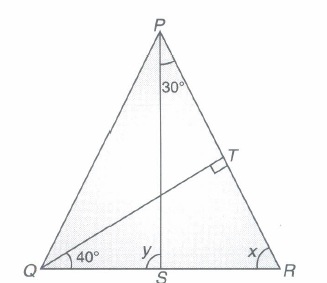
In the given figure QT 丄 PR, ㄥTQR = 40° and ㄥSPR= 30°, then find x and y.
14.
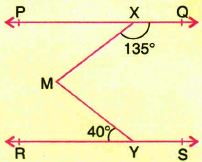
In the figure if PQ || RS, \(\angle MXQ=135^{ 0 }\) and \(\angle MYR=40^{ 0 }\) find \(\angle \) XMY
15.
(i) In figure ,AO \(\bot \)OB Find \(\angle \)AOC and \(\angle \) BOC
.png)
(ii) In figure,\(\angle \) AOB ;\(\angle \)BOC=2:3
If \(\angle \)AOC=\(75^{ 0 }\) then find the measure of ,\(\angle \) AOB ;\(\angle \)BOC
.png)
16.
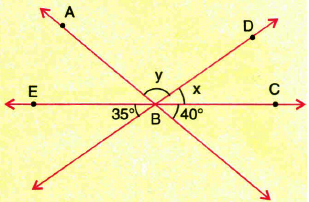
Find the value of x and y in the figure
17.
If a transversal intersects two parallel lines, then each pair of alternate interior angles is equal.
18.
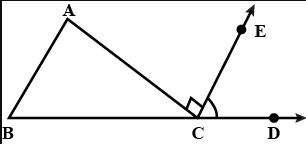
In the given figure, AC 丄 CE and ㄥA: ㄥB: ㄥC = 5:3:2. Find the value of ㄥECD.
19.
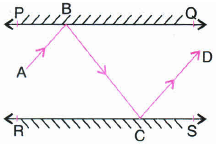
In Figure ,PQ and RS are two mirrors placed parallel to each other An incident ray AB strikes the mirror PQ at B the reflected ray moves along the path BC and strikes the mirror RS at C and again reflects back along CD.Prove that AB|| CD
20.
In figure if \(AB\parallel CD\parallel ,CD\parallel EF\) and y:z=3:7, find x
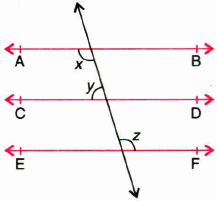
1.
\(40^{ 0 }+50^{ 0 }+100^{ 0 }=190^{ 0 },\)
2.
Required angle = \(360^{ 0 },\) - \(60^{ 0 },\)=\(300^{ 0 },\)
3.
X=\(180^{ 0 }\)-x\(\Rightarrow \)x\(90^{ 0 }\)
4.
Definition of an obuse angle
5.
(c)
\(90^{ 0 }\)-m
6.
(a)
Of different types
7.
\(\therefore \) BO is the bisector of \(\angle ABC\)
\(\therefore \angle OBC=\frac { 1 }{ 2 } \angle ABC=\frac { 1 }{ 2 } \angle B\)
\(\therefore \) CO is the bisector of \(\angle ACB\)
\(\angle OCB=\frac { 1 }{ 2 } \angle ACB=\frac { 1 }{ 2 } \angle C\)
In OBC ,\(\angle BOC+\angle OBC+\angle OCB=180^{ 0 }\)
| \(\therefore \) The sum of the three angles of a is \(180^{ 0 }\)
\(\Rightarrow \angle BOC+\frac { 1 }{ 2 } \angle B+\angle C)=180^{ 0 }\)
\(\Rightarrow \angle BOC=180^{ 0 }-\frac { 1 }{ 2 } (\angle B+\angle C)\)
In \(\triangle \) ABC
\(\angle A+\angle B+\angle C=180^{ 0 }\)
| The sum of the three angles of a triangle is \(180^{ 0 }\)
\(\Rightarrow \angle B+\angle C=180^{ 0 }-\angle A\)
\(\Rightarrow \frac { 1 }{ 2 } (\angle B+\angle C)=\frac { 180^{ 0 }-\angle A }{ 2 } \)
=\(90^{ 0 }-\frac { 1 }{ 2 } \angle A\)
From (3) and (4) we have
\(\angle BOC=180^{ 0 }-90^{ 0 }-\frac { 1 }{ 2 } \angle A=90^{ 0 }+\frac { 1 }{ 2 } \angle A\)
8.
Construction: Join BD and produce upto E
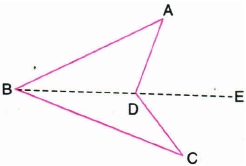
Proof \(\angle ADE=\angle A+\angle ABD\)
| An exterior angle of a traingle is equal to the sum of its two interior opposite angles
\(\angle CDE=\angle C+\angle ABD\)
|An exterior angle of a traingle is equal to the sum of its two interior opposite angles
Adding (1) and (2) we get
\(\angle ADE=\angle CDE=\angle A+\angle ABD+\angle C+\angle CBD\)
\(\Rightarrow \angle ADC=\angle A+(\angle ABD+\angle CBD)+\angle C\)
\(\Rightarrow \angle ADC+\angle A+\angle B+\angle C\)
9.
\(\therefore \) CD || EF
and a transversal DE intersect them
\(\therefore y+40^{ 0 }\)=\(180^{ 0 }\)
Sum of the consecutive interior on the same side of a traversal is \(180^{ 0 }\)
\(\Rightarrow Y=180^{ 0 }-40^{ 0 }=140^{ 0 }\)
\(\therefore \) AB||CD and a traversal BD intersects them
\(\therefore \) c=y | corresponding angles
\(\Rightarrow x=140^{ 0 }\)
\(\therefore EA\quad \bot \quad AB\quad and\quad AB||EF\)
\(\therefore EA\quad \bot \quad EF\quad \)
If a line is perpendicular to a line then it is perpendicular to the parallel line also
\(\Rightarrow \angle AEF=90^{ 0 }\)
\(\Rightarrow Z+40^{ 0 }=90^{ 0 }\)
\(\Rightarrow Z+50^{ 0 }\)
10.
\(\angle \)1=4x+15 | Corresponding angles
2x=180-\(\angle \)1 |Corresponding angles
\(\Rightarrow \) 2x=\(180^{ 0 }\) -(4x+15)
\(\Rightarrow \) 2x=165-4x
\(\Rightarrow \) 6x=165 \(\Rightarrow \)\(x=\frac { 165 }{ 6 } =27\frac { 1^{ 0 } }{ 2 } \)
11.
\(\therefore \) ROS is a line
\(\therefore \) 4b+\(75^{ 0 }\)+b=\(180^{ 0 }\)
\(\Rightarrow 5b=180^{ 0 }-75^{ 0 }=105^{ 0 }\)
\(\Rightarrow \) b=\(\frac { 105^{ 0 } }{ 5 } =21^{ 0 }\)
2c=\(75^{ 0 }\)+b
|Vertically opposite angles
\(\Rightarrow 2c=75^{ 0 }+21^{ 0 }\)
\(\Rightarrow 2c=96^{ 0 }\)
\(\Rightarrow \)\(c=\frac { 96^{ 0 } }{ 2 } =48^{ 0 }\)
a=4b
|Vertically opposite angkes
\(\Rightarrow a=4X21^{ 0 }=84^{ 0 }\)
Thus \(a=84^{ 0 },b=21^{ 0 },c=48^{ 0 }\)
12.
\(\angle \)FOB+\(\angle \)BOE=\(180^{ 0 }\) ...(1)
| Linear pair Axiom
\(\angle \)FOA+\(\angle \)AOE=\(180^{ 0 }\) .. (2)
| Linear Pair Axiom
From (1) and (2)
\(\angle \)FOB+\(\angle \)BOE=\(\angle \) FOA+\(\angle \)AOE ....(3)
But \(\angle \)BOE=\(\angle \)AOE
\(\therefore \) From (3)
\(\Rightarrow \) \(\angle \)FOB=\(\angle \)FOA
13.
Given,OT 丄 PR, ㄥTQR = 40° and ㄥSPR= 30°,
In ΔTQR, ㄥTQR + ㄥQTR + ㄥTRQ = 180° [by angle sum property of a triangle]
⇒ 40° + 90° + x = 180° ⇒ 130° + x = 180°
⇒ x =180°-130° ⇒ x = 500
Now, ㄥPSQ is an exterior angle for ΔPSR.
ஃ ㄥPSQ = ㄥSPR + ㄥSRP [by theorem 2]
⇒ y = 30° + x ⇒ y = 30° + 50° [ஃ x = 50°]
⇒ y = 80°
Hence, x = 50° and y = 80°
14.
Here, we need to draw a line AB parallel to line PQ, through point M as shown in Fig. Now, AB || PQ and PQ || RS.
Therefore, AB || RS
Now, \(\angle\) QXM + \(\angle\) XMB = 180°
(AB || PQ, Interior angles on the same side of the transversal XM)
But \(\angle\) QXM = 135°
So, 135° + \(\angle\) XMB = 180°
Therefore, \(\angle\) XMB = 45° (1)
Now, \(\angle\) BMY = \(\angle\) MYR (AB || RS, Alternate angles)
Therefore, \(\angle\) BMY = 40° (2)
Adding (1) and (2), you get
\(\angle\) XMB + \(\angle\) BMY = 45° + 40°
That is, \(\angle\) XMY = 85°
15.
Let \(\angle AOB=2x\) and \(\angle BOC=3x\)
\(\angle AOB+\angle BOC=\angle AOC\)
2x+3x=75o
\(\Rightarrow x=\frac{75^o}{5}=15^o\)
\(\angle AOB=2x=30^o\) and \(\angle BOC=3x=45^o\)
16.
X=\(35^{ 0 }\)
y=\(105^{ 0 }\)
17.
Now, using the converse of the corresponding angles axiom, can we show the two lines parallel if a pair of alternate interior angles is equal .In Fig. the transversal PS intersects lines AB and CD at points Q and R respectively such that \(\angle\) BQR = \(\angle\) QRC.
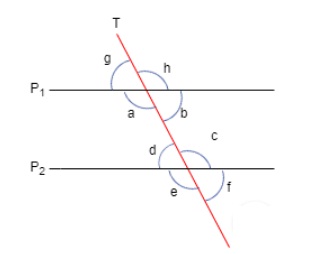
Is AB || CD?
\(\angle\) BQR = \(\angle\) PQA) (1)
But, \(\angle\) BQR = \(\angle\) QRC (Given) (2)
So, from (1) and (2), you may conclude that
\(\angle\) PQA = \(\angle\) QRC
But they are corresponding angles.
So, AB || CD (Converse of corresponding angles axiom)
18.
Let ㄥA = 5x, ㄥB = 3x and ㄥC = 2x.
In ΔABC, we have ㄥA + ㄥB + ㄥC = 180°
⇒ 5x+ 3x+ 2x = 180°
⇒ x=\(\frac{180^{\circ}}{10}\)=18°
ஃ ㄥA=5x=5x18°=90°
ㄥB=3x=3x18°=54°
and ㄥC = 2x = 2 x 18° = 36°
Now, ㄥACD = ㄥBAC + ㄥABC
[ஃ exterior angle = sum of interior opposite angles]
⇒ ㄥACE + ㄥECD = 90° + 54°
ஃ ㄥECD = 54°[∵ ㄥACE = 90°]
19.
Construction: Draw ray BL \(\bot \) PQ and ray CM \(\bot \) RS.
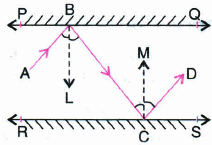
BL \(\bot \) PQ,CM \(\bot \) RS and PQ || RS BL||CM
\(\angle \) LBC=\(\angle \) MCB
|Alternate Interior Angles
\(\angle\)ABL=\(\angle\)LBC
Angle of incidence= Angle of reflection
\(\angle \)MCB=\(\angle \)MCD
Angle of incidence= Angle of reflection
From (1),(2) and (3) we get
\(\angle \)ABL =\(\angle \)MCD
Adding (1) and (4) , we get
\(\angle \) LBC+\(\angle \)ABL =\(\angle \)MCB+\(\angle \)MCD
\(\Rightarrow \) \(\angle \)ABC=\(\angle \)BCD
But these form a pair of equal alternate interior angles
So AB || CD.
20.
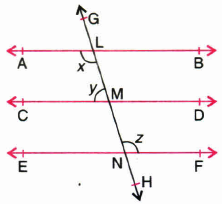
and \(\because AB\parallel CD\)
\( CD\parallel EF\)
\(\because AB\parallel EF\)
Lines parallel to the same line are parallel to each other
\(\therefore x=z\)
Alternate Interior Angles
X+y=\(180^{ 0 }\)
Consecutive interior angles on the same side of a transversal GH to parallel lines AB and CD
From (1) and (2)
z+y=\(180^{ 0 }\)
y:z=3:7
Sum of the ratios=3+7=10
\(\therefore y=\frac { 3 }{ 10 } X180^{ 0 }=54^{ 0 }\)
and \(z=\frac { 7 }{ 10 } x180^{ 0 }=126^{ 0 }\)
\(\therefore x=z=126^{ 0 }\)

9th Standard CBSE Syllabus & Materials
9th Standard CBSE
CBSE 9th Mathematics Lines and Angles Sample Question Papers Study Material - QB365 Set A
NEW9th Standard CBSE
CBSE 9th Mathematics Introduction to Euclid's Geometry Sample Question Papers Study Material - QB365 Set A
NEW9th Standard CBSE
CBSE 9th Mathematics Linear Equations in Two Variables Sample Question Papers Study Material - QB365 Set A
NEW9th Standard CBSE
CBSE 9th Mathematics Coordinate Geometry Sample Question Papers Study Material - QB365 Set A



NCERT Books

Syllabus

Exam Pattern

Sample Question Papers

Previous year Question Papers

Important Notes

MCQ Practice test

NCERT Exemplers

Case study Questions

Image Based Questions

Passage based Questions

HOT Questions

Value Based Questions

Model Questions Papers
NCERT ( Book Back ) Questions

Assertion and Reason
Important Questions And Answers

CBSE 9th Standard CBSE Subjects
CBSE Standards