100% FREE ACCESS
9th Standard CBSE Syllabus & Materials
9th Standard CBSE
CBSE 9th Science Is matter around us pure? - New Model Questions Papers Study Material - QB365 Set A
NEW9th Standard CBSE
CBSE 9th Science Matter in our surroundings - New Model Questions Papers Study Material - QB365 Set A
NEW9th Standard CBSE
CBSE 9th Mathematics Heron's Formula Sample Question Papers Study Material - QB365 Set A
NEW9th Standard CBSE
CBSE 9th Mathematics Circles Sample Question Papers Study Material - QB365 Set A
NEW9th Standard CBSE
CBSE 9th Mathematics Quadrilaterals Sample Question Papers Study Material - QB365 Set A
NEW9th Standard CBSE
CBSE 9th Mathematics Triangles Sample Question Papers Study Material - QB365 Set A

Published on: 29/10/2025
Download CBSE Class 9th Standard CBSE Mathematics question papers, sample papers, important questions, and previous year solved papers in PDF format. Get free study materials, NCERT solutions, and exam preparation resources for Class 9th Standard CBSE Mathematics
Questions + Answers key
Take MCQ Mathematics Test
1.
Prove that bisectors of pair of vertically opposite angles are in the same straight line.
2.
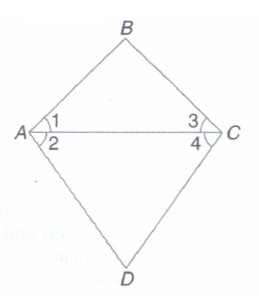
In the given figure, we have \(\angle1=\angle3\) and \(\angle2=\angle4\). Show that, \(\angle A=\angle C.\)
3.
ABCD is a square. Co-ordinates of A and C are (-1,-1) and (1,1) respectively. Write the coordinates of B and D. Also write the equations of all the sides of square.
4.
Determine the co-ordinates of a point on the graph of 5x-y=12 whose
(a)ordinate is twice that of the abscissa
(b)abscissa and ordinate are in the ratio 3:2.
5.
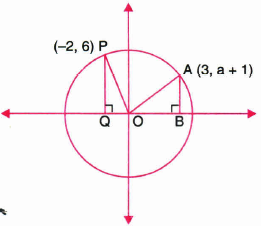
The are(\(\triangle OAB\)) = area(\(\triangle OPQ\)).Find the ordinate of point A.
6.
If \(x=3+2\sqrt { 2 } \) then find the value of \({ \left( x-\frac { 1 }{ x } \right) }^{ 3 }\)
7.
Find five rational numbers between \(\frac { 3 }{ 5 } \) and \(\frac { 4 }{ 5 } \)
8.
Find the value of K so that x=-1 and y=-1 is a solution of the linear equation 9kx+12ky=63.
9.
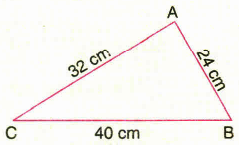
Find the area of a triangle whose sides are 40 cm, 24 cm and 32 cm.
10.
In ΔABC, if ㄥA = 50° and ㄥB = 60°, determine the shortest and the longest side of the triangle.
11.
Find the supplement of \(\frac { 4 }{ 3 } \) of right angle
12.
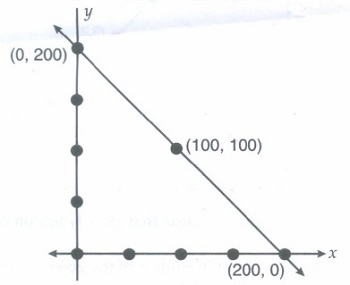
Two friends Sita and Gita, together contributedRs.200 towards Prime Minister's Relief Fund.Write a linear equation which satisfies this data.Draw the graph
13.
Plot the points A(-3,-3), B(3,-3), C(3,3), D(-3,3) in the Cartesian plane.Also, find the length of the line segment AB.
14.
Expand \((4a-2b-3c)^2\)
15.
Simplify: \(\frac { { \left( 25 \right) }^{ \frac { 3 }{ 2 } }\times { \left( 343 \right) }^{ \frac { 1 }{ 5 } } }{ { 16 }^{ \frac { 5 }{ 4 } }\times { 8 }^{ \frac { 4 }{ 3 } }\times { 7 }^{ \frac { 3 }{ 5 } } } \)
16.
Area of a rhombus is 90 cm2 .One of its diagonals measures 10 cm.Length of the other diagonal is
18 cm
36 cm
80 cm
9 cm
17.
If ΔABC is congruent to ΔDEF by SSS congruence rule, then:
ㄥC < ㄥF∆
ㄥB < ㄥE
ㄥA < ㄥD
ㄥA = ㄥD, ㄥB=ㄥE, ㄥC=ㄥF
18.
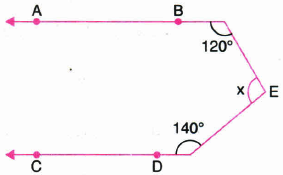
In figure AB and CD are parallel to each other The value of x is:
\(90^{ 0 }\)
\(100^{ 0 }\)
\(120^{ 0 }\)
\(140^{ 0 }\)
19.
In ancient India, alters with combination of shapes like rectangles, triangles and trapeziums were used for
public workship
household rituals
both (a) and (b)
none of the above
20.
Mirror image of the point (9,-8) in the y - axis is:
(-9,8)
(9,8)
(-9,-8)
(-8,9)
21.
Product of \((x-\frac{1}{x})(x+\frac{1}{x})(x^2+\frac{1}{x^2})\) is:
\(x^4+\frac{1}{x^4}\)
\(x^3+\frac{1}{x^3}-2\)
\(x^4-\frac{1}{x^4}\)
\(x^2+\frac{1}{x^2}+2\)
22.
The value of \(\sqrt [ 4 ]{ \sqrt [ 3 ]{ { 2 }^{ 2 } } } \) is equal to:
\({ 2 }^{ -\frac { 1 }{ 6 } }\)
\({ 2 }^{ -6 }\)
\({ 2 }^{ \frac { 1 }{ 6 } }\)
\({ 2 }^{ 6 }\)
23.
The value of \(\frac { { 2 }^{ 0 }\times { 7 }^{ 0 } }{ { 5 }^{ 0 } } \) is:
1
0
9/5
1/5
24.
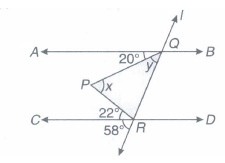
In the given figure, find the value of x and y if AB||CD.
25.
If two parallel lines are intersected by a transversal, then prove that bisectors of the interior angles form a rectangle.
26.
In \(\triangle\)ABC and \(\triangle\)PQR, AB = PQ, AC = PR and altitude AM and PN are equal. Show that, \(\triangle ABC\cong \triangle PQR.\)
27.
In an election, a good candidate may lose because 40% of voters do not cast their votes due to various reasons. Form an equation and draw the graph with data. Form the graph, Find:
(i) the total number of voters, if 300 voters cast their votes
(ii) the number of votes cast, if the total number of voters are 1000.
(iii) What is its value.
28.
If \(\frac { { 9 }^{ n+1 }\times { \left[ { 3 }^{ -n/2 } \right] }^{ -2 }-{ 27 }^{ n } }{ { \left( { 3 }^{ m }\times 2 \right) }^{ 3 } } =\frac { 1 }{ 729 } \), then prove that m-n=2.
29.
The sides of a triangular ground are 5 m, 7 m, and 8 m respectively. Find the cost of levelling the ground at the rate of Rs10 per m2. (Use \(\sqrt { 3 } \) = 1.73).
30.
(i) PlotthepointsA(-4, -1), B(2, -J), C(6, 3) and D(O, 3).
(ii) Join the points to get AB, Be, CD and DA.
(iii) Apala says that the figure obtained is a parallelogram. Is she correct? If so, which value of Apala is depicted by her statement?
(iv) Can we say that ABCD is a trapezium? If not, why?
(v) What is the altitude of the parallelogram ABCD corresponding to the base AB?
(vi) When will the parallelogram ABCD become a rectangle ABCD?
(vii) Which mathematical concept has been covered in this problem?
31.
Let \(R_1\) and \(R_2\)are the remainders when the polynomials \({ x }^{ 3 }+2{ x }^{ 2 }-5ax-7\) and \({ x }^{ 3 }+2{ x }^{ 2 }-5ax-7\) are divided by (x+1) and (x-2) respectively. If 2\(R_1\)+\(R_2\)=6, Find the value of a.
32.
Is it possible to construct a triangle, when its sides are 5.4 cm, 2.3 cm, 3.1 cm?
33.
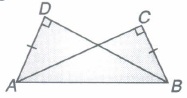
In the figure below, it is given that\(\triangle ABD\cong \triangle BAC\). What criteria is used to prove that the triangles are congruent?
34.
Two supplementary angles are in ratio 2:7. Find the measure of angles.
35.
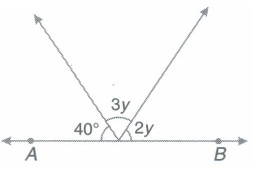
In the figure below, calculate the value of y.
36.
Write the number of dimension(s) of a surface.
37.
Give any one example of a geometrical line from your surroundings.
38.
Express in variables the things which are double of the same thing.
39.
Factorize: 20x2-9x+1.
40.
If f(x) be a polynomial such that \(f\left( -\frac { 1 }{ 3 } \right) \)=0, then calculate one factor of f(x).
41.
Calculate the irrational number between 2 and 2.5.
42.
The equation of a line parallel to y-axis is
43.
If (0,2) is a solution of the linear equation 2x+3y=k, then find the value of k.
44.
If \(\sqrt { 3 } x=\sqrt { 2 } x+1\) , then x is equal to _____
45.
State whether the following statements are true or false.Give reason for your answer.
(i) Every whole number is a natural number.
(ii) Zero is neither a negative nor a positive integer.
(iii) There are finitely many rational numbers between any two given rational numbers.
46.
For spreading the message "Save Girl Child Save Future" a rally was organized by some students of a school. They were given triangular cardboard piece PQR which they divided in to two parts by drawing the angle bisectors QO and RO of base angles Q and R and wrote a slogan. Prove that \(\angle\)QOR = 90° + \(\frac{1}{2}\)\(\angle\)P. What is the benefit of these types of rallies?
1.
Two lines AB and CD intersect at point O. Also, OM and ON are t6he bisectors of \(\angle AOC\) and \(\angle BOD\) respectively.
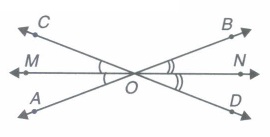
To prove: MON is a straight line/
Prove: Since the sum of all the angles around a point O is 360o , we have
\(\angle AOC+\angle BOC+\angle BOD+\angle AOD=360^o\)
\(\Rightarrow 2\angle MOC+2\angle BOC+2\angle BON=360^o\)
\([\because \angle BOC=\angle AOD\)(ver:opp, \(\angle S\) OM is bisector of \(\angle AOC.ON\) is bisector of \(\angle BOD\)]
\(\Rightarrow \angle MOC+\angle BOC+\angle BON\)
=180o
\(\Rightarrow \angle MON=180^o\)
\(\therefore \angle MON\) is a straight angle
Hence, MON is a straight line.
2.
Since \(\angle1=\angle3\ and \ \angle2=\angle4\), therefore adding before equations.
\(\angle1+\angle2=\angle3+\angle4\)
\(\Rightarrow \angle BAD= \angle BCD\)
\(\Rightarrow \angle A= \angle C.\)
3.
Given, A(-1,-1) and C(1,1)
Then, B(1,-1) and D(-1,1)
Also, equations of sides of square are,
AB: Y=-1
BC: X=1
CD: Y=1
DA: X=-1
4.
(a)(4, 2)
(b)\(\left({36\over13},{24\over13}\right)\)
5.
\(A\rightarrow \left( 3,4 \right) \)
6.
\(128\sqrt { 2 } \)
7.
\(\frac { 3 }{ 5 } =\frac { 3\times 10 }{ 5\times 10 } =\frac { 30 }{ 50 } \)
\(\\ \frac { 4 }{ 5 } =\frac { 4\times 10 }{ 5\times 10 } =\frac { 40 }{ 50 } \)
\(\\ \because 30<31<32<33<34<35\)
\(\\ \therefore \frac { 30 }{ 50 } <\frac { 31 }{ 50 } <\frac { 32 }{ 50 } <\frac { 33 }{ 50 } <\frac { 34 }{ 50 } <\frac { 35 }{ 50 } \)
Therefore, five rational numbers between \(\frac { 3 }{ 4 } \) and \(\frac { 4 }{ 5 } \) and be taken as
\(\frac { 31 }{ 50 } ,\frac { 32 }{ 50 } ,\frac { 33 }{ 50 } ,\frac { 34 }{ 50 } \)and \(\frac { 35 }{ 50 } \)
i.e., \(\frac { 31 }{ 50 } ,\frac { 16 }{ 25 } ,\frac { 33 }{ 50 } ,\frac { 17 }{ 25 } \) and \(\frac { 7 }{ 10 } \)
8.
Substituting x=-1 and y=-1 in 9kx+12ky=63, we get
\(\Rightarrow\) 9k(-1)+12k(-1)=63
\(\Rightarrow\) -9k-12k=63
\(\Rightarrow\) -21k=63 k=-3
9.
384 cm2
10.
BC, AB
11.
\(\frac{4}{3}\) of a right angle=\(\frac{4}{3}\times90^o=120^o\)
(Sum of supplementary angles is 180o)
Supplement of 120o=180o-120o=60o
12.
Let Sita contribute=Rs.x and Gita contribute=Rs.y.
According to the question,
x+y=200
y=200-x
| x | 0 | 200 | 100 |
| y | 200 | 0 | 100 |
13.
6 Units.
14.
Using Identity V, we have
(4a – 2b – 3c)2 = [4a + (–2b) + (–3c)]2
= (4a)2 + (–2b)2 + (–3c)2 + 2(4a)(–2b) + 2(–2b)(–3c) + 2(–3c)(4a)
= 16a2 + 4b2 + 9c2 – 16ab + 12bc – 24ac
15.
\(\frac { 125 }{ 512 } \)
16.
(a)
18 cm
17.
(d)
ㄥA = ㄥD, ㄥB=ㄥE, ㄥC=ㄥF
18.
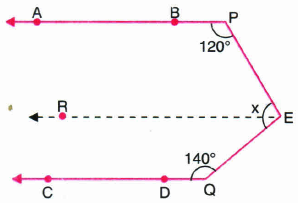
\(x=\angle PEQ\)
\(\angle PER+\angle QER\)
\(=(180^{ 0 }-\angle APE)+180^{ 0 }-140^{ 0 }\)
19.
(a)
public workship
20.
(c)
(-9,-8)
21.
\((x-\frac{1}{x})(x+\frac{1}{x})(x^2+\frac{1}{x^2})\)
\((x^2-\frac{1}{x^2})(x^2+\frac{1}{x^2})=x^4-\frac{1}{x^4}\)
22.
(c)
\({ 2 }^{ \frac { 1 }{ 6 } }\)
23.
(a)
1
24.
y+20o=58o(Corr angles)
y=58o-20o=38o
\(\angle PRQ=180^o-(58^o+22^o)\)(Linear pair)
=180o-80o=100o
x=180o-(100o+38o)(Angle sum of property)
=180o-138o=42o
25.
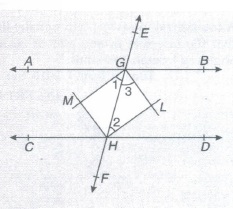
\(\angle AGH=\angle GHD\)
\(\Rightarrow \frac{1}{2}\angle AGH=\frac{1}{2}\angle GHD\Rightarrow\angle 1=\angle2\)
\(\Rightarrow\) GM||LH
Similarly, GL||MH
GMHL is a parallelogram.
\(\angle BGH+\angle GHD=180^o\)
\(\Rightarrow\frac{1}{2}\angle BGH+\frac{1}{2}\angle GHD=90^o\)
\(\Rightarrow \angle 3+\angle 2=90^o\)
In \(\triangle GLH, \angle GLH=180^o-(\angle 2+\angle3)\)
=180o-90o
\(\Rightarrow \angle GLH=90^o\)
\(\angle GMH=90^o\)
So, \(\angle MGL+\angle GLH=180^o\Rightarrow \angle MGL+90^o\)
=180o
\(\Rightarrow \angle MGL=90^o\Rightarrow\angle MHL=90^o\)
26.
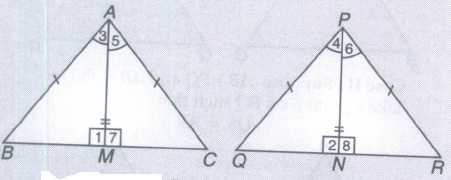
In \(\triangle\)AMB and \(\triangle\)PNQ,
AB = PQ (Given)
AM = PN (Given)
\(\angle\)1 = \(\angle\)2 = 90°
(AM\(\bot \)BC & PN \(\bot \)QR)
\(\Rightarrow\) \( \triangle AMP\cong \triangle PNQ\) (By RHS)
\(\Rightarrow\) \(\angle\)3 =\(\angle\)4 (By c.p.c.t.)
Similarly, \(\triangle AMC\cong \triangle PNR\)
\(\Rightarrow\) \(\angle\)5 = \(\angle\)6
(In congruent triangles, corresponding angles are equal)
\(\therefore\) In \(\triangle\)ABC and \(\triangle\)PQR,
AB = PQ (Given)
AC = PR (Given)
\(\angle\)A =\(\angle\)P
(\(\angle\)3 + \(\angle\)5 = \(\angle\)4 + \(\angle\)6) (proved)
\(\triangle ABC\cong \triangle PQR\) (By SAS)
27.
Since total number of voters who do not cast therir cotes=40%
Hence total number of voters who cast their votes =60%
Let the total numbers of voters are x and number of voters who cast their votes is y.
Then according to the question
y=60% of \(x=\frac{60}{100}x\)
Now, when c=100, then
y=60
when x=200, then y=120
when c=300, then y=180
| x | 100 | 200 | 300 |
| y | 60 | 120 | 180 |
By plotting the points (100,60), (200,120) (300,180) on the graph and by joining them, we get the graph of equation (1) as shown in fig. From the graph, we see that
(i) If 300 voters cast their votes, then total number of votes=500
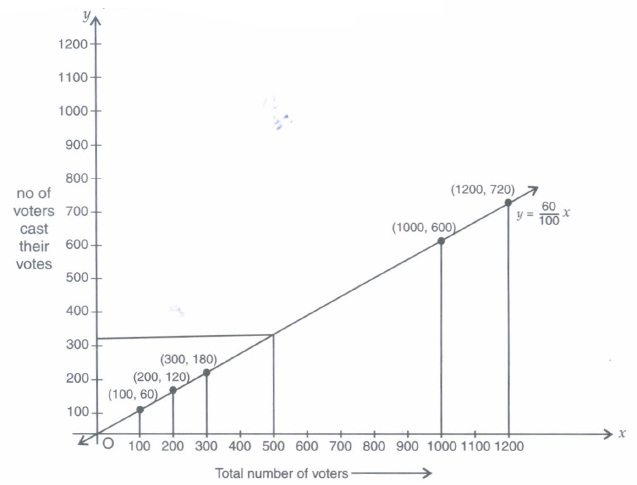
(ii) If the total number of voters are 1000, then number of votes cast=600.
(iii) Everyone should cast his vote to elect an honest candidate.
28.
\(\frac { { \left( { 3 }^{ 2 } \right) }^{ n+1 }\times { 3 }^{ n }-{ \left( { 3 }^{ 3 } \right) }^{ n } }{ { 3 }^{ 3m }\times { 2 }^{ 3 } } =\frac { 1 }{ { 3 }^{ 6 } } \)
⇒ \(\frac { { 3 }^{ 2n+2 }\times { 3 }^{ n }-{ 3 }^{ n } }{ { 3 }^{ 3m }\times 8 } =\frac { 1 }{ { 3 }^{ 6 } } \)
ஃ 3n - 3m = -6
ஃ m - n = -2
29.
For triangular ground a = 5m, b = 7m, c = 8m
\(\therefore s=\frac { a+b+c }{ 2 } =\frac { 5+7+8 }{ 2 } \) m = 10 m
\(\therefore \) Area \(=\sqrt { s(s-a)(s-b)(s-c) } \)
\(=\sqrt { 10(10-5)(10-7)(10-8) }\)
\( \\ =\sqrt { 300 } =10\sqrt { 3 } \)
=10\(\times \)1.73 =17.3 m2
\(\therefore \) Cost of levelling = 17.3 \(\times \) 10 = Rs.173
30.
(i)
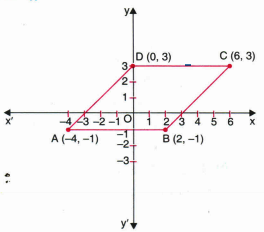
(ii) See above figure
(iii) The figure obtained is a parallelogram. So, Apala is correct. So, the value 'intelligent' is depicted by her statement.
(iv) ABCD is not a trapezium as in a trapezium only one pair of opposite sides are parallel.
(v) The altitude of the parallelogram ABCD corresponding to the base AB are 4 units.
(vi) The parallelogram ABCD will become rectangle ABCD when
31.
Let \(f(x)={ x }^{ 3 }+2{ x }^{ 2 }-5ax-7\)
and \(g(x)={ x }^{ 3 }-a{ x }^{ 2 }-12x+6\)
By remainder theorem,
\(f(-1)={ R }_{ 1 }\ \ \ \ ........(1)\)
\(x+1=0\Rightarrow x=-1\)
\(\Rightarrow { (-1) }^{ 3 }+2{ (-1) }^{ 2 }-5a(-1)-7={ R }_{ 1 }\)
\(\Rightarrow \ -1+2+5a-7={ R }_{ 1 }\)
\(\Rightarrow { R }_{ 1 }=a-6 \ \ ................(2)\)
and \(g(2)={ R }_{ 2 }\ \ ...........(3)\)
\(x-2=0\Rightarrow x=2\)
\(\Rightarrow { (2) }^{ 3 }+a{ (2) }^{ 2 }-12(2)+6={ R }_{ 2 }\)
\(\Rightarrow 8+4a-24+6={ R }_{ 2 }\)
\(\Rightarrow { R }_{ 2 }=4a-10\ \ \ .....(4)\)
According to the question,
\(2{ R }_{ 1 }+{ R }_{ 2 }=6\)
\(\Rightarrow 2(5a-6)+(4a-10)=6\)
\(\Rightarrow -12+4a-10=6\)
\(\Rightarrow 14a=28\)
\(\Rightarrow a=2\)
32.
()
No, Because, 2.3 + 3.1 = 5.4 cm (third side)
\(\therefore\) Not possible to construct a triangle.
33.
()
\(\angle\)BDA = \(\angle\)ACB = 900 (Given)
AD = BC (Given)
AD = AB (Common)
\(\triangle ABD\cong \triangle BAC\) (By RHS)
34.
()
2x+7x=180o\(\Rightarrow\)x=20o
So the angles are
2x=2X20o
=40o
7x=7X20o
=140o
So two angles are 40o and 140o
35.
()
Here, 40o+3y+2y=180o(\(\because\) Straight line makes an angle of 180o)
5y=140o
y=28o
36.
()
Dimension of surface= Length and Breadth (which is 2)
37.
()
Meeting place of two walls.
38.
()
Let, First thing = x
Second thing = y
then, x = 2y
39.
()
20x2-9x+1 = 20x2-5x-4x+1
=5x(4x-1)-1(4x-1)
=(4x-1)(5x-1)
40.
()
Since, \(f\left( -\frac { 1 }{ 3 } \right) \) =0
\(\therefore -\frac { 1 }{ 3 } \) is a zero of polynomial f(x)
So, x+\(\frac { 1 }{ 3 } \)or 3x+1 is a factor of f(x).
41.
()
Since, √5=2.236
Hence, the irrational number between 2 and 2.5 is √5.
42.
()
x=k
43.
()
∵ (0,2) is the solution of given equation
∵ it satisfies the equation
∵ 2(0)+3(2)=k
∵ k=6
44.
()
Given, \(\sqrt { 3 } x=\sqrt { 2 } x+1\)
\(\therefore \ x(\sqrt { 3 } -\sqrt { 2 } )=1\)
\(\therefore \ x=\frac { 1 }{ \sqrt { 3 } -\sqrt { 2 } } \).
45.
()
(i) False, because 0 is not a natural number.
(ii) True, because 0 is non-negative and non-positive integer.
(iii) False, because there are infinitely many rational number between two rational number.
46.
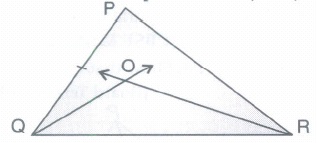
Proof: QO is bisector of \(\angle\)PQR
\(\angle\)OQR = \(\frac{1}{2}\)\(\angle\)PQR = \(\frac{1}{2}\) =\(\angle\)Q
RO is bisector \(\angle\)ORQ
\(\therefore\) \(\angle\)ORQ =\(\frac{1}{2}\) \(\angle\)PRQ = \(\frac{1}{2}\) \(\angle\)R
In \(\angle\)OQR
\(\angle\)QOR + \(\angle\)OQR + \(\angle\)ORQ = 180°
(Angle sum property)
\(\angle\)QOR + \(\frac{1}{2}\) \(\angle\)Q + \(\frac{1}{2}\) \(\angle\)R = 180°
\(\angle\)QOR = 180°- \(\frac{1}{2}\)(\(\angle\)Q + \(\angle\)R)
But in \(\angle\)PQR
\(\angle\)P + \(\angle\)Q + \(\angle\)R = 180°
\(\angle\)Q + \(\angle\)R = 180°- \(\angle\)P
\(\angle\)QOR = 180°- \(\frac{1}{2}\) (180°- \(\angle\)P)
= 180°-90° + \(\frac{1}{2}\)\(\angle\)P
= 90° + \(\angle\)P Hence Proved.
These type of rallies spread awareness among people for not to kill girl child and helping in equalising sex ratio.

9th Standard CBSE Syllabus & Materials
9th Standard CBSE
CBSE 9th Mathematics Lines and Angles Sample Question Papers Study Material - QB365 Set A
NEW9th Standard CBSE
CBSE 9th Mathematics Introduction to Euclid's Geometry Sample Question Papers Study Material - QB365 Set A
NEW9th Standard CBSE
CBSE 9th Mathematics Linear Equations in Two Variables Sample Question Papers Study Material - QB365 Set A
NEW9th Standard CBSE
CBSE 9th Mathematics Coordinate Geometry Sample Question Papers Study Material - QB365 Set A



NCERT Books

Syllabus

Exam Pattern

Sample Question Papers

Previous year Question Papers

Important Notes

MCQ Practice test

NCERT Exemplers

Case study Questions

Image Based Questions

Passage based Questions

HOT Questions

Value Based Questions

Model Questions Papers
NCERT ( Book Back ) Questions

Assertion and Reason
Important Questions And Answers

CBSE 9th Standard CBSE Subjects
CBSE Standards