100% FREE ACCESS
9th Standard CBSE Syllabus & Materials
9th Standard CBSE
CBSE 9th Science Is matter around us pure? - New Model Questions Papers Study Material - QB365 Set A
NEW9th Standard CBSE
CBSE 9th Science Matter in our surroundings - New Model Questions Papers Study Material - QB365 Set A
NEW9th Standard CBSE
CBSE 9th Mathematics Heron's Formula Sample Question Papers Study Material - QB365 Set A
NEW9th Standard CBSE
CBSE 9th Mathematics Circles Sample Question Papers Study Material - QB365 Set A
NEW9th Standard CBSE
CBSE 9th Mathematics Quadrilaterals Sample Question Papers Study Material - QB365 Set A
NEW9th Standard CBSE
CBSE 9th Mathematics Triangles Sample Question Papers Study Material - QB365 Set A

Published on: 29/10/2025
Download CBSE Class 9th Standard CBSE Mathematics question papers, sample papers, important questions, and previous year solved papers in PDF format. Get free study materials, NCERT solutions, and exam preparation resources for Class 9th Standard CBSE Mathematics
Questions + Answers key
Take MCQ Mathematics Test
1.
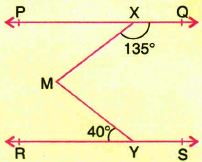
In the figure if PQ || RS, \(\angle MXQ=135^{ 0 }\) and \(\angle MYR=40^{ 0 }\) find \(\angle \) XMY
2.
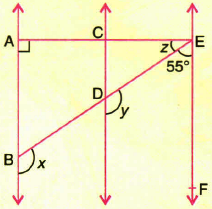
In the figure AB || CD and CD || EF Also \(EA\bot AB\) if \(\angle BEF=55^{ 0 }\) find the values of x,y and z
3.
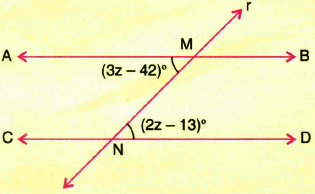
In the figure AB || CD ,find the value of z,\(\angle DNM\) and \(\angle CNM\quad \)
4.
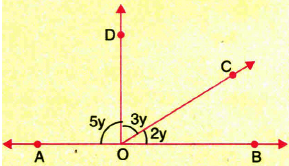
In the given figure if AOB is a line then find the measure of \(\angle \)BOC \(\angle \)COD and \(\angle \)DOA
5.
If two parallel lines are intersected by a transversal then prove that the bisectors of any pair of corresponding angles are parallel.
6.
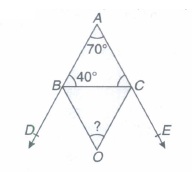
In the given figure, BO and CO are bisectors of \(\angle DBC\) and \(\angle ECB\) respectively. If \(\angle BAC=70^o\) and \(\angle ABC=40^o\), find the measure of \(\angle BOC\)
7.
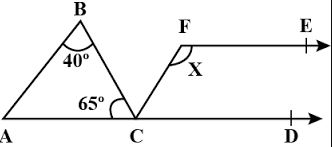
In the given figure, if AB || CF and CD || EF, then find the value of x.
8.
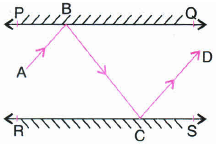
In Figure ,PQ and RS are two mirrors placed parallel to each other An incident ray AB strikes the mirror PQ at B the reflected ray moves along the path BC and strikes the mirror RS at C and again reflects back along CD.Prove that AB|| CD
9.
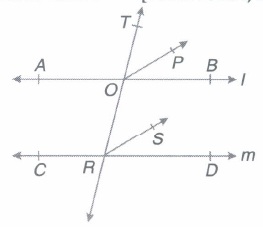
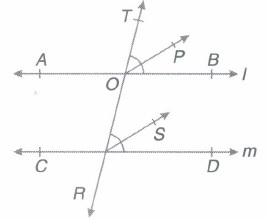
In the following figure, \(l||m\) and RT is a transversal. If OP and RS are respectively the bisectors of corresponding angles TOB and ORD.
(i) Prove that OP||RS.|(ii) Which mathematical concept is used in this problem?
(iii) What is its value?
10.
Students in a school are preparing flags as shown below for a rally to make people aware of saving water. In the diagram below, \(\triangle ABC\) is shown with AC extended through point D.
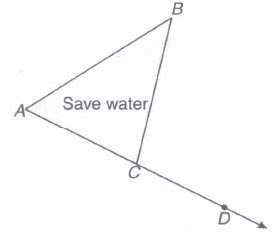
(i) If \(\angle BCD=6x+2, \angle BAC=3x+15\ and\ \angle ABC=2x-1,\) what is the value of x?
(ii) State the property used to solve this problem.
(iii) What value are they exhibiting by doing so?
11.
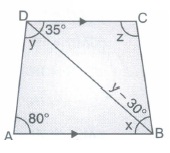
In the given figure, AB||DC, \(\angle BDC=35^o\) and \(\angle BAD=80^o.\) Find x,y,z
12.
In games period, the teacher decided to play the puzzle game. For this game, firstly the teacher draw a geometrical figure on the ground, which is shown as below:
Here line l is parallel to m and q is a transversal line. While drawing this figure, the teacher have no scale for measuring this length, but they know the side which is opposite to the smallest angle, is smaller and the side which is opposite to the largest angle, is larger. In this game, the teacher invite the two students Ankita and Vishal and said to them that specially Ankita stands on point A and Vishal stands on point B respectively (assume that both have some space of walking).
(i) Find the angle θ1, θ2 and θ3 as shown in the figure.
(ii) When both of them started moving along the lines, who will reach the firstly at point D?
(iii) What value is depicted in this question?
13.
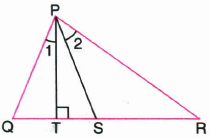
In figure PS is the bisector of \(\angle QPR \) and \(PT\bot QR\) show that \(\angle TPS=\frac { 1 }{ 2 } (\angle Q-\angle R)\)
14.
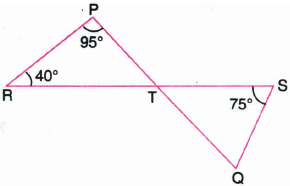
In figure if lines PQ and RS intersect at point T, such that \(\angle \) PRT=\(40^{ 0 }\) \(\angle \)RPT=\(95^{ 0 }\) and \(\angle \)TSQ=\(75^{ 0 }\) find \(\angle \)SQT
15.
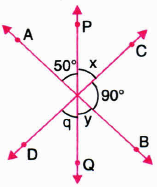
In figure, the value of an angle q is
\(60^{ 0 }\)
\(90^{ 0 }\)
\(50^{ 0 }\)
\(40^{ 0 }\)
16.
Which one of the following pairs is not a pair of adjacent angles?
.png)
.png)
.png)
.png)
17.
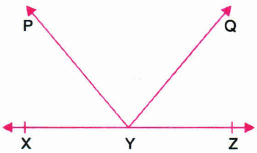
In the given figure XYZ is a straight line.If \(\angle XYP+\angle ZYQ=85^{ 0 }\) then \(\angle PYQ\) is
\(95^{ 0 }\)
\(85^{ 0 }\)
\(90^{ 0 }\)
\(75^{ 0 }\)
18.
Two angles measure \((30-a)^{ 0 }\) and \((125+2a)^{ 0 }\) If each one is the supplement of the other then the value of a is
\(45^{ 0 }\)
\(35^{ 0 }\)
\(25^{ 0 }\)
\(65^{ 0 }\)
19.
If the measure of an angle is twice the measure of its supplementary angle, then the measure of the angle is
\(60^{ 0 }\)
\(90^{ 0 }\)
\(120^{ 0 }\)
\(80^{ 0 }\)
1.
Here, we need to draw a line AB parallel to line PQ, through point M as shown in Fig. Now, AB || PQ and PQ || RS.
Therefore, AB || RS
Now, \(\angle\) QXM + \(\angle\) XMB = 180°
(AB || PQ, Interior angles on the same side of the transversal XM)
But \(\angle\) QXM = 135°
So, 135° + \(\angle\) XMB = 180°
Therefore, \(\angle\) XMB = 45° (1)
Now, \(\angle\) BMY = \(\angle\) MYR (AB || RS, Alternate angles)
Therefore, \(\angle\) BMY = 40° (2)
Adding (1) and (2), you get
\(\angle\) XMB + \(\angle\) BMY = 45° + 40°
That is, \(\angle\) XMY = 85°
2.
Given AB||CD, CD||EF, \(EA\bot AB\)
\(\angle BEF=55^o\)
y = 180o- 55o = 125o(Co-interior angles)
x = y = 125o(Corresponding angles)
\(EA\bot AB\)
\(EA\bot AB\)
Z + 55o = 90o
Z = 90o - 55o
= 35o
3.
\(z=29^{ 0 },\angle DNM=45^{ 0 },\angle CNM=135^{ 0 }\)
4.
\(36^{ 0 },54^{ 0 },90^{ 0 }\)
5.
∵ AB ॥ CD and EF is a transversal.
∴ ∠BEP = ∠EFD [corresponding angles]
⇒ \(\frac{1}{2}\) ∠BEP = \(\frac{1}{2}\) ∠EFD
⇒ ∠PEG = ∠EFH [∵ EG and FH are the angle bisectors of ∠BEP and ∠EFD respectively]
But they form pair of corresponding angles.
∴ EG॥ FH.
6.
\(\angle DBC=180^o-40^o=140^o\) (Linear pair)
\(\angle CBO=\frac{1}{2}\angle DBC=\frac{1}{2}\times140^o\)
=70o
\(\angle ACB=180^o-(70^o+40^o)=70^o\)
\(\angle BCE=180^o-70^o=110^o\) (Linear pair)
\(\angle BCO=\frac{1}{2}\times110^o=55^o\) (Angle bisector)
\(\angle BOC=180^o-(\angle CBO+\angle BCO)\)
=180o-(70o+55o)
=55o
7.
x = 75°
8.
Construction: Draw ray BL \(\bot \) PQ and ray CM \(\bot \) RS.
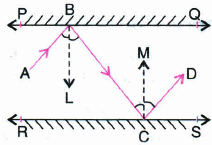
BL \(\bot \) PQ,CM \(\bot \) RS and PQ || RS BL||CM
\(\angle \) LBC=\(\angle \) MCB
|Alternate Interior Angles
\(\angle\)ABL=\(\angle\)LBC
Angle of incidence= Angle of reflection
\(\angle \)MCB=\(\angle \)MCD
Angle of incidence= Angle of reflection
From (1),(2) and (3) we get
\(\angle \)ABL =\(\angle \)MCD
Adding (1) and (4) , we get
\(\angle \) LBC+\(\angle \)ABL =\(\angle \)MCB+\(\angle \)MCD
\(\Rightarrow \) \(\angle \)ABC=\(\angle \)BCD
But these form a pair of equal alternate interior angles
So AB || CD.
9.
(i) \(\angle TOP=\frac{1}{2}\angle TOB\)
(ii)\(\angle ORS=\frac{1}{2}\angle ORD\)
But, \(\angle TOB=\angle ORD\)
(\(l||m\) and corresponding angles)
\(\therefore \angle TOP=\angle ORS\)
But they are corresponding anglesw.r.t transversal TR and lines OP and RS.
Hence, OP||RS
(ii) Lines and angles
(iii) Bisectoring among human beings gives rise to deterioration in the society.
10.
(i) In \(\angle ABC, \angle BCD=\angle BAC+\angle ABC\) [Exterior angle equal to yhe sum of opposite two interior angles]
6x+2=3x+15+2x-1
6x+2=5x+14
6x-5x=14-2
x=12o
(ii) Exterior angle property of a triangle is used in the above problem
(iii) By doing so, students exhibit the importance of water.
11.
AB||DC
\(\angle CDB=\angle ABD\)
=x=35o[alternate angles]
x+y+80o=180o
\(\angle ADB=y=180^o-35^o-80^o\)
=65[angle sum property]
\(\angle DCB=z=180^o-[35^o+35^o]\)
=110o
12.
(i) In the given figure,
ㄥABD + ㄥDBE = 180° [by linear pair axiom]
⇒ㄥABD + 110° = 180° [ஃ ㄥDBE = 110°]
⇒ ㄥABD = 180° - 110°
⇒ ㄥABD = 70° ... (i)
In ΔABD, ㄥDAB + ㄥABD + ㄥBDA = 180°
[sum of all angles in a triangle is 180°]
⇒ θ1 + 70° + 30° = 180° [from Eq (i)]
⇒ θ1 = 180° -100° ⇒ θ1 = 80°
As l || m, so sum of the two interior angle is 180°
ஃ θ2 + ㄥDBE = 180°
⇒ θ2 + 110° = 180° ⇒ θ2 = 70°
As l || m So, ㄥFDA = ㄥDAB
[alternate interior anlges]
=> θ2 = 70°
Also ㄥHDC = ㄥFDA [vertically opposite angles]
⇒ θ3 =ㄥFDA = 80°
Hence, angles are θ1 = 80°, θ2 = 70° and θ3 = 80°.
(ii) As we know that sides opposite to the shortest angle will reach firstly.
In ΔABD, ㄥA is smaller than angle ㄥB, so person who will walk along the line BD, will reach firstly.
Hence, Vishal will reach firstly at point D.
(iii) As the teacher already know the person walking on point B will move firstly. So, the value depicted in this question, that the teacher favour the student Vishal.
13.
Given PS is the bisector of \(\angle PQR\) and \(PT\bot QR\)
To prove \(\angle TPS=\frac { 1 }{ 2 } (\angle Q-\angle R)\)
Proof \(\therefore \) PS is the bisector of \(\angle QPR\)
\(\therefore \angle QPS=\angle RPS\)
\(\Rightarrow \angle 1+\angle TPS=\angle 2\)
In \(\triangle \) PQT,
\(\angle PTQ=90^{ 0 }\)
\(\therefore \angle 1+\angle q=90^{ 0 }\)
|Angle sum property of a traingle
\(\Rightarrow \) \(\angle Q=90^{ 0 }-\angle 1\)
In \(\triangle \) PRT
\(\angle PTR=90^{ 0 }\)
\(\therefore \angle R+\angle TPR=90^{ 0 }\)
|Angle sum property of a traingle
\(\Rightarrow \angle R+(\angle TPS+\angle 2)=90^{ 0 }\)
From (2) and (3),
\(\angle Q-\angle R=\angle TPS+(\angle 2-\angle 1)\)
\(\Rightarrow \angle Q=\angle R=\angle TPS+(\angle 2-\angle 1)\)
\(\Rightarrow \angle Q-\angle R=\angle TPS+\angle TPS\)
\(\Rightarrow \angle Q-\angle R=2\angle TPS\)
\(\Rightarrow \) \(\angle TPS=\frac { 1 }{ 2 } (\angle Q-\angle R)\)
14.
In \(\triangle \) PRT
\(\angle PTR\angle PRT+\angle RPT=180^{ 0 }\)
The sum of all angles of a triangle is \(180^{ 0 }\)
\(\Rightarrow \angle PTR+40^{ 0 }+95^{ 0 }=180^{ 0 }\)
\(\Rightarrow \angle PTR+135^{ 0 }=180^{ 0 }\)
\(\Rightarrow \angle PTR+45^{ 0 }\)
\(\Rightarrow \angle QTS=\angle PTR=45^{ 0 }\)
|Vertically Opposite Angles
In TSQ
\(\Rightarrow \angle QTS+\angle TSQ+\angle SQT=180^{ 0 }\)
The sum of all the angles of a triangle is \(180^{ 0 }\)
\(\Rightarrow 45^{ 0 }+75^{ 0 }+\angle SQT=180^{ 0 }\)
\(\Rightarrow 120^{ 0 }+\angle SQT=180^{ 0 }\)
=\(60^{ 0 }\)
15.
\(x+50^{ 0 }\)
\(y+90^{ 0 }+x=180^{ 0 }\quad 50^{ 0 }+90^{ 0 }+x=180^{ 0 }\)
\(\Rightarrow x=40^{ 0 }\)
\(q=x=40^{ 0 }\)
16.
\(\angle COA\) and \(\angle BOA\) are not a pair of adjacent angles
17.
\(\angle PYQ=180^{ 0 }-(\angle XYP+\angle ZYQ)\)
\(=180^{ 0 }-85^{ 0 }=95^{ 0 }\)
18.
\((30-a)^{ 0 }+(125+2a)^{ 0 }=180^{ 0 }\)
19.
\(\theta =2(180^{ 0 })\Rightarrow 0=120^{ 0 }\)

9th Standard CBSE Syllabus & Materials
9th Standard CBSE
CBSE 9th Mathematics Lines and Angles Sample Question Papers Study Material - QB365 Set A
NEW9th Standard CBSE
CBSE 9th Mathematics Introduction to Euclid's Geometry Sample Question Papers Study Material - QB365 Set A
NEW9th Standard CBSE
CBSE 9th Mathematics Linear Equations in Two Variables Sample Question Papers Study Material - QB365 Set A
NEW9th Standard CBSE
CBSE 9th Mathematics Coordinate Geometry Sample Question Papers Study Material - QB365 Set A



NCERT Books

Syllabus

Exam Pattern

Sample Question Papers

Previous year Question Papers

Important Notes

MCQ Practice test

NCERT Exemplers

Case study Questions

Image Based Questions

Passage based Questions

HOT Questions

Value Based Questions

Model Questions Papers
NCERT ( Book Back ) Questions

Assertion and Reason
Important Questions And Answers

CBSE 9th Standard CBSE Subjects
CBSE Standards