100% FREE ACCESS
9th Standard CBSE Syllabus & Materials
9th Standard CBSE
CBSE 9th Science Is matter around us pure? - New Model Questions Papers Study Material - QB365 Set A
NEW9th Standard CBSE
CBSE 9th Science Matter in our surroundings - New Model Questions Papers Study Material - QB365 Set A
NEW9th Standard CBSE
CBSE 9th Mathematics Heron's Formula Sample Question Papers Study Material - QB365 Set A
NEW9th Standard CBSE
CBSE 9th Mathematics Circles Sample Question Papers Study Material - QB365 Set A
NEW9th Standard CBSE
CBSE 9th Mathematics Quadrilaterals Sample Question Papers Study Material - QB365 Set A
NEW9th Standard CBSE
CBSE 9th Mathematics Triangles Sample Question Papers Study Material - QB365 Set A

Published on: 29/10/2025
Download CBSE Class 9th Standard CBSE Mathematics question papers, sample papers, important questions, and previous year solved papers in PDF format. Get free study materials, NCERT solutions, and exam preparation resources for Class 9th Standard CBSE Mathematics
Questions + Answers key
Take MCQ Mathematics Test
1.
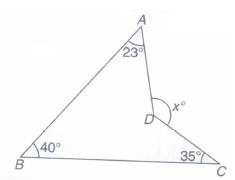
In the given figure, find the value of xo
2.
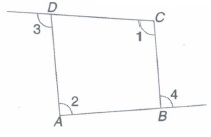
In the given figure \(\angle 3\) and \(\angle 4\) are exterior angles of quadrilateral ABCD at point D and B respectively. and \(\angle A=\angle 2, \angle C=\angle 1.\) Prove that \(\angle 3+\angle 4=\angle1+\angle2\)
3.
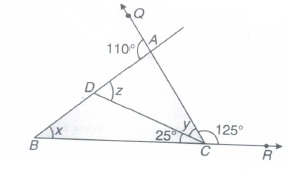
In the given figure, if \(\angle BCD=25^0,\angle BAQ=110^o\ and\ \angle ACR=125^o\), then find the values of x, y, z.
4.
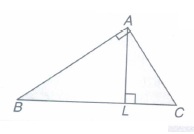
In figure, triangle ABC is right angles at A, AL is drawn perpendicular ro BC. Prove that \(\angle BAL=\angle ACB.\)
5.
In figure, a transversal l cuts two lines AB and CD at E and F respectively. EG is the bisector of \(\angle AEF\) and FH is the bisector of \(\angle EFD\) such that \(\angle a=\angle b.\) Show that EG||FH and AB||CD.
6.
If two parallel lines are intersected by a transversal, prove that the bisectors of the interior angles on the same side of transversal interest each other at right angles.
7.
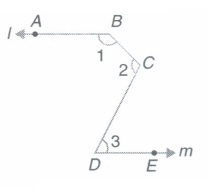
In the figure, l||m. Prove that \(\angle 1+\angle2-\angle3=180^o\)
8.
If a transversal intersects two lines such that the bisectos of pair of a pair of corresponding angles are parallel, then prove that the two lines are parallel.
9.
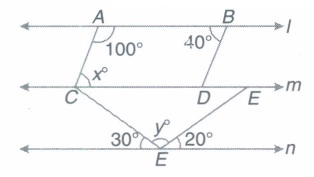
In the given figure, l||m||n. From the figure, find the ratio of (x+y):(y-x).
10.
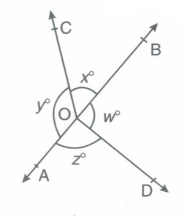
In the figure, if x+y=w+z, then prove that AOB is a straight line.
11.
Prove that bisectors of pair of vertically opposite angles are in the same straight line.
12.
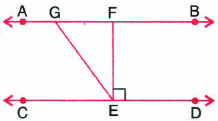
In figure if AB \(\parallel \) CD .EF \(\bot \) CD and \(\angle \) AGE,\(\angle \) GEF and \(\angle \) FGE
1.
\(23^o+40^o+35^o+\angle D=360^o\) (Angle sum property of a quadrilateral)
\(\angle D=262^o\)
\(x^o=Reflex\angle D=360^o-262^0\)
=98o
2.
Join AC,
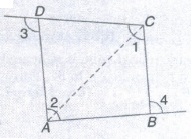
\(In\ \triangle ABC\ Ext\angle 4=\angle ACB+\angle CAB...(i)\)
Again, in \(\triangle ACD\ Ext.\angle 3=\angle DAC+\angle DCA...(ii)\)
Adding (i) and (i), we get
\(\angle 3+\angle 4=(\angle ACB+\angle DCA)+(\angle CAB+\angle DAC)\)
\(=\angle 1+\angle 2\)
\(\therefore \angle 3+\angle 4=\angle 1+\angle 2\)
3.
y=180o-(25o+125o)(Linear pair)
\(\Rightarrow\) y=30o
y+z=110o (Exterior angle)
z=110o-30o=80o
x+25o=z (Exterior angle)
x=80o-25o=55o
4.
In \(\triangle ABC,\angle A+\angle B+\angle C=180^o\)(Angle sum property)
\(\Rightarrow 90^o+\angle B+\angle C=180^o(\angle A=90^o)\)
\(\Rightarrow \angle B+\angle C=90^o\)
\(\therefore \angle C=\angle ACB=90^o-\angle B...(i)\)
Also in \(\triangle ALB,\)
\(\angle ALB+\angle BAL+\angle B=180^o\) (Angle sum property)
\(\Rightarrow 90^o+\angle BAL+\angle B=180^o\)
\(\angle BAL=90^o-\angle B....(ii)\)
Hence, from (i) and (ii), we get
\(\angle BAL=\angle ACB\)
5.
EG is the bisector of \(\angle AEF\)
\(\angle AEG=\angle GEF=a\)
Similarly, \(\angle EFH=\angle HFD=b\)
\(\angle GEF=\angle EFH(\because a=b)\)
But these are alternate interior angles
EG||FH
Again, \(\angle AEF=2a\)
and \(\angle EFD=2b\)
\(\angle AEF=\angle EFD=2a \ or\ 2b\)
But these are alternate angles
AB||CD.
6.
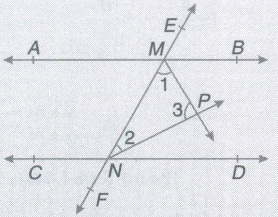
\(\angle BMN+\angle DNM=180^o\) (Interior angles)
\(\Rightarrow \frac{\angle BMN}{2}+ \frac{\angle DMN}{2}=\frac{180^o}{2}\Rightarrow\angle1+\angle2=90^o\)
\(\angle 1+\angle2+\angle3=180^o\Rightarrow \angle3=90^o\)
PM and PN intersect at right angle.
7.
Draw CF||AB, produce ED to H
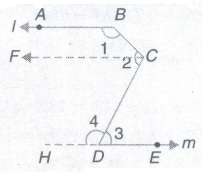
AB||CD||CF
\(\angle 1+\angle BCF=180^o...(i)\)
\(\angle 3=180^o-\angle4\)
\(\Rightarrow \angle4=180^o-\angle3..(ii)\)
Again CF||EH
\(\angle DCF+\angle 4=180^o...(iii)\)
Adding (i) and (iii), we get
\(\angle1+\angle 4+\angle BCF+\angle DCF=180^o+180^o=360^o\)\(\angle1+\angle2+\angle4=360^o\)
Using (ii) we get
\(\angle1+\angle2+180^o-\angle3=360^o\)
\(\Rightarrow \angle1+\angle2-\angle3=360^o-180^o=180^o\)
8.
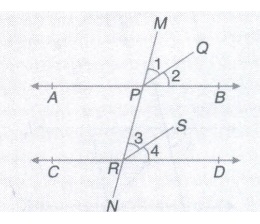
Given PQ||RS
Given \(\angle 1=\angle 2\ and \angle 3 =\angle 4\)
But, \(\angle 1=\angle 3 \) (Corres angles)
\(2\angle 1=2\angle3\)
\(\angle MPB=\angle PRD\)
Hence, AB||CD.
9.
y=180o-(30o+20o)=130o
l||m \(\Rightarrow\)x+100o=180o\(\Rightarrow\)x=80o
x+y=210o,y-x=50o
(x+y):(y-x)=21:5
10.
x+y+w+z=360o
\(\Rightarrow\) 2(x+y)=360o \((\because x+y=w+z)\)
\(\Rightarrow\) x+y=180o
\(\therefore\) AOB is a straight line.
11.
Two lines AB and CD intersect at point O. Also, OM and ON are t6he bisectors of \(\angle AOC\) and \(\angle BOD\) respectively.
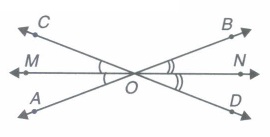
To prove: MON is a straight line/
Prove: Since the sum of all the angles around a point O is 360o , we have
\(\angle AOC+\angle BOC+\angle BOD+\angle AOD=360^o\)
\(\Rightarrow 2\angle MOC+2\angle BOC+2\angle BON=360^o\)
\([\because \angle BOC=\angle AOD\)(ver:opp, \(\angle S\) OM is bisector of \(\angle AOC.ON\) is bisector of \(\angle BOD\)]
\(\Rightarrow \angle MOC+\angle BOC+\angle BON\)
=180o
\(\Rightarrow \angle MON=180^o\)
\(\therefore \angle MON\) is a straight angle
Hence, MON is a straight line.
12.
(i) \(\angle \) AGE=\(\angle \)GED = \(126^{ 0 }\)
Alternate Interior Angles
(ii) \(\angle \) GED=\(126^{ 0 }\)
\(\Rightarrow \angle GEF\) +\( \angle FED\) =\(126^{ 0 }\)
\(\therefore\) EF \(\bot \) CD \(\therefore \) \(\angle \) FED=\(180^{ 0 }\)
\(\Rightarrow \) \(\angle \) GEC=\(126^{ 0 }\) -\(90^{ 0 }\) =\(180^{ 0 }\)
\(\therefore \) EF\(\bot \) CD \(\therefore \) \(\angle \) FED=\(90^{ 0 }\)
\(\angle \)GEF=\(126^{ 0 }\) -\(90^{ 0 }\)=\(36^{ 0 }\)
(iii) \(\angle \) GEC+\(36^{ 0 }\) +\(90^{ 0 }\)=\(180^{ 0 }\)
\(\therefore \)CD is line
\(\Rightarrow \) \(\angle \) GEC+\(36^{ 0 }\) +\(90^{ 0 }\) =\(180^{ 0 }\)
\(\Rightarrow \) \(\angle \) GEC=\(180^{ 0 }\)-\(126^{ 0 }\)=\(54^{ 0 }\)
Now, \(\angle \) FGE=\(\angle \) GEC=\(54^{ 0 }\)
Alternate Interior Angles

9th Standard CBSE Syllabus & Materials
9th Standard CBSE
CBSE 9th Mathematics Lines and Angles Sample Question Papers Study Material - QB365 Set A
NEW9th Standard CBSE
CBSE 9th Mathematics Introduction to Euclid's Geometry Sample Question Papers Study Material - QB365 Set A
NEW9th Standard CBSE
CBSE 9th Mathematics Linear Equations in Two Variables Sample Question Papers Study Material - QB365 Set A
NEW9th Standard CBSE
CBSE 9th Mathematics Coordinate Geometry Sample Question Papers Study Material - QB365 Set A



NCERT Books

Syllabus

Exam Pattern

Sample Question Papers

Previous year Question Papers

Important Notes

MCQ Practice test

NCERT Exemplers

Case study Questions

Image Based Questions

Passage based Questions

HOT Questions

Value Based Questions

Model Questions Papers
NCERT ( Book Back ) Questions

Assertion and Reason
Important Questions And Answers

CBSE 9th Standard CBSE Subjects
CBSE Standards