100% FREE ACCESS
9th Standard CBSE Syllabus & Materials
9th Standard CBSE
CBSE 9th Science Is matter around us pure? - New Model Questions Papers Study Material - QB365 Set A
NEW9th Standard CBSE
CBSE 9th Science Matter in our surroundings - New Model Questions Papers Study Material - QB365 Set A
NEW9th Standard CBSE
CBSE 9th Mathematics Heron's Formula Sample Question Papers Study Material - QB365 Set A
NEW9th Standard CBSE
CBSE 9th Mathematics Circles Sample Question Papers Study Material - QB365 Set A
NEW9th Standard CBSE
CBSE 9th Mathematics Quadrilaterals Sample Question Papers Study Material - QB365 Set A
NEW9th Standard CBSE
CBSE 9th Mathematics Triangles Sample Question Papers Study Material - QB365 Set A

Published on: 29/10/2025
Download CBSE Class 9th Standard CBSE Mathematics question papers, sample papers, important questions, and previous year solved papers in PDF format. Get free study materials, NCERT solutions, and exam preparation resources for Class 9th Standard CBSE Mathematics
Questions + Answers key
Take MCQ Mathematics Test
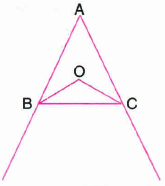
1.
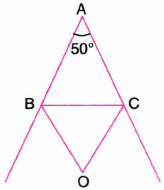
In \(\triangle \) ABC,\(\angle A=50^{ 0 }\) and the external bisectors of \(\angle B\) and \(\angle C\) meet at O as shown in figure The measure of \(\angle BOC\) is:
\(40^{ 0 }\)
\(65^{ 0 }\)
\(115^{ 0 }\)
\(140^{ 0 }\)
2.
In \(\triangle \) ABC, the bisectors of \(\angle ABC\) and \(\angle BCA\) intersect each other at O. The measure of \(\angle BOC\) is:
\(90^{ 0 }+\angle A\)
\(90^{ 0 }+\frac { \angle A }{ 2 } \)
\(180^{ 0 }-\angle A\)
\(90^{ 0 }-\frac { \angle A }{ 2 } \)
3.
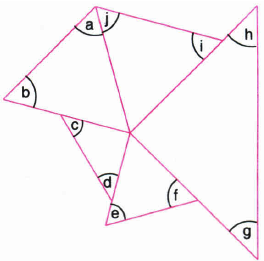
In the figure the measure of (a+b+c+d+e+f+g+h+i+j) is
\(900^{ 0 }\)
\(720^{ 0 }\)
\(540^{ 0 }\)
\(360^{ 0 }\)
4.
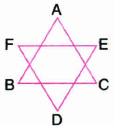
In the figure if \(\angle A+\angle B+\angle C+\angle D+\angle E+\angle F=k\) right angles,then k is :
2
3
4
5
5.
One interior angle of hexagon is \(165^{ 0 }\) and each of the remaining interior angles is of \(x^{ 0 }\) Find the measure of each of the remaining angles
\(111^{ 0 }\)
\(109^{ 0 }\)
\(107^{ 0 }\)
\(115^{ 0 }\)
6.
The ratio of the four angles of a quadrilateral is 1:2:3:4 The measure of its smallest angle is:
\(120^{ 0 }\)
\(36^{ 0 }\)
\(18^{ 0 }\)
\(10^{ 0 }\)
7.
The angles of a triangle are in the ratio 2:3:4 The angles are:
\(20^{ 0 },60^{ 0 },80^{ 0 }\)
\(80^{ 0 },40^{ 0 },60^{ 0 }\)
\(40^{ 0 },60^{ 0 },80^{ 0 }\)
\(60^{ 0 },40^{ 0 },80^{ 0 }\)
8.
The angles of a traingle are in the ratio 5:3:7 the traingle is :
An acute angled triangle
An obtuse-angled traingle
A right traingle
An isosceles traingle
9.
The ratio of the measures of the three angles of a triangle is 2:3:4 The measure of the largest angle is:
\(80^{ 0 }\)
\(60^{ 0 }\)
\(40^{ 0 }\)
\(180^{ 0 }\)
10.
An exterior angle of a triangle is \(80^{ 0 }\) and the interior opposite angles in the ratio 1 :3 measure of each interior opposite angles is:
\(30^{ 0 },90^{ 0 }\)
\(40^{ 0 },120^{ 0 }\)
\(20^{ 0 },60^{ 0 }\)
\(30^{ 0 },60^{ 0 }\)
11.
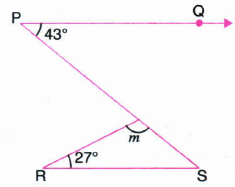
In figure if PQ || RS,then the measure of m is:
\(110^{ 0 }\)
\(100^{ 0 }\)
\(90^{ 0 }\)
\(133^{ 0 }\)
12.
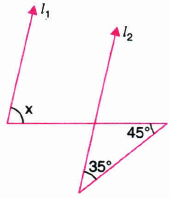
In figure \(l_{ 1 }\quad ||\quad l_{ 2 }\) the value of x is:
\(80^{ 0 }\)
\(100^{ 0 }\)
\(110^{ 0 }\)
\(70^{ 0 }\)
13.
If one angle of a triangle is equal to the sum of the other two then the triangle is:
an isosceles triangle
an obtuse angled traingle
an equilateral traingle
a right triangle
14.
An exterior angle of a triangle is \(105^{ 0 }\) and its two interior opposite angles are equal Each of these equal angles is:
\(37\frac { 1^{ 0 } }{ 2 } \)
\(52\frac { 1^{ 0 } }{ 2 } \)
\(72\frac { 1^{ 0 } }{ 2 } \)
\(75^{ 0 }\)
15.
A,B,C are three angles of a triangle If A+B=\(145^{ 0 }\) B+C=\(100^{ 0 }\) then angles A,B
\(80^{ 0 },65^{ 0 },35^{ 0 }\)
\(80^{ 0 },35^{ 0 },65^{ 0 }\)
\(65^{ 0 },80^{ 0 },35^{ 0 }\)
\(35^{ 0 },65^{ 0 },80^{ 0 }\)
16.
One of the angles of a triangle is \(75^{ 0 }\) if the difference of the other two angles is \(35^{ 0 }\) then the largest angle of the triangle has a measure of :
\(80^{ 0 }\)
\(75^{ 0 }\)
\(100^{ 0 }\)
\(135^{ 0 }\)
17.
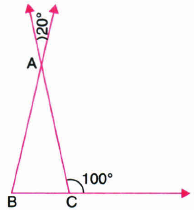
In the given figure the measure of \(\angle ABC\) is
\(80^{ 0 }\)
\(20^{ 0 }\)
\(100^{ 0 }\)
\(60^{ 0 }\)
18.
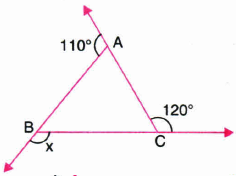
In figure the value of x is :
\(120^{ 0 }\)
\(130^{ 0 }\)
\(110^{ 0 }\)
\(100^{ 0 }\)
19.
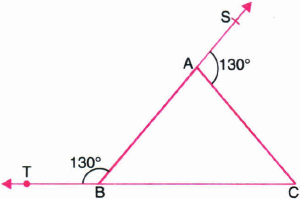
In the given figure if \(\angle ABT=130^{ 0 }\) and \(\angle CAS=130^{ 0 }\) then \(\angle \)ACB is:
\(130^{ 0 }\)
\(100^{ 0 }\)
\(50^{ 0 }\)
\(80^{ 0 }\)
20.
In a traingle ABC IF \(\angle A=53^{ 0 }\angle C=44^{ 0 }\) the value of b is:
\(73^{ 0 }\)
\(83^{ 0 }\)
\(93^{ 0 }\)
\(46^{ 0 }\)
21.
The exterior angles of a traingle is equal to the sum of two:
Exterior angles
Exterior angle between
Interior angles
Interior opposite angles
22.
A triangle can havee
Two right angles
Angle sum property of a traingle
Two obtuse angles
All angles more than 60
23.
In a regular polygon of an sides the measure of each interior angle is
\(\frac { 360^{ 0 } }{ n } \)
\(\frac { 2n-4 }{ n } \)
n right angles
2n right angles
24.
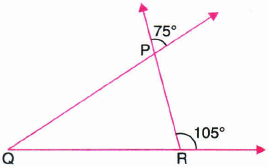
In figure \(\angle PQR\) is
\(40^{ 0 }\)
\(50^{ 0 }\)
\(30^{ 0 }\)
\(105^{ 0 }\)
25.
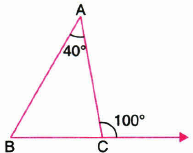
In figure the value of \(\angle x+\angle y\) is
\(80^{ 0 }\)
\(100^{ 0 }\)
\(120^{ 0 }\)
\(60^{ 0 }\)
26.
In a traingle ABC IF \(\angle A=53^{ 0 }\angle C=44^{ 0 }\) the value of b is:
\(73^{ 0 }\)
\(83^{ 0 }\)
\(93^{ 0 }\)
\(46^{ 0 }\)
27.
The exterior angles of a traingle is equal to the sum of two:
Exterior angles
Interior angles
Interior opposite angles
Alternate angles
28.
A triangle can havee
Two right angles
Two obtuse angles
All angles more than 60
Two acute angles
29.
In a regular polygon of an sides the measure of each interior angle is
\(\frac { 360^{ 0 } }{ n } \)
\(\frac { 2n-4 }{ n } \)
n right angles
2n right angles
30.
Which of the following can be the angles of a quadrilateral?
\(90^{ 0 },90^{ 0 },60^{ 0 },120^{ 0 }\)
\(85^{ 0 },95^{ 0 },50^{ 0 },120^{ 0 }\)
\(90^{ 0 },90^{ 0 },60^{ 0 },130^{ 0 }\)
\(90^{ 0 },90^{ 0 },50^{ 0 },140^{ 0 }\)
31.
Which of the following are not the angles of a traingle?
\(45^{ 0 },45^{ 0 },90^{ 0 }\)
\(60^{ 0 },30^{ 0 },90^{ 0 }\)
\(40^{ 0 },50^{ 0 },100^{ 0 }\)
\(60^{ 0 },60^{ 0 },60^{ 0 }\)
32.
The measure of each of regular angles octagon is
\(120^{ 0 }\)
\(60^{ 0 }\)
\(135^{ 0 }\)
\(108^{ 0 }\)
33.
The sum of all the interior angles of a pentagon is
\(900^{ 0 }\)
\(360^{ 0 }\)
\(540^{ 0 }\)
\(1080^{ 0 }\)
34.
The sum of all interior angles of a hexagon is:
\(720^{ 0 }\)
\(360^{ 0 }\)
\(540^{ 0 }\)
\(1080^{ 0 }\)
35.
Each angle of an equilateral triangle is :
\(50^{ 0 }\)
\(90^{ 0 }\)
\(80^{ 0 }\)
\(60^{ 0 }\)
36.
The sum of the three angles of a traingle is:
one right angle
two right angles
three right angles
four right angles
37.
If l,m,n are lines in the same plane such that l intersects m and n n || m then i and n are:
parallel
Intersecting
Always perpendicular
Always intersecting at \(60^{ 0 }\)
38.
Lines parallel to the same line are
perpendicular to each other
parallel to each other
opposite to each other
None of these
39.
Two lines are respectively perpendicular to two perpendicular lines then the these two lines to each other are
parallel
perpendicular
inclined at some acute angle
intersecting at \(110^{ 0 }\)
40.
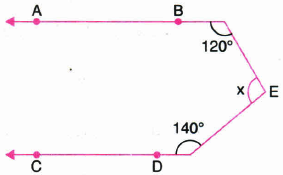
In figure AB and CD are parallel to each other The value of x is:
\(90^{ 0 }\)
\(100^{ 0 }\)
\(120^{ 0 }\)
\(140^{ 0 }\)
41.
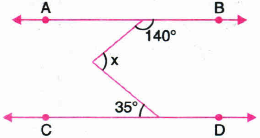
In figure ,AB || CD the value of x is:
\(35^{ 0 }\)
\(40^{ 0 }\)
\(60^{ 0 }\)
\(75^{ 0 }\)
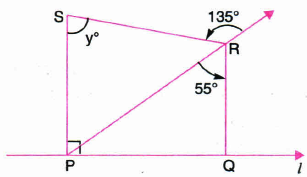
42.
In the figure \(PS\bot L\) and RQ \(\bot \)l the degree measure of y is:
\(55^{ 0 }\)
\(90^{ 0 }\)
\(80^{ 0 }\)
\(135^{ 0 }\)
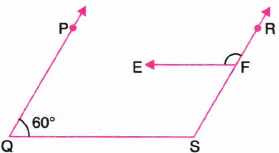
43.
In the given figure PQ || RS and EF || QS If \(\angle PQS=60^{ 0 }\) then the measure of \(\angle RFE\)
\(115^{ 0 }\)
\(120^{ 0 }\)
\(60^{ 0 }\)
\(180^{ 0 }\)
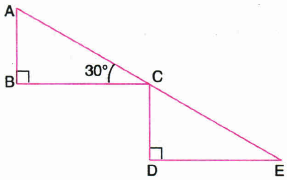
44.
In figure BC || DE if \(\angle ABC=\angle CDE=90^{ 0 }\) and \(\angle ACB=30^{ 0 }\) then the measure of \(\angle DCE\) is:
\(30^{ 0 }\)
\(60^{ 0 }\)
\(60^{ 0 }\)
\(180^{ 0 }\)
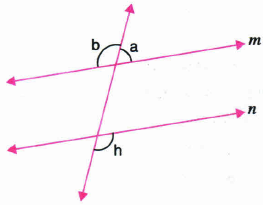
45.
In figure if m || n and \(\angle a:\angle b=2:3\) then the measure of h is :
\(72^{ 0 }\)
\(108^{ 0 }\)
\(120^{ 0 }\)
\(150^{ 0 }\)
46.
If two interior angles on the same side of a transversal intersecting two parallel lines are in the ratio 2:3 then the smaller of two angles
\(72^{ 0 }\)
\(108^{ 0 }\)
\(54^{ 0 }\)
\(36^{ 0 }\)
47.
Given lines \(l_{ 1 },l_{ 2}\) and \(l_{ 3 }\) in the figure are parallel the value of x is:
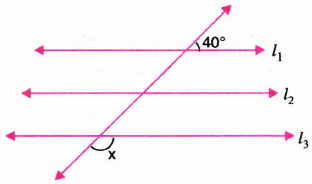
\(40^{ 0 }\)
\(140^{ 0 }\)
\(50^{ 0 }\)
\(80^{ 0 }\)
48.
In figure AB || CD and t is a transversal the value of x is equal to:
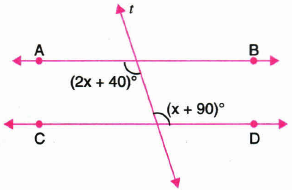
\(50^{ 0 }\)
\(70^{ 0 }\)
\(35^{ 0 }\)
\(20^{ 0 }\)
49.
If two parallel lines are intersected by a transversal then corresponding angles are:
Equal
Complimentary
Supplementary
Sum of the two angles is \(360^{ 0 }\)
50.
If two parallel lines are cut by a transversal then which of the following is not true?
Corresponding angles are equal
Alternate interior angles are equal
Interior angles of the same side of the transversal are supplementary
Interior angles on the same side of the transversal are complimentary
51.
In the following figure a transversal c intersects two parallel lines a and b The angles formed at A and B have been marked.Tell which pair of angles need not be equal?
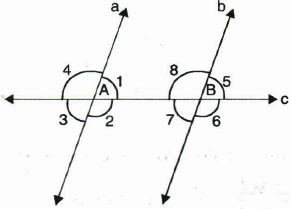
\(\angle 1,\angle 2\)
\(\angle 1,\angle 3\)
\(\angle 1,\angle 5\)
\(\angle 2,\angle 8\)
52.
From the given figure , identify the incorrect statement given l || m and t is the transversal:
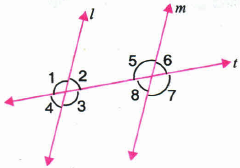
\(\angle 2\) and \(\angle 5\) are supplementary
\(\angle 2\) and 8 are supplementary
\(\angle 2\) and \(\angle 3\) are supplementary
\(\angle 2\) and \(\angle 1\) are supplementary
53.
In figure lines AB and CD intersect at O.if \(\frac { \angle AOD }{ \angle DOB } =\frac { 4 }{ 5 } \angle COB\)
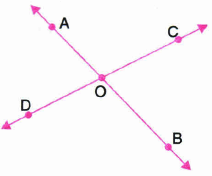
\(80^{ 0 }\)
\(100^{ 0 }\)
\(90^{ 0 }\)
\(70^{ 0 }\)
54.
In figure, the value of an angle q is
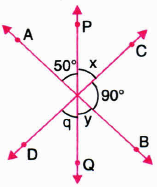
\(60^{ 0 }\)
\(90^{ 0 }\)
\(50^{ 0 }\)
\(40^{ 0 }\)
55.
In the following figure two straight lines AB and CD intersect each other at O and angles formed at O are marked Here \(\angle x-\angle y\) has value
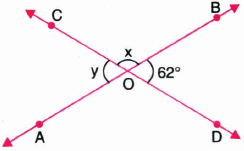
\(56^{ 0 }\)
\(118^{ 0 }\)
\(62^{ 0 }\)
\(180^{ 0 }\)
56.
In figure value of x is
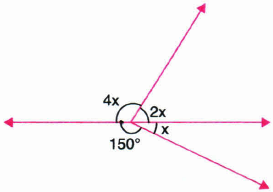
\(30^{ 0 }\)
\(40^{ 0 }\)
\(30^{ 0 }\)
\(50^{ 0 }\)
57.
In the given figure the value of x which makes POQ a straight line is:
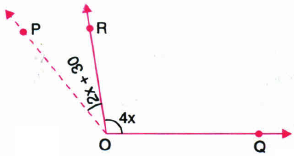
35
30
25
40
58.
In the given figure if AOB is a straight line, then \(\angle BOC\) is
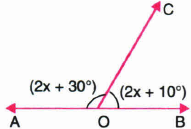
\(80^{ 0 }\)
\(70^{ 0 }\)
\(60^{ 0 }\)
\(20^{ 0 }\)
59.
In figure the value of y is:
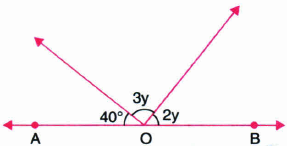
\(28^{ 0 }\)
\(32^{ 0 }\)
\(36^{ 0 }\)
\(44^{ 0 }\)
60.
The value of x in figure is:
\(80^{ 0 }\)
\(20^{ 0 }\)
\(25^{ 0 }\)
\(40^{ 0 }\)
61.
A pair of angles is called linear pair if the sum of two adjacent angles is:
\(90^{ 0 }\)
\(180^{ 0 }\)
\(230^{ 0 }\)
\(360^{ 0 }\)
62.
Which one of the following pairs is not a pair of adjacent angles?
.png)
.png)
.png)
.png)
63.
In the following figure \(\angle AOB\) and \(\angle BOC\) are:
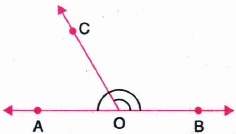
Supplementary angles
complementary angles
adjacent angles
None of these
64.
The length of the common perpendiculars at different points on parallel lines is the same and is called
the distance between the parallel lines
the altitude
the median
None of these
65.
A line indicates
Only one direction
two directions
no direction
None of these
66.
We can draw two different lines in
Only one way
two different ways
three different ways
None of these
67.
In the given figure XYZ is a straight line.If \(\angle XYP+\angle ZYQ=85^{ 0 }\) then \(\angle PYQ\) is
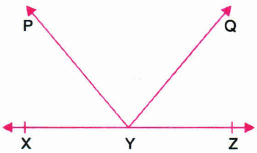
\(95^{ 0 }\)
\(85^{ 0 }\)
\(90^{ 0 }\)
\(75^{ 0 }\)
68.
Two angles measure \((30-a)^{ 0 }\) and \((125+2a)^{ 0 }\) If each one is the supplement of the other then the value of a is
\(45^{ 0 }\)
\(35^{ 0 }\)
\(25^{ 0 }\)
\(65^{ 0 }\)
69.
Two complementary angles are in the ratio 4:5 then angles are:
\(90^{ 0 },90^{ 0 }\)
\(40^{ 0 },50^{ 0 }\)
\(30^{ 0 },150^{ 0 }\)
\(45^{ 0 },45^{ 0 }\)
70.
The angle which exceeds its complimentary angle by \(30^{ 0 }\)
\(50^{ 0 }\)
\(120^{ 0 }\)
\(60^{ 0 }\)
\(80^{ 0 }\)
71.
If the measure of an angle is twice the measure of its supplementary angle, then the measure of the angle is
\(60^{ 0 }\)
\(90^{ 0 }\)
\(120^{ 0 }\)
\(80^{ 0 }\)
72.
The angle which is equal to 8 times its compliment is:
\(80^{ 0 }\)
\(72^{ 0 }\)
\(90^{ 0 }\)
\(88^{ 0 }\)
73.
In the following figure, the reflex angle AOB is equal to
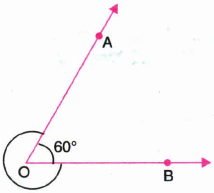
\(60^{ 0 },\)
\(120^{ 0 },\)
\(300^{ 0 },\)
\(360^{ 0 },\)
74.
Which of the following is not a pair of supplementary angles?
\(90^{ 0 },90^{ 0 }\)
\(32^{ 0 },58^{ 0 }\)
\(0^{ 0 },180^{ 0 }\)
76,\(104^{ 0 }\)
75.
Which of the following is not a pair of complementary angles?
\(60^{ 0 },30^{ 0 }\)
\(56^{ 0 },34^{ 0 }\)
\(0^{ 0 },90^{ 0 }\)
\(150^{ 0 },30^{ 0 }\)
76.
The angle supplementary to \(180^{ 0 }\)-\(9^{ 0 }\) is
\(9^{ 0 }\)
\(180^{ 0 }\)
\(180^{ 0 }\) + \(9^{ 0 }\)
\(90^{ 0 }\) + \(9^{ 0 }\)
77.
The angle of supplementary to \(90^{ 0 }\)+\(9^{ 0 }\) is
\(90^{ 0 }\)+\(9^{ 0 }\)
\(90^{ 0 }\)-\(9^{ 0 }\)
\(180^{ 0 }\)-+\(9^{ 0 }\)
\(180^{ 0 }\)-\(9^{ 0 }\)
78.
The angle complementary to \(90^{ 0 }\)-\(9^{ 0 }\) is
\(90^{ 0 }\)+\(9^{ 0 }\)
\(9^{ 0 }\)
\(180^{ 0 }\)-\(9^{ 0 }\)
\(360^{ 0 }\)-\(9^{ 0 }\)
79.
The compliment of (\(90^{ 0 }\)-\(a^{ 0 }\)) is
\(-a^{ 0 }\)
\(90^{ 0 }\)+\(a^{ 0 }\)
\(90^{ 0 }\)-\(a^{ 0 }\)
\(a^{ 0 }\)
80.
Find the measure of the angle which is supplement of itself
\(30^{ 0 }\)
\(90^{ 0 }\)
\(45^{ 0 }\)
\(180^{ 0 }\)
81.
Find the measure of the angle which is complement of itself
\(30^{ 0 }\)
\(90^{ 0 }\)
\(45^{ 0 }\)
\(180^{ 0 }\)
82.
The angle supplementary to \(60^{ 0 }\) is
\(30^{ 0 }\)
\(120^{ 0 }\)
\(45^{ 0 }\)
\(300^{ 0 }\)
83.
A straight angle
is greater than \(90^{ 0 }\) but less than \(180^{ 0 }\)
is exactly equal to \(90^{ 0 }\)
measures between \(0^{ 0 }\) and \(90^{ 0 }\)
is exactly equal to \(180^{ 0 }\)
84.
An angle which is greater than \(90^{ 0 }\) and less than \(180^{ 0 }\) is called
a right angle
a straight angle
an acute angle
an obtuse angle
85.
An angle which is exactly equal to \(90^{ 0 }\) is called
an obtuse angle
an acute angle
a straight angle
a right angle
86.
Two angles whose sum is \(90^{ 0 }\) are called
Supplementary angles
complimentary angles
corresponding angles
alternate angles
87.
A reflex angle
is greater than \(180^{ 0 }\) but less than \(360^{ 0 }\)
is exactly equal to \(180^{ 0 }\)
is exactly equal to \(90^{ 0 }\)
is greater than \(90^{ 0 }\) but less than \(180^{ 0 }\)
88.
An right angle
measures between \(0^{ 0 }\) and \(90^{ 0 }\)
is exactly equal to \(90^{ 0 }\)
is greater than \(90^{ 0 }\) but less than \(180^{ 0 }\)
is equal to \(180^{ 0 }\)
89.
The complement of an angle m is:
m
\(90^{ 0 }\)+m
\(90^{ 0 }\)-m
mx\(90^{ 0 }\)
90.
The sum of two supplementary angles is
\(90^{ 0 }\)
\(180^{ 0 }\)
\(360^{ 0 }\)
None of these
91.
The angles whose sum is \(180^{ 0 }\) are called
supplementary angles
complementary angles
alternate angles
corresponding angles
92.
The sum of two complimentary angles is
\(180^{ 0 }\)
\(360^{ 0 }\)
\(90^{ 0 }\)
None of these
93.
An obtuse angle
measures between \(0^{ 0 }\) and \(90^{ 0 }\)
is greater than \(90^{ 0 }\) but less than \(180^{ 0 }\)
is exactly equal to \(90^{ 0 }\)
is exactly equal to \(180^{ 0 }\)
94.
An angle which measures between \(0^{ 0 }\) and \(90^{ 0 }\) is called
a straight angle
an acute angle
a right angle
an obtuse angle
95.
How many types of angles are formed between the edges of plane surfaces?
Of different types
Of only one type
Of only two types
of only three types
96.
In how many points two intersecting lines intersect?
4
3
2
1
97.
The minimum number of points required to draw a line is
1
2
3
4
1.
\(\angle A+\angle B+\angle X=180^{ 0 }\)
\(\Rightarrow 50^{ 0 }+\angle B+\angle C=180^{ 0 }\)
\(\Rightarrow \angle B+\angle C=130^{ 0 }\)
\(\angle BOC+\frac { 180^{ 0 }-\angle B }{ 2 } +\frac { 180^{ 0 }-\angle C }{ 2 } =180^{ 0 }\)
\(\Rightarrow \angle BOC=\frac { \angle B+\angle C }{ 2 } =65^{ 0 }\)
2.
\(\angle A+\angle B+\angle C=180^{ 0 }\)
\(\Rightarrow \angle B+\angle C=180^{ 0 }-\angle A\)
\(\angle BOC+\frac { \angle B }{ 2 } +\frac { \angle C }{ 2 } =180^{ 0 }\)
\(\Rightarrow \angle BOC+\frac { 180^{ 0 }-\angle A }{ 2 } =180^{ 0 }\)
\(\angle BOC=90^{ 0 }+\frac { \angle A }{ 2 } \)
3.
a+b+c+d+e+f+g+h+i+j
= 5 x \(180^{ 0 }\)-\(360^{ 0 }\)
=\(900^{ 0 }\)-\(360^{ 0 }\)
=\(540^{ 0 }\)
4.
\(\angle A+\angle B+\angle C+\angle D+\angle E+\angle F\)
\(=(\angle A+\angle B+\angle C)+(\angle D+\angle E+\angle F)\)
\(=180^{ 0 }+180^{ 0 }=360^{ 0 }=4X90^{ 0 }\)
5.
n=6
(2n-4)\(90^{ 0 }\)=(2X6-4)\(90^{ 0 }\)=\(720^{ 0 }\)
\(720^{ 0 }\)-\(165^{ 0 }\)=\(555^{ 0 }\)
Each of the remaining interior angles
\(\frac { 555^{ 0 } }{ 5 } =111^{ 0 }\)
6.
Measure of the smallest angles
\(=\frac { 1 }{ 1+2+3+4 } x360^{ 0 }=36^{ 0 }\)
7.
2+3+4=9
First angle=\(\frac { 2 }{ 9 } x180^{ 0 }=40^{ 0 }\)
Second angle=\(\frac { 3 }{ 9 } x180^{ 0 }=60^{ 0 }\)
Third angle=\(\frac { 4 }{ 9 } x180^{ 0 }=80^{ 0 }\)
8.
First angle \(=\frac { 5 }{ 5+3+7 } x180^{ 0 }=60^{ 0 }\)
Second angle \(=\frac { 3 }{ 5+3+7 } x180^{ 0 }=36^{ 0 }\)
Third angle \(=\frac { 7 }{ 5+3+7 } x180^{ 0 }=84^{ 0 }\)
9.
Measure of the largest angle
\(=\frac { 4 }{ 2+3+4 } x180^{ 0 }=80^{ 0 }\)
10.
1+3=4
One interior angle =\(\frac { 1 }{ 4 } x80^{ 0 }=20^{ 0 }\)
Other interior angles = \(\frac { 3 }{ 4 } x80^{ 0 }=60^{ 0 }\)
11.
\(\angle PSR=\angle SPQ=43^{ 0 }\)
|Alternate Interior angles
\(27^{ 0 }+43^{ 0 }+m=180^{ 0 }\)
|Angle sum property
12.
\(x=35^{ 0 }+45^{ 0 }\)
13.
\(\angle A+\angle B+\angle C=180^{ 0 }\quad \)
\(\angle A=\angle B+\angle C\)
\(\therefore 2\angle A=180^{ 0 }\)
\(\Rightarrow \angle A=90^{ 0 }\)
14.
\(x^{ 0 }+x^{ 0 }=105^{ 0 }\)
\(\Rightarrow 2x^{ 0 }=105^{ 0 }\)
\(\Rightarrow x^{ 0 }=\frac { 105^{ 0 } }{ 2 } =52\frac { 1^{ 0 } }{ 2 } \)
15.
\(A+B=145^{ 0 }\quad \)
\(B+C=100^{ 0 }\)
Adding (1) and (2) we get
A+2B+C=245
Also A+B+C=\(180^{ 0 }\)
Subtracting (4) from (3),we get
\(B=65^{ 0 }\)
From (2) ,C=\(35^{ 0 }\)
From (1),A= \(80^{ 0 }\)
16.
\(\angle A=75^{ 0 }\)
\(A+B+\angle C=180^{ 0 }\)
\(\Rightarrow \angle B+\angle C=105^{ 0 }\)
\(\angle B-\angle C=35^{ 0 }\)
\(\therefore \angle B=70^{ 0 },\angle C=35^{ 0 }\)
17.
\(\angle BAC=20^{ 0 }\)
\(\angle ABC+\angle BAC=100^{ 0 }\)
18.
\(x=(180^{ 0 }-120^{ 0 })+(180^{ 0 }-110^{ 0 })\)
19.
\(\angle ABC=180^{ 0 }-130^{ 0 }=50^{ 0 }\)
\(\angle BAC=180^{ 0 }-130^{ 0 }=50^{ 0 }\)
\(\therefore \angle ACB=180^{ 0 }-(\angle ABC+\angle BAC)\)
\(180^{ 0 }-(50^{ 0 }+50^{ 0 })\)
\(80^{ 0 }\)
20.
\(\angle A+\angle B+\angle C=180^{ 0 }\)
21.
(a)
Exterior angles
22.
(a)
Two right angles
23.
formula
24.
\(\angle QPR=75^{ 0 }\)
\(\angle PQR+\angle QPR=105^{ 0 }\)
25.
\(x+y=100^{ 0 }\)
26.
\(\angle A+\angle B+\angle C=180^{ 0 }\)
27.
Exterior angle between
28.
Angle sum property of a traingle
29.
formula
30.
\(90^{ 0 },+90^{ 0 }+,60^{ 0 }+,120^{ 0 }=360^{ 0 }\)
31.
\(40^{ 0 }+50^{ 0 }+100^{ 0 }=190^{ 0 },\)
32.
n=8
\(\frac { 2n-4 }{ n } \)
33.
n=5
2n-4=2x5-4=6
34.
\(n=6\)
\(\therefore 2n-4=2x6-4=8x90^{ 0 }\)
35.
\(\angle A+\angle B+\angle C\)
\(\therefore \angle A=\angle B=\angle C=60^{ 0 }\)
36.
Angle sum property of a traingle
37.
(a)
parallel
38.
Let l does not interest n
Then l || n
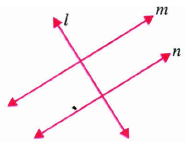
But n ||m
l || m
l and m do not intersect
Which is a contradication as l and m intersect
39.
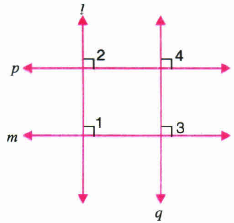
Let \(l\bot m\)
Then \(\angle 1=90^{ 0 }\)
\(P\bot 1\)
Then \(\angle 2=90^{ 0 }\)
40.
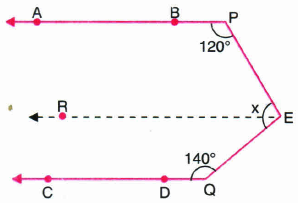
\(x=\angle PEQ\)
\(\angle PER+\angle QER\)
\(=(180^{ 0 }-\angle APE)+180^{ 0 }-140^{ 0 }\)
41.
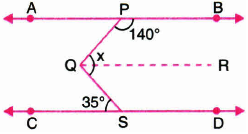
\(x=\angle PQS=\angle PQR+\angle SQR\)
\(=(180^{ 0 }-\angle QPR)+\angle CSQ\)
42.
\(\therefore PS\bot L\) and RQ \(\bot\) L
PS || PQ
\(y^{ 2 }+\angle SRQ=180^{ 0 }\)
43.
\(\angle PQS+\angle RSQ=180^{ 0 }\)
\(\Rightarrow 60^{ 0 }+\angle RSQ=180^{ 0 }\)
\(\Rightarrow \angle RSQ=120^{ 0 } \)
\(\angle RFE=\angle RSQ=120^{ 0 }\)
44.
\(\angle BC||DE\) and \(\angle CDE=90^{ 0 }\quad \)
\(\therefore \angle BCD=90^{ 0 }\) | Alternate Interior angles
\(\angle CDE=90^{ 0 }\)
\(\therefore \angle DCE=180^{ 0 }-(30^{ 0 }+90^{ 0 })=60^{ 0 }\)
45.
\(\angle a+\angle b=180^{ 0 }\)
2 + 3 = 5
\(\therefore \angle b=\frac { 3 }{ 5 } x180^{ 0 }=108^{ 0 }=\angle h\)
46.
2+3=5
Required angle =\(\frac { 2 }{ 5 } x180^{ 0 }\)
47.
\(x+40^{ 0 }=180^{ 0 }\)
48.
\(2x+40^{ 0 }=x+90^{ 0 }\)
49.
Corresponding angles axiom
50.
The sum of consecutive interior angles on the same side of a transversal is \(180^{ 0 }\)
51.
\(\angle 1\) and \(\angle 2\) are simply adjacent angles
52.
\(\angle 2\) and \(\angle 8\) are alternate interior angles
53.
\((\angle AOD+\angle DOB=180^{ 0 }\)
\(4+5=9\)
\(\therefore \angle AOD=\frac { 4 }{ 9 } X180^{ 0 }=80^{ 0 }\)
\(\angle COB= 80^0\)
54.
\(x+50^{ 0 }\)
\(y+90^{ 0 }+x=180^{ 0 }\quad 50^{ 0 }+90^{ 0 }+x=180^{ 0 }\)
\(\Rightarrow x=40^{ 0 }\)
\(q=x=40^{ 0 }\)
55.
\(y=62^{ 0 }\)
\(x+62^{ 0 }=180^{ 0 }\Rightarrow x=118^{ 0 }\)
\(\therefore \angle x-\angle y=118^{ 0 }-62^{ 0 }=56^{ 0 }\)
56.
\(4x+2x=180^{ 0 }\)
57.
\(4x+(2x+30)=180^{ 0 }\)
58.
\(\Rightarrow (2x+10^{ 0 })+(2x+30^{ 0 })=180^{ 0}\)
\(\Rightarrow 4x+40^{ 0 }=180^{ 0 }\)
\(\Rightarrow 4x=140^{ 0 }\)
\(\Rightarrow x=35^{ 0 }\)
59.
\(40^{ 0 }+3y+2y=180^{ 0 }\)
60.
\(5x+4x=180^{ 0 }\)
61.
Linear Pair Axiom
62.
\(\angle COA\) and \(\angle BOA\) are not a pair of adjacent angles
63.
\(\angle AOB\) and \(\angle BOC\) are neither supplementary not complementary nor adjusted angles
64.
(a)
the distance between the parallel lines
65.
(b)
two directions
66.
(b)
two different ways
67.
\(\angle PYQ=180^{ 0 }-(\angle XYP+\angle ZYQ)\)
\(=180^{ 0 }-85^{ 0 }=95^{ 0 }\)
68.
\((30-a)^{ 0 }+(125+2a)^{ 0 }=180^{ 0 }\)
69.
\(\frac { x }{ y } =\frac { 4 }{ 3 } =k\)
70.
\(x=90^{ 0 }-x)+30^{ 0 }\Rightarrow x=60^{ 0 }\)
71.
\(\theta =2(180^{ 0 })\Rightarrow 0=120^{ 0 }\)
72.
0=8\((90^{ 0 }-\theta )\)
73.
Required angle = \(360^{ 0 },\) - \(60^{ 0 },\)=\(300^{ 0 },\)
74.
\(32^{ 0 }+,58^{ 0 }=90^{ 0 }\neq 180^{ 0 }\)
75.
\(150^{ 0 },30^{ 0 }=180^{ 0 }\neq 90^{ 0 }\)
76.
Required angle=\(180^{ 0 }\)-(\(180^{ 0 }\)+\(9^{ 0 }\)) =\(9^{ 0 }\)
77.
Required angle=\(180^{ 0 }\)-(\(90^{ 0 }\)+\(9^{ 0 }\)) =\(90^{ 0 }\)+\(9^{ 0 }\)
78.
Required angle=\(180^{ 0 }\)-(\(90^{ 0 }\)+\(9^{ 0 }\)) = \(90^{ 0 }\)+\(9^{ 0 }\)
79.
Complement of (\(90^{ 0 }\)-\(a^{ 0 }\))
=\(90^{ 0 }\)-(\(90^{ 0 }\)-\(a^{ 0 }\))=\(a^{ 0 }\)
80.
X=\(180^{ 0 }\)-x\(\Rightarrow \)x\(90^{ 0 }\)
81.
\(\theta =90^{ 0 }-\theta \)
82.
Required angle=\(180^{ 0 }\)-\(60^{ 0 }\)=\(120^{ 0 }\)
83.
Definition of straight angle
84.
Definition of an obuse angle
85.
Definition of right angle
86.
Definition of complimentary angles
87.
Definition of a reflex angle
88.
Definition of an right angle
89.
(c)
\(90^{ 0 }\)-m
90.
(b)
\(180^{ 0 }\)
91.
Definition of complementary angles
92.
Definition of complementary angles
93.
Definition of an obtuse angle
94.
Definition of an acute angle
95.
(a)
Of different types
96.
(d)
1
97.
(b)
2

9th Standard CBSE Syllabus & Materials
9th Standard CBSE
CBSE 9th Mathematics Lines and Angles Sample Question Papers Study Material - QB365 Set A
NEW9th Standard CBSE
CBSE 9th Mathematics Introduction to Euclid's Geometry Sample Question Papers Study Material - QB365 Set A
NEW9th Standard CBSE
CBSE 9th Mathematics Linear Equations in Two Variables Sample Question Papers Study Material - QB365 Set A
NEW9th Standard CBSE
CBSE 9th Mathematics Coordinate Geometry Sample Question Papers Study Material - QB365 Set A



NCERT Books

Syllabus

Exam Pattern

Sample Question Papers

Previous year Question Papers

Important Notes

MCQ Practice test

NCERT Exemplers

Case study Questions

Image Based Questions

Passage based Questions

HOT Questions

Value Based Questions

Model Questions Papers
NCERT ( Book Back ) Questions

Assertion and Reason
Important Questions And Answers

CBSE 9th Standard CBSE Subjects
CBSE Standards