100% FREE ACCESS
9th Standard CBSE Syllabus & Materials
9th Standard CBSE
CBSE 9th Science Is matter around us pure? - New Model Questions Papers Study Material - QB365 Set A
NEW9th Standard CBSE
CBSE 9th Science Matter in our surroundings - New Model Questions Papers Study Material - QB365 Set A
NEW9th Standard CBSE
CBSE 9th Mathematics Heron's Formula Sample Question Papers Study Material - QB365 Set A
NEW9th Standard CBSE
CBSE 9th Mathematics Circles Sample Question Papers Study Material - QB365 Set A
NEW9th Standard CBSE
CBSE 9th Mathematics Quadrilaterals Sample Question Papers Study Material - QB365 Set A
NEW9th Standard CBSE
CBSE 9th Mathematics Triangles Sample Question Papers Study Material - QB365 Set A

Published on: 29/10/2025
Download CBSE Class 9th Standard CBSE Mathematics question papers, sample papers, important questions, and previous year solved papers in PDF format. Get free study materials, NCERT solutions, and exam preparation resources for Class 9th Standard CBSE Mathematics
Questions + Answers key
Take MCQ Mathematics Test
1.
The compliment of (\(90^{ 0 }\)-\(a^{ 0 }\)) is
\(-a^{ 0 }\)
\(90^{ 0 }\)+\(a^{ 0 }\)
\(90^{ 0 }\)-\(a^{ 0 }\)
\(a^{ 0 }\)
2.
An angle which is greater than \(90^{ 0 }\) and less than \(180^{ 0 }\) is called
a right angle
a straight angle
an acute angle
an obtuse angle
3.
Two angles whose sum is \(90^{ 0 }\) are called
Supplementary angles
complimentary angles
corresponding angles
alternate angles
4.
A reflex angle
is greater than \(180^{ 0 }\) but less than \(360^{ 0 }\)
is exactly equal to \(180^{ 0 }\)
is exactly equal to \(90^{ 0 }\)
is greater than \(90^{ 0 }\) but less than \(180^{ 0 }\)
5.
The sum of two complimentary angles is
\(180^{ 0 }\)
\(360^{ 0 }\)
\(90^{ 0 }\)
None of these
6.
An obtuse angle
measures between \(0^{ 0 }\) and \(90^{ 0 }\)
is greater than \(90^{ 0 }\) but less than \(180^{ 0 }\)
is exactly equal to \(90^{ 0 }\)
is exactly equal to \(180^{ 0 }\)
7.
An angle which measures between \(0^{ 0 }\) and \(90^{ 0 }\) is called
a straight angle
an acute angle
a right angle
an obtuse angle
8.
How many types of angles are formed between the edges of plane surfaces?
Of different types
Of only one type
Of only two types
of only three types
9.
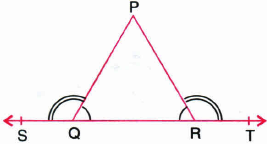
In figure \(\angle \)PQR =\(\angle \)PRQ then prove that \(\angle \) PQS =\(\angle \)PRT
10.
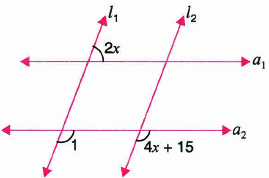
In the figure below \(l_{ 1 }||l_{ 2 }\) and \(a_{ 1 }||a_{ 2 }\) find the value of x.
11.
If two lines are perpendicular to the same line prove that they are parallel to each other.
12.
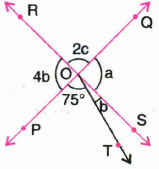
In the given figure , two straight lines PQ and RS intersect each other at O
If \(\angle \)POT =\(75^{ 0 }\) Find the values of a,b,c
13.
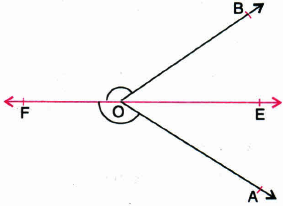
Ray OE bisects \(\angle \)AOB and OF the ray opposite to OE Show that \(\angle \)FOB=\(\angle \)FOA
14.
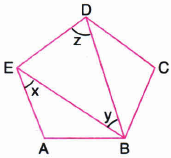
ABCDE is a regular pentagon as shown in the given figure Find the values \(\angle x\angle y\angle z\)
15.
Find the supplement of \(\frac { 4 }{ 3 } \) of right angle
16.
Two complementary angles are such that two times the measure of one to three times the measure of the other .Find the measure of the largest angle.
17.
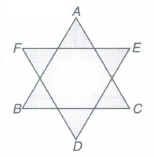
In the figure below, if \(\angle A+\angle B+\angle C+\angle D+\angle E+\angle F=k\) right angles, then what is the value of k?
18.
If a transversal intersects two parallel lines, then which of the pairs of angles is equal.
19.
Two supplementary angles are in ratio 2:7. Find the measure of angles.
20.
Write the angle which is one-fifth of its complement.
21.
What is the measure of an angle which is complement of itself?
1.
Complement of (\(90^{ 0 }\)-\(a^{ 0 }\))
=\(90^{ 0 }\)-(\(90^{ 0 }\)-\(a^{ 0 }\))=\(a^{ 0 }\)
2.
Definition of an obuse angle
3.
Definition of complimentary angles
4.
Definition of a reflex angle
5.
Definition of complementary angles
6.
Definition of an obtuse angle
7.
Definition of an acute angle
8.
(a)
Of different types
9.
\(\therefore \)Ray QP stands on line ST
\(\therefore \) \(\angle \)PQS +\(\angle \)PQR = \(180^{ 0 }\)
|Linear Pair Axiom
Ray RP stands on line ST
\(\therefore \) \(\angle \)PRQ +\(\angle \)PRT= \(180^{ 0 }\)
| Linear Pair Axiom
From (1) and (2) we obtain
\(\angle \)PQS+\(\angle \)PQR =\(\angle \)PRQ +\(\angle \)PRT
\(\Rightarrow \)\(\angle \) PQS =\(\angle \)PRT
\(\therefore \) \(\angle \)PQR=\(\angle \)PRQ(Given)
10.
\(\angle \)1=4x+15 | Corresponding angles
2x=180-\(\angle \)1 |Corresponding angles
\(\Rightarrow \) 2x=\(180^{ 0 }\) -(4x+15)
\(\Rightarrow \) 2x=165-4x
\(\Rightarrow \) 6x=165 \(\Rightarrow \)\(x=\frac { 165 }{ 6 } =27\frac { 1^{ 0 } }{ 2 } \)
11.
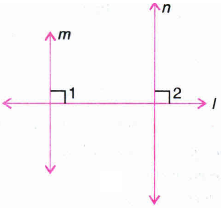
Let the two lines m and n each be perpendicular to the same line L
Then,
\(\angle \)1=\(90^{ 0 }\)
\(\angle \)2=\(90^{ 0 }\)
\(\angle \)1=\(\angle \)2
But these angles form a pair of equal corresponding angles
\(\therefore \) m||n
12.
\(\therefore \) ROS is a line
\(\therefore \) 4b+\(75^{ 0 }\)+b=\(180^{ 0 }\)
\(\Rightarrow 5b=180^{ 0 }-75^{ 0 }=105^{ 0 }\)
\(\Rightarrow \) b=\(\frac { 105^{ 0 } }{ 5 } =21^{ 0 }\)
2c=\(75^{ 0 }\)+b
|Vertically opposite angles
\(\Rightarrow 2c=75^{ 0 }+21^{ 0 }\)
\(\Rightarrow 2c=96^{ 0 }\)
\(\Rightarrow \)\(c=\frac { 96^{ 0 } }{ 2 } =48^{ 0 }\)
a=4b
|Vertically opposite angkes
\(\Rightarrow a=4X21^{ 0 }=84^{ 0 }\)
Thus \(a=84^{ 0 },b=21^{ 0 },c=48^{ 0 }\)
13.
\(\angle \)FOB+\(\angle \)BOE=\(180^{ 0 }\) ...(1)
| Linear pair Axiom
\(\angle \)FOA+\(\angle \)AOE=\(180^{ 0 }\) .. (2)
| Linear Pair Axiom
From (1) and (2)
\(\angle \)FOB+\(\angle \)BOE=\(\angle \) FOA+\(\angle \)AOE ....(3)
But \(\angle \)BOE=\(\angle \)AOE
\(\therefore \) From (3)
\(\Rightarrow \) \(\angle \)FOB=\(\angle \)FOA
14.
\(36^{ 0 },36^{ 0 },72^{ 0 }\)
15.
\(\frac{4}{3}\) of a right angle=\(\frac{4}{3}\times90^o=120^o\)
(Sum of supplementary angles is 180o)
Supplement of 120o=180o-120o=60o
16.
\(54^{ 0 }\)
17.
()
In \(\triangle ABC,\)
\(\angle A+\angle B+\angle C=180^o\)
Also, in \(\triangle DEF,\)
\(\angle D+\angle E+\angle F=180^o\)
\(\therefore \angle A+\angle B+\angle C+\angle D+\angle E+\angle F=360^o\)
=4 X 90o
Hence,k=4 right angles.
18.
()
Pair of alternate interior angles.
19.
()
2x+7x=180o\(\Rightarrow\)x=20o
So the angles are
2x=2X20o
=40o
7x=7X20o
=140o
So two angles are 40o and 140o
20.
()
Let the angle be x, then
By given condition, \(x=\frac{1}{5}(90^o-x)\Rightarrow6x=90^0\)
\(\Rightarrow x=15^0\)
21.
()
Let the angle be x, then
Angle x= Complement of x
\(\Rightarrow\) x=90o-x\(\Rightarrow\)x=45o

9th Standard CBSE Syllabus & Materials
9th Standard CBSE
CBSE 9th Mathematics Lines and Angles Sample Question Papers Study Material - QB365 Set A
NEW9th Standard CBSE
CBSE 9th Mathematics Introduction to Euclid's Geometry Sample Question Papers Study Material - QB365 Set A
NEW9th Standard CBSE
CBSE 9th Mathematics Linear Equations in Two Variables Sample Question Papers Study Material - QB365 Set A
NEW9th Standard CBSE
CBSE 9th Mathematics Coordinate Geometry Sample Question Papers Study Material - QB365 Set A



NCERT Books

Syllabus

Exam Pattern

Sample Question Papers

Previous year Question Papers

Important Notes

MCQ Practice test

NCERT Exemplers

Case study Questions

Image Based Questions

Passage based Questions

HOT Questions

Value Based Questions

Model Questions Papers
NCERT ( Book Back ) Questions

Assertion and Reason
Important Questions And Answers

CBSE 9th Standard CBSE Subjects
CBSE Standards