100% FREE ACCESS
9th Standard CBSE Syllabus & Materials
9th Standard CBSE
CBSE 9th Science Is matter around us pure? - New Model Questions Papers Study Material - QB365 Set A
NEW9th Standard CBSE
CBSE 9th Science Matter in our surroundings - New Model Questions Papers Study Material - QB365 Set A
NEW9th Standard CBSE
CBSE 9th Mathematics Heron's Formula Sample Question Papers Study Material - QB365 Set A
NEW9th Standard CBSE
CBSE 9th Mathematics Circles Sample Question Papers Study Material - QB365 Set A
NEW9th Standard CBSE
CBSE 9th Mathematics Quadrilaterals Sample Question Papers Study Material - QB365 Set A
NEW9th Standard CBSE
CBSE 9th Mathematics Triangles Sample Question Papers Study Material - QB365 Set A

Published on: 28/10/2025
Download CBSE Class 9th Standard CBSE Mathematics question papers, sample papers, important questions, and previous year solved papers in PDF format. Get free study materials, NCERT solutions, and exam preparation resources for Class 9th Standard CBSE Mathematics
Questions + Answers key
Take MCQ Mathematics Test
1.
Factorise 4x2 + y2 + z2 – 4xy – 2yz + 4xz.
2.
Find four different solutions of the equation x + 2y = 6
3.
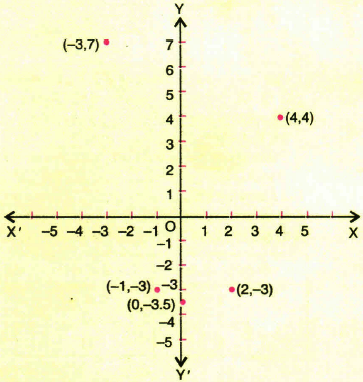
Plot the following ordered pairs (x, y) of numbers as points in the Cartesian plane. Use the scale 1cm = 1 unit on the axes.
| x | -3 | 04 | -1 | 4 | 2 |
|---|---|---|---|---|---|
| y | 7 | -3.5 | -3 | 4 | -3 |
4.
Find an irrational number between 1/7 and 2/7.
5.
Factorise 8x3+ y3-27z3 + 18xyz.
6.
Which one of the following options is true and why?
y = 3x + 5 hs
(i) a unique solution
(ii) only two solutions
(iii) infinitely many solutions
7.
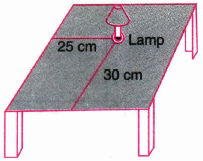
How will you describe the position of a table lamp on your study table another person?
8.
Express the following in the form p/q, where p and q are integers and \(q\neq 0\)
\(0.\overline { 47 } \)
9.
In the figure, l is the graph of the equation:
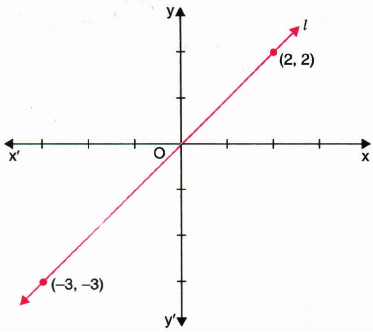
y=x
x+y=0
x=2y
y=2x
10.
The line y=mx+c
passes through origin
does not pass through origin
is parallel to x-axis
is parallel to y-axis
11.
Which of the following is a linear equation in one variable?
2x+y=0
x2=5x+3
5x+y2+3
x+5=6
12.
In which quadrant does the point (1,-2) lie?
I
II
III
IV
13.
The points (-5,2) and (2,-5) lie in the:
Same quadrant
II and III quadrants respectively
II and IV quadrants respectively
IV and III quadrants respectively
14.
One of the factors of \(42+y-y^2\) is:
\((7+y)\)
\((6-y)\)
\((7-y)\)
\((-6+y)\)
15.
Which of the following is a quadratic polynomial in one variable?
\(\sqrt{2x^3}+5\)
\(2x^2+2x^-2\)
\(x^2\)
\(2x^2+y^2\)
16.
The expansion for \((x-y)^2\) is
\((x-y)^2=x^2-2xy+y^2\) is an algebraic identity
\(x^2-2xy+y^2\)
\(x^2+2xy+y^2\)
\(x^2+y^2\)
\(x^2-y^2\)
17.
Simplified value of \({ \left( 16 \right) }^{ \frac { 1 }{ 4 } }\times \sqrt [ 4 ]{ 16 } \) is:
16
4
1
0
18.
The value of \(\sqrt [ 3 ]{ 216 } -\sqrt [ 3 ]{ 125 } \) is:
1
0
2
-1
19.
\(\left( \sqrt { a } +\sqrt { b } \right) \left( \sqrt { a } -\sqrt { b } \right) \) is:
a+b
a-b
\(2\sqrt { a } \)
\(2\sqrt { b } \)
20.
Which of the following is a rational number?
\(1+\sqrt { 3 } \)
\(\pi \)
\(2\sqrt { 3 } \)
0
21.
Express the following linear equations in the form ax + by + c = 0 and indicate the values of a, b and c in each case:
(i) 2x + 3y = 9.3\(\overline{5}\)
(ii) x - \(\frac{y}{5}\) - 10 = 0
(iii) -2x + 3y = 6
(iv) x = 3y
(v) 2x = -5y
(vi) 3x + 2 = 0
(vii) Y - 2 = 0
(viii) 5 = 2x
22.
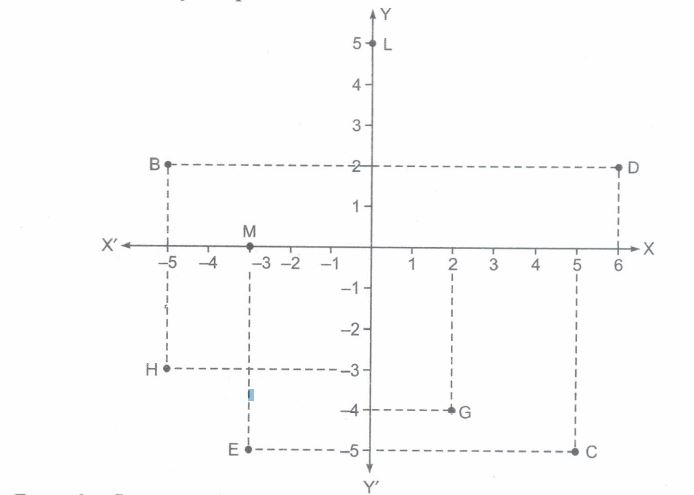
See the figure given below and write the following:
(i) The co-ordinates of B.
(ii) The co-ordinates of C.
(iii) The point identified by the co-ordinates (-3, -5).
(iv) The point identified by the co-ordinates (2, -4).
(v) The abscissa of the point D.
(vi) The ordinate of the point H
(vii) The co-ordinates of the point L.
(viii) The co-ordinates of the point M.
23.
If p(x) = x2 - 4x + 3, find the value of p(2) - P(-1) + \(p\left( \frac { 1 }{ 2 } \right) \)
24.
Represent \(\sqrt { 9.3 } \) on the number line.
25.
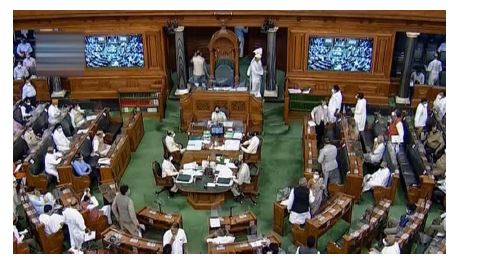
Student of class IX are on visit of Sansad Bhawan. Teacher assign them the activity of observe and take some pictures to analyses the seating arrangement between variuos MP and speaker based on coordiate geometry. The staff tour guide explained various facts related to Math's of Sansad Bhawan to the students, students were surprised when teacher ask them you need to apply coordiante geometry on the seating arrangement of MP's and speaker.
Calcualte the following reger to the below image and graph. Answer the following questions:
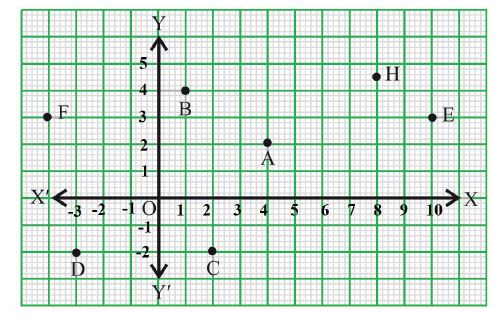
Answer the following refer to the above image and graph:
(i) What are the coordinates of postion 'F'?
| (a) (3, 4) | (b) (4, 3) |
| (c) (-3, 4) | (d) (-4, 3) |
(ii) What are the coordinates of position 'D'?
| (a) (3, 2) | (b) (-3, -2) |
| (c) (-3, 2) | (d) (3, -2) |
(iii) What are the coordinates of position 'H'?
| (a) (8, 5) | (b) (8, 4.5) |
| (c) (8, 4) | (d) (8, 5.5) |
(iv) In which quadrant, the point 'C' lie?
| (a) I | (b) II |
| (c) III | (d) IV |
(v) Find the perpendicular distance of the point E from the y-axis.
| (a) 13 units | (b) 10 units |
| (c) 11 units | (d) 3 units |
26.
On his birthday, Manoj planned that this time he celebrates his birthday in a small orphanage centre. He bought apples to give to children and adults working there. Manoj donated 2 apples to each children and 3 apples to each adult working there along with birthday cake. He distributed 60 total apples.

(a) How to represent the above situation in linear equations in two variables by taking the number of children as 'x' and the number of adults as 'y'?
| (i) 2x + y = 60 | (iii) 2x + 3y =60 |
| (ii) 3x + 2y = 60 | (iv) 3x + y =60 |
(b) If the number of children is 15, then find the number of adults?
| (i) 10 | (iii) 15 |
| (ii) 25 | (iv) 20 |
(c) If the number of adults is 12, then find the number of children?
| (i) 12 | (iii) 15 |
| (ii) 14 | (iv) 18 |
(d) Find the value of b, if x = 5, y = 0 is a solution of the equation 3x + 5y = b.
| (i) 12 | (iii) 15 |
| (ii) 14 | (iv) 18 |
(e) Which is the standard form of linear equations in two variables: y - x = 5?
| (i) 1.y - 1.x - 5 = 0 | (ii) 1.x - 1.y + 5 = 0 |
| (iii) 1.x + 0.y + 5 = 0 | (iv) 1.x - 1.y -5 = 0 |
1.
We have 4x2 + y2 + z2 – 4xy – 2yz + 4xz = (2x)2 + (–y)2 + (z)2 + 2(2x)(–y) + 2(–y)(z) + 2(2x)(z)
= [2x + (–y) + z]2 (Using Identity V)
= (2x – y + z)2 = (2x – y + z)(2x – y + z)
So far, we have dealt with identities involving second degree terms. Now let us extend Identity I to compute (x + y)3. We have:
(x + y)3 = (x + y) (x + y)2
= (x + y)(x2 + 2xy + y2)
= x(x2 + 2xy + y2) + y(x2 + 2xy + y2)
= x3 + 2x2y + xy2 + x2y + 2xy2 + y3
= x3 + 3x2y + 3xy2 + y3
= x3 + y3 + 3xy(x + y)
2.
By inspection, x = 2, y = 2 is a solution because for x = 2, y = 2
x + 2y = 2 + 4 = 6
Now, let us choose x = 0. With this value of x, the given equation reduces to 2y = 6 which has the unique solution y = 3. So x = 0, y = 3 is also a solution of x + 2y = 6. Similarly, taking y = 0, the given equation reduces to x = 6. So, x = 6, y = 0 is a solution of x + 2y = 6 as well. Finally, let us take y = 1. The given equation now reduces to x + 2 = 6, whose solution is given by x = 4. Therefore, (4, 1) is also a solution of the given equation. So four of the infinitely many solutions of the given equation are:
(2, 2), (0, 3), (6, 0) and (4, 1).
3.
4.
\(\frac{1}{7}=0.142857142857 \ldots=0 . \overline{142857}\) and \(\frac{2}{7}=0.28571428571428 \ldots=0 . \overline{285714}\)
Here, the two decimal expansions are non-terminating recurring.
Hence, 1/7 and 2/7 are two rational numbers.
We know, between any two rational numbers, there are infinitely many irrational numbers.
An irrational number has non-terminating non-recurring decimal expansions.
Then an irrational number between \(\frac{1}{7} \text { and } \frac{2}{7}\) is 0.15015001500015.
Similarly, 0.21020020002... is another irrational number between \(\frac{1}{7} \text { and } \frac{2}{7}\)
5.
Here, we have
8x3 + y3 + 27z3 – 18xyz
= (2x)3 + y3 + (3z)3 – 3(2x)(y)(3z)
= (2x + y + 3z)[(2x)2 + y2 + (3z)2 – (2x)(y) – (y)(3z) – (2x)(3z)]
= (2x + y + 3z) (4x2 + y2 + 9z2 – 2xy – 3yz – 6xz)
6.
The true option is (iii) y = 3x + 5 has infinitely many solution
Reason: For every value of x, there is a corresponding value of y and vice-versa.
7.
Consider the lamp as a point and table as a plane.Choose any two perpendicular edges of the table.Measure the distance of the lamp from the longer edge, suppose it is 25 cm. Again, measure the distance of the lamp from the shorter edge, and suppose it is 30 cm.You can write the position of the lamp as (30,25) or (25, 30), depending on the order you fix.
8.
Let x=\(0.\overline { 47 } \) =0.4777....
Multiplying both sides by 10, we get
10x = 9.9999...
10x = 4.7777...
10x = 4.3+0.47777...
10x = 4.3+x
10x - x = 4.3
9x = 4.3
x = 4.3/9 = 43/90
Thus, \(0.\overline { 47 } \) = 43/90
Here p =4 3
q = 90(\(\neq 0\))
9.
(2,2) and (-3,-3) both satisfy y=x
10.
O(0,0) does not satisfy y=mx+c
11.
x+5=6 ⇒ x=1
12.
(d)
IV
13.
(c)
II and IV quadrants respectively
14.
\(42+y-y^2=42+7y-6y-y^2\)
\(=7(6+y)-y(6+y)\)
\(=(6+y)(7-y)\)
15.
Definition of quadratic polynomial
16.
(a)
\(x^2-2xy+y^2\)
17.
(c)
1
18.
(a)
1
19.
(c)
\(2\sqrt { a } \)
20.
(d)
0
21.
(i) We have 2x + 3y = 9.3\(\overline{5}\)
∴ (2)x + (3)y + (-9.3\(\overline{5}\)) = 0
Comparing it with ax + bx + c = 0, we have a = 2, b = 3 and c = -9.3\(\overline{5}\).
(ii) We have x - \(\frac{y}{5}\)- 10 = 0
or x + \(\left(-\frac{1}{5}\right)\) y + (-10) = 0
Comparing with ax + bx + c = 0, we get
a = 1, b = \(-\frac{1}{5}\) and c = -10
Note: Above equation can also be compared by:
Multiplying throughout by 5,
5(x) - (5x\(\frac{y}{5}\)) - (5 x 10) = 0
or 5x - y - 50 = 0
or 5(x) + (-1)y + (-50) = 0
Comparing with ax + by + c = 0, we get a = 5, b = -1 and c = -50.
(iii) We have -2x + 3y = 6
⇒ -2x + 3y - 6 = 0
⇒ (-2)x + (3)y + (-6) = 0
Comparing with ax + bx + c = 0, we get a = -2, b = 3 and c = -6.
(iv) We have x = 3y
⇒ x - 3y = 0
⇒ (1)x + (-3)y + 0 = 0
Comparing with ax + bx + c = 0, we get a = 1, b = -3 and c = 0.
(v) We have 2x = -5y
⇒ 2x + 5y = 0
⇒ (2)x + (5)y + 0 = 0
Comparing with ax + by + c = 0, we get a = 2, b = 5 and c = 0.
(vi) We have 3x + 2 = 0
⇒ 3x + 2 + 0y = 0
⇒ (3)x + (0)y + (2) = 0
Comparing with ax + by + c = 0, we get a = 3, b = 0 and c = 2.
(vii) We have y - 2 = 0
⇒ (0)x + (1)y + (-2) = 0
Comparing with ax + by + c = 0, we have a = 0, b = 1 and c = -2.
(viii) We have 5 = 2x
⇒ 5 - 2x = 0
⇒ -2x + 0y + 5 = 0
⇒ (-2)x + (0)y + (5) = 0
Comparing with ax + by + c = 0, we get a = -2, b = 0 and c = 5.
22.
From the figure, we have
(i) The co-ordinates of B are (-5, 2).
(ii) The co-ordinates of C are (5, -5).
(iii) The point E is identified by the co-ordinates (-3, -5)
(iv) The point G is identified by the co-ordinates (2, -4).
(v) The abscissa of the point D is 6.
(vi) The ordinate of the point H is -3.
(vii) The co-ordinates of the point L are (0, 5).
(viii) The co-ordinates of the point M are (-3, 0).
Plotting a point in the plane when coordinates of the point are given
To plot a point in the coordinate plane we draw the coordinate axes and choose our units such that we can mark equal distances on the x-axis or on the y-axis or on both the axes. We take origin as zero for x-axis as well as on y-axis. The distances marked along OX and OY are taken as positive and those along OX and OY are taken as negative.
23.
\(-\frac { 31 }{ 4 } \)
24.
First, we draw AB = 9.3 units. Now, from B, mark a distance of 1 unit. Let this point be C. Let D be the mid-point of AC. Now, draw a semi-circle with centre D and radius DA. Let us draw a line perpendicular to AC passing through point B and intersecting the semi-circle at point D.
\(\therefore\) Distance, BD=\(\sqrt { 9.3 } \)
Draw an arc with centre B and radius BD, which intersects the number line at point E. So point E represents \(\sqrt { 9.3 } \) .
25.
(i) (d) (-4, 3)
(ii) (b) (-3, -2)
(iii) (b) (8, 4.5)
(iv) (d) IV
(v) (b) 10 units
26.
(a) (iii) 2x + 3y = 60
Let the number of children be x and the number of adults be y then the linear equation in two variable for the given situation is
2x + 3y = 60.
(b) (i) 10
2x + 3y =60 ⇒ 2(15) + 3y = 60
⇒ 3y = 60 - 30 = 30
⇒ y = 10
(c) (i) 12
2x + 3y = 60 ⇒ 2x + 3(12) = 60
⇒ 2x 60 - 36 = 24
⇒ x = 12
(d) (iii) 15
On putting x = 5 and y = 0 in the equation 3x + 5y = b, we have
3 x 5 + 5 x 0 = b
⇒ 15 + 0 = b
⇒ b = 15
(e) (ii) 1.x - 1.y + 5 = 0
y - x = 5 ⇒ y = x + 5
⇒ x - y + 5 = 0
⇒ 1.x - 1.y + 5 = 0

9th Standard CBSE Syllabus & Materials
9th Standard CBSE
CBSE 9th Mathematics Lines and Angles Sample Question Papers Study Material - QB365 Set A
NEW9th Standard CBSE
CBSE 9th Mathematics Introduction to Euclid's Geometry Sample Question Papers Study Material - QB365 Set A
NEW9th Standard CBSE
CBSE 9th Mathematics Linear Equations in Two Variables Sample Question Papers Study Material - QB365 Set A
NEW9th Standard CBSE
CBSE 9th Mathematics Coordinate Geometry Sample Question Papers Study Material - QB365 Set A



NCERT Books

Syllabus

Exam Pattern

Sample Question Papers

Previous year Question Papers

Important Notes

MCQ Practice test

NCERT Exemplers

Case study Questions

Image Based Questions

Passage based Questions

HOT Questions

Value Based Questions

Model Questions Papers
NCERT ( Book Back ) Questions

Assertion and Reason
Important Questions And Answers

CBSE 9th Standard CBSE Subjects
CBSE Standards