100% FREE ACCESS
9th Standard CBSE Syllabus & Materials
9th Standard CBSE
CBSE 9th Science Is matter around us pure? - New Model Questions Papers Study Material - QB365 Set A
NEW9th Standard CBSE
CBSE 9th Science Matter in our surroundings - New Model Questions Papers Study Material - QB365 Set A
NEW9th Standard CBSE
CBSE 9th Mathematics Heron's Formula Sample Question Papers Study Material - QB365 Set A
NEW9th Standard CBSE
CBSE 9th Mathematics Circles Sample Question Papers Study Material - QB365 Set A
NEW9th Standard CBSE
CBSE 9th Mathematics Quadrilaterals Sample Question Papers Study Material - QB365 Set A
NEW9th Standard CBSE
CBSE 9th Mathematics Triangles Sample Question Papers Study Material - QB365 Set A

Published on: 29/10/2025
Download CBSE Class 9th Standard CBSE Mathematics question papers, sample papers, important questions, and previous year solved papers in PDF format. Get free study materials, NCERT solutions, and exam preparation resources for Class 9th Standard CBSE Mathematics
Questions + Answers key
Take MCQ Mathematics Test
1.
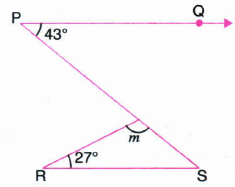
In figure if PQ || RS,then the measure of m is:
\(110^{ 0 }\)
\(100^{ 0 }\)
\(90^{ 0 }\)
\(133^{ 0 }\)
2.
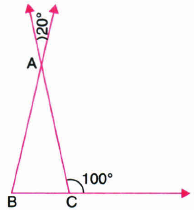
In the given figure the measure of \(\angle ABC\) is
\(80^{ 0 }\)
\(20^{ 0 }\)
\(100^{ 0 }\)
\(60^{ 0 }\)
3.
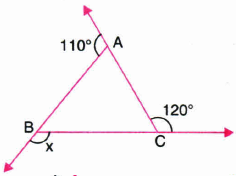
In figure the value of x is :
\(120^{ 0 }\)
\(130^{ 0 }\)
\(110^{ 0 }\)
\(100^{ 0 }\)
4.
Euclid stated that things which are equal to the same thing are equal to one another in the form of:
an axiom
a definition
a postulate
a proof
5.
The things which coincide with one another are:
equal to one another
un equal
double of same thing
triple of same thing
6.
Two planes intersect each other to form a:
plane
Point
straight line
angle
7.
If (x+2,4)=(5,y-2), then the coordinates (x,y) are:
(7,12)
(6,3)
(3,6)
(2,1)
8.
If x and y, both are positive, then the point (x,y) lies in
I quadrant
II quadrant
III quadrant
IV quadrant
9.
The remainder when \(x^2+2x+1\)is divided by (x+1) is:
4
0
1
-2
10.
If a polynomial f(x) is divided by x-a, then remainder is:
f(0)
f(a)
f(-a)
f(a)-f(0)
11.
The value of polynomial \(6a^2+7a-3\) when a=1 is:
10
4
-13
-4
12.
The maximum number of terms in a polynomial of degree 10 is:
9
10
11
1
13.
If \(x=\frac { \sqrt { 7 } }{ 5 } \) and \(\frac { 5 }{ x } =p\sqrt { 7 } \) , then the value of p is:
\(\frac { 5 }{ \sqrt { 7 } } \)
\(\frac { 25 }{ 7 } \)
\(\frac { 7 }{ 25 } \)
\(\frac { \sqrt { 7 } }{ 5 } \)
14.
An irrational number between \(\frac { 5 }{ 7 } \) and \(\frac { 7 }{ 9 } \)
0.75
\(\sqrt { 6 } \)
0.750 7500 75000...
0.7512
15.
Which of the following numbers is an irrational number?
\(\sqrt { 23 } \)
\(\sqrt { 225 } \)
0.3796
\(7.\overline { 478 } \)
16.
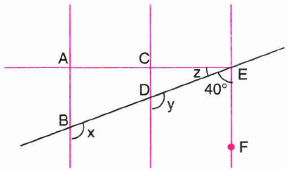
In figure AB || CD and CD || EF Also EA \(\bot \) AB if \(\angle BEF=40^{ 0 }\) , then find x,y,z
17.
If both (x-2) and \(\left( x-\frac { 1 }{ 2 } \right) \) are factors of \({ p }x^{ 2 }+5x+r\) show that p=r.
18.
If \(\frac { 2 }{ \sqrt { 3 } +\sqrt { 5 } } +\frac { 5 }{ \sqrt { 3 } -\sqrt { 5 } } =a\sqrt { 3 } +b\sqrt { 5 } \), find a and b
19.
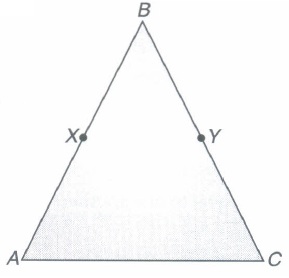
In the given figure, we have AB = BC, BX = BY. Show that AX = CY. State the axiom used.
20.
Represent \(0.\overline { 237 } \) in the form of \(\frac{p}{q}\) , where p and q are integers and q≠0.
21.
Factorise x4-625.
22.
If the angles of a triangle are in the ratio 1 : 2 : 3. then find the angles.
23.
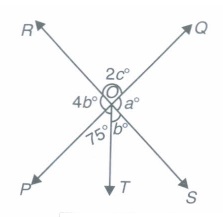
In the given figure, two straight lines PQ and RS intersect each other at O. If \(\angle\)POT = 75°, then find the values of a, b and c
24.
Factorise:
(i) \(49a^2+70ab+25b^2\)
(ii) \(\frac{25}{4}x^2-\frac{y^2}{9}.\)
25.
Find the value of x in \(\sqrt[3]{44 x-7}-5=0\)
26.
Express \(0 . \overline{38}\) as a rational number in simplest form.
27.
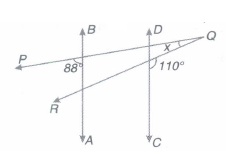
In figure, if AB||CD, then find the measure of x.
28.
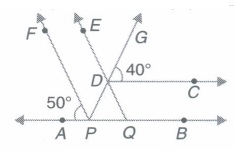
In the figure AB||CD and DE||PF. If \(\angle APF=50^o\) and \(\angle CDG=40^o.\) Find
\((i)\angle AQD\)
\((ii)\angle EDG\)
\((iii) \angle DPF\)
29.
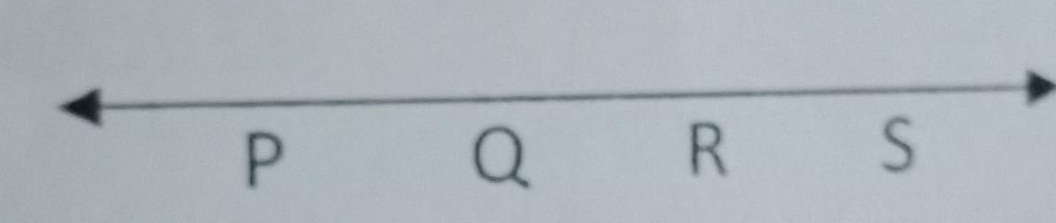
In the adjoining figure, PR = RS and RQ = RT. Show that PQ = and write the Euclid's axiom to support this.
30.
Factorise: \(64a^2-27b^3-144a^2b+108ab^2\)
31.
If \(x^2-3x+2\) is a factor of \(x^4-ax^2+b\) then find a and b
32.
KGB schools provide free education to girls students from weaker sections. The local body of a town want to open a KGB school in the town for which a rectangular plot ABCD, as shown in the following figure, is very suitable. But this plot belongs to Rati Ram. Rati Ram agrees to exchange it with triangular plot PQR as shown in the same figure. The co-ordinates of the vertices of both the plots are shown in the figure:
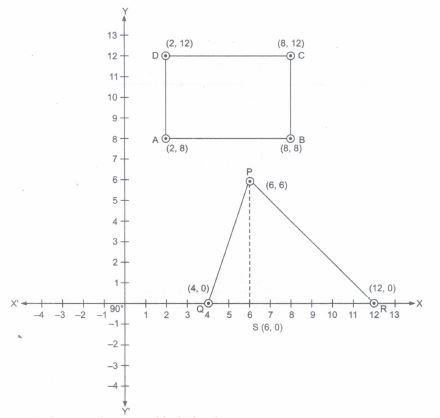
(i) Compare the areas of both the plots.
(ii) Which mathematical concept is used in the above problem?
(iii) By opening KGB school in the town, which value is depicted by the local body?
33.
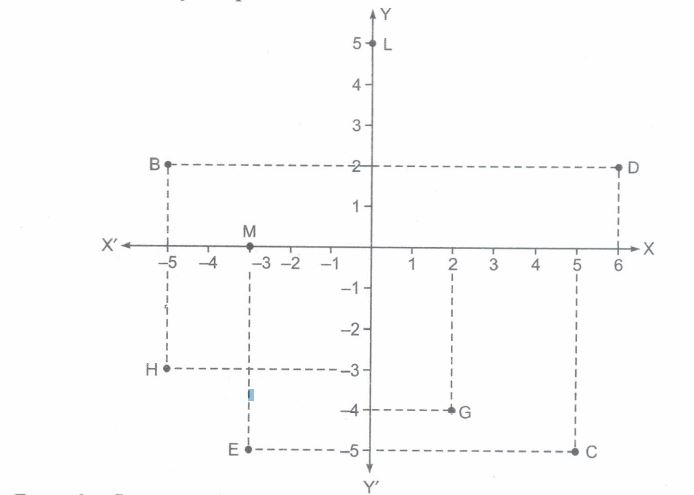
See the figure given below and write the following:
(i) The co-ordinates of B.
(ii) The co-ordinates of C.
(iii) The point identified by the co-ordinates (-3, -5).
(iv) The point identified by the co-ordinates (2, -4).
(v) The abscissa of the point D.
(vi) The ordinate of the point H
(vii) The co-ordinates of the point L.
(viii) The co-ordinates of the point M.
34.
Find the value of \(\frac { { 3 }^{ 30 }+{ 3 }^{ 29 }+{ 3 }^{ 28 } }{ { 3 }^{ 31 }+{ 3 }^{ 30 }-{ 3 }^{ 29 } } \)
35.
If \({ z }^{ 2 }+\frac { 1 }{ { z }^{ 2 } } =47,\) find the value of \({ z }^{ 3 }+\frac { 1 }{ { z }^{ 3 } } ,\)using only the positive value of \(z+\frac { 1 }{ z } \) .
36.
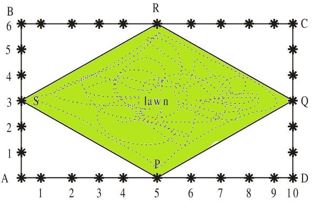
The Class IX students of a secondary school in Krishinagar have been allotted a rectangular plot of land for their gardening activity. Sapling of Gulmohar are planted on the boundary at a distance of 1m from each other. There is a lawn PQRS in the ground as shown in below figure.
(a) What are the coordinates of C, taking A as origin?
| (i) C(6, 10) | (ii) C(10, 10) |
| (iii) C(6, 6) | (iv) C(10, 6) |
(b) What are the coordinates of R, taking A as origin?
| (i)R(6, 5) | (ii) R(5, 5) |
| (iii) R(5, 6) | (iv) R(6, 6) |
(c) Side of lawn is :
| (i) 4 units | (ii) \(\sqrt{34}\) units | (iii) 34 units | (iv) None |
(d) Shape of lawn is :
| (i) Rectangle | (ii) Square |
| (iii) Parallelogram | (iv) Rhombus |
(e) Area of lawn is :
| (i) 30 sq. units | (ii) 60 sq. units |
| (iii) 45 sq. units | (iv) None |
37.
Students of a school are standing in rows and columns in their playground for a drill practice. A, B, C and D are the positions of four students as shown in the figure.
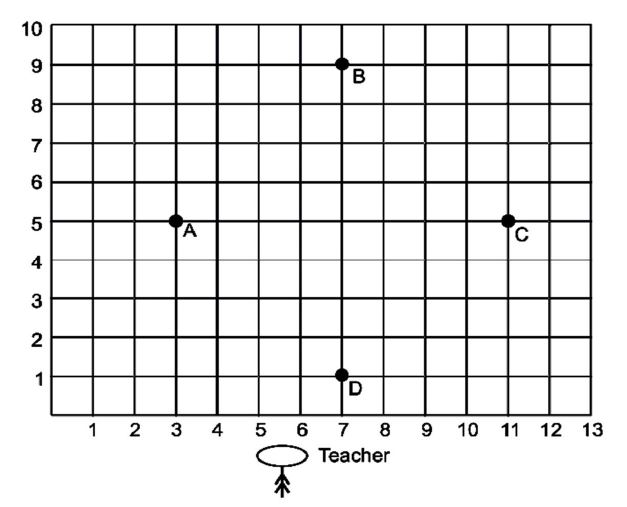
(a) What are the coordinates of A and B respectively?
| (i) A(3, 5); B(7, 8) | (ii) A(5, 3); B(8, 7) |
| (iii) A(3, 5); B(7, 9) | (iv) A(5, 3); B(9, 7) |
(b) What are the coordinates of C and D respectively?
| (i) C(11, 5); D(7, 1) | (ii) C(5, 11); D(1, 7) |
| (iii) C(5, 11); D(7, 1) | (iv) C(5, 11); D(-1, 7) |
(c) What is the distance between B and D?
| (i) 5 units | (ii) 14 units |
| (iii) 8 units | (iv) 10 units |
(d) What is the distance between A and C?
| (i) 5 units | (ii) 14 units |
| (iii) 8 units | (iv) 10 units |
(e) What are the coordinates of the point of intersection of AC and BD?
| (i) (7, 5) | (ii) (5, 7) |
| (iii) (7, 7) | (iv) (5, 5) |
38.
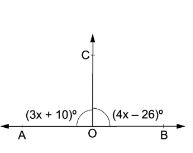
Assertion: In the given figure, AOB is a straight line. ∠AOC = (3x + 10)° and ∠BOC (4x − 26)°, then ∠BOC = 86°
Reason: The sum of angles that are formed on a straight line is equal to 180°.
Codes
(a) Both assertion (A) and reason (R) are true and reason (R) is the correct explanation of assertion (A).
(b) Both assertion (A) and reason (R) are true but reason (R) is not the correct explanation of assertion (A).
(c) Assertion (A) is true but reason (R) is false.
(d) Assertion (A) is false but reason (R) is true.
39.
Assertion: Point A(-2, -4) lies on III quadrant
Reason: A point both of whose coordinates are negative lies in III quadrant
Codes:
(a) Both assertion (A) and reason (R) are true and reason (R) is the correct explanation of assertion (A).
(b) Both assertion (A) and reason (R) are true but reason (R) is not the correct explanation of assertion (A).
(c) Assertion (A) is true but reason (R) is false.
(d) Assertion (A) is false but reason (R) is true.
40.
Assertion : 0.329 is a terminating decimal.
Reason : A decimal in which a digit or a set of digits is repeated periodically, is called a repeating, or a recurring, decimal.
Codes:
(a) Both assertion (A) and reason (R) are true and reason (R) is the correct explanation of assertion (A).
(b) Both assertion (A) and reason (R) are true but reason (R) is not the correct explanation of assertion (A).
(c) Assertion (A) is true but reason (R) is false.
(d) Assertion (A) is false but reason (R) is true.
1.
\(\angle PSR=\angle SPQ=43^{ 0 }\)
|Alternate Interior angles
\(27^{ 0 }+43^{ 0 }+m=180^{ 0 }\)
|Angle sum property
2.
\(\angle BAC=20^{ 0 }\)
\(\angle ABC+\angle BAC=100^{ 0 }\)
3.
\(x=(180^{ 0 }-120^{ 0 })+(180^{ 0 }-110^{ 0 })\)
4.
(a)
an axiom
5.
(a)
equal to one another
6.
(c)
straight line
7.
(c)
(3,6)
8.
(a)
I quadrant
9.
Remainder \(=f(-1)=(-1)^2+2(-1)+1=0\)
Aliter: \(x^2+2x+1=(x+1)^2\)
ஃ Remainder =0
10.
Remainder theorem
11.
Value=\(6(1)^2+7(1)-3\)
\(=6+7-3=10\)
12.
A polynomial of degree n has maximum number of terms as (n+1)
13.
(b)
\(\frac { 25 }{ 7 } \)
14.
(c)
0.750 7500 75000...
15.
(a)
\(\sqrt { 23 } \)
16.
\(\therefore \) CD || EF
and a transversal DE intersect them
\(\therefore y+40^{ 0 }\)=\(180^{ 0 }\)
Sum of the consecutive interior on the same side of a traversal is \(180^{ 0 }\)
\(\Rightarrow Y=180^{ 0 }-40^{ 0 }=140^{ 0 }\)
\(\therefore \) AB||CD and a traversal BD intersects them
\(\therefore \) c=y | corresponding angles
\(\Rightarrow x=140^{ 0 }\)
\(\therefore EA\quad \bot \quad AB\quad and\quad AB||EF\)
\(\therefore EA\quad \bot \quad EF\quad \)
If a line is perpendicular to a line then it is perpendicular to the parallel line also
\(\Rightarrow \angle AEF=90^{ 0 }\)
\(\Rightarrow Z+40^{ 0 }=90^{ 0 }\)
\(\Rightarrow Z+50^{ 0 }\)
17.
Let \(f(x)={ p }x^{ 2 }+5x+r\)
If (x-2) is a factor of f(x), then by factor theorem
\(f(2)=0\ |x-2=0\)
\(\Rightarrow \ x=2\)
\(\Rightarrow { p }(2)^{ 2 }+5(2)+r=0\)
\(\Rightarrow \ 4p+r+10=0\ ......(1)\)
If \(\left( x-\frac { 1 }{ 2 } \right) \)is a factor of f(x), then by factor theorem,
\(f\left( \frac { 1 }{ 2 } \right) =0\)
\(|x-\frac { 1 }{ 2 } =0\ \Rightarrow x=\frac { 1 }{ 2 } \)
\(\Rightarrow \ p{ \left( \frac { 1 }{ 2 } \right) }^{ 2 }+5\left( \frac { 1 }{ 2 } \right) +r=0\)
\(\Rightarrow \ \frac { p }{ 4 } +\frac { 5 }{ 2 } +r=0\)
\(\Rightarrow p+4r+10=0\ \ ..........(2)\)
Subtracting (2) from (1), we get
\(3p-3r=0\)
\(\Rightarrow\)\(p=r\)
18.
\(\frac { 2 }{ \sqrt { 3 } +\sqrt { 5 } } +\frac { 5 }{ \sqrt { 3 } -\sqrt { 5 } } =a\sqrt { 3 } +b\sqrt { 5 } \)
\(\\ =\frac { 2\left( \sqrt { 3 } -\sqrt { 3 } \right) }{ \left( \sqrt { 3 } -\sqrt { 5 } \right) } +\frac { 5 }{ \sqrt { 3 } -\sqrt { 5 } } \frac { \sqrt { 3 } +\sqrt { 5 } }{ \sqrt { 3 } +\sqrt { 5 } } \)
\(\\ =a\sqrt { 3 } +b\sqrt { 5 } \)
\(\\ \frac { 2\left( \sqrt { 3 } -\sqrt { 5 } \right) }{ 3-5 } +\frac { 5\left( \sqrt { 3 } +\sqrt { 5 } \right) }{ 3-5 } =a\sqrt { 3 } +b\sqrt { 5 } \)
\(\\ -\left( \sqrt { 3 } -\sqrt { 5 } \right) -\frac { 5 }{ 2 } \left( \sqrt { 3 } +\sqrt { 5 } \right) =a\sqrt { 3 } +b\sqrt { 5 } \)
\(\\ -\frac { 7 }{ 2 } \sqrt { 3 } -\frac { 3 }{ 2 } \sqrt { 5 } =a\sqrt { 3 } +b\sqrt { 5 } \)
\(\\ a=-\frac { 7 }{ 2 } ,\ b=-\frac { 3 }{ 2 } \)
19.
Since, AB = BC
AX + BX = BY + CY
Since, BX = BY
AX + BX - BX = BY + CY - BY
AX = CY
Axiom : If equals are subtracted from the equals, the remainders are equal.
20.
1000x = 237.\(\overline{237}\)
x = \(\frac{237}{999}\)
21.
x4-625
=(x2)2-(25)2=(x2-25)(x2+25) \(\left[ \because { a }^{ 2 }-{ b }^{ 2 }=(a+b)(a-b) \right] \)
=[(x)2-(5)2](x2+25)
=(x+5)(x-5)(x2+25) \(\left[ \because { a }^{ 2 }-{ b }^{ 2 }=(a+b)(a-b) \right] \)
22.
30°, 60°, 90°.
23.
Consider line RS. Then, 4b + 75° + b = 180°
[sum of all angles on a straight line is 180°]
b = 21°
Consider line PQ. Then, 75° + b + a = 180° \(\Rightarrow\)a = 84°
[sum of all angles on a straight line is 180°]
Again, consider line RS, 2c+ a = 180° [linear pair]
c = 48°
24.
(i) \((7a+5b)^2\)
(ii) \((\frac{5}{2}x+\frac{y}{3})(\frac{5}{2}x-\frac{y}{3})\)
25.
\(\sqrt[3]{44 x-7}\) = 5 ⇒ (44x - 7)1/3 = 5
= [(44x - 7)1/3]3 = [5]3
= 44x - 7 = 125 ⇒ x = \(\frac{132}{44}\) = 3
26.
Let x = \(0 . \overline{38}\) = 0.3838...
∴ 100x = 100 x (0.3838...)
or 100x = 38.3838
Subtracting (1) from (2), we have
100x - x = (38.3838 ... ) - (0.3838 ... )
or 99x = 38
or \(x=\frac{38}{99}\)
Thus, \(0 . \overline{38}=\frac{38}{99}\).
27.
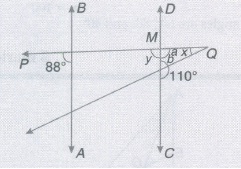
y=88o (Corresponding angles)
a=180o-88o=92o (linear pair)
b=180o-110o=70o (linear pair)
x=180o-(92+70)o (Angle sum property)
=180o-162o
=18o
28.
EQ||FP and transversal cut them
\(\therefore \angle AQD=\angle APF\) (Conresponding angles)
\(\angle AQD=50^o\)
\(\therefore \angle DQB=180^o-50^o=130^o\)
AB||CD and transversal EQ cuts them
\(\therefore \angle EDG=\angle DQB=130^o\)
\(\therefore \angle EDG=130^o-40^o=90^o\)
FP||EQ and transversal PG cut them
\(\therefore \angle FPD=\angle EDG=90^o\)
29.
Euclid's axiom 2
30.
\((4a-3b)^3\)
31.
a=5, b=4
32.
(i) For rectangle ABCD:
AB = 8 - 2 = 6 units ← Length
AD = 12 - 8 = 4 units ← Breadth
∴ Area of rectangle ABCD = AB x AD
= 6 units x 4 units
= 24 sq. units.
For triangle PQR:
QR = 12 - 4 = 8 units ← Base
SP = 6 - 0 = 6 units ← Height
∴ Area of ΔPQR = \(\frac{1}{2}\) base x height
= \(\frac{1}{2}\) x 8 x 6 sq. units
= 24 sq. units.
⇒ \(\left[\begin{array}{l} \text { area of } \\ \text { rect. } \mathrm{ABCD} \end{array}\right]=\left[\begin{array}{l} \text { area of } \\ \Delta \mathrm{PQR} \end{array}\right]\)
(ii) Co-ordinate Geometry.
(iii) Community or social upliftment.
33.
From the figure, we have
(i) The co-ordinates of B are (-5, 2).
(ii) The co-ordinates of C are (5, -5).
(iii) The point E is identified by the co-ordinates (-3, -5)
(iv) The point G is identified by the co-ordinates (2, -4).
(v) The abscissa of the point D is 6.
(vi) The ordinate of the point H is -3.
(vii) The co-ordinates of the point L are (0, 5).
(viii) The co-ordinates of the point M are (-3, 0).
Plotting a point in the plane when coordinates of the point are given
To plot a point in the coordinate plane we draw the coordinate axes and choose our units such that we can mark equal distances on the x-axis or on the y-axis or on both the axes. We take origin as zero for x-axis as well as on y-axis. The distances marked along OX and OY are taken as positive and those along OX and OY are taken as negative.
34.
\(\frac { { 3 }^{ 30 }+{ 3 }^{ 29 }+{ 3 }^{ 28 } }{ { 3 }^{ 31 }+{ 3 }^{ 30 }-{ 3 }^{ 29 } } =\frac { { 3 }^{ 38 }\left( { 3 }^{ 2 }+{ 3 }^{ 1 }+1 \right) }{ { 3 }^{ 29 }\left( { 3 }^{ 2 }+{ 3 }^{ 1 }-1 \right) } \)
\(=\frac { \left( 9+3+1 \right) }{ 3\left( 9+3-1 \right) } \)
\(=\frac { 13 }{ 3\times 11 } =\frac { 13 }{ 33 } \)
35.
322
36.
(a) (iv) C(10, 6)
(b) (iii) R(5, 6)
(c) (ii) \(\sqrt{34}\) units
PS2 = AS2 + AP2 = 52 + 32
= 25 + 9 = 34
⇒ PS = \(\sqrt{34}\)
(d) (iv) Rhombus
(e) (i) 30 sq. units
Area of rhombus = \(1 / 2\) x product of diagonals
= \(1 / 2\) x 6 x 10
= 30 sq. units
37.
(a) (iii) A(3, 5); B(7, 9)
(b) (i) C(11, 5); D(7, 1)
(c) (iii) 8 units
(d) (iii) 8 units
(e) (i) (7, 5)
38.
We know that the sum of angles that are formed on a straight line is equal to 180°.
So, Reason is correct
We have : ∠AOC+∠BOC=180° [Since AOB is a straight line ]
⇒3x + 10 + 4x − 26 = 180°
⇒7x = 196°
⇒x = 28°
∴∠BOC = [4 × 28 − 26]°
⇒∠BOC=86°.
So, Assertion (A) is also true.
Correct option is (a) Both assertion (A) and reason (R) are true and reason (R) is the correct explanation of assertion (A).
39.
We know that a point both of whose coordinates are negative lies in III quadrant
So, Reason is correct.
Hence, Point A(-2, -4) lies on III quadrant
So, Assertion is also correct and Reason explains Assertion
Correct option is (a) Both assertion (A) and reason (R) are true and reason (R) is the correct explanation of assertion (A).
40.
We know that a decimal in which a digit or a set of digits is repeated periodically, is called a repeating, or a recurring, decimal.
So, Reason is correct.
Also, we know that a decimal that ends after a finite number of digits is called a terminating decimal.
Hence Assertion is correct but reason is not the correct explanation of Assertion Correct option is (b) Both assertion (A) and reason (R) are true but reason (R) is not the correct explanation of assertion (A).

9th Standard CBSE Syllabus & Materials
9th Standard CBSE
CBSE 9th Mathematics Lines and Angles Sample Question Papers Study Material - QB365 Set A
NEW9th Standard CBSE
CBSE 9th Mathematics Introduction to Euclid's Geometry Sample Question Papers Study Material - QB365 Set A
NEW9th Standard CBSE
CBSE 9th Mathematics Linear Equations in Two Variables Sample Question Papers Study Material - QB365 Set A
NEW9th Standard CBSE
CBSE 9th Mathematics Coordinate Geometry Sample Question Papers Study Material - QB365 Set A



NCERT Books

Syllabus

Exam Pattern

Sample Question Papers

Previous year Question Papers

Important Notes

MCQ Practice test

NCERT Exemplers

Case study Questions

Image Based Questions

Passage based Questions

HOT Questions

Value Based Questions

Model Questions Papers
NCERT ( Book Back ) Questions

Assertion and Reason
Important Questions And Answers

CBSE 9th Standard CBSE Subjects
CBSE Standards