100% FREE ACCESS
9th Standard CBSE Syllabus & Materials
9th Standard CBSE
CBSE 9th Science Is matter around us pure? - New Model Questions Papers Study Material - QB365 Set A
NEW9th Standard CBSE
CBSE 9th Science Matter in our surroundings - New Model Questions Papers Study Material - QB365 Set A
NEW9th Standard CBSE
CBSE 9th Mathematics Heron's Formula Sample Question Papers Study Material - QB365 Set A
NEW9th Standard CBSE
CBSE 9th Mathematics Circles Sample Question Papers Study Material - QB365 Set A
NEW9th Standard CBSE
CBSE 9th Mathematics Quadrilaterals Sample Question Papers Study Material - QB365 Set A
NEW9th Standard CBSE
CBSE 9th Mathematics Triangles Sample Question Papers Study Material - QB365 Set A

Published on: 29/10/2025
Download CBSE Class 9th Standard CBSE Mathematics question papers, sample papers, important questions, and previous year solved papers in PDF format. Get free study materials, NCERT solutions, and exam preparation resources for Class 9th Standard CBSE Mathematics
Questions + Answers key
Take MCQ Mathematics Test
1.
Evaluate 105 x 106 without multiplying directly
2.
Find the remainder when x3 + 3x2 + 3x + 1 is divided by
(i) x + 1
(ii) x-\(\frac {1}{2}\)
(iii) x
(iv) x +\(\pi\)
(v) 5 + 2x
3.
Solve the equation 2x + 1 = x - 3, and represent the solution(s) on
(i) the number line
(ii) the Cartesian plane
4.
Find four different solutions of the equation x + 2y = 6
5.
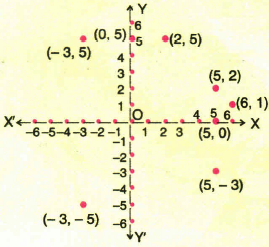
Locate the points (5,0), (0,5), (2,5), (5,2), (-3,5), (-3,-5),(5,-3) and (6,1) in the Cartesian plane.
6.
See figure and complete the following statements:
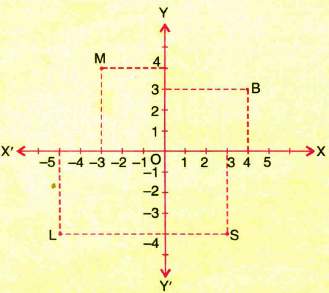
(i) The abscissa and the ordinate of the point B are ________ and _________ respectively.Hence the coordinates of B are (________).
(ii) The x-coordinate and the y-coordinate of the point M are _______ and ________ respectively. Hence the coordinates of M are (________)
(iii) The x-coordinate and the y-coordinate of the point L are _______and _________ respectively. Hence the coordinates of L are (__________)
(iv) The x-coordinate and the y-coordinate of the point S are ________ and __________respectively. Hence the coordinates of S are (__________)
7.
Verify whether 2 and 0 are zeroes polynomial \(x^2-2x\)
8.
Multiply \(6\sqrt { 5 } \) by \(2\sqrt { 5 } \)
9.
Are the following statements true or false? Give reasons for your answers.
(i) Every whole number is a natural number.
(ii) Every integer is a rational number.
(iii) Every rational number is an integer.
10.
Locate √3 on the number line.
11.
Check which of the following are solutions of equation x - 2y = 4 and which are not:
(4,0)
12.
Express the following linear equation in the form ax+by+c=0 and indicate the values of a, b and c in each case:
\(2x+3y=9.3 \overset{-}{5}\)
13.
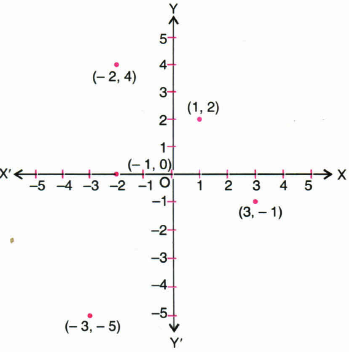
In which quadrant or on which axis do each of the points (-2,4), (3,-1), (-1,0), (1,2) and (-3,-5) lie?Verify your answer by locating them on the Cartesian plane.
14.
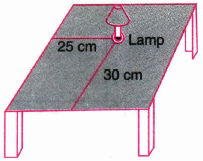
How will you describe the position of a table lamp on your study table another person?
15.
Evaluate the following using suitable identities: (99)3
16.
Use the Factor Theorem to determine whether g(x) is a factor of p(x) in each of the following cases: \(p(x)={ x }^{ 3 }+{ 3x }^{ 2 }-3x+1,\ g(x)=x+2\)
17.
Simplify: \(3\sqrt { 45 } -\sqrt { 125 } +\sqrt { 200 } -\sqrt { 50 } \)
18.
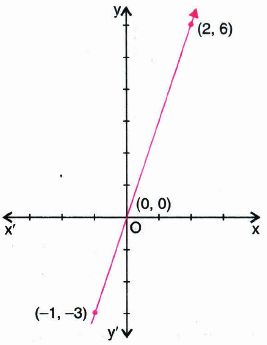
In the figure, the graph of the equation is drawn. Choose the correct equation for which the graph has been drawn:
y=x
y=x
y=2x
y=3x
19.
If y=2x-3 and y=5, then the value of x is
1
2
3
4
20.
The point whose abscissa and ordinates have different single will lie in:
I and II Quadrants
II and III Quadrants
I and III Quadrants
II and IV Quadrants
21.
Where do the I and III quadrants meet?
in x - axis
in y - axis
at O
do not intersect
22.
The value of p for which x+p is a factor of \(x^2+px+3-p \) is:
1
-1
3
-3
23.
If \(p(x)=2+\frac{x}{2}+x^2-\frac{x^2}{3},\) then p(-1) is:
\(\frac{15}{6}\)
\(\frac{17}{6}\)
\(\frac{1}{6}\)
\(\frac{13}{6}\)
24.
In the polynomial \(1-\sqrt{11} x,\) the coefficient of x is:
1
11
\(-\sqrt{11}\)
\(\sqrt{11}\)
25.
\(\left( 5+\sqrt { 8 } \right) +\left( 3-\sqrt { 2 } \right) -\left( \sqrt { 2 } -6 \right) \) when simplified is:
positive and irrational
negative and irrational
positive and rational
negative and rational
26.
\(\left( -2-\sqrt { 3 } \right) \left( -2+\sqrt { 3 } \right) \) when simplified is:
positive and irrational
positive and rational
negative and irrational
negative and rational
27.
Which of the following numbers is an irrational number?
\(\sqrt { 16 } -4\)
\(\left( 3-\sqrt { 3 } \right) \left( 3+\sqrt { 3 } \right) \)
\(\sqrt { 5 } +3\)
\(-\sqrt { 25 } \)
28.
Factorise:
(i) 4x2 + 9y2 + 16z2 + 12xy - 24yz - 16xz
(ii) 2x2 + y2+ 8z2 - 2 \(\sqrt{2}\)xy + 4\(\sqrt{2}\) yz - 8xz
29.
Factorise x3 - 23x2 + 142x - 120
30.
The cost of a notebook is twice the cost of a pen. Write a linear equation in two variables to represent this statement.
(Take the cost of a notebook to be Rs x and that of a pen to be Rs y)
31.
A city has two main roads which cross each other at the centre of the city. These two roads are along the North-South direction and East-West direction.
All the other streets of the city run parallel to these roads and are 200 m apart. There are 5 streets in each direction.
Using 1cm = 200 m, draw a model of the city on your notebook. Represent the roads/streets by single lines. There are many cross-streets in your model. A particular cross-street is made by two streets, one running in the North-South direction and another in the East-West direction. Each cross-street is referred to in the following manner:
If the 2nd street running in the North-South direction and 5th in the East-West direction meet at some crossing, then we will call this cross-street (2, 5).
Using this convention, find
(i) how many cross-streets can be referred to as (4,3)?
(ii) how many cross-streets can be referred to as (3,4) ?
32.
Rationalise the denominators of the following:
(i) \(\frac { 1 }{ \sqrt { 7 } } \)
(ii) \(\frac { 1 }{ \sqrt { 7 } -\sqrt { 6 } } \)
(iii) \(\frac { 1 }{ \sqrt { 5 } +\sqrt { 2 } } \)
(iv) \(\frac { 1 }{ \sqrt { 7 } -2 } \)
33.
Represent \(\sqrt { 9.3 } \) on the number line.
34.
On his birthday, Manoj planned that this time he celebrates his birthday in a small orphanage centre. He bought apples to give to children and adults working there. Manoj donated 2 apples to each children and 3 apples to each adult working there along with birthday cake. He distributed 60 total apples.

(a) How to represent the above situation in linear equations in two variables by taking the number of children as 'x' and the number of adults as 'y'?
| (i) 2x + y = 60 | (iii) 2x + 3y =60 |
| (ii) 3x + 2y = 60 | (iv) 3x + y =60 |
(b) If the number of children is 15, then find the number of adults?
| (i) 10 | (iii) 15 |
| (ii) 25 | (iv) 20 |
(c) If the number of adults is 12, then find the number of children?
| (i) 12 | (iii) 15 |
| (ii) 14 | (iv) 18 |
(d) Find the value of b, if x = 5, y = 0 is a solution of the equation 3x + 5y = b.
| (i) 12 | (iii) 15 |
| (ii) 14 | (iv) 18 |
(e) Which is the standard form of linear equations in two variables: y - x = 5?
| (i) 1.y - 1.x - 5 = 0 | (ii) 1.x - 1.y + 5 = 0 |
| (iii) 1.x + 0.y + 5 = 0 | (iv) 1.x - 1.y -5 = 0 |
35.
Aditya is a Class IX student residing in a village. One day, he went to a city Hospital along with his grandfather for general checkup. From there he visited three places - School, Library and Police Station. After returning to his village, he plotted a graph by taking Hospital as origin and marked three places on the graph as per his direction of movement and distance. The graph is shown below:
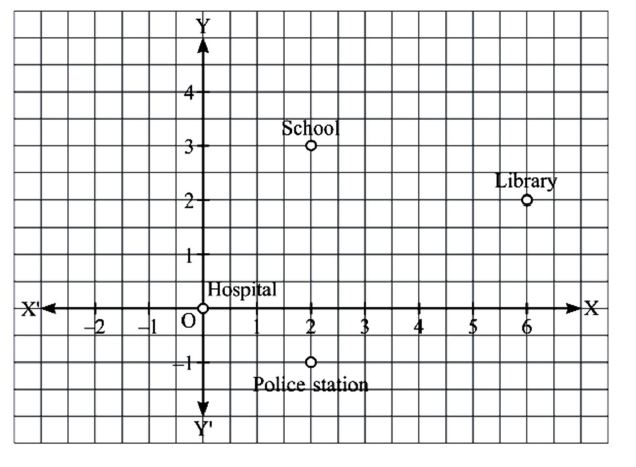
(i) What are the coordinates of School?
| (a) (3, 2) | (b) (2, 3) |
| (c) (3, 5) | (d) (5, 3) |
(ii) What are the coordinates of Police Station?
| (a) (2, -1) | (b) (2, 1) |
| (c) (-2, -1) | (d) (-2, 1) |
(iii) Distance between school and police station:
| (a) 4 | (b) 3 | (c) 2 | (d) 1 |
(iv) What are the coordinates of Library?
| (a) (2, 6) | (b) (2, -6) |
| (c) (6, -2) | (d) (6, 2) |
(v) In which quadrant the point (-1, 4) lies?
| (a) I | (b) II |
| (c) III | (d) IV |
1.
105 x 106 = (100 + 5) x (100 + 6)
= (100)2 + (5 + 6) (100) + (5 x 6), using Identity IV
= 10000 + 1100 + 30
= 11130
2.
Let f(x) = x3 + 3x2 + 3x + 1
(i) Here, the zero of x + 1 is x=-1. [\(\because\) x + 1 = 0 \(\Rightarrow\) x = -1]
On putting x =- 1 in f(x), we get
f (-1) = (-1)3 + 3 x (-1)2 + 3 x (-1)+1
= - 1 + 3 - 3 + 1 = 0
Hence, the remainder is zero.
(ii) \(\frac {27}{8}\)
(iii) 1
(iv) \(-{ \pi }^{ 3 }+3{ \pi }^{ 3 }-3\pi +1\)
(v) \(\frac {-27}{8}\)
3.
(i)
.png)
(ii)
.png)
4.
By inspection, x = 2, y = 2 is a solution because for x = 2, y = 2
x + 2y = 2 + 4 = 6
Now, let us choose x = 0. With this value of x, the given equation reduces to 2y = 6 which has the unique solution y = 3. So x = 0, y = 3 is also a solution of x + 2y = 6. Similarly, taking y = 0, the given equation reduces to x = 6. So, x = 6, y = 0 is a solution of x + 2y = 6 as well. Finally, let us take y = 1. The given equation now reduces to x + 2 = 6, whose solution is given by x = 4. Therefore, (4, 1) is also a solution of the given equation. So four of the infinitely many solutions of the given equation are:
(2, 2), (0, 3), (6, 0) and (4, 1).
5.
6.
(i) 4,3, (4,3)
(ii) -3,4, (-3,4)
(iii) -5,-4, (-5,-4)
(iv) 3,-4, (3,-4)
7.
Let p(x) = x2 – 2x
Then p(2) = 22 – 4 = 4 – 4 = 0
and p(0) = 0 – 0 = 0
Hence, 2 and 0 are both zeroes of the polynomial x2 – 2x.
8.
\(6 \sqrt{5} \times 2 \sqrt{5}=6 \times 2 \times \sqrt{5} \times \sqrt{5}=12 \times 5=60\)
9.
(i) False, because zero is a whole number but not a natural number.
(ii) True, because every integer m can be expressed in the form m/1, and so it is a rational number.
(iii) False because 3/5 is a rational number but not an integer.
10.
Let AB = BC = 1 unit length
Using Pythagoras theorem, we see that
OC =\(\sqrt{1^{2}+1^{2}}=\sqrt{2}\)
Construct CD=1 unit length perpendicular to OC, then using Pythagoras theorem, we see that
OD =\(\sqrt{(\sqrt{2}^{2}+1^{2}}=\sqrt{3}\)
Using a compass with centre O and radius OD, draw an arc which intersects the number line at the point Q, then Q corresponds to √3
11.
The given equation is x-2y = 4
(4,0)
Put x = 4 and y = 0 in (1) we get
x - 2y = 4 - 2(0) = 4
(4,0) is a solution of (1).
12.
\(2x+3y=9.3 \overset{-}{5}\)=0
Comparing with ax+by+c=0, we get
a=2, b=3, c=-9.3\(\overset{-}5\).
13.
(i) The point (-2,4) lies in the II quadrant.
(ii) The point (3, -1) lies in the IV quadrant.
(iii) The point (- 1,0) lies on the negative x-axis.
(iv) The point (1, 2) lies in the I quadrant.
(v) The point (- 3, - 5) lies in the Ill quadrant.
14.
Consider the lamp as a point and table as a plane.Choose any two perpendicular edges of the table.Measure the distance of the lamp from the longer edge, suppose it is 25 cm. Again, measure the distance of the lamp from the shorter edge, and suppose it is 30 cm.You can write the position of the lamp as (30,25) or (25, 30), depending on the order you fix.
15.
(99)3
(99)3=(100-1)3
=(100)3-(1)3-3(100)(1)(100-1) | Using Identity VII
=1000000-1-300(100-1)
=1000000-1-30000+300
=970299
16.
\(p(x)={ x }^{ 3 }+{ 3x }^{ 2 }-3x+1,\ g(x)=x+2\)
g(x)=0
\(\Rightarrow x+2=0\ \Rightarrow \ x=-2\)
\(\therefore\) Zero of g(x) is -2.
Now, p(-2)
\(={ (-2) }^{ 3 }+{3 (-2) }^{ 2 }+3(-2)+1\)
\(=-8+12-6+1=-1\neq 0\)
\(\therefore\) By factor theorem, g(x) is not a factor of p(x)
17.
\(4\sqrt { 5 } +5\sqrt { 2 } \)
18.
(2, 2) and (-1, -3) both satisfy y=3x
19.
5=2x-3 ⇒ x=4
20.
(d)
II and IV Quadrants
21.
(c)
at O
22.
\(x+p=0\ \Rightarrow \ x=-p\)
By factor theorem,
\((-p)^2+p(-p)+3-p=0 \ \Rightarrow \ p=3\)
23.
\(p(-1)=2+\frac{-1}{2}+(-1)^2-\frac{(-1)^3}{3}=\frac{17}{6}\)
24.
Evident
25.
(d)
negative and rational
26.
(b)
positive and rational
27.
(a)
\(\sqrt { 16 } -4\)
28.
(i) 4x2 + 9y2 + 16z2 + 12xy - 24yz - 16xz
= (2x)2 + (3y)2 + (-4z)2 + 2(2x)(3y) + 2(3y)(-4z) + 2(-4z)(2x)
= (2x + 3y - 4z)2 [Using Identity V]
= (2x + 3y - 4z)(2x + 3y - 4z)
(ii) 2x2 + y2+ 8z2 - 2 \(\sqrt{2}\)xy + 4\(\sqrt{2}\) yz - 8xz
= (-2 \(\sqrt{2}\)x)2 + (y)2 + (2\(\sqrt{2}\)z)2 + 2 (-\(\sqrt{2}\)x)(y) + 2 (2\(\sqrt{2}\)z)(y) + 2 (2\(\sqrt{2}\)z) (-\(\sqrt{2}\)x)
= (-\(\sqrt{2}\)x + y + 2 \(\sqrt{2}\))2
= (-\(\sqrt{2}\)x + y + 2\(\sqrt{2}\)z)( -\(\sqrt{2}\)x + y + 2\(\sqrt{2}\)z)
29.
Let p(x) = x3 – 23x2 + 142x – 120
We shall now look for all the factors of –120. Some of these are ±1, ±2, ±3, ±4, ±5, ±6, ±8, ±10, ±12, ±15, ±20, ±24, ±30, ±60.
By trial, we find that p(1) = 0. So x – 1 is a factor of p(x).
Now we see that x3 – 23x2 + 142x – 120 = x3 – x2 – 22x2 + 22x + 120x – 120
= x2(x –1) – 22x(x – 1) + 120(x – 1)
= (x – 1) (x2 – 22x + 120) [Taking (x – 1) common]
We could have also got this by dividing p(x) by x – 1.
Now x2 – 22x + 120 can be factorised either by splitting the middle term or by using the Factor theorem. By splitting the middle term, we have:
x2 – 22x + 120 = x2 – 12x – 10x + 120
= x(x – 12) – 10(x – 12)
= (x – 12) (x – 10)
So, x3 – 23x2 – 142x – 120 = (x – 1)(x – 10)(x – 12)
30.
Let the cost of a notebook = Rs x
and the cost of a pen = Rs y
According to the question,
Cost of a notebook = 2 (Cost of a pen)
\(\Rightarrow\)x = 2y
\(\Rightarrow\) x-2y = 0
which is the required linear equation in two variables.
31.
Let EW and NS be two main roads such that the road EW is along the East-West direction and road NS is along the North-South direction. Then, the angle between the two roads is 90°, i.e. the roads EW and NS are perpendicular to each other.
Let us consider EW along X-axis and NS along Y-axis and let the center of ciry is 0
Here, the distance be in two consecutive streets in same direction is 200 m and all the streets are parallel to the main
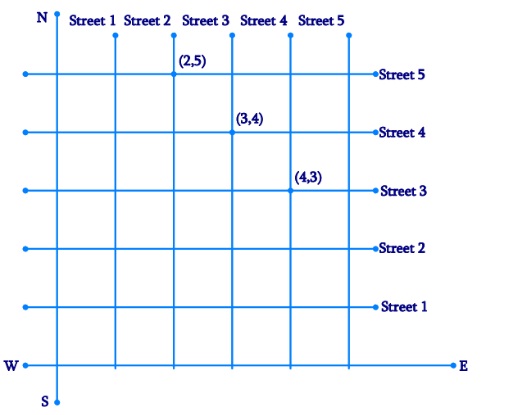
The street plan is shown in the above figure:
(i) Because of the two reference lines that we have used for locating them, there is only one cross-street which can be referred to as (4, 3).
(ii) Similarly, there is only one cross-street which can be referred to as (3, 4).
32.
(i) We have, \(\frac { 1 }{ \sqrt { 7 } } \)
On multiplying both numerator and denominator by \(\sqrt { 7 } \) , we get
\(\frac { 1 }{ \sqrt { 7 } } \times \frac { \sqrt { 7 } }{ \sqrt { 7 } } =\frac { \sqrt { 7 } }{ 7 } \)
(ii) We have,\(\frac { 1 }{ \sqrt { 7 } -\sqrt { 6 } } \)
On multiplying both numerator and denominator by \(\sqrt { 7 } +\sqrt { 6 } ,\) we get
\(\frac { 1 }{ \sqrt { 7 } -\sqrt { 6 } } \times \frac { \left( \sqrt { 7 } +\sqrt { 6 } \right) }{ \left( \sqrt { 7 } +\sqrt { 6 } \right) } \)
\(=\frac { \sqrt { 7 } +\sqrt { 6 } }{ { \left( \sqrt { 7 } \right) }^{ 2 }-{ \left( \sqrt { 6 } \right) }^{ 2 } } [\because (a-b)(a+b)={ a }^{ 2 }-{ b }^{ 2 }]\)
\(=\frac { \sqrt { 7 } +\sqrt { 6 } }{ 7-6 } =\frac { \sqrt { 7 } +\sqrt { 6 } }{ 1 } \)
\(=\sqrt { 7 } +\sqrt { 6 } \)
(iii) \(\left[ \frac { \sqrt { 5 } -\sqrt { 2 } }{ 3 } \right] \)
(iv) \(\left[ \frac { \sqrt { 7 } +1 }{ 3 } \right] \)
33.
First, we draw AB = 9.3 units. Now, from B, mark a distance of 1 unit. Let this point be C. Let D be the mid-point of AC. Now, draw a semi-circle with centre D and radius DA. Let us draw a line perpendicular to AC passing through point B and intersecting the semi-circle at point D.
\(\therefore\) Distance, BD=\(\sqrt { 9.3 } \)
Draw an arc with centre B and radius BD, which intersects the number line at point E. So point E represents \(\sqrt { 9.3 } \) .
34.
(a) (iii) 2x + 3y = 60
Let the number of children be x and the number of adults be y then the linear equation in two variable for the given situation is
2x + 3y = 60.
(b) (i) 10
2x + 3y =60 ⇒ 2(15) + 3y = 60
⇒ 3y = 60 - 30 = 30
⇒ y = 10
(c) (i) 12
2x + 3y = 60 ⇒ 2x + 3(12) = 60
⇒ 2x 60 - 36 = 24
⇒ x = 12
(d) (iii) 15
On putting x = 5 and y = 0 in the equation 3x + 5y = b, we have
3 x 5 + 5 x 0 = b
⇒ 15 + 0 = b
⇒ b = 15
(e) (ii) 1.x - 1.y + 5 = 0
y - x = 5 ⇒ y = x + 5
⇒ x - y + 5 = 0
⇒ 1.x - 1.y + 5 = 0
35.
(i) (b) (2, 3)
(ii) (a) (2, -1)
(iii) (a) 4
(iv) (d) (6, 2)
(v) (b) II

9th Standard CBSE Syllabus & Materials
9th Standard CBSE
CBSE 9th Mathematics Lines and Angles Sample Question Papers Study Material - QB365 Set A
NEW9th Standard CBSE
CBSE 9th Mathematics Introduction to Euclid's Geometry Sample Question Papers Study Material - QB365 Set A
NEW9th Standard CBSE
CBSE 9th Mathematics Linear Equations in Two Variables Sample Question Papers Study Material - QB365 Set A
NEW9th Standard CBSE
CBSE 9th Mathematics Coordinate Geometry Sample Question Papers Study Material - QB365 Set A



NCERT Books

Syllabus

Exam Pattern

Sample Question Papers

Previous year Question Papers

Important Notes

MCQ Practice test

NCERT Exemplers

Case study Questions

Image Based Questions

Passage based Questions

HOT Questions

Value Based Questions

Model Questions Papers
NCERT ( Book Back ) Questions

Assertion and Reason
Important Questions And Answers

CBSE 9th Standard CBSE Subjects
CBSE Standards