100% FREE ACCESS
9th Standard CBSE Syllabus & Materials
9th Standard CBSE
CBSE 9th Science Is matter around us pure? - New Model Questions Papers Study Material - QB365 Set A
NEW9th Standard CBSE
CBSE 9th Science Matter in our surroundings - New Model Questions Papers Study Material - QB365 Set A
NEW9th Standard CBSE
CBSE 9th Mathematics Heron's Formula Sample Question Papers Study Material - QB365 Set A
NEW9th Standard CBSE
CBSE 9th Mathematics Circles Sample Question Papers Study Material - QB365 Set A
NEW9th Standard CBSE
CBSE 9th Mathematics Quadrilaterals Sample Question Papers Study Material - QB365 Set A
NEW9th Standard CBSE
CBSE 9th Mathematics Triangles Sample Question Papers Study Material - QB365 Set A

Published on: 29/10/2025
Download CBSE Class 9th Standard CBSE Mathematics question papers, sample papers, important questions, and previous year solved papers in PDF format. Get free study materials, NCERT solutions, and exam preparation resources for Class 9th Standard CBSE Mathematics
Questions + Answers key
Take MCQ Mathematics Test
1.
Find the value of k, so that x = -1 and y = -1 is a solution of 2x + ky = 19. Find two more solutions of the resulting equation.
2.
Check which of the following are solutions of equation x-2y = 4 and which are not:
\((\sqrt{2}, 4\sqrt{2})\)
3.
Express the following linear equation in the form ax+by+c=0 and indicate the values of a, b and c in each case:
-2x+3y=6
4.
Using factor theorem, factorise the polynomial: \(x^4+3x^3+2x^2-3x-3\)
5.
Write the following cubes in expanded from: \({ \left[ \frac { 3 }{ 2 } x+1 \right] }^{ 3 }\)
6.
Verify whether the following are zeroes of the polynomial, indicated against them.
\(p(x)=2x+1,x=\frac { 1 }{ 2 } \)
7.
Simplify by rationalizing the denominator of \(\frac { 7\sqrt { 3 } -5\sqrt { 2 } }{ \sqrt { 48 } +\sqrt { 18 } } \)
8.
Express \(2.\overline { 93 } \) in the form of \(\frac { p }{ q } \), where p and q are integers, \(q\neq 0\)
9.
Find five rational numbers between \(\frac { 3 }{ 5 } \) and \(\frac { 4 }{ 5 } \)
10.
Evaluate 105 x 106 without multiplying directly
11.
Write each of the following as an equation in two variables:
(i) x = -5
(ii) Y = 2
(iii) 2x = 3
(iv) 5y = 2
12.
Write the following equations in the form ax+by+c=0 and indicate the values of a, b and c
2x+3y=4.37
13.
If 2x-1 is a factor of \(4x^3-16x^2+10x+k\) then find the value of k.
14.
Simplify: \({ \left( 4\sqrt { 3 } -3\sqrt { 5 } \right) }^{ 2 }\)
15.
Simplify: (7)-3(9)-3
16.
Show that 0.3333...=\(0.\overline { 3 } \) can be expressed in the form p/q, where p and q are integers and \(q\neq 0\)
17.
If the point (4, 1) lies on the line x-ky=2, then the value of k is
1
-1
-2
2
18.
Which of the following is the solution of y-4=0?
x=0, y=4
x=4, y=0
x=-4, y=-4
x=0, y=0
19.
The equation x=7 in two variables can be written as:
1.x+1.y=7
1.x+1.y=3
0.x+1.y=7
0.x+0.y=7
20.
Write a, b, c for the equation x+y=0
1,1,0
1,-1,0
-1,1,0
1,-1,1
21.
The condition that the equation ax+by+c=0 represents a linear equation in two variables is:
a≠0, b=0
b≠0, a=0
a=0, b=0
a≠0, b≠0
22.
\(\sqrt{2}y+ \sqrt{3}=0\) is
a linear equation in one variable
not a linear equation in one variable
a linear equation in two variables
none of these
23.
If x-2 is a factor of \(5x^2-kx-18,\) then the value of k is:
-1
1
0
5
24.
The zeros of the polynomial p(x)=(x-6)(x-5) are:
-6, -5
-6, 5
6, -5
6, 5
25.
Degree of the polynomial \(4x^4+0x^3+0x^5+5x+7\) is:
7
5
4
3
26.
Which of the following is cubic polynomial?
\(x^3+3x^2-4x+3\)
\(x^2+4x-7\)
\(3x^2+4\)
\(3(x^2+x+1)\)
27.
\(y+\frac{1}{y}\) is:
polynomial of degree 1
polynomial of degree 2
polynomial of degree 3
Not a polynomial
28.
The compact form of (x+y)(x-y) is
\((x+y)(x-y)=x^2-y^2\) is an algebraic identity
\(x^2+y^2\)
\(x^2-2xy+y^2\)
\(x^2+2xy+y^2\)
\(x^2-y^2\)
29.
The value of \(\frac { { 2 }^{ 0 }\times { 7 }^{ 0 } }{ { 5 }^{ 0 } } \) is:
1
0
9/5
1/5
30.
Rationalization of the denominator of \(\frac { 1 }{ \sqrt { 5 } +\sqrt { 2 } } \) gives:
\(\frac { 1 }{ \sqrt { 10 } } \)
\(\sqrt { 5 } +\sqrt { 2 } \)
\(\sqrt { 5 } -\sqrt { 2 } \)
\(\frac { \left( \sqrt { 5 } -\sqrt { 2 } \right) }{ 3 } \)
31.
\(\pi \) is:
a rational number
an integer
an irrational number
a whole number
32.
Which of the following is an irrational number?
0.15
\(0.15\overline { 16 } \)
\(0.\overline { 1516 } \)
0.501 5001 50001...
33.
If \(\sqrt { x } \) is an irrational number, then x is:
rational
irrational
0
real
34.
Which of the following is a rational number?
\(1+\sqrt { 3 } \)
\(\pi \)
\(2\sqrt { 3 } \)
0
35.
Write four solutions for each of the following equations:
(i) 2x + y = 7
(ii) πx + y = 9
(iii) x = 4y
36.
Check whether 7 + 3x is a factor of 3x3 + 7x.
37.
If a + b = 12 and ab = 27, find the value of a3 + b3.
38.
Check, which of the followings are solution of the equation x - 2y = 4 and which are not?
(i) (0,2) (ii) (2, 0) (iii) (4, 0)
39.
Express \(0.6+0.\overline { 7 } +0.4\overline { 7 } \) in the form of \(\frac { p }{ q } ,\) where p,q are integers and q\(\ne\)0.
40.
Represent \(\sqrt { 9.3 } \) on the number line.
41.
On his birthday, Manoj planned that this time he celebrates his birthday in a small orphanage centre. He bought apples to give to children and adults working there. Manoj donated 2 apples to each children and 3 apples to each adult working there along with birthday cake. He distributed 60 total apples.

(a) How to represent the above situation in linear equations in two variables by taking the number of children as 'x' and the number of adults as 'y'?
| (i) 2x + y = 60 | (iii) 2x + 3y =60 |
| (ii) 3x + 2y = 60 | (iv) 3x + y =60 |
(b) If the number of children is 15, then find the number of adults?
| (i) 10 | (iii) 15 |
| (ii) 25 | (iv) 20 |
(c) If the number of adults is 12, then find the number of children?
| (i) 12 | (iii) 15 |
| (ii) 14 | (iv) 18 |
(d) Find the value of b, if x = 5, y = 0 is a solution of the equation 3x + 5y = b.
| (i) 12 | (iii) 15 |
| (ii) 14 | (iv) 18 |
(e) Which is the standard form of linear equations in two variables: y - x = 5?
| (i) 1.y - 1.x - 5 = 0 | (ii) 1.x - 1.y + 5 = 0 |
| (iii) 1.x + 0.y + 5 = 0 | (iv) 1.x - 1.y -5 = 0 |
42.
Prime Minister's National Relief Fund (also called PMNRF in short) is the fund raised to provide support for people affected by natural and man-made disasters. Natural disasters that are covered under this include flood, cyclone, earthquake etc. Man-made disasters that are included are major accidents, acid attacks, riots, etc.

Two friends Sita and Gita, together contributed Rs. 200 towards Prime Minister's Relief Fund. Answer the following :
(a) Which out of the following is not the linear equation in two variables ?
| (i) 2x = 3 | (iii) x2 + x = 1 |
| (ii) 4 = 5x – 4y | (iv) x – √2y = 3 |
(b) How to represent the above situation in linear equations in two variables ?
| (i) 2x + y = 200 | (ii) x + y = 200 |
| (iii) 200x = y | (iv) 200 + x = y |
(c) If Sita contributed Rs. 76, then how much was contributed by Gita ?
| (i) Rs. 120 | (ii) Rs. 123 |
| (iii) Rs. 124 | (iv) Rs. 125 |
(d) If both contributed equally, then how much is contributed by each?
| (i) Rs. 50, Rs. 150 | (ii) Rs. 100, Rs. 100 |
| (iii) Rs. 50, Rs. 50 | (iv) Rs. 120, Rs. 120 |
(e) Which is the standard form of linear equations x = – 5 ?
| (i) x + 5 = 0 | (ii) 1.x – 5 = 0 |
| (iii) 1.x + 0.y + 5 = 0 | (iv) 1.x + 0.y = 5 |
43.
In the below given layout, the design and measurements has been made such that area of two bedrooms and Kitchen together is 95 sq. m.
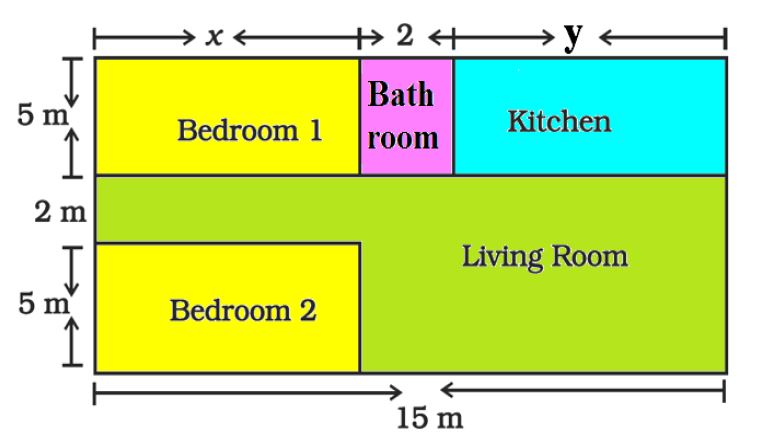
(i) The area of two bedrooms and kitchen are respectively equal to
| (a) 5x, 5y | (b) 10x, 5y |
| (c) 5x, 10y | (c) x, y |
(ii) Find the length of the outer boundary of the layout.
| (a) 27 m | (b) 15 m | (c) 50 m | (d) 54 m |
(iii) The pair of linear equation in two variables formed from the statements are
(a) x + y = 13, x + y = 9
(b) 2x + y = 13, x + y = 9
(c) x + y = 13, 2x + y = 9
(d) None of the above
(iv) Which is the solution satisfying both the equations formed in (iii)?
| (a) x = 7, y = 6 | (b) x = 8, y = 5 |
| (c) x = 6, y = 7 | (d) x = 5, y = 8 |
(v) Find the area of each bedroom.
| (a) 30 sq. m | (b) 35 sq. m |
| (c) 65 sq. m | (d) 42 sq. m |
44.
Assertion : If x = 2k – 1 and y = k is a solution of the equation 3x – 5y – 7 = 0, then the value of k is 10
Reason : A linear equation in two variables has infinitely many solutions.
Codes:
(a) Both assertion (A) and reason (R) are true and reason (R) is the correct explanation of assertion (A).
(b) Both assertion (A) and reason (R) are true but reason (R) is not the correct explanation of assertion (A).
(c) Assertion (A) is true but reason (R) is false.
(d) Assertion (A) is false but reason (R) is true.
45.
Assertion : 5 is a rational number.
Reason : The square roots of all positive integers are irrationals.
Codes:
(a) Both assertion (A) and reason (R) are true and reason (R) is the correct explanation of assertion (A).
(b) Both assertion (A) and reason (R) are true but reason (R) is not the correct explanation of assertion (A).
(c) Assertion (A) is true but reason (R) is false.
(d) Assertion (A) is false but reason (R) is true.
1.
\(k=-17;(10,\frac{1}{17}) and(18,1)\)
2.
The given equation is x - 2y = 4
Put \(x=\sqrt{2}\), y=\(4\sqrt{2}\) in (1), we get
x-2y =\(\sqrt{2}-2(4\sqrt{2})\)
\(=\sqrt{2}-8\sqrt{2}=-7\sqrt{2}\) which is not 4.
\((\sqrt{2},\ 4\sqrt{2})\) which is not 4.
\((\sqrt{2}, 4\sqrt{2})\) is not a soluton of (1)
3.
-2x+3y=6
Comparing with ax+by+c=0, we get
a=2, b=3, c=-6
4.
\((x-1)(x+1)(x^2+3x+3)\)
5.
\({ \left[ \frac { 3 }{ 2 } x+1 \right] }^{ 3 }\)
\(={ \left( \frac { 3 }{ 2 } x \right) }^{ 3 }+{ (1) }^{ 3 }+3\left( \frac { 3 }{ 2 } x \right) (1)\left( \frac { 3 }{ 2 } x+1 \right) \) | Using Identity VI
\(=\frac { 27 }{ 8 } { x }^{ 3 }+1+\frac { 9 }{ 2 } x\left( \frac { 3 }{ 2 } x+1 \right) \)
\(=\frac { 27 }{ 8 } { x }^{ 3 }+1+\frac { 27 }{ 4 } { x }^{ 2 }+\frac { 9 }{ 2 } x\)
\(=\frac { 27 }{ 8 } { x }^{ 3 }+\frac { 27 }{ 4 } { x }^{ 2 }+\frac { 9 }{ 2 } x+1\)
6.
\(p\left( \frac { 1 }{ 2 } \right) =2\left( \frac { 1 }{ 2 } \right) +1=1+1=2\neq 0\)
\(\therefore \frac { 1 }{ 2 } \)is not a zero of p(x).
7.
\(\frac { 114-41\sqrt { 6 } }{ 30 } \)
8.
\(\frac { 291 }{ 99 } \)
9.
\(\frac { 3 }{ 5 } =\frac { 3\times 10 }{ 5\times 10 } =\frac { 30 }{ 50 } \)
\(\\ \frac { 4 }{ 5 } =\frac { 4\times 10 }{ 5\times 10 } =\frac { 40 }{ 50 } \)
\(\\ \because 30<31<32<33<34<35\)
\(\\ \therefore \frac { 30 }{ 50 } <\frac { 31 }{ 50 } <\frac { 32 }{ 50 } <\frac { 33 }{ 50 } <\frac { 34 }{ 50 } <\frac { 35 }{ 50 } \)
Therefore, five rational numbers between \(\frac { 3 }{ 4 } \) and \(\frac { 4 }{ 5 } \) and be taken as
\(\frac { 31 }{ 50 } ,\frac { 32 }{ 50 } ,\frac { 33 }{ 50 } ,\frac { 34 }{ 50 } \)and \(\frac { 35 }{ 50 } \)
i.e., \(\frac { 31 }{ 50 } ,\frac { 16 }{ 25 } ,\frac { 33 }{ 50 } ,\frac { 17 }{ 25 } \) and \(\frac { 7 }{ 10 } \)
10.
105 x 106 = (100 + 5) x (100 + 6)
= (100)2 + (5 + 6) (100) + (5 x 6), using Identity IV
= 10000 + 1100 + 30
= 11130
11.
(i) x = –5 can be written as 1.x + 0.y = –5, or 1.x + 0.y + 5 = 0.
(ii) y = 2 can be written as 0.x + 1.y = 2, or 0.x + 1.y – 2 = 0.
(iii) 2x = 3 can be written as 2x + 0.y – 3 = 0.
(iv) 5y = 2 can be written as 0.x + 5y – 2 = 0.
12.
2x+3y-4.37=0;
a=2, b=3 and c=-4.37
13.
\(-\frac{3}{2}\)
14.
\(93-24\sqrt { 15 } \)
15.
63-3
16.
Since we do not know what 0 3 . is , let us call it ‘x’ and so
x = 0.3333
Now here is where the trick comes in. Look at
10 x = 10 x (0.333...) = 3.333
Now, 3.3333 = 3 + x, since x = 0.3333
Therefore, 10 x = 3 + x
Solving for x, we get
\(9 x=3, \text { i.e., } x=\frac{1}{3}\)
17.
4-k(1)=2 ⇒ k=2
18.
x=0, y=4 satisfies y-4=0
19.
Evident
20.
x+y+0=0
21.
definition
22.
(a)
a linear equation in one variable
23.
\(x-2=0\quad \Rightarrow \quad x=2\)
\(f(x)=5x^2-kx-18\)
\(f(2)=0\)
\(\Rightarrow \ 5(2)^2-k(2)-18=0\)
\(\Rightarrow \ k=1\)
24.
\((x-6)(x-5)=0\quad \Rightarrow\quad\quad x=6, 5\)
25.
Highest power of x=4
26.
Degree of \(x^3+3x^2-4x+3\) is 3
27.
\(\frac{1}{y}=y^-1\) has negative exponent so, not a polynomial
28.
(a)
\(x^2+y^2\)
29.
(a)
1
30.
(d)
\(\frac { \left( \sqrt { 5 } -\sqrt { 2 } \right) }{ 3 } \)
31.
(c)
an irrational number
32.
(d)
0.501 5001 50001...
33.
(d)
real
34.
(d)
0
35.
(i) 2x + y = 7
When x = 0, 2(0) + y = 7
⇒ 0+ y = 7
⇒ y = 7
∴ Solution is (0, 7).
When x = 1, 2(1) + y = 7
⇒ y = 7 - 2
⇒ y = 5
∴ Solution is (1, 5).
When x = 2, 2(2) + y = 7
⇒ y = 7 - 4
⇒ y = 3
∴ Solution is (2, 3).
When x = 3, 2(3) + y = 7
⇒ y = 7 - 6
⇒ y = 1
∴ Solution is (3, 1).
(ii) πx + y = 9
When x = 0, π(0) + y = 9
⇒ y = 9 - 0
⇒ y = 9
∴ Solution is (0, 9).
When x = 1, π(1) + y = 9
⇒ y =9-π
∴ Solution is {1, (9 - π)}.
When x = 2, π(2) + y = 9
⇒ y = 9 - 2π
∴ Solution is {2, (9 - 2π)}.
When x = -1, π(-1) + y = 9
⇒ -π+ y = 9
⇒ y=9+π
∴ Solution is {-1, (9 + π)}.
(iii) x = 4y
When x = 0, 4y = 0
⇒ y = 0
∴ Solution is (0, 0).
When x = 1, 4y = 1
⇒ y= \(\frac{1}{4}\)
∴ Solution is (1,\(\frac{1}{4}\)).
When x = 4, 4y = 4
⇒ y = \(\frac{4}{4}\) = 1
∴ Solution is (4, 1).
When x =-4, 4y =-4
y = \(\frac{-4}{4}\) =-1
∴ Solution is (-4, -1).
36.
We have p(x) = 3x3 + 7x and zero of 7 + 3x is \(\frac{-7}{3}\)
[∵7 + 3x = 0 ⇒ x = \(\frac{-7}{3}\)]
∴ p\(\left(\frac{-7}{3}\right)\) = 3\(\left(\frac{-7}{3}\right)\)+7\(\left(\frac{-7}{3}\right)\) = 3\(\left(\frac{-343}{27}\right)\) + \(\left(\frac{-49}{3}\right)\)
= -\(\frac{343}{9}\) - \(\frac{49}{3}\) = \(\frac{-490}{9}\)
Since \(\left(\frac{-490}{9}\right)\) ≠ 0
i.e. the remainder is not 0.
∴ 3x3 - 7x is not divisible by 7 + 3x.
Thus, (7 + 3x) is not a factor of 3x3 - 7x.
37.
756
38.
(i) Given equation is x - 2y= 4.
On putting x = 0 and y = 2 in LHS, we get
LHS = x - 2y = 0 - 2 X 2
=0-4=-4≠4
⇒LHS≠RHS
Hence, (0,2) is not a solution of x - 2y = 4.
(ii) Given equation is x - 2y= 4.
On putting x = 2 and y = 0 in LHS, we get
LHS = x - 2y = 2 - 2 X 0
=2-0=2≠4
⇒LHS≠RHS
Hence, (2, 0) is not a solution of x - 2y = 4.
(iii) Given equation is x - 2y= 4.
On putting x = 4 and y = 0 in LHS, we get
LHS =x - 2y = 4 - 2 X 0
= 4 -0 =RHS
Hence, (4, 0) is a solution of x - 2Y = 4.
39.
\(\therefore \ 0.6+0.\overline { 7 } +0.4\overline { 7 } =\frac { 6 }{ 10 } +\frac { 7 }{ 9 } +\frac { 43 }{ 90 } \)
\(=\frac { 54+70+43 }{ 90 } =\frac { 167 }{ 90 } \)
40.
First, we draw AB = 9.3 units. Now, from B, mark a distance of 1 unit. Let this point be C. Let D be the mid-point of AC. Now, draw a semi-circle with centre D and radius DA. Let us draw a line perpendicular to AC passing through point B and intersecting the semi-circle at point D.
\(\therefore\) Distance, BD=\(\sqrt { 9.3 } \)
Draw an arc with centre B and radius BD, which intersects the number line at point E. So point E represents \(\sqrt { 9.3 } \) .
41.
(a) (iii) 2x + 3y = 60
Let the number of children be x and the number of adults be y then the linear equation in two variable for the given situation is
2x + 3y = 60.
(b) (i) 10
2x + 3y =60 ⇒ 2(15) + 3y = 60
⇒ 3y = 60 - 30 = 30
⇒ y = 10
(c) (i) 12
2x + 3y = 60 ⇒ 2x + 3(12) = 60
⇒ 2x 60 - 36 = 24
⇒ x = 12
(d) (iii) 15
On putting x = 5 and y = 0 in the equation 3x + 5y = b, we have
3 x 5 + 5 x 0 = b
⇒ 15 + 0 = b
⇒ b = 15
(e) (ii) 1.x - 1.y + 5 = 0
y - x = 5 ⇒ y = x + 5
⇒ x - y + 5 = 0
⇒ 1.x - 1.y + 5 = 0
42.
(a) (iii) x2 + x = 1
(b) (ii) x + y = 200
Here, x represents Sita's contribution and y represents Gita's contribution.
(c) (iii) Rs. 124
If x = 76 then 76 + y = 200
y = 200 - 76
y = 124
(d) (ii) Rs. 100, Rs. 100
If x = y then x + x = 200
2x = 200
x = 200/2 = 100
(e) (iii) 1.x + 0.y + 5 = 0
Since, x = -5 ⇒ x + 5 = 0
Thus, standard form of x = -5 is 1.x + 0.y + 5 = 0.
43.
(i) (b) 10x, 5y
Area of one bedroom = 5x sq.m
Area of two bedrooms = 10x sq.m
Area of kitchen = 5y sq. m
(ii) (d) 54 m
Length of outer boundary = 12 + 15 + 12 + 15 = 54 m
(iii) (d) None of the above
Area of two bedrooms = 10x sq.m
Area of kitchen = 5y sq. m
So, 10x + 5y = 95 2x + y = 19
Also, x + 2 + y = 15 x + y = 13
(iv) (c) x = 6, y = 7
x + y = 6 + 7 = 13
2x + y = 2(6) + 7 = 19
x = 6, y = 7
x + y = 6 + 7 = 13
2x + y = 2(6) + 7 = 19
x = 6, y = 7
(v) (a) 30 sq. m
Area of living room = (15 x 7) – 30
= 105 – 30 =75 sq. m
44.
We know that a linear equation in two variables has infinitely many solutions. So, Reason is correct.
Since x = 2k - 1 and y = k is solution of the given linear equation, we have 3 x (2k – 1) – 5k – 7 = 0 ⇒ 6k – 3 – 5k – 7 = 0 ⇒ k – 10 = 0 ⇒ k = 10.
So, Assertion is also correct
But reason (R) is not the correct explanation of assertion (A).
Correct option is (b) Both assertion (A) and reason (R) are true and reason (R) is not the correct explanation of assertion (A).
45.
Here reason is not true.
\(\sqrt{4}\)= ±2, which is not an irrational number.
Correct option is (c) Assertion (A) is true but reason (R) is false.

9th Standard CBSE Syllabus & Materials
9th Standard CBSE
CBSE 9th Mathematics Lines and Angles Sample Question Papers Study Material - QB365 Set A
NEW9th Standard CBSE
CBSE 9th Mathematics Introduction to Euclid's Geometry Sample Question Papers Study Material - QB365 Set A
NEW9th Standard CBSE
CBSE 9th Mathematics Linear Equations in Two Variables Sample Question Papers Study Material - QB365 Set A
NEW9th Standard CBSE
CBSE 9th Mathematics Coordinate Geometry Sample Question Papers Study Material - QB365 Set A



NCERT Books

Syllabus

Exam Pattern

Sample Question Papers

Previous year Question Papers

Important Notes

MCQ Practice test

NCERT Exemplers

Case study Questions

Image Based Questions

Passage based Questions

HOT Questions

Value Based Questions

Model Questions Papers
NCERT ( Book Back ) Questions

Assertion and Reason
Important Questions And Answers

CBSE 9th Standard CBSE Subjects
CBSE Standards