100% FREE ACCESS
9th Standard CBSE Syllabus & Materials
9th Standard CBSE
CBSE 9th Science Is matter around us pure? - New Model Questions Papers Study Material - QB365 Set A
NEW9th Standard CBSE
CBSE 9th Science Matter in our surroundings - New Model Questions Papers Study Material - QB365 Set A
NEW9th Standard CBSE
CBSE 9th Mathematics Heron's Formula Sample Question Papers Study Material - QB365 Set A
NEW9th Standard CBSE
CBSE 9th Mathematics Circles Sample Question Papers Study Material - QB365 Set A
NEW9th Standard CBSE
CBSE 9th Mathematics Quadrilaterals Sample Question Papers Study Material - QB365 Set A
NEW9th Standard CBSE
CBSE 9th Mathematics Triangles Sample Question Papers Study Material - QB365 Set A

Published on: 29/10/2025
Download CBSE Class 9th Standard CBSE Mathematics question papers, sample papers, important questions, and previous year solved papers in PDF format. Get free study materials, NCERT solutions, and exam preparation resources for Class 9th Standard CBSE Mathematics
Questions + Answers key
Take MCQ Mathematics Test
1.
If x = 4-√15, then find the value of \({ \left( x+\frac { 1 }{ x } \right) }^{ 2 }\)
2.
If \(a=7-4\sqrt { 3 } \) , find the value of \(\sqrt { a } +\frac { 1 }{ \sqrt { a } } \)
3.
Evaluate:\(\frac { 40 }{ 2\sqrt { 10 } +\sqrt { 20 } +\sqrt { 40 } -2\sqrt { 5 } } \) when it is given that \(\sqrt { 10 } =3.162\)
4.
Find two irrational numbers between 2 and 2.5.
5.
If 7x = 1, then find the decimal expansion of x.
6.
Express -0.00875 in the form \(\frac{p}{q}\) , where p and q are integers and q≠0.
7.
Represent
(i) \(2\frac { 3 }{ 8 } \) and
(ii) \(-\left( 1\frac { 5 }{ 7 } \right) \) on a real number line.
8.
Find the values of a and b, if \(\frac { \sqrt { 2 } +\sqrt { 3 } }{ 3\sqrt { 2 } -2\sqrt { 3 } } =a+b\sqrt { 6 } \)
9.
If \(a=\frac { \sqrt { 2 } +1 }{ \sqrt { 2 } -1 } \) and \(b=\frac { 1 }{ a } \), find the value of \({ a }^{ 2 }+{ b }^{ 2 }\)
10.
\(\sqrt [ 3 ]{ \frac { 54 }{ 250 } } \) equals:
\(\frac { 9 }{ 25 } \)
\(\frac { 3 }{ 5 } \)
\(\frac { 27 }{ 125 } \)
\(\frac { \sqrt [ 3 ]{ 2 } }{ 5 } \)
11.
Simplified value of \({ \left( 25 \right) }^{ \frac { 1 }{ 3 } }\times { \left( 5 \right) }^{ \frac { 1 }{ 3 } }\) is:
25
3
1
5
12.
\(\left( 5+\sqrt { 8 } \right) +\left( 3-\sqrt { 2 } \right) -\left( \sqrt { 2 } -6 \right) \) when simplified is:
positive and irrational
negative and irrational
positive and rational
negative and rational
13.
\(\left( -2-\sqrt { 3 } \right) \left( -2+\sqrt { 3 } \right) \) when simplified is:
positive and irrational
positive and rational
negative and irrational
negative and rational
14.
\(\pi \) is:
a rational number
an integer
an irrational number
a whole number
15.
The decimal expansion of \(\sqrt { 2 } \) is
finite decimal
1.4121
non-terminating recurring
non-terminating non-recurring
16.
A number is an irrational if and only if its decimal representation is:
non-terminating
non-terminating and repeating
non terminating and non repeating
terminating
17.
The decimal form of 56/1000 is
0.56
0.056
0.0056
5.6
18.
If \(\sqrt { x } \) is an irrational number, then x is:
rational
irrational
0
real
19.
Every rational number is:
a natural number
an integer
a real number
a whole number
20.
If √2 = 1.414 and √3 = 1.732, then calculate \(\frac { 4 }{ 3\sqrt { 3 } -2\sqrt { 2 } } +\frac { 3 }{ 3\sqrt { 3 } -2\sqrt { 2 } } \)
21.
Simplify: \(\frac { 1 }{ 1+\sqrt { 2 } } +\frac { 1 }{ \sqrt { 2 } +\sqrt { 3 } } +\frac { 2 }{ \sqrt { 3 } +\sqrt { 5 } } \)
22.
Find the sum of \(2.\overline { 3 } \quad and\quad 4.\overline { 15 } .\)
23.
If a and b are rational numbers and \(\frac { 2+\sqrt { 3 } }{ 2-\sqrt { 3 } } =a+b\sqrt { 3 } ,\) find the value of a2+b2.
24.
Find the sum of 0.0333... and 0.444.....
1.
x = 4-√15
\(\frac { 1 }{ x } =\frac { 1 }{ 4-\sqrt { 15 } } \times \frac { 4+\sqrt { 15 } }{ 4+\sqrt { 15 } } \)
\(\frac { 1 }{ x } =\frac { 4+\sqrt { 15 } }{ 16-15 } \)
\(\frac { 1 }{ x } =4+\sqrt { 15 } \)
\({ \left( x+\frac { 1 }{ x } \right) }^{ 2 }={ \left( 4-\sqrt { 15 } +4+\sqrt { 15 } \right) }^{ 2 }\)
= (8)2
= 64
2.
\(a=7-4\sqrt { 3 } =4+3-4\sqrt { 3 } \)
\(\\ ={ 2 }^{ 2 }+{ \left( \sqrt { 3 } \right) }^{ 2 }-2(2)(\sqrt { 3 } )\)
\(\\ ={ \left( 2-\sqrt { 3 } \right) }^{ 2 }\)
\(\\ \sqrt { a } =2-\sqrt { 3 } \quad ...(1)\)
\(\\ \frac { 1 }{ \sqrt { a } } =\frac { 1 }{ 2-\sqrt { 3 } }\)
\( \\ =\frac { 1 }{ 2-\sqrt { 3 } } \times \frac { 2+\sqrt { 3 } }{ 2+\sqrt { 3 } } =\frac { 2+\sqrt { 3 } }{ 4-3 } \)
\(\\ =2+\sqrt { 3 } \ ...(2)\)
From (1) and (2)
\(\sqrt { a } +\frac { 1 }{ \sqrt { a } } =\left( 2-\sqrt { 3 } \right) +\left( 2+\sqrt { 3 } \right) =4\)
3.
\(=\frac { 40 }{ 2\sqrt { 10 } +\sqrt { 2\times 2\times 5 } +\sqrt { 2\times 2\times 10 } -2\sqrt { 5 } } \)
\(\\ =\frac { 40 }{ 2\sqrt { 10 } +\sqrt { 20 } +\sqrt { 40 } -2\sqrt { 5 } } \)
\(\\ =\frac { 40 }{ 4\sqrt { 10 } } =\frac { 10 }{ \sqrt { 10 } } \)
\(\\ \sqrt { 10 } =3.162\)
4.
The two irrational numbers between 2 and 2.5 can be taken as
2.101001000100001...
2.201001000100001...
5.
x = \(\frac{1}{7}\)
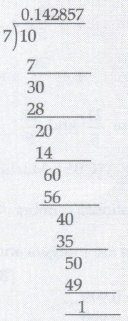
x = \(0.\overline{142857}\)
6.
-0.00875 = \(\frac{875}{100000}\)
=\(\frac{35}{4000}=\frac{7}{800}\)
7.
Draw a line XY and take a fixed length as unit length, which represents integers on this line.
(i) On the right side of O, take OA = 1 unit, then OB = 2 units. Divide the 3rd unit BC into 8 equal parts. Mark a point P on BC, such that BP represents 3/8 of a unit.
Therefore, OP represents \(2\frac { 3 }{ 8 } .\)
(ii) On the left side of O, take OD = 1 unit, then DE =1 unit. Divide the 2nd unit DE into 7 equal parts. Make a point Q on DE such that DQ represents 5/7 of a unit.
Therefore, OQ represents \(-\left( 1\frac { 5 }{ 7 } \right) .\)
8.
\(a=2,\quad b=\frac { 5 }{ 6 } \)
9.
34
10.
(b)
\(\frac { 3 }{ 5 } \)
11.
(d)
5
12.
(d)
negative and rational
13.
(b)
positive and rational
14.
(c)
an irrational number
15.
(d)
non-terminating non-recurring
16.
(c)
non terminating and non repeating
17.
(b)
0.056
18.
(d)
real
19.
(c)
a real number
20.
\(\frac { 4 }{ 3\sqrt { 3 } -2\sqrt { 2 } } +\frac { 3 }{ 3\sqrt { 3 } -2\sqrt { 2 } } =\frac { 21\sqrt { 3 } +2\sqrt { 2 } }{ 19 } \)
\(=\frac { 21(1.732)+2(1.414) }{ 19 } \)
\(=\frac { 39.2 }{ 19 } \)
= 2.063
21.
\(\frac { 1 }{ 1+\sqrt { 2 } } +\frac { 1 }{ \sqrt { 2 } +\sqrt { 3 } } +\frac { 2 }{ \sqrt { 3 } +\sqrt { 5 } } \)
\(=\frac { 1 }{ \left( \sqrt { 2 } +1 \right) } \times \frac { \left( \sqrt { 2 } -1 \right) }{ \left( \sqrt { 2 } -1 \right) } +\frac { 1 }{ \left( \sqrt { 3 } +\sqrt { 2 } \right) } \times \frac { \left( \sqrt { 3 } -\sqrt { 2 } \right) }{ \left( \sqrt { 3 } -\sqrt { 2 } \right) } +\frac { 2 }{ \left( \sqrt { 5 } +\sqrt { 3 } \right) } \times \frac { \left( \sqrt { 5 } -\sqrt { 3 } \right) }{ \left( \sqrt { 5 } -\sqrt { 3 } \right) } \)
\(\frac { \left( \sqrt { 2 } -1 \right) }{ 2-1 } +\frac { \left( \sqrt { 3 } -\sqrt { 2 } \right) }{ 3-2 } +\frac { 2\left( \sqrt { 5 } -\sqrt { 3 } \right) }{ 5-3 } \)
= √2-1 + √3 - √2 + √5-√3 = √5 - 1
22.
\(\frac { 214 }{ 33 } \)
23.
\(\frac { 2+\sqrt { 3 } }{ 2-\sqrt { 3 } } =\frac { 2+\sqrt { 3 } }{ 2-\sqrt { 3 } } \times \frac { 2+\sqrt { 3 } }{ 2+\sqrt { 3 } } \)
\(=\frac { { (2+\sqrt { 3 } ) }^{ 2 } }{ { (2) }^{ 2 }-{ (\sqrt { 3 } ) }^{ 2 } } \left[ \because (a+b)(a-b)={ a }^{ 2 }-{ b }^{ 2 } \right] \)
\(=\frac { { (2+\sqrt { 3 } ) }^{ 2 } }{ 4-3 } \)
\(={ (2+\sqrt { 3 } ) }^{ 2 }=4+3+4\sqrt { 3 } \ \left[ \because \ { (a+b) }^{ 2 }={ a }^{ 2 }+{ b }^{ 2 }+2ab \right] \)
\(=7+4\sqrt { 3 } \)
\(But\quad \frac { 2+\sqrt { 3 } }{ 2-\sqrt { 3 } } =a+b\sqrt { 3 } \)
\(\because \ a+b\sqrt { 3 } =7+4\sqrt { 3 } \)
On comparing coefficient of a and b from both sides, we gieta=7, b=4
\(\therefore \ { a }^{ 2 }+{ b }^{ 2 }={ (7) }^{ 2 }+{ (4) }^{ 2 }=49+16=65\)
24.
Let x = 0.0333 ...(i)
On multiplying Eq. (i) by 10, we get
10 x = 0.333 ....(ii)
Again, multiplying Eq. (ii) by 10, we get
100 x = 3.333 .....(iii)
On subtracting Eq. (ii) from Eq. (iii), we get
100 x - 10x = 3.333 ... - 0 .333
\(\Rightarrow\) 90 x = 3
\(\therefore \ x=\frac { 3 }{ 90 } \) ...(iv)
Again, let y = 0.444 ... ...(v)
On multiplying Eq. (iv) by 10, we get
10y = 4.444 ...
On subtracting Eq. (iv) from Eq. (v), we get
10y - y = 4 .444 ... - 0.444 ...
\(\Rightarrow \ 9y=4\ \Rightarrow y=\frac { 4 }{ 9 } \)
\(\therefore\)Sum of 0.0333.... and 0.444...=x+y
\(=\frac { 3 }{ 90 } +\frac { 4 }{ 9 } =\frac { 3+40 }{ 90 } =\frac { 43 }{ 90 } \)

9th Standard CBSE Syllabus & Materials
9th Standard CBSE
CBSE 9th Mathematics Lines and Angles Sample Question Papers Study Material - QB365 Set A
NEW9th Standard CBSE
CBSE 9th Mathematics Introduction to Euclid's Geometry Sample Question Papers Study Material - QB365 Set A
NEW9th Standard CBSE
CBSE 9th Mathematics Linear Equations in Two Variables Sample Question Papers Study Material - QB365 Set A
NEW9th Standard CBSE
CBSE 9th Mathematics Coordinate Geometry Sample Question Papers Study Material - QB365 Set A



NCERT Books

Syllabus

Exam Pattern

Sample Question Papers

Previous year Question Papers

Important Notes

MCQ Practice test

NCERT Exemplers

Case study Questions

Image Based Questions

Passage based Questions

HOT Questions

Value Based Questions

Model Questions Papers
NCERT ( Book Back ) Questions

Assertion and Reason
Important Questions And Answers

CBSE 9th Standard CBSE Subjects
CBSE Standards