100% FREE ACCESS
9th Standard CBSE Syllabus & Materials
9th Standard CBSE
CBSE 9th Science Is matter around us pure? - New Model Questions Papers Study Material - QB365 Set A
NEW9th Standard CBSE
CBSE 9th Science Matter in our surroundings - New Model Questions Papers Study Material - QB365 Set A
NEW9th Standard CBSE
CBSE 9th Mathematics Heron's Formula Sample Question Papers Study Material - QB365 Set A
NEW9th Standard CBSE
CBSE 9th Mathematics Circles Sample Question Papers Study Material - QB365 Set A
NEW9th Standard CBSE
CBSE 9th Mathematics Quadrilaterals Sample Question Papers Study Material - QB365 Set A
NEW9th Standard CBSE
CBSE 9th Mathematics Triangles Sample Question Papers Study Material - QB365 Set A

Published on: 29/10/2025
Download CBSE Class 9th Standard CBSE Mathematics question papers, sample papers, important questions, and previous year solved papers in PDF format. Get free study materials, NCERT solutions, and exam preparation resources for Class 9th Standard CBSE Mathematics
Questions + Answers key
Take MCQ Mathematics Test
1.
Factorise:
(i) 49a2 + 70ab + 25b2
\(\text { (ii) } \frac{25}{4} x^{2}-\frac{y^{2}}{9}\)
2.
Simplify \(13^{\frac{1}{5}} \cdot 17^{\frac{1}{5}}\)
3.
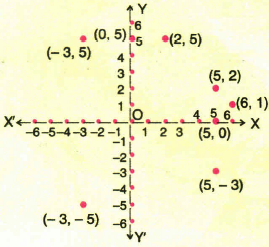
Locate the points (5,0), (0,5), (2,5), (5,2), (-3,5), (-3,-5),(5,-3) and (6,1) in the Cartesian plane.
4.
Write \((3a+4b+5c)^2\) in expanded form.
5.
Find the value of k if x - 1 is a factor of \(4x^3+3x^2-4x+k\)
6.
If \(p(x)=x^3+3x^2-2x+4\) then find the value of \(p(2)+p(-2)-p(0).\)
7.
Find the value of x if \({ 2 }^{ 4 }\times { 2 }^{ 5 }={ \left( { 2 }^{ 5 } \right) }^{ x }\)
8.
Rationalize the denominator of \(\frac { 1 }{ 2+\sqrt { 3 } } \)
9.
Simplify: \({ \left( 4\sqrt { 3 } -3\sqrt { 5 } \right) }^{ 2 }\)
10.
Find five rational numbers between 1 and 2.
11.
Factorise:
(i) x3 - 2x2 - x + 2
(ii) x3 – 3x2 – 9x – 5
(iii) x3 + 13x2 + 32x + 20
(iv) 2y3 + y2 - 2y - 1
12.
Write the co-efficients of x2 in each of the following:
(i) 2 + x2 + x
(ii) 2 - x2 + x3
(iii) \(\frac{\pi}{2}\)x2+ x
(iv) \(\sqrt{2}\)x-1
13.
If p(x) = x2 - 4x + 3, find the value of p(2) - P(-1) + \(p\left( \frac { 1 }{ 2 } \right) \)
14.
Find (i) 93/2
(ii) 322/5
(iii) 163/4
(iv) 125-1/3
15.
Show how can\(\sqrt { 5 } \) be represented on the number line?
1.
(i) Here you can see that
49a2 = (7a)2, 25b2 = (5b)2, 70ab = 2(7a) (5b)
Comparing the given expression with x2 + 2xy + y2, we observe that x = 7a and y = 5b.
Using Identity I, we get
49a2 + 70ab + 25b2 = (7a + 5b)2 = (7a + 5b) (7a + 5b)
(ii) We have \(\frac{25}{4} x^{2}-\frac{y^{2}}{9}=\left(\frac{5}{2} x\right)^{2}-\left(\frac{y}{3}\right)^{2}\)
Now comparing it with Identity III, we get
\(\frac{25}{4} x^{2}-\frac{y^{2}}{9}=\left(\frac{5}{2} x\right)^{2}-\left(\frac{y}{3}\right)^{2}\)
\(=\left(\frac{5}{2} x+\frac{y}{3}\right)\left(\frac{5}{2} x-\frac{y}{3}\right)\)
2.
\(13^{\frac{1}{5}} \cdot 17^{\frac{1}{5}}=(13 \times 17)^{\frac{1}{5}}=221^{\frac{1}{5}}\)
3.
4.
Comparing the given expression with (x + y + z)2, we find that
x = 3a, y = 4b and z = 5c.
Therefore, using Identity V, we have
(3a + 4b + 5c)2 = (3a)2 + (4b)2 + (5c)2 + 2(3a)(4b) + 2(4b)(5c) + 2(5c)(3a)
= 9a2 + 16b2 + 25c2 + 24ab + 40bc + 30ac
5.
As x – 1 is a factor of p(x) = 4x3 + 3x2 – 4x + k, p(1) = 0
Now, p(1) = 4(1)3 + 3(1)2 – 4(1) + k
So, 4 + 3 – 4 + k = 0
i.e., k = –3
6.
28
7.
3
8.
\(2-\sqrt { 3 } \)
9.
\(93-24\sqrt { 15 } \)
10.
7/6,4/3,3/2,5/3 and 11/6
11.
(i) x3 - 2x2 - x + 2
Rearranging the terms, we have
x3 - 2x2 - x + 2 = x3 - x - 2x2 + 2
= x(x2 - 1) - 2(x2 - 1)
= [(x)2 - (1)2][x - 2]
= (x - 1)(x + 1)(x - 2)
[∴ a2 - b2 = (a + b)(a - b)]
Thus, x3 - 2x2 - x + 2 = (x - 1)(x + 1)(x - 2)
(ii) Let p(x) = x3 - 3x2 - 9x - 5
We shall find a factor of p(y) by using some trial value of y, say x = -1
p(-1) = (-1)3 - 3(-1)2 - 9(-1) - 5
= -1 - 3 + 9 - 5
= -9 + 9 = 0
Since the remainder of p(-1) = 0 , by factor theorem we can say x + 1 is a factor ofp(x) = x3 - 3x2 - 9x - 5.
Now dividing p(x) by x + 1 using long division.
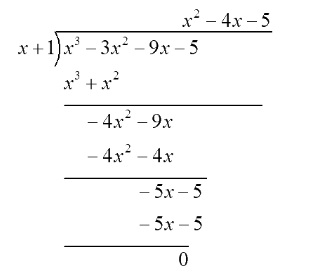
Hence x3 - 3x2 - 9x - 5 = (x +1) (x2 - 4x - 5)
Now taking x2 - 4x - 5, find two numbers p, q such that:
p + q = -4 (co-efficient of x)
p x q = 1 × -5 = -5 (product of co-efficient of x2 and the constant term)
By trial and error method, we get p = -5, q = 1.
Now splitting the middle term of the given polynomial,
x2 - 4x - 5 = x2 - 5x + x - 5
= x(x - 5) + 1(x - 5)
= (x + 1)(x - 5)
(iii) x3 + 13x2 + 32x + 20
We have p(x) = x3 + 13x2 + 32x + 20
By trial, let us find: p(1) = (1)3 + 13(1)2 + 32(1) + 20
= 1 + 13 + 32 + 20
= 66 ≠ 0
Now p(-1) = (-1)3 + 13(-1)2+ 32(-1) + 20
= -1 + 13 - 32 + 20
= 0
∴ By factor theorem, [x - (-1)], i.e. (x + 1) is a factor p(x).
∴ \(\frac{x^{3}-13 x^{2}-32 x-20}{(x+1)}\) = x2 + 12x+ 20
or x3 + 13x2 + 32x + 20 = (x + 1)(x2 + 12x + 20)
= (x + 1)[x2 + 2x + 10x + 20]
[Splitting the middle term]
= (x + 1)[x(x + 2) + 10(x + 2)]
= (x + 1)[(x + 2)(x + 10)]
= (x + 1)(x + 2)(x + 10)
(iv) 2y3 + y2 - 2y - 1
We have p(y) = 2y3 + y2 - 2y - 1
By trial, we have p(1) = 2(1)3 + (1)2 - 2(1) - 1
= 2( 1) + 1 - 2 - 1
= 2 + 1 - 2 - 1 = 0
∴ By factor theorem, (y - 1) is a factor of p(y).
∴ \(\frac{\left(2 y^{3}+y^{2}-2 y-1\right)}{(y-1)}\) = 2y2 + 3y + 1
∴ 2y3- y2 - 2y - 1 = (y - 1)(2y2 + 3y + 1)
= (y - 1)[2y2 + 2y + y + 1]
[Splitting the middle term]
= (y - 1)[2y(y + 1) + 1(y + 1)]
= (y - 1)[(y + 1)(2y + 1)]
= (y - 1)(y + 1)(2y + 1)
12.
(i) 2 + x2 + x
The co-efficient of x2 is 1.
(ii) 2 - x2 + x3
The co-efficient of x2 is (-1).
(iii) \(\frac{\pi}{2}\)x2+ x
The co-efficient of x2 is \(\frac{\pi}{2}\).
(iv) \(\sqrt{2}\)x-1
∵ \(\sqrt{2}\)x-1 ⇒ \(\sqrt{2}\)x-1 + 0・x2
∴ The co-efficient of x2 is 0.
13.
\(-\frac { 31 }{ 4 } \)
14.
(i) (9)3/2 = (32)3/2=(3)3 = 27 [\(\because\) (am)n=(a)mn]
(ii) (32)2/5 = (25)2/5 = (2)2 = 4
(iii) (16)3/4 = (24)3/4 = (2)3 = 8
(iv) (125)-1/3 = \(\frac { 1 }{ { (125 })^{ 1/3 } } =\frac { 1 }{ ({ 5 }^{ 3 })^{ 1/3 } } =\frac { 1 }{ 5 } \)
\(\left[ \because \ { (a) }^{ -n }=\frac { 1 }{ { a }^{ n } } and\ ({ a }^{ m })^{ n }=({ a) }^{ mn } \right] \)
15.
We have, \(\sqrt { 5 } \)
Now, 5 can be written as 5 = 4 + 1 = (2)2 + (1)2
So, we take OQ = 2 and PQ = 1
Now, draw OQ = 2 units on the number line and then draw PQ=1 unit, such that \(OP\bot OQ\) join OP
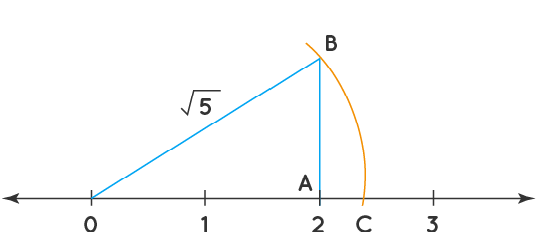
Now, by Pythagoras theorem, we get
OP2 = OQ2 + PQ2
On taking positive square root, we get
\(OP=\sqrt { { OQ }^{ 2 }+{ PQ }^{ 2 } } =\sqrt { { 2 }^{ 2 }+{ 1 }^{ 2 } } \)
\(=\sqrt { 4+1 } =\sqrt { 5 } \)
On taking O as centre and Op = \(\sqrt { 5 } \) as radius, draw an arc, which intersects the number line at point R.
Hence, the point R represents \(\sqrt { 5 } \)

9th Standard CBSE Syllabus & Materials
9th Standard CBSE
CBSE 9th Mathematics Lines and Angles Sample Question Papers Study Material - QB365 Set A
NEW9th Standard CBSE
CBSE 9th Mathematics Introduction to Euclid's Geometry Sample Question Papers Study Material - QB365 Set A
NEW9th Standard CBSE
CBSE 9th Mathematics Linear Equations in Two Variables Sample Question Papers Study Material - QB365 Set A
NEW9th Standard CBSE
CBSE 9th Mathematics Coordinate Geometry Sample Question Papers Study Material - QB365 Set A



NCERT Books

Syllabus

Exam Pattern

Sample Question Papers

Previous year Question Papers

Important Notes

MCQ Practice test

NCERT Exemplers

Case study Questions

Image Based Questions

Passage based Questions

HOT Questions

Value Based Questions

Model Questions Papers
NCERT ( Book Back ) Questions

Assertion and Reason
Important Questions And Answers

CBSE 9th Standard CBSE Subjects
CBSE Standards