100% FREE ACCESS
9th Standard CBSE Syllabus & Materials
9th Standard CBSE
CBSE 9th Science Is matter around us pure? - New Model Questions Papers Study Material - QB365 Set A
NEW9th Standard CBSE
CBSE 9th Science Matter in our surroundings - New Model Questions Papers Study Material - QB365 Set A
NEW9th Standard CBSE
CBSE 9th Mathematics Heron's Formula Sample Question Papers Study Material - QB365 Set A
NEW9th Standard CBSE
CBSE 9th Mathematics Circles Sample Question Papers Study Material - QB365 Set A
NEW9th Standard CBSE
CBSE 9th Mathematics Quadrilaterals Sample Question Papers Study Material - QB365 Set A
NEW9th Standard CBSE
CBSE 9th Mathematics Triangles Sample Question Papers Study Material - QB365 Set A

Published on: 29/10/2025
Download CBSE Class 9th Standard CBSE Mathematics question papers, sample papers, important questions, and previous year solved papers in PDF format. Get free study materials, NCERT solutions, and exam preparation resources for Class 9th Standard CBSE Mathematics
Questions + Answers key
Take MCQ Mathematics Test
1.
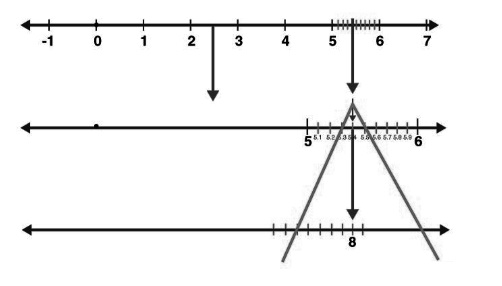
Visualize the representation of \(5.3 \overline{7}\) on the number line upto 5 decimal places, that is, up to 5.37777.
2.
Locate\(\sqrt{2}\) on the number line (or on the real line).
3.
Rationalise the denominators of the following:
(i) \(\frac { 1 }{ \sqrt { 7 } } \)
(ii) \(\frac { 1 }{ \sqrt { 7 } -\sqrt { 6 } } \)
(iii) \(\frac { 1 }{ \sqrt { 5 } +\sqrt { 2 } } \)
(iv) \(\frac { 1 }{ \sqrt { 7 } -2 } \)
4.
Represent \(\sqrt { 9.3 } \) on the number line.
5.
Visualise 4.\(\overline { 26 } \) on the number line up to 4 decimal places.
6.
Visualise 3.765 on the number line, using successive magnification.
7.
Classroom activity (constructing the 'square root spiral').
1.
Once again we proceed by successive magnification, and successively decrease the lengths of the portions of the number line in which \(5.3 \overline{7}\) is located. First, we see that \(5.3 \overline{7}\) is located between 5 and 6. In the next step, we locate 5.37 between 5.3 and 5.4. To get a more accurate visualization of the representation, we divide this portion of the number line into 10 equal parts and use a magnifying glass to visualize that \(5.3 \overline{7}\) lies between 5.37 and 5.38. To visualize \(5.3 \overline{7}\) more accurately, we again divide the portion between \(5.3 \overline{7}\) and 5.38 into ten equal parts and use a magnifying glass to visualize that \(5.3 \overline{7}\) lies between 5.377 and 5.378. Now to visualize 5.37 still more accurately, we divide the portion between 5.377 an 5.378 into 10 equal parts, and visualize the representation of 5.37 as in Fig. 1.14 (iv). Notice that \(5.3 \overline{7}\) is located closer to 5.3778 than to 5.3777 [see Fig 1.14 (iv)].
2.
Draw XOX' and mark O as 0. Take OA = 1 unit.
Draw AB ⊥ OX and cut off AB = 1 unit.
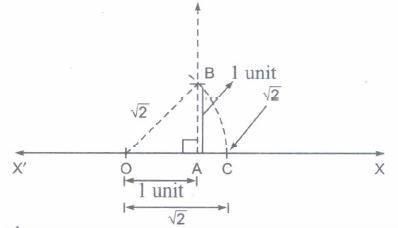
Now, OAB is a right triangle.
∴ OA2+ AB2 = OB2
or 12 + 12= OB2
or 2 = OB2
⇒ OB = \(\sqrt{2}\)
With centre O and OB as radius, draw an arc intersecting OX at C.
Thus, OC = \(\sqrt{2}\) on the real line XOX'.
3.
(i) We have, \(\frac { 1 }{ \sqrt { 7 } } \)
On multiplying both numerator and denominator by \(\sqrt { 7 } \) , we get
\(\frac { 1 }{ \sqrt { 7 } } \times \frac { \sqrt { 7 } }{ \sqrt { 7 } } =\frac { \sqrt { 7 } }{ 7 } \)
(ii) We have,\(\frac { 1 }{ \sqrt { 7 } -\sqrt { 6 } } \)
On multiplying both numerator and denominator by \(\sqrt { 7 } +\sqrt { 6 } ,\) we get
\(\frac { 1 }{ \sqrt { 7 } -\sqrt { 6 } } \times \frac { \left( \sqrt { 7 } +\sqrt { 6 } \right) }{ \left( \sqrt { 7 } +\sqrt { 6 } \right) } \)
\(=\frac { \sqrt { 7 } +\sqrt { 6 } }{ { \left( \sqrt { 7 } \right) }^{ 2 }-{ \left( \sqrt { 6 } \right) }^{ 2 } } [\because (a-b)(a+b)={ a }^{ 2 }-{ b }^{ 2 }]\)
\(=\frac { \sqrt { 7 } +\sqrt { 6 } }{ 7-6 } =\frac { \sqrt { 7 } +\sqrt { 6 } }{ 1 } \)
\(=\sqrt { 7 } +\sqrt { 6 } \)
(iii) \(\left[ \frac { \sqrt { 5 } -\sqrt { 2 } }{ 3 } \right] \)
(iv) \(\left[ \frac { \sqrt { 7 } +1 }{ 3 } \right] \)
4.
First, we draw AB = 9.3 units. Now, from B, mark a distance of 1 unit. Let this point be C. Let D be the mid-point of AC. Now, draw a semi-circle with centre D and radius DA. Let us draw a line perpendicular to AC passing through point B and intersecting the semi-circle at point D.
\(\therefore\) Distance, BD=\(\sqrt { 9.3 } \)
Draw an arc with centre B and radius BD, which intersects the number line at point E. So point E represents \(\sqrt { 9.3 } \) .
5.
Since, 4.\(\overline { 26 } \) is located between 4 and 5, so divide it into 10 eq ual parts [Fig. (i)]. In further, we locate 4.\(\overline { 26 } \) between 4.2 and 4.3 [Fig. (ii)].
To get more accurate visualisation of the representation, we divide this portion into 10 equal parts and use a magnifying glass to visualise that 4.\(\overline { 26 } \) lies between 4.26 and 4.27.
To visualise 4.\(\overline { 26 } \) more clearly, we divide again portion between 4.\(\overline { 26 } \) and 4.27 into 10 equal pans and visualise the representation of 4.\(\overline { 26 } \) between 4.262 and 4.263 [Fig. (iii)].
Now, for a much better visualisation between 4.262 and 4.263, again divide it into 10 equal pans [Fig. (iv)].
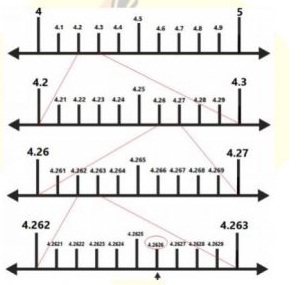
Notice that 4.\(\overline { 26 } \) is located closer to 4.263 than to 4.262. We ~n adopt the process endlessly in this manner and simultaneously imagine the decrease in the length of the number line, in which 4.\(\overline { 26 } \) is located.
6.
We know that, 3.765 lies between 3 and 4. So, divide the portion between 3 and 4 into 10 equal parts and look at the portion between 3.7 and 3.8 through a magnifying glass. Then, 3.765 lies between 3.7 and 3.8 [Fig. (i)]. Now, we imagine to divide this again into 10 equal parts. The first mark will represent 3.71, the next 3.72 and so on. To see this clearly, we magnify this as shown [Fig. (ii)]. Then, 3.765 lies between 3.76 and 3.77 [Fig. (ii)]. So, let us focus on this portion of the number line [Fig. (iii)] and imagine to divide it again into 10 equal parts [Fig. (iii)].
Here, we can visualise that 3.761 is the first mark, 3.762 is the second mark and so on.
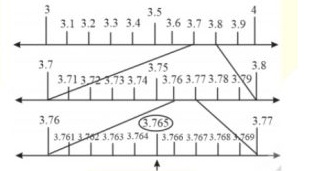
Thus, 3.765 is the fifth mark in these subdivisions.
7.
Take a large sheet of paper and construct the 'square root!'spiral' in the following pattern.
Start with a point O and draw a line segment OP1 of unit length. Draw a line segment P1P2 , perpendicular to OIl of unit ~ength (see figure) and join OP2.
Now, draw a line segment P2P3 perpendicular to OP2 of unit length and join OP 3. Then, draw a line segment P 3,P 4, perpendicular to OP 3, of unit length and join OP • Continuing in this manner, you can get the line segment P n-1Pn by drawing a line segment of unit length perpendicular to OPn-1 . Thus, you have created the points P 2 ,P3 ,...Pn and join them to create a spiral depicting \(\sqrt { 2 } ,\sqrt { 3 } ,\sqrt { 4 } ......\)

9th Standard CBSE Syllabus & Materials
9th Standard CBSE
CBSE 9th Mathematics Lines and Angles Sample Question Papers Study Material - QB365 Set A
NEW9th Standard CBSE
CBSE 9th Mathematics Introduction to Euclid's Geometry Sample Question Papers Study Material - QB365 Set A
NEW9th Standard CBSE
CBSE 9th Mathematics Linear Equations in Two Variables Sample Question Papers Study Material - QB365 Set A
NEW9th Standard CBSE
CBSE 9th Mathematics Coordinate Geometry Sample Question Papers Study Material - QB365 Set A



NCERT Books

Syllabus

Exam Pattern

Sample Question Papers

Previous year Question Papers

Important Notes

MCQ Practice test

NCERT Exemplers

Case study Questions

Image Based Questions

Passage based Questions

HOT Questions

Value Based Questions

Model Questions Papers
NCERT ( Book Back ) Questions

Assertion and Reason
Important Questions And Answers

CBSE 9th Standard CBSE Subjects
CBSE Standards