9th Standard CBSE Syllabus & Materials
9th Standard CBSE
CBSE 9th Science Is matter around us pure? - New Model Questions Papers Study Material - QB365 Set A
NEW9th Standard CBSE
CBSE 9th Science Matter in our surroundings - New Model Questions Papers Study Material - QB365 Set A
NEW9th Standard CBSE
CBSE 9th Mathematics Heron's Formula Sample Question Papers Study Material - QB365 Set A
NEW9th Standard CBSE
CBSE 9th Mathematics Circles Sample Question Papers Study Material - QB365 Set A
NEW9th Standard CBSE
CBSE 9th Mathematics Quadrilaterals Sample Question Papers Study Material - QB365 Set A
NEW9th Standard CBSE
CBSE 9th Mathematics Triangles Sample Question Papers Study Material - QB365 Set A

Published on: 14/08/2026
Download CBSE Class 9th Standard CBSE Mathematics question papers, sample papers, important questions, and previous year solved papers in PDF format. Get free study materials, NCERT solutions, and exam preparation resources for Class 9th Standard CBSE Mathematics
Questions + Answers key
Take MCQ Mathematics Test
1.
Find the value of y if the distance between the points (3,-2) and (8, y) is \(\sqrt{89}\) units.
2.
A surveyor marks four points A(0, 0), B(4,0), C(6, 3), and D(2, 3). Find the lengths of AB, BC, CD, and DA. Hence, identify the quadrilateral formed and justify your answer.
3.
Two opposite corners of a square in a coordinate plane are P(-2, 1) and R(6, 7). Find:
(A)The centre of the square (midpoint of the diagonal),
(B) The length of the diagonal PR,
(C) The side length of the square.
4.
The vertices of triangle ABC are A(-3, 4), B(5, 4) and C(1, -2). Find:
(A)The length of each side,
(B) The perimeter,
(C) Whether the triangle is isosceles, equilateral, or scalene.
5.
Show that the points P(-2, 5), Q(3, 1) and R(8, -3) are collinear, and find which of the three points lies between the other two.
6.
Three points A(1, 2), B(4, 6), and C(7, 10) are marked on a city map. Find AB, BC, and AC. Hence, determine whether the points are collinear, giving a reason.
7.
Without plotting, identify the quadrant or axis on which each of the points P(-4, 3), Q(2, -7), R(0, 5) and S(-6, -1) lies. Also state how each point relates to the y-axis and the x-axis (left/right, above/below).
8.
State the quadrant or axis on which each of the following points lies.
(A) (4, 7)
(B) (-3, 5)
(C) (-6, -2)
(D) (7,-4)
(E) (0, 8)
(F) (-5, 0).
9.
Mohenjo-Daro's main streets ran exactly North-South and East-West, and they were spaced 10 metres apart. The Great Bath is at the city centre. A merchant's shop is 3 streets east and 2 streets North of the Great Bath. Write the shop's location as an (East-distance, North-distance) coordinate pair, in metres.
10.
ldentify which of the following descriptions could form a 2-D coordinate system. Give a reason for each.
(A) Two perpendicular streets crossing at the city centre, with distances measured along the streets.
(B) Two parallel railway tracks running east-to-west, with distances measured along the tracks.
(C) A map with north-south and east-west grid lines used to locate places.
11.
On a coordinate map of a city park, a fountain is at F(0, 0), a bench at B(6, 8), and a swing at S(-8, 6). Which one is farthest from the fountain?
Bench
Swing
Both are equidistant
Cannot be determined
12.
If M(2, 5) is the midpoint of A(-4, 7) and B, then B is:
(8,3)
(0, 6)
(-1, 6)
(8, 5)
13.
The distance between A(a, 0) and B(0, b) is:
a+b
\(|a-b|\)
\(\sqrt{\left(a^2+b^2\right)}\)
ab
14.
ldentify the false statement among the following
(a) Every point on the x-axis has y-coordinate 0.
(b) The origin lies on both the axes.
(c) (2,3) and (3, 2) are the same point.
(d) Points in Quadrant () have negative x-coordinate and positive y-coordinate.
15.
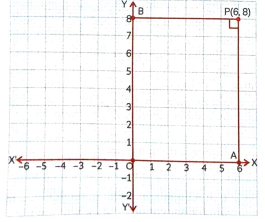
In the given figure, O shows the position of Ram and he wants to reach point P in the shortest way. The shortest distance travelled by him to reach point P will be:
6 units
8 units
5 units
10 units
16.
Match each pair of points (Column A) with its midpoint (Column B).
Column A | Column B |
|---|---|
(i) (2, 4) and (6, 10) | (P) (0, 0) |
(ii) (-3, 5) and (3, -5) | (Q) (4,7) |
(iii) (-6, 2) and (-2, 8) | (R) (-4, 5) |
(iv) (1, 3) and (5, 9) | (S) (3, 6) |
(i)-(Q), (ii)-(P), (iii)-(S), (iv)-(R)
(i)-(Q), (ii)-(S), (iii)-(P), (iv)-(R)
(i)-(R), (ii)-(P), (iii)-(Q), (iv)-(S)
(i)-(Q), (ii)-(P), (iii)-(R), (iv)-(S)
17.
A school is at S(3, 4) and a library is at L(11, 10). The midpoint oft he segment SL is the location of a park. Which combination is correct?
(i) Park is at (7, 7)
(ii) Distance SL = 10 units.
(iii) Distance from S to the park is 5 units
Only (i) and (ii) are true.
Only (i) and (ii) are true.
Only (i) and (iii) are true.
All three are true.
18.
A delivery boy uses a city map with the central post office at the origin. He picks up a parcel at A (2, 5) and delivers it at B (-6, -4). The distance between A and B is calculated using the distance formula. Which mathematical theorem is the basis of this formula?
Midpoint formula
By the Baudhayana-Pythagoras Theorem
145 is a prime number.
The points lie in different quadrants.
19.
Riya tabulates four points and the quadrant in which she thinks each lies. Which entry is INCORRECT?
Point | Quadrant |
|---|---|
(-7, 2) | (II) |
(5, -3) | (IV) |
(-4, -9) | (I) |
(6, 8) | (I) |
(-7, 2) → (II)
(5, -3) → (IV)
(-4,-9)→ (I)
(6, 8)→ (I)
20.
Read the two statements and choose the correct option.
(i) The midpoint of the segment joining (4, 6) and (-2, 2) is (1, 4).
(ii) The distance between (4, 6) and (-2, 2) equals \(2 \sqrt{13} \text { units. }\)
Only (i) is true.
Only (ii) is true.
Both are true.
Both are false.
21.
The distance between the points P (0,-5) and Q (12, 0) is:
13 units
17 units
5 units
12 units
22.
The point (-4, 0) lies:
in Quadrant lI
on the x-axis
on the y-axis
in Quadrant llI
23.
Assertion (A) : The midpoint of the segment joining (a, b)and (-a, -b) is the origin
Reason (R) : The midpoint formula gives \(\left(\frac{(a+-a)}{2}\right),\left(\frac{(b+-b)}{2}\right)=(0,0) .\)
Codes:
(a) Both assertion (A) and reason (R) are true and reason (R) is the correct explanation of assertion (A).
(b) Both assertion (A) and reason (R) are true and reason (R) is not the correct explanation of assertion (A).
(c) Assertion (A) is true but reason (R) is false.
(d) Assertion (A) is false but reason (R) is true.
24.
Assertion (A): If three points P, Q, R satisfy PQ = QR = PR, then the triangle POR is equilateral.
Reason (R): with three equal sides; the distance formula confirms this when used on coordinates.
Codes:
(a) Both assertion (A) and reason (R) are true and reason (R) is the correct explanation of assertion (A).
(b) Both assertion (A) and reason (R) are true and reason (R) is not the correct explanation of assertion (A).
(c) Assertion (A) is true but reason (R) is false.
(d) Assertion (A) is false but reason (R) is true.
25.
Assertion (A): The points (3, 0), (0, 4) and (3, 4) form a right triangle.
Reason (R): Among the three sides, two are along the axes and the longest is the hypotenuse, so by the Baudhayana Pythagoras Theorem, the angle opposite the hypotenuse is a right angle.
Codes:
(a) Both assertion (A) and reason (R) are true and reason (R) is the correct explanation of assertion (A).
(b) Both assertion (A) and reason (R) are true and reason (R) is not the correct explanation of assertion (A).
(c) Assertion (A) is true but reason (R) is false.
(d) Assertion (A) is false but reason (R) is true.
26.
Assertion (A): The points (1, 1), (2, 2) and (3, 3) are non-collinear.
Reason (R): Three points are collinear if the sum of two of the pairwise distances equals the third.
Codes:
(a) Both assertion (A) and reason (R) are true and reason (R) is the correct explanation of assertion (A).
(b) Both assertion (A) and reason (R) are true and reason (R) is not the correct explanation of assertion (A).
(c) Assertion (A) is true but reason (R) is false.
(d) Assertion (A) is false but reason (R) is true.
27.
Assertion (A): The distance from A(3, 4) to B(0, 0) is 5 units
Reason (R): By the distance formula, OP = \(\sqrt{\left(x^2-y^2\right)}\) for any point P(x, y).
Codes:
(a) Both assertion (A) and reason (R) are true and reason (R) is the correct explanation of assertion (A).
(b) Both assertion (A) and reason (R) are true and reason (R) is not the correct explanation of assertion (A).
(c) Assertion (A) is true but reason (R) is false.
(d) Assertion (A) is false but reason (R) is true.
28.
Assertion (A): The point (0, -5) lies on the y-axis.
Reason (R): Every point on the y-axis has its x-coordinate equal to 0.
Codes:
(a) Both assertion (A) and reason (R) are true and reason (R) is the correct explanation of assertion (A).
(b) Both assertion (A) and reason (R) are true and reason (R) is not the correct explanation of assertion (A).
(c) Assertion (A) is true but reason (R) is false.
(d) Assertion (A) is false but reason (R) is true.
29.
The midpoint of the segment joining (-3, 5) and (7, -1) is _____________.
30.
The coordinates of the origin are ______________. The distance between (x1, y1) and (x2, y2) is ________________.
31.
The distance from any point P(x, y) to the origin equals \(\sqrt{\left(x^2+y^2\right)} .\)
32.
The point (0, 7) lies in Quadrant I.
33.
A group of class X students goes to picnic during winter holidays The position of three friends Aman, Kirti and Chahat are shown by the points P,Q and R.
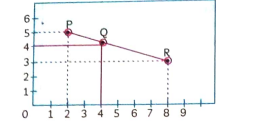
(A) Find the distance between P and R
(B) Is Q, the midpoint of PR? Justify by finding midpoint of PR.
(C) Find the point on x-axis which is equidistant from P and Q.
34.
A society located in Jaipur, does not have any park for the residencies, so the committee of the society decides to construct two different parks for children and adults respectively as shown in the figure.
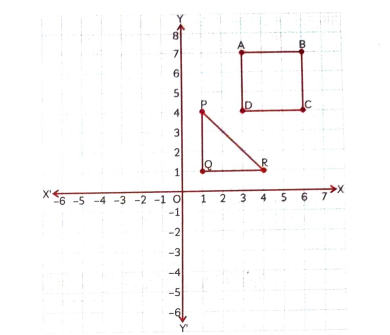
Based on the given information, answer the following questions:
(A) Find the area of park PQR
(B) Find the length of AC. If the graph is scales 10 times i.e., the one smallest square = 10 units. Find the area of parks constructed for adults.
(C) Find the length of PR.
35.
Sumit while playing in the street with his 3 more friends thought of locating them in different quadrants of a Cartesian plane and curious to know their location by constructing them in words.
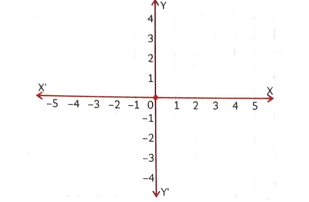
Based on the given information, answer the following questions:
(A) Sumit said, "I am located in the quadrant whose abscissa is always greater than its ordinate. No matter what are the values'".
Find the quadrant in which Sumit lies.
(B) Raju said, "l am located in the quadrant whose abscissa is always lesser than its ordinate. No matter what are the values."
Find the quadrant in which Raju lies.
(C) Deepti said, "my both abscissa and ordinates need value which is less than zero." And Ramaya said, "guys I am a positive person, so my both the coordinates are positive". Find the quadrant in which Deepti and Ramya lies.
36.
In Jan 2020, Australia witnessed the worst-ever wildfire. According to various reports, about 50 crores animals and birds died or were severely affected. Thousands of people left their homes and the property of millions of dollars was destroyed. If the forest is divided into four quadrants and animals have been placed at different places as shown in the figure.
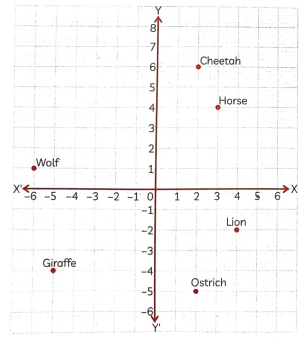
Based on the given information, answer the following questions:
(A) Which among the following animals are parallel to y-axis on the graph?
(a) Horse and Lion
(b) Giraffe and Ostrich
(c) Lion and Giraffe
(d) Cheetah and Ostrich
(B) If Ostrich travels 11 units towards the North direction, he will meet:
(a) Giraffe
(b) Horse
(c) Cheetah
(d) Wolf
(C) If a giraffe moves 6 units towards East direction, in which quadrant will it be? Also, find the new coordinates.
37.
Without plotting, identify the quadrant of each point:
(A) (5, -7),
(B) (-9, -4),
(C) (-2,6),
(D) (8, 1).
38.
Verify whether the points A(0, O), B(3, 4), C(7, 4) form a right-angled triangle. Identify the right angle.
39.
A point P lies on the x-axis at a distance of 13 units from the origin. Write all possible coordinates of P.
40.
M(0, 4) is the midpoint of segment AB where A(-6, 7). Find the coordinates of B.
41.
Find the distance of the point (-7, 24) from the origin. Show all working.
42.
Find the midpoint of the segment joining the points (8, -3) and (-4, 7).
43.
Find the distance between the points (-6, 7) and (-1, -5).
44.
Plot the points P(-3, 0), Q(0, 4), R(0, -5) on graph paper and state the axis on which each lies.
45.
Consider the points R (3, 0), A (-2, -2), M (-5, -2) and P(-5, 2). f they are joined in the same order, predict: (A) Two sides of RAMP that are perpendicular to each other. (B) One side of RAMP that is parallel to one of the axes. (C) Two points that are mirror images of each other in one axis. Which axis will this be? Now plot the points and verify your predictions.
46.
Analyse the statement: "The midpoint formula is just an average that is why distances from the midpoint to the two endpoints are equal" In your answer,
(A) Verify the statement for any specific pair of points
(B) Prove it in general using the distance formula.
(C) Explain how this fact is used in computer graphics to draw a smooth path between two points on a screen. (Analyse the statement)
47.
A school is planning a rectangular sports ground with corners at P(0, 0), Q(80, 0), R(80o, 60) and S(0, 60). (A) Find the lengths of the two diagonals PR and Qs. (B) Find the centre of the field (the intersection of the diagonals). (C) Two flagpoles are to be placed at the midpoints of the two longer sides; find their coordinates. (D) Find the distance between the two flagpoles.
48.
Prove that the points A(1, 7), B(4, 2), C(-1, -1) and D(-4, 4) are the vertices of a square. Show all four side-lengths and both diagonal lengths, and explain why the conditions taken together imply that ABCD is a square (and not merely a rhombus or rectangle). (Prove that)
1.
Using the distance formula,
(8 – 3)2+ (y - (-2)2 = 89
25 + (y + 2)2 = 89
(y + 2)2 = 89 - 25
(y + 2)2 =64
Taking square roots,
y + 2 = ± 8
Therefore, y = 6 or y = -10
Hence, the possible values of yare 6 and -10.
2.
\(\begin{aligned} & \mathrm{AB}=\sqrt{(16+0)}=4 ; \\ & \mathrm{BC}=\sqrt{(4+9)}=\sqrt{13} ; \\ & \mathrm{CD}=\sqrt{(16+0)}=4 ; \\ & \mathrm{DA}=\sqrt{(4+9)}=\sqrt{13} . \end{aligned}\)
AB = CD (4) and BC = DA \(\sqrt{13}\),
So, opposite sides are equal but the diagonals AC = \(\sqrt{(36+9)}=\sqrt{45} \text { and } \mathrm{BD}=\sqrt{(4+9)}=\sqrt{13}\) are unequal So, ABCD is a parallelogram (NOT a rectangle, since the diagonals are unequal).
3.
(A) Centre = midpoint of PR
\(=\left(\frac{(-2+6)}{2}, \frac{(1+7)}{2}\right)\)
= (2, 4).
(B) \(\begin{aligned} P R & =\sqrt{(64+36)} \\ & =\sqrt{100}=10 . \end{aligned}\)
(C) Side of square = \(\frac{\text { diagonal }}{\sqrt{2}}\)
\(=\frac{10}{\sqrt{2}}=5 \sqrt{2}\)
= 7.07 units
4.
(A) \(A B=\sqrt{(64+0)}=8 ;\)
\(\begin{aligned} B C & =\sqrt{(16+36)} \\ & =\sqrt{52}=2 \sqrt{13} \\ C A & =\sqrt{(16+36)}=2 \sqrt{13} . \end{aligned}\)
(B) Perimeter = \(8+2 \sqrt{13}+2 \sqrt{13}\)
\(=8+4 \sqrt{13}\)
= 22.42 units.
(C) BC = CA, so the triangle is isosceles.
5.
\(\begin{aligned} P Q & =\sqrt{(25+16)}=\sqrt{41} ; \\ Q R & =\sqrt{(25+16)}=\sqrt{41} ; \\ P R & =\sqrt{(100+64)} \\ & =\sqrt{164}=2 \sqrt{41} . \end{aligned}\)
Since \(P Q+Q R=2 \sqrt{41}=P R\) the points are colinear with Q lying between P and R.
6.
\(\begin{aligned} & A B=\sqrt{(9+16)}=5 ; \\ & B C=\sqrt{(9+16)}=5 ; \\ & A C=\sqrt{(36+64)}=10 . \end{aligned}\)
Check: AB + BC= 10 = AC.
The points are collinear, and B is the midpoint of the segment AC.
7.
P(-4, 3): The x-coordinate is negative and the y-coordinate is positive (x < 0,y> 0). Therefore, P lies in Quadrant Il. It is 4 units to the left of
the y-axis and 3 units above the x-axis.
Q(2, -7): The X-coordinate is positive and the y-coordinate is negative (x > 0,y< 0). Therefore, Q lies in Quadrant IV. It is 2 units to the right of the y-axis and 7 units below the x-axis.
R(0, 5): The x-coordinate is 0 and the y-coordinate is positive.
Therefore, R lies on the positive y-axis. It is 5 units above the origin and does not belong to any quadrant. S(-6, -1): Both coordinates are negative (x< 0, y<0). Therefore, S lies in Quadrant lIl. It is 6 units to the left of the y-axis and 1 unit below the x-axis.
8.
(A) Both coordinates are positive (x > 0, y> 0). Therefore, the point lies in Quadrant I.
(B) The X-coordinate is negative and the y-coordinate is positive (x<0.y> 0). Therefore, the point lies in Quadrant II
(C) Both coordinates are negative (x <0,y< 0). Therefore, the point lies in Quadrant III.
(D) The x-coordinate is positive and the y-coordinate is negative (x>0.y< 0). Therefore, the point lies in Quadrant IV.
(E) The x-coordinate is 0 and the y-coordinate is positive. Therefore, the point lies on the positive y-axis.
(F) The y-coordinate is 0 and the x-coordinate is negative. Therefore, the point lies on the negative x-axis.
9.
The streets are spaced 10 metres apart.
Distance of the shop from the Great Bath towards the east = 3 x 10 = 30 m
Distance of the shop from the Great Bath towards the north = 2 x 10 = 20 m
Therefore, the coordinate of the merchant's shop is (30, 20).
10.
(A) Yes, two perpendicular axes that cross at a fixed origin (the city centre), distances measured along each give a unique (x, y) for any location
(B) No, two railway tracks are parallel, not perpendicular. Two parallel reference lines cannot uniquely specify a point. Coordinate axes must be perpendicular.
(C) Yes, it can form a 2-D coordinate system. The north-south and east-west grid lines provide two perpendicular reference directions. The position of a place can be determined uniquely by specifying its location along these two directions.
11.
Distance of the bench from the fountain:
\(\begin{aligned} \mathrm{FB} & =\sqrt{(6-0)^2+(8-0)^2} \\ & =\sqrt{36+64}=\sqrt{100}=10 \end{aligned}\)
Distance of the swing from the fountain
\(\begin{aligned} \mathrm{FS} & =\sqrt{(-8-0)^2+(6-0)^2} \\ & =\sqrt{64+36}=\sqrt{100}=10 \end{aligned}\)
Since FB = FS = 10 units, the bench and the swing are equidistant from the fountain.
12.
Let B = (x, y).
For x-coordinate \(2=\frac{(-4+x)}{2}\)
⇒ x = 8;
For y-coordinate \(5=\frac{(7+y)}{2 y}=3 .\)
So, B = (8,3).
13.
\(\mathrm{AB}=\sqrt{\left[(0-a)^2+(b-0)^2\right]}\)
\(\sqrt{\left(a^2+b^2\right)}\)
14.
(2, 3) and (3, 2) represent different points because the first number denotes the x-coordinate and the second number denotes the y-coordinate.
15.
S The shortest distance to reach point P will be OP.
From the figure,
AP = 8 units
OA = PB 6 units
By Baudhayana Pythagoras theorem, in △OPA
OP2 = AP2+ OA2
⇒ OP2 = (8)2+ (6)2
⇒ OP2 = 64+ 36
⇒ OP2 = 100
⇒ \(\mathrm{OP}=\sqrt{100}\)
⇒ OP = 10 units
16.
Using the midpoint the formula
(i) \(\begin{aligned} M & =\left(\frac{x_1+x_2}{2}, \frac{y_1+y_2}{2}\right) \\ M & =\left(\frac{2+6}{2}, \frac{4+10}{2}\right) \\ & =\left(\frac{8}{2}, \frac{14}{2}\right)=(4,7) \end{aligned}\)
(ii) \(\begin{aligned} M & =\left(\frac{-3+3}{2}, \frac{5+(-5)}{2}\right) \\ & =\left(\frac{0}{2}, \frac{0}{2}\right)=(0,0) \end{aligned}\)
(iii) \(\begin{aligned} M & =\left(\frac{-6+(-2)}{2}, \frac{2+8}{2}\right) \\ & =\left(\frac{-8}{2}, \frac{10}{2}\right)=(-4,5) \end{aligned}\)
(iv) \(\begin{aligned} M & =\left(\frac{1+5}{2}, \frac{3+9}{2}\right) \\ & =\left(\frac{6}{2}, \frac{12}{2}\right)=(3,6) \end{aligned}\)
17.
Let S and L be the endpoints of a line segment, and let M(7, 7) be its midpoint.
\(\mathrm{SL}=\sqrt{64+36}=\sqrt{100}=10\)
Since M is the midpoint of SL,
\(S M=M L=\frac{S L}{2}=\frac{10}{2}=5\)
Thus, the distance from S to the midpoint M is 5 units, which is half the length of the segment SL
18.
The distance formula is derived from the Baudhayana-Pythagoras Theorem.
19.
(-4, -9) has both coordinates negative, so it lies in Quadrant (lII), not in (i).
20.
\(\begin{aligned} \text { Midpoint } & =\left(\frac{(4+(-2)}{2}\right) \cdot\left(\frac{6+2}{2}\right) \\ & =(1,4) \\ \text { Distance } & =\sqrt{\left[(-2-4)^2+(2-6)^2\right]} \\ & =\sqrt{(36+16)}=\sqrt{52}=2 \sqrt{13} . \end{aligned}\)
21.
Since,
\(\begin{aligned} P Q & =\sqrt{\left(x_2-x_1\right)^2+\left(y_2-y_1\right)^2} \\ & =\sqrt{(12-0)^2+[0-(-5)]^2} \\ & =\sqrt{(144+25)}=\sqrt{169}=13 . \end{aligned}\)
22.
A point whose y-coordinate is 0 always lies on the x-axis.
So, (-4, O) lies on the x-axis (specifically on the negative side of the x-axis because x= -4).
23.
(a) Both assertion (A) and reason (R) are true and reason (R) is the correct explanation of assertion (A).
Explanation:
The midpoint of the segment joining (a, b) and (-a, -b) is the origin.
Using the midpoint formula,
\(\begin{aligned} & =\left(\frac{a+(-a)}{2}, \frac{b+(-b)}{2}\right) \\ & =\left(\frac{0}{2}, \frac{0}{2}\right)=(0,0) \end{aligned}\)
24.
(a) Both assertion (A) and reason (R) are true and reason (R) is the correct explanation of assertion (A).
Explanation:
An equilateral triangle is a triangle in which all three sides are equal. Since
PQ = QR= PR,
all three sides of APOR are equal. Therefore, △POR is an equilateral triangle.
25.
(a) Both assertion (A) and reason (R) are true and reason (R) is the correct explanation of assertion (A).
Explanation: Let the points be A(3, 0), B(0,4) and C(3, 4)
Using the distance formula:
\(\begin{aligned} A B & =\sqrt{(3-3)^2+(4-0)^2}=4 \\ B C & =\sqrt{(3-0)^2+(4-4)^2}=3 \\ A B & =\sqrt{(3-0)^2+(0-4)^2} \\ & =\sqrt{9+16}=5 \end{aligned}\)
Thus, the three side lengths are 3, 4, and 5.
Since
32+42=52
by the converse of the Baudhayana-Pythagoras Theorem, the triangle is right-angled. Equivalently. AC is vertical and BC is horizontal, so they are perpendicular and angle \(\angle \mathrm{C}=90^{\circ} .\)
Hence, the Assertion is true. The Reason is also true and correctly explains why the triangle is right-angled.
26.
(d) Assertion (A) is false but reason (R) is true.
Explanation:
\(\begin{aligned} & A B=\sqrt{(2-1)^2+(2-1)^2}=\sqrt{2} \\ & B C=\sqrt{(3-2)^2+(3-2)^2}=\sqrt{2} \end{aligned}\)
\(A C=\sqrt{(3-1)^2+(3-1)^2}=\sqrt{8}=2 \sqrt{2}\)
Since, \(A B+B C=\sqrt{2}+\sqrt{2}=2 \sqrt{2}=A C,\)
the three points are collinear.
Therefore, the Assertion "the points are non-collinear" is false, while the Reason is true.
27.
(c) Assertion (A) is true but reason (R) is false.
Explanation :
The distance between A(3, 4) and B(0, 0) is
\(\begin{aligned} A B & =\sqrt{(3-0)^2+(4-0)^2} \\ & =\sqrt{9+16}=\sqrt{25}=5 \end{aligned}\)
Hence, assertion (A) is true.
However, the distance of a point P (x, y) from the origin is
\(\begin{aligned} &\sqrt{x^2+y^2}, \text { not } \sqrt{x^2-y^2} \text {. }\\ &\text { Therefore, reason ( } R \text { ) is false. } \end{aligned}\)
28.
(a) Both assertion (A) and reason (R) are true and reason (R) is the correct explanation of assertion (A).
Explanation:
The point (0, -5) has x-coordinate 0. By definition, every point on the y-axis has x-coordinate 0. Therefore, (0, -5) lies on the y-axis.
29.
(2, 2)
Explanation :
\(\text { Midpoint }=\left(\frac{(-3+7)}{2}, \frac{(5+(-1))}{2}\right)=(2,2) .\)
30.
\((0,0): \sqrt{\left[\left(x_2-x_1\right)^2+\left(y_2-y_1\right)^2\right]}\)
31.
True
Explanation:
The distance from (x, y) to the origin (0, 0) is \(\sqrt{\left[(x-0)^2+(y-0)^2\right.}=\sqrt{\left(x^2+y^2\right)} .\)
32.
False
Explanation:
(0, 7) lies on the positive y-axis, not in Quadrant I, because points in Quadrant I must satisfy x>0 and y> 0.
33.
(A) \(\begin{aligned} P R & =\sqrt{(8-2)^2+(3-5)^2} \\ & =2 \sqrt{10} \end{aligned}\)
(B) Coordinates of Q (4, 4).
The mid-point of PR is (5,4)
∴ Q is not the mid-point of PR
(C) Let the point be (x, 0)
\(\text { So, } \sqrt{(2-x)^2+25}=\sqrt{(4-x)^2+16}\)
Hence, x = \(\frac{3}{4} \text {. Therefore, the point is }\left(\frac{3}{4}, 0\right)\)
34.
(A) Area of triangle = \(\frac{1}{2} \times \text { base × height }\)
Base = OR= (4-1) = 3 units
Height = PQ = (4- 1) = 3 units
∴ \(\text { Area }=\frac{1}{2} \times 3 \times 3\)
= 4.5 sq. units
(B) The shape of park constructed for adults is square.
AB = BC = CD = DA =3 units
Hence, side of square =3 units
Diagonal, AC = \(\sqrt{2} \times \text { side }\)
\(=\sqrt{2} \times 3 \text { units }\)
\(=3 \sqrt{2} \text { units }\)
According to question,
1 square box = 10 units
So, AB = BC= CD = DA
=3x 10 units
= 30 units
Area of square = side2
= (30)2
= 900 sq. units
(C) QR =3 units, PQ=3 units
Apply, Pythagoras theorem
PR2 = PQ2+OR2
⇒ (3)2 + (3)2
⇒ = 9+9 = 18
\(P R=3 \sqrt{2} \text { units }\)
35.
(A) In IV quadrant, abscissa (x-coordinate) is always positive and ordinate (y-coordinate) is negative. Since, Abscissa > Ordinate
Hence, Sumit is in the IV quadrant.
(B) In | quadrant, abscissa (x-coordinate) is always negative and ordinate y-coordinate) is always positive.
Since, Abscissa < Ordinate
Hence, Raju is in the ll quadrant.
(C) In I quadrant Abscissa (K-coordinate) is always negative and ordinate y-coordinate) is negative.
Since, Abscissa < 0
Also, ordinate < 0
Hence, Deepti is located in lIl quadrant.
In I quadrant, abscissa (x-coordinate) is always positive and ordinate (y-coordinate) is positive
Since, Abscissa > 0
Also, Ordinate > 0
Hence, Ramya is located in I quadrant
36.
(A) (d) Cheetah and Ostrich
Explanation: From the graph cheetah and ostrich are parallel toy-axis.
(B) (c) Cheetah
Explanation: Ostrich moves 11 units in North direction, ie., along y-axis. So, ostrich will meet cheetah and the new coordinates of ostrich are (2, 6).
(C) The coordinates of giraffe are (-5, -4), Now moving 6 units towards East direction along X-axis so, giraffe's new coordinates are (-5 + 6, -4) = (1, -4). Hence, giraffe will be in IV quadrant.
37.
(A) (5, -7): x> 0,y<0, so the point lies in Quadrant IV.
(B) (-9,-4): both coordinates are negative, so the point lies in Quadrant III.
(C) (-2.6): x <0.y> 0, so the point lies in Quadrant II.
(D) (8, 1): both coordinates are positive, so the point lies in Quadrant I.
38.
\(\begin{aligned} & A B=\sqrt{(9+16)}=5 ; \\ & B C=\sqrt{(16+0)}=4 ; \end{aligned}\)
\(\mathrm{AC}=\sqrt{(49+16)}=\sqrt{16}\)
Check: AB2 + BC2 = 25 + 16 = 41
≠ AC2.
The equality is not satisfied. Therefore, the triangle does not satisfy Pythagoras theorem and hence is not a right-angled triangle.
39.
Since the point lies on the x-axis, its y-coordinate is 0.
Distance from the origin is \(|x|=13\)
Therefore, X = ±13
Hence, the possible coordinates are (13, 0) and (-13, 0).
40.
Let \(B=(x, y) \cdot 0=\frac{(-6+x)}{2}\)
⇒ \(x=6.4=\frac{(7+y)}{2}\)
⇒ y=1. So B= (6, 1).
41.
Distance from origin = \(\sqrt{x^2+y^2}\)
\(\begin{aligned} & =\sqrt{\left[(-7)^2+24^2\right]} \\ & =\sqrt{(49+576)} \\ & =\sqrt{625}=25 \text { units. } \end{aligned}\)
42.
\(\begin{aligned} \text { Midpoint } & =\left(\frac{x_1+x_2}{2}, \frac{y_1+y_2}{2}\right) \\ & =\left(\frac{(8+(-4))}{2}, \frac{(-3+7)}{2}\right) \end{aligned}\)
= (2, 2).
43.
\(\begin{aligned} \text { Distance } & =\sqrt{\left(x_2-x_1\right)^2+\left(y_2-y_1\right)^2} \\ & =\sqrt{(25+144)}=\sqrt{169} \end{aligned}\)
= 13 units.
44.
P (-3, 0): on the negative x-axis.
Q (0, 4): on the positive y-axis.
R (0, -5): on the negative y-axis.
45.
On plotting the points in the cartesian plane:
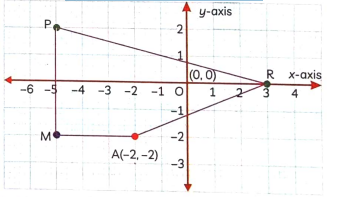
(A) A horizontal line and a vertical line are perpendicular. So, AM⊥MP.
(B) AM has slope 0, so AM is parallel to the x-axis. Also, MP is parallel to the y-axis.
(C) M(-5, -2) and P(-5, 2) has same x-coordinate and opposite y-coordinates. They are mirror images in the x-axis.
46.
Specific case: P(2,4), Q(8, 10).
Midpoint M = (5, 7).
\(\begin{aligned} & \mathrm{PM}=\sqrt{(9+9)}=\sqrt{18} \\ & \mathrm{QM}=\sqrt{(9+9)}=\sqrt{18} . \text { Equal. } \end{aligned}\)
(B) General proof.
\(\begin{aligned} \mathrm{M} & =\left(\frac{\left(x_1+x_2\right)}{2}, \frac{\left(y_1+y_2\right)}{2}\right) \\ \mathrm{PM} & =\sqrt{\left[\left(\frac{\left(x_1+x_2\right)}{2}-x_1\right)^2+\left(\frac{\left(y_1^*+y_2\right)}{2}-y_1\right)^2\right]} \\ & =\sqrt{\left[\left(\frac{\left(x_2-x_1\right)}{2}\right)^2+\left(\frac{\left(y_2-y_1\right)}{2}\right)^2\right]} \\ & =\left(\frac{1}{2}\right) \sqrt{\left[\left(x_2-x_1\right)^2+\left(y_2-y_1\right)^2\right.}=\frac{\mathrm{PQ}}{2} . \end{aligned}\)
By symmetry. QM\(=\frac{P Q}{2}\) Hence PM=QM.
(C) In computer graphics, smooth lines are drawn by repeatedly finding midpoints. First, the midpoint between two pixels is found and plotted. Then the midpoints of the smaller line segments are found again. By repeating this process many times, the line appears smooth between the two endpoints.
47.
(A) \(P R=\sqrt{\left(80^2+60^2\right)}=\sqrt{(6400+3600)}\)
\(=\sqrt{10000}=100 ;\)
\(Q S=\sqrt{\left(80^2+60^2\right)}=100 .\)
(B) Centre = midpoint of PR = (40, 30).
(C) Midpoint of PQ = (40, 0); midpoint of RS = (40, 60).
(D) Distance between flagpoles = \(\sqrt{(0+3600)}=60\) units (= the width ofthe field, as expected).
48.
Compute all four sides:
\(\begin{aligned} & \mathrm{AB}=\sqrt{(9+25)}=\sqrt{34} ; \\ & \mathrm{BC}=\sqrt{(25+9)}=\sqrt{34} ; \\ & \mathrm{CD}=\sqrt{(9+25)}=\sqrt{34} ; \\ & \mathrm{DA}=\sqrt{(25+9)}=\sqrt{34} ; \end{aligned}\)
Since all four sides are equal, the figure is at least a rhombus.
Now check the diagonals:
\(\begin{aligned} & A C=\sqrt{(4+64)}=\sqrt{68} \\ & B D=\sqrt{(64+4)}=\sqrt{68} \end{aligned}\)
Both diagonals are equal. A rhombus with equal diagonals is a square. Therefore, ABCD is a square.

9th Standard CBSE Syllabus & Materials
9th Standard CBSE
CBSE 9th Mathematics Lines and Angles Sample Question Papers Study Material - QB365 Set A
NEW9th Standard CBSE
CBSE 9th Mathematics Introduction to Euclid's Geometry Sample Question Papers Study Material - QB365 Set A
NEW9th Standard CBSE
CBSE 9th Mathematics Linear Equations in Two Variables Sample Question Papers Study Material - QB365 Set A
NEW9th Standard CBSE
CBSE 9th Mathematics Coordinate Geometry Sample Question Papers Study Material - QB365 Set A



NCERT Books

Syllabus

Exam Pattern

Sample Question Papers

Previous year Question Papers

Important Notes

MCQ Practice test

NCERT Exemplers

Case study Questions

Image Based Questions

Passage based Questions

HOT Questions

Value Based Questions

Model Questions Papers
NCERT ( Book Back ) Questions

Assertion and Reason
Important Questions And Answers

CBSE 9th Standard CBSE Subjects
CBSE Standards