100% FREE ACCESS
9th Standard CBSE Syllabus & Materials
9th Standard CBSE
CBSE 9th Science Is matter around us pure? - New Model Questions Papers Study Material - QB365 Set A
NEW9th Standard CBSE
CBSE 9th Science Matter in our surroundings - New Model Questions Papers Study Material - QB365 Set A
NEW9th Standard CBSE
CBSE 9th Mathematics Heron's Formula Sample Question Papers Study Material - QB365 Set A
NEW9th Standard CBSE
CBSE 9th Mathematics Circles Sample Question Papers Study Material - QB365 Set A
NEW9th Standard CBSE
CBSE 9th Mathematics Quadrilaterals Sample Question Papers Study Material - QB365 Set A
NEW9th Standard CBSE
CBSE 9th Mathematics Triangles Sample Question Papers Study Material - QB365 Set A

Published on: 29/10/2025
Download CBSE Class 9th Standard CBSE Mathematics question papers, sample papers, important questions, and previous year solved papers in PDF format. Get free study materials, NCERT solutions, and exam preparation resources for Class 9th Standard CBSE Mathematics
Questions + Answers key
Take MCQ Mathematics Test
1.
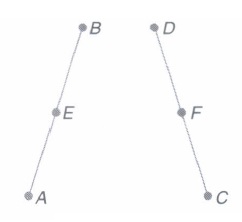
In figure, AE = DF, E is the mid-point of AB and F is the mid-point of DC. Using an Euclid's axiom, show that AB = DC.
2.
State any two Eulis's axioms.
3.
If x2+1/x2 = 7, find the value of x3+1/x3, using only the positive value of x+1/x.
4.
Factorise
(i) 2x2-7x-15
(ii) 84-2r-2r2
5.
The price of 2 pens and 5 pencils is Rs 60. Draw the graph after forming a linear equation.
6.
The unequal side of an isosceles triangle is 6 cm and its perimeter is 24 cm. Find its area.
7.
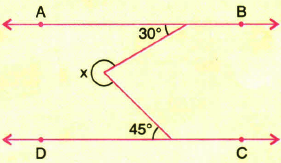
In figure AB || CD Determine x.
8.
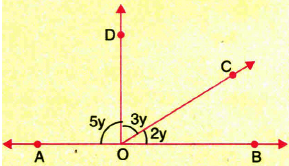
In the given figure if AOB is a line then find the measure of \(\angle \)BOC \(\angle \)COD and \(\angle \)DOA
9.
The taxi fare in a city is as follows: for the first kilometer, the fare is Rs.10 and for the subsequent distance it is Rs.6 per km. Taking the distance covered as x km and total fare as Rs.y, write a linear equation for this information, and draw its graph.
10.
Write the following equations in the form ax+by+c=0 and indicate the values of a, b and c
\(x-4=\sqrt{3}y\)
11.
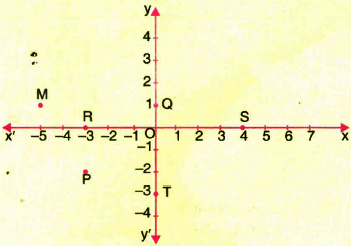
From given figure write the following:
(a) The coordinates of P
(b) The abscissa of the point Q
(c ) The ordinate of the point R
(d) The points whose abscissa is 0.
12.
In which quadrant do the given point lie? (-4,-5)
13.
Rationalize the denominator of \(\frac { 1 }{ 2+\sqrt { 3 } } \)
14.
Show that 0.2353535...\(=0.2\overline { 35 } \) can be expressed in the form p/q, where p and q are integers and \(q\neq 0\)
15.
Find the decimal expansions of 10/3, 7/8 and 1/7.
16.
Area of a triangle having base 6 cm and altitude 8 cm is
48 cm2
24 cm2
64 cm2
36 cm2
17.
In figure, the value of an angle q is
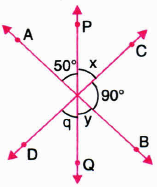
\(60^{ 0 }\)
\(90^{ 0 }\)
\(50^{ 0 }\)
\(40^{ 0 }\)
18.
Find the measure of the angle which is supplement of itself
\(30^{ 0 }\)
\(90^{ 0 }\)
\(45^{ 0 }\)
\(180^{ 0 }\)
19.
The sum of two complimentary angles is
\(180^{ 0 }\)
\(360^{ 0 }\)
\(90^{ 0 }\)
None of these
20.
'Lines are parallel if they do not intersect' is stated in the form of:
an axiom
a definition
a postulate
a proof
21.
The number of lines that can pass through a given point is:
two
none
only one
infinite many
22.
which of the following is a linear equation?
x2+4x-3=-(x2-1)
x2=3x+4
x+\(1\over x\)=5
(x-1)=1-x
23.
The equation x=7 in two variables can be written as:
1.x+1.y=7
1.x+1.y=3
0.x+1.y=7
0.x+0.y=7
24.
Write the coordinates of P
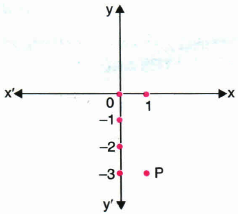
(1,-3)
(1,3)
(-1,-3)
(-1,3)
25.
The line of intersection of I and II quadrants is
x - axis
y - axis
vertical axis
None of these
26.
If x and y, both are positive, then the point (x,y) lies in
I quadrant
II quadrant
III quadrant
IV quadrant
27.
Which of the following is an example of a geometrical line?
Black Board
Sheet of paper
Meeting place of two walls
Tip of the sharp pencil
28.
The degree of the polynomial \((x^3+5)(4-x^5)\) is:
5
3
8
2
29.
\(y+\frac{1}{y}\) is:
polynomial of degree 1
polynomial of degree 2
polynomial of degree 3
Not a polynomial
30.
Select the correct statement from the following:
Degree of a zero polynomial is zero.
Degree of a zero polynomial is not defined.
Degree of a constant polynomial is not defined
Zero of the polynomial is not defined
31.
The compact form of (x+y)(x-y) is
\((x+y)(x-y)=x^2-y^2\) is an algebraic identity
\(x^2+y^2\)
\(x^2-2xy+y^2\)
\(x^2+2xy+y^2\)
\(x^2-y^2\)
32.
The value of \({ \left( 243 \right) }^{ \frac { 1 }{ 3 } }\) is equal to:
5
3
6
1
33.
A rational number lying between \(\sqrt { 2 } \) and \(\sqrt { 3 } \) is:
\(\frac { \sqrt { 2 } +\sqrt { 3 } }{ 2 } \)
\(\sqrt { 6 } \)
1.6
1.9
34.
Every rational number is:
a natural number
an integer
a real number
a whole number
35.
Which of the following is a rational number?
\(1+\sqrt { 3 } \)
\(\pi \)
\(2\sqrt { 3 } \)
0
36.
In a triangle, the bisectors of ∠B and ∠C intersect each other at a point O. Prove that ∠BOC = 90° + \(\frac{1}{2}\) ∠A.
37.
If x = 3-2√2, find the value of √x+\(\frac{1}{\sqrt{x}}\)
38.
Prove that: \({ \left( \frac { { x }^{ { a }^{ 2 } } }{ { x }^{ { b }^{ 2 } } } \right) }^{ \frac { 1 }{ a+b } }.{ \left( \frac { { x }^{ { b }^{ 2 } } }{ { x }^{ { c }^{ 2 } } } \right) }^{ \frac { 1 }{ b+c } }.{ \left( \frac { { x }^{ { c }^{ 2 } } }{ { x }^{ { a }^{ 2 } } } \right) }^{ \frac { 1 }{ c+a } }=1\)
39.
Find the area of a triangle two sides of which are 18 cm and 10 cm and the perimeter is 42 cm.
40.
Without actual division, prove that (x - 2) is a factor of the polynomial (3x3 - 13x2 + 8x + 12). Also, factorise it completely.
41.
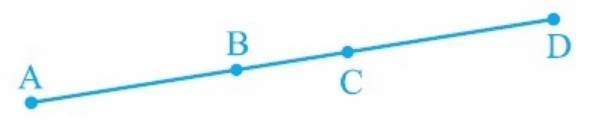
In the given figure, if AC = BD, then prove that AB = CD.
42.
Student of class IX are on visit of Sansad Bhawan. Teacher assign them the activity of observe and take some pictures to analyses the seating arrangement between variuos MP and speaker based on coordiate geometry. The staff tour guide explained various facts related to Math's of Sansad Bhawan to the students, students were surprised when teacher ask them you need to apply coordiante geometry on the seating arrangement of MP's and speaker.
Calcualte the following reger to the below image and graph. Answer the following questions:
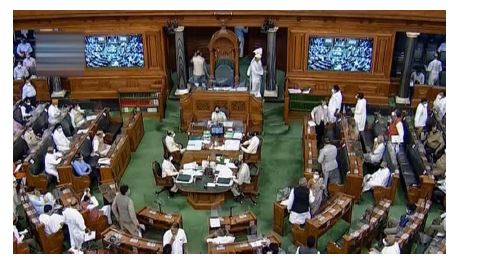
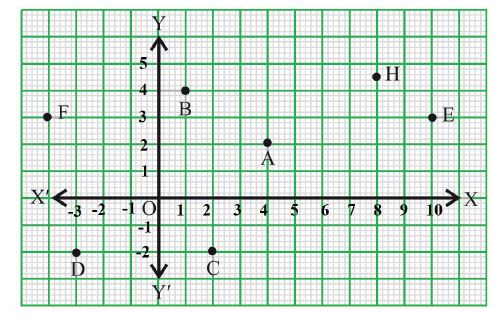
Answer the following refer to the above image and graph:
(i) What are the coordinates of postion 'F'?
| (a) (3, 4) | (b) (4, 3) |
| (c) (-3, 4) | (d) (-4, 3) |
(ii) What are the coordinates of position 'D'?
| (a) (3, 2) | (b) (-3, -2) |
| (c) (-3, 2) | (d) (3, -2) |
(iii) What are the coordinates of position 'H'?
| (a) (8, 5) | (b) (8, 4.5) |
| (c) (8, 4) | (d) (8, 5.5) |
(iv) In which quadrant, the point 'C' lie?
| (a) I | (b) II |
| (c) III | (d) IV |
(v) Find the perpendicular distance of the point E from the y-axis.
| (a) 13 units | (b) 10 units |
| (c) 11 units | (d) 3 units |
43.
Deepak bought 3 notebooks and 2 pens for Rs. 80. His friend Ram said that price of each notebook could be Rs. 25. Then three notebooks would cost Rs.75, the two pens would cost Rs.5 and each pen could be for Rs. 2.50. Another friend Ajay felt that Rs. 2.50 for one pen was too little. It should be at least Rs. 16. Then the price of each notebook would also be Rs.16.

Lohith also bought the same types of notebooks and pens as Aditya. He paid 110 for 4 notebooks and 3 pens. Later, Deepak guess the cost of one pen is Rs. 10 and Lohith guess the cost of one notebook is Rs. 30.
(i) Form the pair of linear equations in two variables from this situation by taking cost of one notebook as Rs. x and cost of one pen as Rs. y.
(a) 3x + 2y = 80 and 4x + 3y = 110
(b) 2x + 3y = 80 and 3x + 4y = 110
(c) x + y = 80 and x + y = 110
(d) 3x + 2y = 110 and 4x + 3y = 80
(ii) Which is the solution satisfying both the equations formed in (i)?
| (a) x = 10, y = 20 | (b) x = 20, y = 10 |
| (c) x = 15, y = 15 | (d) none of these |
(iii) Find the cost of one pen?
| (a) Rs. 20 | (b) Rs. 10 | (c) Rs. 5 | (d) Rs. 15 |
(iv) Find the total cost if they will purchase the same type of 15 notebooks and 12 pens.
| (a) Rs. 400 | (b) Rs. 350 | (c) Rs. 450 | (d) Rs. 420 |
(v) Find whose estimation is correct in the given statement.
| (a) Deepak | (b) Lohith | (c) Ram | (d) Ajay |
1.
AB = 2AE ( E is the mid-point of AB)
CD = 2DF (F is the mid-point of CD)
Also, AE = DF(Given)
Therefore, AB = CD(things which are double of the same things are equal to one another)
2.
Euclid's axioms
(i) Things which are equal to the same thing are equal to one another.
(ii) If equals are added to equals, the wholes are equal.
3.
Given, x2+1/x2 = 7
\(\Rightarrow\) x2+1/x2+2 = 7+2
\(\Rightarrow\) (x+1/x)2 = (3)2
x+1/x = 3
Now, cubing both sides, we get
x3+(1/x)3+3xX1/x(x+1/x) = (3)3
\(\Rightarrow\) x3+1/x3+3(3) = 27
\(\therefore\) x3+1/x3 = 27-9 = 18
4.
(i) 2x2-7x-15=2x2-10x+3x-15 [by splitting the middle term]
=2x(x-5)+3*x-5)=(2x+3)(x-5)
(ii) 84-2r-2r2=-2(r2+r-42)
=-2(r2+7r-6r-42)
=-2[r(r+7)-6(r+7)]
-2(r-6)(r+7)=2(6-r)(r+7)
5.
2x+ 5y = 60 and draw the graph as in black board example.
6.
\(18\sqrt { 2 } \)cm2
7.
\(255^{ 0 }\)
8.
\(36^{ 0 },54^{ 0 },90^{ 0 }\)
9.
y=10+6(x-1) ⇒ y=4+6x
10.
\(x-4=\sqrt{3}y\)=0; a=2, b=\(-\sqrt{3}\), c=-4
11.
(a) (-3,-2)
(b) 0
(c) 0
(d) R, Q, S, T, O
12.
III
13.
\(2-\sqrt { 3 } \)
14.
Let x = 0.235 . Over here, note that 2 does not repeat, but the block 35 repeats. Since two digits are repeating, we multiply x by 100 to get
100 x = 23.53535
100 x = 23.3 + 0.23535... = 23.3 + x
99 x = 23.3
\(99 x=\frac{233}{10}, \text { which gives } x=\frac{233}{990}\)
You can also check the reverse that \(\frac{233}{990}=0.2 \overline{35}\)
15.
3.3333....= \(3.\overline { 3 } \); 0.875; 0.142857 142857...
= \(0.\overline { 142857 } \)
16.
Area = \(\frac { Base\times Perpendicular }{ 2 } =\frac { 6\times 8 }{ 2 } \) = 24 cm2
17.
\(x+50^{ 0 }\)
\(y+90^{ 0 }+x=180^{ 0 }\quad 50^{ 0 }+90^{ 0 }+x=180^{ 0 }\)
\(\Rightarrow x=40^{ 0 }\)
\(q=x=40^{ 0 }\)
18.
X=\(180^{ 0 }\)-x\(\Rightarrow \)x\(90^{ 0 }\)
19.
Definition of complementary angles
20.
(a)
an axiom
21.
(d)
infinite many
22.
x-1=1-x ⇒ x=1 so a linear equation
23.
Evident
24.
(a)
(1,-3)
25.
(a)
x - axis
26.
(a)
I quadrant
27.
(c)
Meeting place of two walls
28.
\((x^3+5)(4-x^5)\)\(=4x^3-x^8+20-5x^5\)
29.
\(\frac{1}{y}=y^-1\) has negative exponent so, not a polynomial
30.
Convention
31.
(a)
\(x^2+y^2\)
32.
(b)
3
33.
(c)
1.6
34.
(c)
a real number
35.
(d)
0
36.
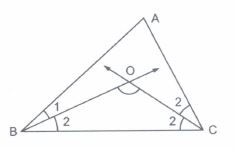
In a ΔABC, we have:
∠A + ∠B + ∠C = 180° [By angle sum property]
∴ \(\frac{1}{2}\) ∠A + ∠B + ∠C = \(\frac{1}{2}\) (180°) = 90°
⇒ \(\frac{1}{2}\) ∠A + ∠1 + ∠2 = 90°
⇒ ∠1 + ∠2 = 90° - \(\frac{1}{2}\) ∠A
Again, in ΔOBC, we have
∠1+ ∠2 + ∠BOC = 180° [By angle sum property]
⇒ (∠1+ ∠2) + ∠BOC = 180°
⇒ [ 90° -\(\frac{1}{2}\) ∠A] + ∠BOC = 180°
⇒ ∠BOC = 180° - [ 90° -\(\frac{1}{2}\) ∠A]
⇒ ∠BOC = 180° - 90° + \(\frac{1}{2}\) ∠A]
⇒ ∠BOC = 90° + \(\frac{1}{2}\) ∠A]
37.
\(x=3-2\sqrt { 2 } \Rightarrow \frac { 1 }{ x } =3+2\sqrt { 2 } \)
\({ \left( \sqrt { x } +\frac { 1 }{ \sqrt { x } } \right) }^{ 2 }=8\)
\(\Rightarrow \sqrt { x } +\frac { 1 }{ \sqrt { x } } =\pm 2\sqrt { 2 } \)
38.
\(={ \left( { x }^{ { a }^{ 2 }-{ b }^{ 2 } } \right) }^{ \frac { 1 }{ a+b } }.{ \left( { x }^{ { b }^{ 2 }-{ c }^{ 2 } } \right) }^{ \frac { 1 }{ b+c } }.{ \left( { x }^{ { c }^{ 2 }-{ a }^{ 2 } } \right) }^{ \frac { 1 }{ c+a } }\)
\(={ x }^{ \frac { { a }^{ 2 }-{ b }^{ 2 } }{ a+b } }.{ x }^{ \frac { { b }^{ 2 }-{ c }^{ 2 } }{ a+b } }.{ x }^{ \frac { { c }^{ 2 }-{ a }^{ 2 } }{ c+a } }\)
\(={ x }^{ a-b }.{ x }^{ b-c }.{ x }^{ c-a }\)
\(={ x }^{ 0 }\)
39.
Given, perimeter of the triangle, 2s = 42 cm
\(\therefore s=\frac{42}{2}=21cm\)
Let the given sides of the triangle be a = 18 cm, b = 10 cm and let c = x cm
Then, perimeter of the triangle
\(2s=a+b+c=18+10+x\ \ \ \ \ \ (ii)\)
From Eqs. (i) and (ii) 18+10x=42
\(\Rightarrow 28+x=42\Rightarrow x=42-48=14\)
\(\Rightarrow\ c=14cm\)
Now, area of a triangle\(=\sqrt{s(s-a)(s-b)(s-c)}\)
\(=\sqrt{21(21-18)(21-10)(21-14)}\)
\(=\sqrt{21\times3\times11\times7}=\sqrt{7\times3\times3\times11\times7}\)
\(=7\times3\sqrt{11}=21\sqrt{11}cm^2\)
Hence, the area of triangle is \(21\sqrt{11}cm^2\)
40.
(x - 2) (x - 3) (3x + 2)
41.
Given, AC = BD ...(i)
From figure, it is clear that
AC = AB + BC and BD = BC + CD.
On putting these values in Eq. (i), we get
AB + BC = BC + CD
On subtracting BC from both sides, we get
AB + BC - BC = BC + CD - BC
⇒ AB = CD [by axiom 3]
Hence proved
42.
(i) (d) (-4, 3)
(ii) (b) (-3, -2)
(iii) (b) (8, 4.5)
(iv) (d) IV
(v) (b) 10 units
43.
(i) (a) 3x + 2y = 80 and 4x + 3y = 110
Here, the cost of one notebook be Rs. x and that of pen be Rs. y.
According to the statement, we have
3x + 2y = 80 and
4x + 3y = 110
(ii) (b) x = 20, y = 10
3x + 2y = 3(20) + 2(10) = 60 + 20 = 80
4x + 3y = 4(20) + 3(10) = 80 + 30 = 110
(b) x = 20, y = 10
(iii) (b) Rs. 10
Cost of 1 pen = Rs. 10
(b) Rs. 10
(iv) (d) Rs. 420
Total cost = Rs. 15 x 20 + Rs. 12 x 10
= 300 + 120
= Rs. 420
(v) (a) Deepak
Ram said that price of each notebook could be Rs. 25.
Ajay felt that Rs. 2.50 for one pen was too little. It should be at least Rs. 16
Deepak guess the cost of one pen is Rs. 10 and
Lohith guess the cost of one notebook is Rs. 30
Therefore, estimation of Deepak is correct

9th Standard CBSE Syllabus & Materials
9th Standard CBSE
CBSE 9th Mathematics Lines and Angles Sample Question Papers Study Material - QB365 Set A
NEW9th Standard CBSE
CBSE 9th Mathematics Introduction to Euclid's Geometry Sample Question Papers Study Material - QB365 Set A
NEW9th Standard CBSE
CBSE 9th Mathematics Linear Equations in Two Variables Sample Question Papers Study Material - QB365 Set A
NEW9th Standard CBSE
CBSE 9th Mathematics Coordinate Geometry Sample Question Papers Study Material - QB365 Set A



NCERT Books

Syllabus

Exam Pattern

Sample Question Papers

Previous year Question Papers

Important Notes

MCQ Practice test

NCERT Exemplers

Case study Questions

Image Based Questions

Passage based Questions

HOT Questions

Value Based Questions

Model Questions Papers
NCERT ( Book Back ) Questions

Assertion and Reason
Important Questions And Answers

CBSE 9th Standard CBSE Subjects
CBSE Standards