100% FREE ACCESS
9th Standard CBSE Syllabus & Materials
9th Standard CBSE
CBSE 9th Science Is matter around us pure? - New Model Questions Papers Study Material - QB365 Set A
NEW9th Standard CBSE
CBSE 9th Science Matter in our surroundings - New Model Questions Papers Study Material - QB365 Set A
NEW9th Standard CBSE
CBSE 9th Mathematics Heron's Formula Sample Question Papers Study Material - QB365 Set A
NEW9th Standard CBSE
CBSE 9th Mathematics Circles Sample Question Papers Study Material - QB365 Set A
NEW9th Standard CBSE
CBSE 9th Mathematics Quadrilaterals Sample Question Papers Study Material - QB365 Set A
NEW9th Standard CBSE
CBSE 9th Mathematics Triangles Sample Question Papers Study Material - QB365 Set A

Published on: 29/10/2025
Download CBSE Class 9th Standard CBSE Mathematics question papers, sample papers, important questions, and previous year solved papers in PDF format. Get free study materials, NCERT solutions, and exam preparation resources for Class 9th Standard CBSE Mathematics
Questions + Answers key
Take MCQ Mathematics Test
1.
The angles of a triangle are in the ratio 2 : 3 : 4. What is the measure of the greatest angle?
2.
If a = 3+b, then what is the value of a3-b3-9ab.
3.
How many planes can be made to pass through
(i) Three collinear points.
(ii) Three non-collinear points.
4.
If a and b are natural numbers, then \((\sqrt { a } +\sqrt { b } )(\sqrt { a } -\sqrt { b } )\) is rational is it true?
5.
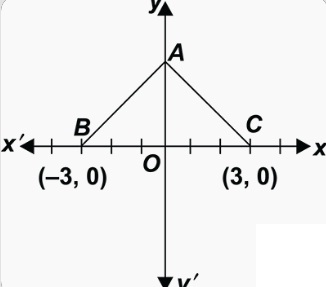
In the given figure, ABC is an equilateral triangle. The coordinates of vertices Band Care (3, 0) and (- 3, 0). respectively. Find the coordinates of its vertex A. Also, find
6.
An angle is equal to five times its supplement. Find the measure of the angle
7.
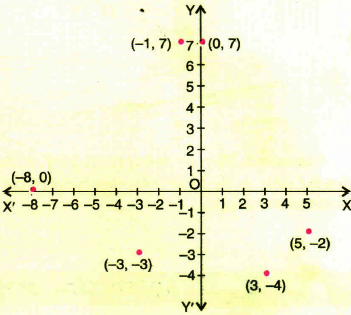
Plot the points given in the table below in cartesian plane:
|
x |
y |
|---|---|
| -1 | 7 |
| 3 | -4 |
| 0 | 7 |
| -8 | 0 |
| 5 | -2 |
| -3 | -3 |
8.
Rationalize \(\frac { 5 }{ \sqrt { 3 } -\sqrt { 5 } } \left( -\frac { 5 }{ 2 } \right) \)
9.
A triangle can havee
Two right angles
Two obtuse angles
All angles more than 60
Two acute angles
10.
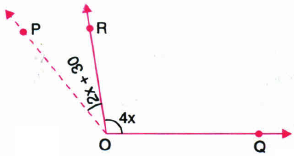
In the given figure the value of x which makes POQ a straight line is:
35
30
25
40
11.
Given four points such that no three of them are collinear, then the number of lines that can be drawn through them is:
2 lines
4 lines
6 lines
8 lines
12.
The thing which coincide with one another are:
equal
unequal
half of some thinf
triple of one another
13.
In which quadrant does the point (1,-2) lie?
I
II
III
IV
14.
The line of intersection of IV and I quadrants is
x - axis
y - axis
vertical axis
None of these
15.
If x-2 is a factor of \(5x^2-kx-18,\) then the value of k is:
-1
1
0
5
16.
If \(p(x)=2+\frac{x}{2}+x^2-\frac{x^2}{3},\) then p(-1) is:
\(\frac{15}{6}\)
\(\frac{17}{6}\)
\(\frac{1}{6}\)
\(\frac{13}{6}\)
17.
Simplified value of \({ \left( 25 \right) }^{ \frac { 1 }{ 3 } }\times { \left( 5 \right) }^{ \frac { 1 }{ 3 } }\) is:
25
3
1
5
18.
In the given figure, name the following:
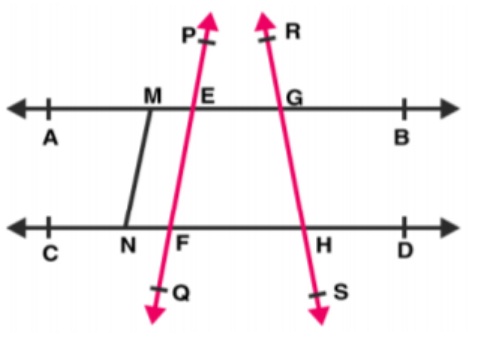
(i) Six points
(ii) Five line segments
(iii) Four collinear points
(iv) Four lines
19.
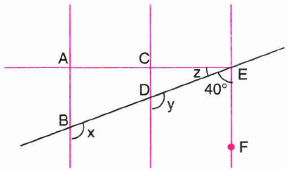
In figure AB || CD and CD || EF Also EA \(\bot \) AB if \(\angle BEF=40^{ 0 }\) , then find x,y,z
20.
Plot the points A(2,0), B(2,2), C(0,2) and D(0,0) and draw line segments OA, AB, BC and CO.What figure do you obtain?
21.
If \(x=-2\) is the root of the equation \(\sqrt { 2 } (x+p)=0\) and is also the zero the zero of the polynomial \({ px }^{ 2 }+kx+2\sqrt { 2 } \) then find the value of k.
22.
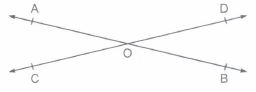
Two lines AB and CD intersect at a point O. Prove that: ∠AOD = ∠BOC.
23.
Simplify \(\sqrt [ 4 ]{ 81 } -8(\sqrt [ 3 ]{ 216 } )+15(\sqrt [ 5 ]{ 32 } )+\sqrt { 225 } .\)
24.
Consider two 'postulates' given below:
(i) Given any two distinct points A and B, there exists a third point C which is in between A and B.
(ii) There exist at least three points that are not on the same line.
Do these postulates contain any undefined terms? Are these postulates consistent? Do they follow from Euclid's postulates? Explain.
25.
In which quadrant do the given points lie?(-6,2)
26.
Write the following cubes in expanded from: \((2a-3b)^3\)
27.
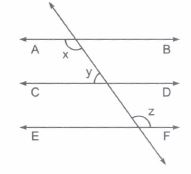
In the following Figure, if AB II CD, CD ll EF and y : z = 3 : 7, find x.
28.
Which of the following statements are true and which are false? Give reason for your answers.
(i) Only one line can pass through a single point.
(ii) There are an infinite number of lines which pass through two distinct points.
(iii) The terminated line can be produced indefinitely on both the sides.
(iv) If two circles are equal, then their radii are equal.
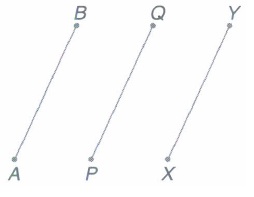
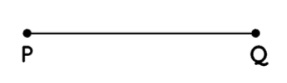
(v) In the given figure, if AB = PO and PO = XY, then AB =XY.
29.
Express 0.3333 .... in the form of \(\frac{\mathrm{p}}{\mathrm{q}}(\mathrm{q} \neq 0)\).
30.
Find the zeros of the polynomial p(x) = (x-3)2 - (x + 3)2.
31.
Can a triangle have all angles less than 60°? Give reason.
32.
Find the coordinate of a point whose ordinate is 4 and which lies on Y-axis.
33.
The difference of two complementary angles is 40°. Find the angles.
34.
Aditya is a Class IX student residing in a village. One day, he went to a city Hospital along with his grandfather for general checkup. From there he visited three places - School, Library and Police Station. After returning to his village, he plotted a graph by taking Hospital as origin and marked three places on the graph as per his direction of movement and distance. The graph is shown below:
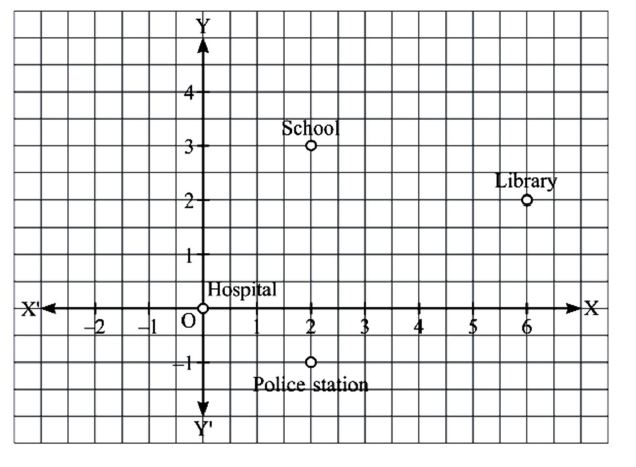
(i) What are the coordinates of School?
| (a) (3, 2) | (b) (2, 3) |
| (c) (3, 5) | (d) (5, 3) |
(ii) What are the coordinates of Police Station?
| (a) (2, -1) | (b) (2, 1) |
| (c) (-2, -1) | (d) (-2, 1) |
(iii) Distance between school and police station:
| (a) 4 | (b) 3 | (c) 2 | (d) 1 |
(iv) What are the coordinates of Library?
| (a) (2, 6) | (b) (2, -6) |
| (c) (6, -2) | (d) (6, 2) |
(v) In which quadrant the point (-1, 4) lies?
| (a) I | (b) II |
| (c) III | (d) IV |
35.
Assertion : Sum of the pair of angles 120о and 60о is supplementary.
Reason : Two angles, the sum of whose measures is 180о, are called supplementary angles.
Codes
(a) Both assertion (A) and reason (R) are true and reason (R) is the correct explanation of assertion (A).
(b) Both assertion (A) and reason (R) are true but reason (R) is not the correct explanation of assertion (A).
(c) Assertion (A) is true but reason (R) is false.
(d) Assertion (A) is false but reason (R) is true.
36.
Assertion : If two internal opposite angles of a triangle are equal and external angle is given to be 110о, then each of the equal internal angle is 55о.
Reason : A triangle with one of its angle 90о, is called a right triangle.
Codes
(a) Both assertion (A) and reason (R) are true and reason (R) is the correct explanation of assertion (A).
(b) Both assertion (A) and reason (R) are true but reason (R) is not the correct explanation of assertion (A).
(c) Assertion (A) is true but reason (R) is false.
(d) Assertion (A) is false but reason (R) is true.
37.
Assertion: A point whose abscissa is 2 and ordinate is -3 lies in fourth quadrant
Reason: Points of the type (–, +) lie in the second quadrant.
Codes:
(a) Both assertion (A) and reason (R) are true and reason (R) is the correct explanation of assertion (A).
(b) Both assertion (A) and reason (R) are true but reason (R) is not the correct explanation of assertion (A).
(c) Assertion (A) is true but reason (R) is false.
(d) Assertion (A) is false but reason (R) is true.
38.
Assertion : The point (-2, 0) lies on y -axis and (0, 4) on x -axis.
Reason : Every point on the x -axis has zero distance from x -axis and every point on the y -axis has zero distance from y -axis.
Codes:
(a) Both assertion (A) and reason (R) are true and reason(R) is the correct explanation of assertion (A).
(b) Both assertion (A) and reason (R) are true but reason (R) is not the correct explanation of assertion (A).
(c) Assertion (A) is true but reason (R) is false.
(d) Assertion (A) is false but reason (R) is true.
39.
Assertion : Rational number lying between two rational numbers x and y is \(\frac{1}{2}\)(x + y).
Reason : There is one rational number lying between any two rational numbers.
Codes:
(a) Both assertion (A) and reason (R) are true and reason (R) is the correct explanation of assertion (A).
(b) Both assertion (A) and reason (R) are true but reason (R) is not the correct explanation of assertion (A).
(c) Assertion (A) is true but reason (R) is false.
(d)Assertion (A) is false but reason (R) is true.
1.
80°
2.
a=3+b
\(\Rightarrow\) a-b=3
\(\Rightarrow\) (a-b)3=(3)3
a3-b3-3ab(a-b)=27
a3-b3-3ab\(\times\)3=27
a3-b3-9ab=27.
3.
(i) Infinite, if they are collinear.
(ii) Only one, if they are non-collinear points.
4.
True
5.
Since, BC = 3 + 3 = 6
\(\therefore \) its area. Length of altitude OA = \(=\frac { \sqrt { 3 } }{ 2 } \times BC=\frac { \sqrt { 3 } }{ 2 } \times 6\times 3\sqrt { 3 } \)
[ \(\therefore \) Altitude of an equilateral triangle ,AQ = \(\frac { 1 }{ 2 } \times 6\times 3\sqrt { 3 } \)
= \(9\sqrt { 3 } \) sq units
6.
\(150^{ 0 }\)
7.
8.
\(\left( \sqrt { 3 } +\sqrt { 5 } \right) \)
9.
Angle sum property of a traingle
10.
\(4x+(2x+30)=180^{ 0 }\)
11.
(c)
6 lines
12.
(a)
equal
13.
(d)
IV
14.
(a)
x - axis
15.
\(x-2=0\quad \Rightarrow \quad x=2\)
\(f(x)=5x^2-kx-18\)
\(f(2)=0\)
\(\Rightarrow \ 5(2)^2-k(2)-18=0\)
\(\Rightarrow \ k=1\)
16.
\(p(-1)=2+\frac{-1}{2}+(-1)^2-\frac{(-1)^3}{3}=\frac{17}{6}\)
17.
(d)
5
18.
(i) E,F,G,H,M,N
(ii) \(\overline{EG}\),\(\overline{FH}\),\(\overline{EF}\),\(\overline{GH}\),\(\overline{MN}\)
(iii) M,E,G,B
(iv) \(\overleftrightarrow { AB } ,\overleftrightarrow { CD } ,\overleftrightarrow { PQ } ,\overleftrightarrow { RS } \)
19.
\(\therefore \) CD || EF
and a transversal DE intersect them
\(\therefore y+40^{ 0 }\)=\(180^{ 0 }\)
Sum of the consecutive interior on the same side of a traversal is \(180^{ 0 }\)
\(\Rightarrow Y=180^{ 0 }-40^{ 0 }=140^{ 0 }\)
\(\therefore \) AB||CD and a traversal BD intersects them
\(\therefore \) c=y | corresponding angles
\(\Rightarrow x=140^{ 0 }\)
\(\therefore EA\quad \bot \quad AB\quad and\quad AB||EF\)
\(\therefore EA\quad \bot \quad EF\quad \)
If a line is perpendicular to a line then it is perpendicular to the parallel line also
\(\Rightarrow \angle AEF=90^{ 0 }\)
\(\Rightarrow Z+40^{ 0 }=90^{ 0 }\)
\(\Rightarrow Z+50^{ 0 }\)
20.
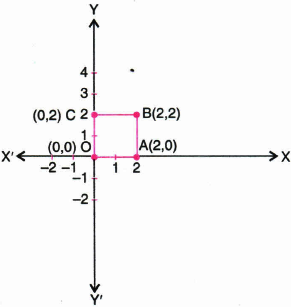
The figure obtained is a square.
21.
\(\sqrt { 2 } (x+p)=0\)
\(\Rightarrow x+p=0\)
\(\Rightarrow x=-p\)
According to the question,
\(-p=-2\)
\(\Rightarrow \ p=2\)
Let \(f(x)={ px }^{ 2 }+kx+2\sqrt { 2 } \)
Then, \(f(x)={ 2x }^{ 2 }+kx+2\sqrt { 2 } \)
If \(x=-2\) is a zero of f(x) then
\(f(-2)=0\)
\(\Rightarrow \ 2{ (-2) }^{ 2 }+k(-2)+2\sqrt { 2 } =0\)
\(\Rightarrow 2k=8+2\sqrt { 2 }\)
\(\Rightarrow k=4+\sqrt { 2 } \)
22.
Since, OA stands on the given line CD.
∴ ∠AOC + ∠AOD = 180о ...(1)
Again, OD stands on the given line AB.
∴ ∠AOD + ∠BOD = 180° ...(2)
From (1) and (2), we have:
∠AOC + ∠AOD = ∠AOD + ∠BOD
or ∠AOC = ∠BOD
23.
0
24.
Yes! These postulates contain two undefined terms: Point and Line. Yes! These postulates are consistent because they deal with two different situations
(i) says that given two points A and B, there is a point C lying on the line in between them,
(ii) says that given A and B, we can take C not lying on the line through A and B. These 'postulates' do not follow from Euclid's postulates, however, they follow from Axiom 'Given two distinct lines, there is a unique line that passes through them.
25.
II
26.
\((2a-3b)^3\)
\({ (2a-3b) }^{ 3 }={ (2a) }^{ 3 }-{ (3b) }^{ 3 }-2(2a)(3b)(2a-3b)\) | Using Identity VII
\(=8{ a }^{ 3 }-27{ b }^{ 3 }-18ab(2a-3b)\)
\(=8{ a }^{ 3 }-27{ b }^{ 3 }-36{ a }^{ 2 }b+54{ ab }^{ 2 }\)
27.
∵ \(\left.\begin{array}{l} \mathrm{AB} \| \mathrm{CD} \\ \mathrm{EF} \| \mathrm{CD} \end{array}\right\}\) (given)
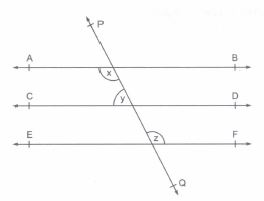
∴ AB II EF and PQ is a transversal.
∴ Interior alternate angles are equal.
∴ ∠x = ∠y ...(1)
Again, AB II CD,
∴ Interior opposite angles are supplementary,
⇒ y + z = 180o
But y : z = 3 : 7
∴ y = \(\frac{180^{\circ}}{(y+z)}\) x 3 = \(\left[\frac{180^{\circ}}{(3+7)}\right]\) x 3 = \(\frac{180^{\circ}}{10}\) x 3 = 54о
and z = \(\frac{180^{\circ}}{(y+z)}\) x 7 = \(\left[\frac{180^{\circ}}{(3+7)}\right]\) x 7 = \(\frac{180^{\circ}}{10}\) x 7 = 126о ...(2)
From (1) and (2), we have
x = 126о
28.
(i) False, because from a single point, infinite number of lines can pass.
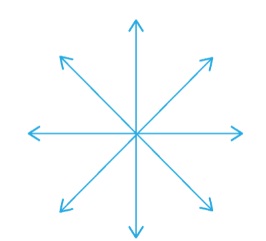
(ii) False, because from two distinct points, only one straight line can pass. [by postulate axiom]
(iii) True, it is Euclid's postulate 2.
(iv) True, because radii of congruent (equal) circles are always equal. In other words, if we superimpose the region bounded by one circle on the other circle, then they coincide. Then, their centres and boundaries also a>incide. Therefore, their radii will be same.
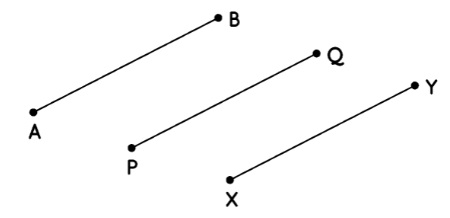
(v) True,given that AB = PQ (i) and PQ = XY (ii)
From Eqs. (i) and (ii), AB = XY
29.
()
\(\frac{1}{3}\)
30.
()
0
31.
()
No, a triangle cannot have all the angles less than 60° because if all the angles will be less than 60°, then their sum will not be equal to 180°. Hence, it will not be a triangle.
32.
()
(0,4)
33.
()
25° and 65°
34.
(i) (b) (2, 3)
(ii) (a) (2, -1)
(iii) (a) 4
(iv) (d) (6, 2)
(v) (b) II
35.
We know that two angles are said to be supplementary if their sum of measure of angles is 180о.
So, Reason is correct.
Now, 120о + 60о = 180о ⇒ Sum of the pair of angles 120о and 60о is supplementary.
So, Assertion is also correct
Also, reason (R) is the correct explanation of assertion (A).
Correct option is (a) Both assertion (A) and reason (R) are true and reason (R) is the correct explanation of assertion (A).
36.
For Assertion: We know that the exterior angle is equal to the sum of its interior opposite angles. So, x + x =110о.
⇒ 2x = 110о
⇒ x = 55о
So, Assertion is correct
Also, we know that a triangle with one of its angle 90о, is called a right triangle.
So, Reason is also correct.
But reason (R) is not the correct explanation of assertion (A).
Correct option is (b) Both assertion (A) and reason (R) are true and reason (R) is not the correct explanation of assertion (A).
37.
We know that Points of the type (–, +) lie in the second quadrant. So, Reason is correct.
Also, we know that Points of the type (+, –) lie in the fourth quadrant.
Hence, point whose abscissa is 2 and ordinate is -3 lies in fourth quadrant So, Assertion is also correct but Reason is the not the correct explanation of Assertion.
Correct option is (b) Both assertion (A) and reason (R) are true but reason (R) is not the correct explanation of assertion (A).
38.
We know that Every point on the x -axis has zero distance from x -axis and every point on the y -axis has zero distance from y -axis.
So, Reason is correct.
Now, point (-2, 0) lies on x-axis and (0, 4) on y-axis So, Assertion is not correct
Correct option is (d) Assertion (A) is false but reason (R) is true.
39.
We know that there are infinitely many rational numbers between any two given rational numbers.
So, Reason is not correct.
One of the rational number lying between two rational numbers x and y is \(\frac{1}{2}\)(x + y).
So, Assertion is correct
Correct option is (c) Assertion (A) is true but reason (R) is false.

9th Standard CBSE Syllabus & Materials
9th Standard CBSE
CBSE 9th Mathematics Lines and Angles Sample Question Papers Study Material - QB365 Set A
NEW9th Standard CBSE
CBSE 9th Mathematics Introduction to Euclid's Geometry Sample Question Papers Study Material - QB365 Set A
NEW9th Standard CBSE
CBSE 9th Mathematics Linear Equations in Two Variables Sample Question Papers Study Material - QB365 Set A
NEW9th Standard CBSE
CBSE 9th Mathematics Coordinate Geometry Sample Question Papers Study Material - QB365 Set A



NCERT Books

Syllabus

Exam Pattern

Sample Question Papers

Previous year Question Papers

Important Notes

MCQ Practice test

NCERT Exemplers

Case study Questions

Image Based Questions

Passage based Questions

HOT Questions

Value Based Questions

Model Questions Papers
NCERT ( Book Back ) Questions

Assertion and Reason
Important Questions And Answers

CBSE 9th Standard CBSE Subjects
CBSE Standards