100% FREE ACCESS
9th Standard CBSE Syllabus & Materials
9th Standard CBSE
CBSE 9th Science Is matter around us pure? - New Model Questions Papers Study Material - QB365 Set A
NEW9th Standard CBSE
CBSE 9th Science Matter in our surroundings - New Model Questions Papers Study Material - QB365 Set A
NEW9th Standard CBSE
CBSE 9th Mathematics Heron's Formula Sample Question Papers Study Material - QB365 Set A
NEW9th Standard CBSE
CBSE 9th Mathematics Circles Sample Question Papers Study Material - QB365 Set A
NEW9th Standard CBSE
CBSE 9th Mathematics Quadrilaterals Sample Question Papers Study Material - QB365 Set A
NEW9th Standard CBSE
CBSE 9th Mathematics Triangles Sample Question Papers Study Material - QB365 Set A

Published on: 29/10/2025
Download CBSE Class 9th Standard CBSE Mathematics question papers, sample papers, important questions, and previous year solved papers in PDF format. Get free study materials, NCERT solutions, and exam preparation resources for Class 9th Standard CBSE Mathematics
Questions + Answers key
Take MCQ Mathematics Test
1.
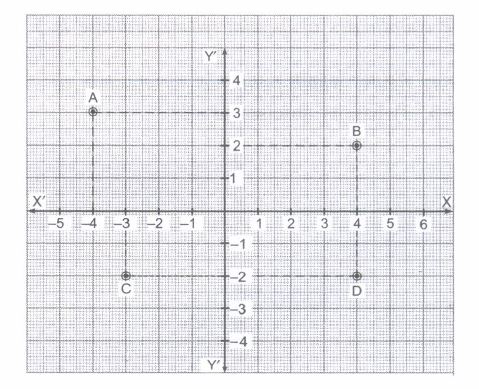
What are the coordinates of A, B, C and D in the following figure?
2.
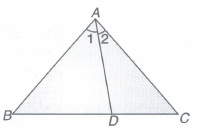
In \(\triangle ABC,\angle B=45^o,\angle C=55^o\), AD bisects \(\angle A.\) Find \(\angle ADB\) and \(\angle ADC\)
3.
State any two Euclid's axioms.
4.
If √2 = 1.414, then, find the value of \(\frac{1}{\sqrt{2}+1}\)
5.
In which quadrant, do the given points lie?
(i) (4, -2) (ii) (-3, 7) (iii) (-1, -2) (iv) (3,6)
6.
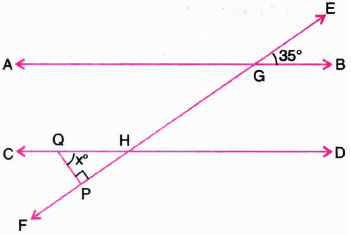
In the given figure AB ||CD and EF is transversal cutting them at G and H respectively.If \(\angle EGB=35^{ 0 }\) and QP \(\bot \) then find \(\angle PQH\)
7.
Factorise: \(216x^3+\frac{1}{125}\)
8.
Find three rational numbers between -5/6 and 3/8.
9.
Two lines are respectively perpendicular to two perpendicular lines then the these two lines to each other are
parallel
perpendicular
inclined at some acute angle
intersecting at \(110^{ 0 }\)
10.
The angle supplementary to \(180^{ 0 }\)-\(9^{ 0 }\) is
\(9^{ 0 }\)
\(180^{ 0 }\)
\(180^{ 0 }\) + \(9^{ 0 }\)
\(90^{ 0 }\) + \(9^{ 0 }\)
11.
The number of line segments determined by three collinear points is:
two
Three
Only one
Four
12.
Euclid belonged to the country
Babylonia
Egypt
Greek
india
13.
By plotting the points O(0,0), A(1,0), B(1,1), C(0,1) and joining OA, AB, BC and CO, the figure we obtain is:
Square
Rectangle
Trapezium
Rhombus
14.
The distance of a point (0,-3) from the origin is:
0 units
Cannot be determined
-3 units
3 units
15.
The zeros of the polynomial \(x^2+2 x+3\) are
real
not real
irrational
rational
16.
Select the correct statement from the following:
Degree of a zero polynomial is zero.
Degree of a zero polynomial is not defined.
Degree of a constant polynomial is not defined
Zero of the polynomial is not defined
17.
The decimal expansion of \(\sqrt { 2 } \) is
finite decimal
1.4121
non-terminating recurring
non-terminating non-recurring
18.
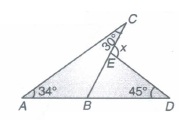
In the given figure, find the value of x:
19.
If x = √2-1, then find the value of \((x-\frac{1}{x})^{3}\) .
20.
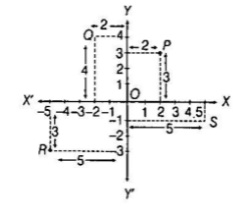
Write down the
(i) abscissa
(ii) ordinate
(iii) coordinates and
(iv) quadrant in which points P, Q, R and S lie.
21.
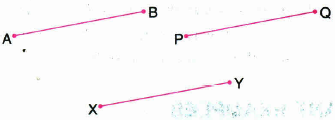
Which of the following statements are true and which are false? Give reasons for your answers:
(i) Only one line can pass through a single point.
(ii) There are an infinite number of lines which pass through two distinct points.
(iii) A terminated line can be produced indefinitely on both the sides.
(iv) If two circles are equal, then their radii are Equal.
22.
Which of the following expressions are polynomials in one variable and which are not? State reasons for your answer.
\(y+\frac { 2 }{ y } \)
23.
Factorise: (p - q)3 + (q - r)3 + (r - p)3
24.
Which of the following is the 5th postulate of Euclid?
(i) The whole is greater than the part.
(ii) If a straight line falling on two straight lines make the interior angles on the same side of it taken together less than two right angles then the two straight lines if produced indefinitely meet on that side on which the sum of angles is less than two right angles.
(iii) "all right angles are equal to one another."
25.
In \(\triangle ABC,\angle A=\angle B/2=\angle C/6,\) then what will be the measurement of \(\angle A?\)
26.
Find the coordinate of a point whose ordinate is 4 and which lies on Y-axis.
27.
State whether the following statements are true or false. Give reasons for your answers.
(i) Zero is neither a negative nor a positive integer.
(ii) There are finitely many rational numbers between any two given rational numbers.
28.
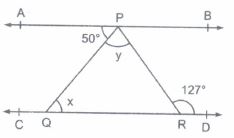
In the following figure, if AB ॥ CD, ∠APQ = 50° and ∠PRD = 127о find x and y.
29.
Why is axiom 5, in the list of Euclid's axioms, considered a 'universal truth'?
30.
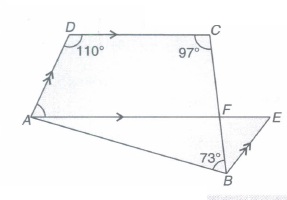
In the above figure ABCD is a quadrilateral in which \(\angle ABC=73^o,\angle C=97^o\) and \(\angle D=110^o\). If AE||DC and BE||AD and AE intersects BC at F, find the measure of \(\angle EBF.\)
31.
find the value of p if the polynomial p(x)=x4-2x3+3x2-px+3p-7 when divided by (x+1) leaves the remainder 19. Also find the remainder when p(x) is divided by x+2.
32.
Plot the points (x, y) given in the following table.
| X | 4 | 5.5 | -2 | -1 | 0 | 2.5 |
| y | -5 | -3 | 5 | -6 | 5 | 0 |
33.
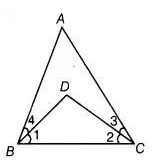
In the given figure, we have ㄥABC = ㄥACB and ㄥ3 =ㄥ4. Show that BD = DC
34.
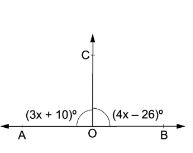
Assertion: In the given figure, AOB is a straight line. ∠AOC = (3x + 10)° and ∠BOC (4x − 26)°, then ∠BOC = 86°
Reason: The sum of angles that are formed on a straight line is equal to 180°.
Codes
(a) Both assertion (A) and reason (R) are true and reason (R) is the correct explanation of assertion (A).
(b) Both assertion (A) and reason (R) are true but reason (R) is not the correct explanation of assertion (A).
(c) Assertion (A) is true but reason (R) is false.
(d) Assertion (A) is false but reason (R) is true.
35.
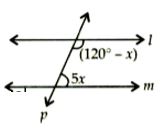
Assertion: The value of x from the adjoining figure, if l || m is 150.
Reason: If two parallel lines are intersected by a transversal, then each pair of corresponding angles so formed is equal.
Codes
(a) Both assertion (A) and reason (R) are true and reason (R) is the correct explanation of assertion (A).
(b) Both assertion (A) and reason (R) are true but reason (R) is not the correct explanation of assertion (A).
(c) Assertion (A) is true but reason (R) is false.
(d) Assertion (A) is false but reason (R) is true.
36.
Assertion : The point (0, 4) lies on y -axis.
Reason : The x co-ordinate on the point on y -axis is zero.
Codes:
(a) Both assertion (A) and reason (R) are true and reason (R) is the correct explanation of assertion (A).
(b) Both assertion (A) and reason (R) are true but reason (R) is not the correct explanation of assertion (A).
(c) Assertion (A) is true but reason (R) is false.
(d) Assertion (A) is false but reason (R) is true.
37.
Assertion: The abscissa of a point (5, 2) is 5.
Reason: The perpendicular distance of a point from y-axis is called its abscissa.
Codes:
(a) Both assertion (A) and reason (R) are true and reason (R) is the correct explanation of assertion (A).
(b) Both assertion (A) and reason (R) are true but reason (R) is not the correct explanation of assertion (A).
(c) Assertion (A) is true but reason (R) is false.
(d) Assertion (A) is false but reason (R) is true.
38.
Assertion : 0.329 is a terminating decimal.
Reason : A decimal in which a digit or a set of digits is repeated periodically, is called a repeating, or a recurring, decimal.
Codes:
(a) Both assertion (A) and reason (R) are true and reason (R) is the correct explanation of assertion (A).
(b) Both assertion (A) and reason (R) are true but reason (R) is not the correct explanation of assertion (A).
(c) Assertion (A) is true but reason (R) is false.
(d) Assertion (A) is false but reason (R) is true.
39.
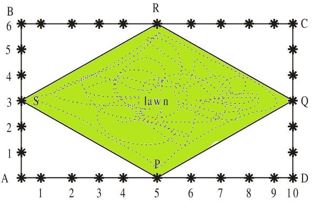
The Class IX students of a secondary school in Krishinagar have been allotted a rectangular plot of land for their gardening activity. Sapling of Gulmohar are planted on the boundary at a distance of 1m from each other. There is a lawn PQRS in the ground as shown in below figure.
(a) What are the coordinates of C, taking A as origin?
| (i) C(6, 10) | (ii) C(10, 10) |
| (iii) C(6, 6) | (iv) C(10, 6) |
(b) What are the coordinates of R, taking A as origin?
| (i)R(6, 5) | (ii) R(5, 5) |
| (iii) R(5, 6) | (iv) R(6, 6) |
(c) Side of lawn is :
| (i) 4 units | (ii) \(\sqrt{34}\) units | (iii) 34 units | (iv) None |
(d) Shape of lawn is :
| (i) Rectangle | (ii) Square |
| (iii) Parallelogram | (iv) Rhombus |
(e) Area of lawn is :
| (i) 30 sq. units | (ii) 60 sq. units |
| (iii) 45 sq. units | (iv) None |
1.
The coordinates of A are (-4, 3).
The coordinates of B are (4, 2).
The coordinates of C are (-3, -2).
The coordinates of D are (4, -2).
2.
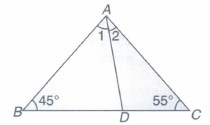
\(\angle 1=\angle 2=x, \angle B=45^o\)
\(\angle A+\angle B+\angle, C=180^o \angle C=55^o\) (Angle sum prop of \(\triangle)\)
\(\Rightarrow\) 2x+45o+55o=180o
2x=80o
x=40o
\(\angle ADB=\angle 2+\angle C\) (Exterior angle is the sum of the two interior opposite angles)
=40o+55o
=95o
Similarly, \(\angle ADC=\angle 1+\angle B\)
=45o+40o
=85o
3.
Euclid's axioms
(i) Things which are equal to the same thing are equal to one another.
(ii) If equals are added to equals, the wholes are equal.
4.
\(\frac{1}{\sqrt{2}+1}\)=\(\frac { \left( \sqrt { 2 } -1 \right) }{ \left( \sqrt { 2 } -1 \right) } \) = √2-1
= 1.414-1
= 0.414
5.
(i) IV (ii) II (iii) III (iv) I
6.
\(55^{ 0 }\)
7.
\((6x+\frac{1}{5})(36x^2-\frac{6x}{5}+\frac{1}{25})\)
8.
-11/48, 7/96, 43/192
9.
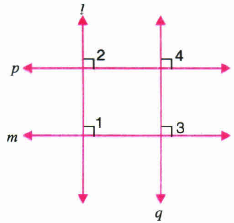
Let \(l\bot m\)
Then \(\angle 1=90^{ 0 }\)
\(P\bot 1\)
Then \(\angle 2=90^{ 0 }\)
10.
Required angle=\(180^{ 0 }\)-(\(180^{ 0 }\)+\(9^{ 0 }\)) =\(9^{ 0 }\)
11.
(b)
Three
12.
(c)
Greek
13.
(a)
Square
14.
(d)
3 units
15.
\(x^2+2 x+3=0\)
\(\Rightarrow\quad x=\frac{-2\pm\sqrt{4-12}}{2}=\frac{-2\pm2\sqrt{2}i}{2}\)
\(=-1\pm\sqrt{2}i\)
16.
Convention
17.
(d)
non-terminating non-recurring
18.
\(\angle CBD=34^o+30^o\)
=64o( Exterior \(\angle\)of \(\triangle ABC\))
\(x^o=\angle EBD+\angle EDB\)
=64o+65o
xo=109o
19.
x = √2-1
\(\frac { 1 }{ x } =\frac { 1 }{ \sqrt { 2 } -1 } \times \frac { \sqrt { 2 } +1 }{ \sqrt { 2 } +1 } \)
\(\frac { 1 }{ x } =\frac { \sqrt { 2 } +1 }{ 2-1 } =\sqrt { 2 } +1\)
\({ \left( x-\frac { 1 }{ x } \right) }^{ 3 }={ \left( \sqrt { 2 } -1-\sqrt { 2 } -1 \right) }^{ 3 }\)
= (-2)3
= -8
20.
For Point P
(i) Abscissa of the point = 2
(ii) Ordinate of the point = 3
(iii) Coordinates of the point = (2, 3)
(iv) The point (2, 3) lies in the I quadrant.
For Point Q
(i) Abssissa of the point = - 2
(ii) Ordinate of the point = 4
(iii) Coordinates of the point = (-2, 4)
(iv) The point (-2, 4) lies in the II quadrant.
For Point R
(i) Abscissa of the point = - 5
(ii) Ordinate of the point = - 3
(iii) Coordinates of the point = (-5, - 3)
(iv) The point (-5, -3) lies in the III quadrant.
For Point S
(i) Abscissa of the point = 5
(il; Ordinate of the point = -1
(iii) Coordinates of the point = (5, -1)
(iv) The point (5, -1) lies in the IV quadrant.
21.
(i) False. This can be seen visually.
(ii) False. This contradicts the Axiom.
[Given two distinct points, there is a unique line that passes through them.]
(iii) True by Euclid's Postulate
[A terminated line can be produced indefinitely.]
(iv) True. If we superimpose the region bounded by one circle on the other, then they coincide. So, their centres and boundaries coincide, therefore, their radii will coincide.
(v) True by the first Axiom of Euclid.
[Things which are equal to the same thing are equal to one another.]
22.
This expression is not a polynomial because in the term \(\frac { 2 }{ y } \) , the exponent of y is (- 1) which is not a whole number.
23.
()
3(p - q)(q - r)(r - p)
24.
()
The option (ii) is the Euclid's fifth postulate.
25.
()
In \(\triangle ABC,\)
\(\angle A+\angle B+\angle C=180^o\)(By given conditions)
\(\Rightarrow \angle A+2\angle A+6\angle A=180^o\)
\(\Rightarrow 9\angle A=180^o\)
\(\Rightarrow \angle A=20^o\)
26.
()
(0,4)
27.
()
(i) True, because 0 is non-negative or non-positive integer.
(ii) False, because there are infintely many rational numbers between two rational numbers.
28.
We have AB ॥ CD [Given] and PQ is a transversal.
∴ Interior alternate angles are equal.
∴ ∠APQ = ∠PQR
or 50° = x [∵ APQ = 50° (Given)] ...(1)
Again, AB ॥ CD and PR is a transversal.
∴ ∠APR = ∠PRD [Interior alternate angles]
⇒ ∠APR = 127° [∵ It is given that ∠PRD = 127o]
But ∠APR = ∠APQ + ∠QPR
∴ ∠APQ + ∠QPR = 127°
⇒ 50° + y = 127° [∵ It is given that ∠APQ = 50о]
⇒ y = 127° - 50° = 77°
Thus, x = 50° and y = 77°
29.
According to axiom 5, we have the whole is greater than the part, which is a universal truth. Let a line segment PQ = 8 cm. Consider a point R in its interior, such that PR = 5cm.
Clearly, PR is a part of the line segment PQ and R lies in its interior. So, PR is smaller than PQ. Hence, the whole is greater than its part and this is true for anything in any part of the world.
30.
Let \(\angle DAF=\angle 1\)
\(\angle CFA=\angle 2,\)
\(\angle BFE=\angle 3\)
\(\angle BEF=\angle 4\)
Since, AE||DC
\(\angle D+\angle 1=180^o\)
(Angles on the same side of transversal)
\(\angle 1=180^o-110^o=70^o\)
\(\angle 4=\angle 1=70^o\) (Alternate angle)
Again, \(97^o+\angle2=180^o\) (Angle on the same side of transversal)
\(\angle 2=180^o-97^o=83^o\)
\(\angle 3=\angle2=83^o\)
(Vertically opp.angles)
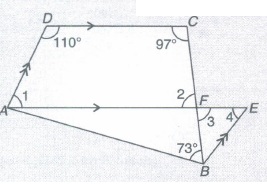
In \(\triangle BEF,\)
\(\angle 3+\angle 4+\angle EBF=180^o\)
(Angle sum property)
\(\Rightarrow 83^o+70^0+\angle EBF=180^o\)
\(\Rightarrow \angle EBF=180^o-153^o\)
\(\Rightarrow \angle EBF=27^o\)
31.
p(x)=x4-2x3+3x2-px+3p-7
Put, x+1=0 or x=-1 in p(x), we get
p(-1)=(-1)4-2(-1)3+3(-1)2-p(-1)+3p-7=19
\(\Rightarrow\) 1+2+3+p+3p-7=19
\(\Rightarrow\) 4p-1=19
\(\Rightarrow\) 4p = 20
\(\therefore\) p = 5
\(\therefore\) The polynomial p(x)=x4-2x3+3x2-5x+15-7
=x4-2x3+3x2-5x+8
Put, x+2 = 0 or x = -2 in p(x)
p(-2)=(-2)4-2(-2)3+3(-2)2-5(-2)+8
= 16+ 16 + 12 + 10 + 8
= 62.
32.
Plot the points (4,- 5), (5.5,- 3), (-2, 5), (-1, - 6), (0, 5) and (2.5, 0) on the graph paper.
33.
Given, ㄥABC = ㄥACB ......(i)
and ㄥ4 = ㄥ3 ............ (ii)
According to Euclid's axiom 3, if equals are subtracted from equals, then reminders are also equal.
On subtracting Eq. (ii) from Eq. (i), we get
ㄥABC-ㄥ4 =ㄥACB-ㄥ3 ⇒ ㄥ1 =ㄥ2
Now, in ΔBDC, ㄥ1 = ㄥ2 ⇒ DC = BD
[since sides opposite to equal angles are equal]
ஃ BD = DC
Hence proved.
34.
We know that the sum of angles that are formed on a straight line is equal to 180°.
So, Reason is correct
We have : ∠AOC+∠BOC=180° [Since AOB is a straight line ]
⇒3x + 10 + 4x − 26 = 180°
⇒7x = 196°
⇒x = 28°
∴∠BOC = [4 × 28 − 26]°
⇒∠BOC=86°.
So, Assertion (A) is also true.
Correct option is (a) Both assertion (A) and reason (R) are true and reason (R) is the correct explanation of assertion (A).
35.
We know that If two parallel lines are intersected by a transversal, then each pair of corresponding angles so formed is equal.
So, Reason is correct.
Also, we know that If a transversal intersects two parallel lines, then the sum of the interior angles on the same side of the transversal is 180о.
From figure we have, 120о – x + 5x = 180о
⇒ 4x = 180о – 120о
⇒ 4x = 60о
⇒ x = 15о
So, Assertion is also correct.
But reason (R) is not the correct explanation of assertion (A). Correct option is (b) Both assertion (A) and reason (R) are true and reason (R) is not the correct explanation of assertion (A).
36.
We know that the if the point lies on y-axis, its x-coordinate is 0.
So, Reason is correct.
The x co-ordinate of the point (0, 4) is zero.
So, Point (0, 4) lies on y -axis.
So, Assertion is also correct
Correct option is (a) Both assertion (A) and reason (R) are true and reason (R) is the correct explanation of assertion (A).
37.
We know that the perpendicular distance of a point from y-axis is called its x-coordinate or abscissa.
So, Reason is correct.
The x co-ordinate of the point (5, 2) is 5.
So, Assertion is also correct
Correct option is (a) Both assertion (A) and reason (R) are true and reason (R) is the correct explanation of assertion (A).
38.
We know that a decimal in which a digit or a set of digits is repeated periodically, is called a repeating, or a recurring, decimal.
So, Reason is correct.
Also, we know that a decimal that ends after a finite number of digits is called a terminating decimal.
Hence Assertion is correct but reason is not the correct explanation of Assertion Correct option is (b) Both assertion (A) and reason (R) are true but reason (R) is not the correct explanation of assertion (A).
39.
(a) (iv) C(10, 6)
(b) (iii) R(5, 6)
(c) (ii) \(\sqrt{34}\) units
PS2 = AS2 + AP2 = 52 + 32
= 25 + 9 = 34
⇒ PS = \(\sqrt{34}\)
(d) (iv) Rhombus
(e) (i) 30 sq. units
Area of rhombus = \(1 / 2\) x product of diagonals
= \(1 / 2\) x 6 x 10
= 30 sq. units

9th Standard CBSE Syllabus & Materials
9th Standard CBSE
CBSE 9th Mathematics Lines and Angles Sample Question Papers Study Material - QB365 Set A
NEW9th Standard CBSE
CBSE 9th Mathematics Introduction to Euclid's Geometry Sample Question Papers Study Material - QB365 Set A
NEW9th Standard CBSE
CBSE 9th Mathematics Linear Equations in Two Variables Sample Question Papers Study Material - QB365 Set A
NEW9th Standard CBSE
CBSE 9th Mathematics Coordinate Geometry Sample Question Papers Study Material - QB365 Set A



NCERT Books

Syllabus

Exam Pattern

Sample Question Papers

Previous year Question Papers

Important Notes

MCQ Practice test

NCERT Exemplers

Case study Questions

Image Based Questions

Passage based Questions

HOT Questions

Value Based Questions

Model Questions Papers
NCERT ( Book Back ) Questions

Assertion and Reason
Important Questions And Answers

CBSE 9th Standard CBSE Subjects
CBSE Standards