100% FREE ACCESS
9th Standard CBSE Syllabus & Materials
9th Standard CBSE
CBSE 9th Science Is matter around us pure? - New Model Questions Papers Study Material - QB365 Set A
NEW9th Standard CBSE
CBSE 9th Science Matter in our surroundings - New Model Questions Papers Study Material - QB365 Set A
NEW9th Standard CBSE
CBSE 9th Mathematics Heron's Formula Sample Question Papers Study Material - QB365 Set A
NEW9th Standard CBSE
CBSE 9th Mathematics Circles Sample Question Papers Study Material - QB365 Set A
NEW9th Standard CBSE
CBSE 9th Mathematics Quadrilaterals Sample Question Papers Study Material - QB365 Set A
NEW9th Standard CBSE
CBSE 9th Mathematics Triangles Sample Question Papers Study Material - QB365 Set A

Published on: 29/10/2025
Download CBSE Class 9th Standard CBSE Mathematics question papers, sample papers, important questions, and previous year solved papers in PDF format. Get free study materials, NCERT solutions, and exam preparation resources for Class 9th Standard CBSE Mathematics
Questions + Answers key
Take MCQ Mathematics Test
1.
Factorise 4x2 + 9y2 + 16z2 + 12xy + 2yz + 16xz
2.
Find the value of K so that x=-1 and y=-1 is a solution of the linear equation 9kx+12ky=63.
3.
If \(a=\frac { { 2 }^{ x-1 } }{ { 2 }^{ x-2 } } ,\quad b=\frac { 2^{ -x } }{ 2^{ x+1 } } \) and a-b=0, find the value of x.
4.
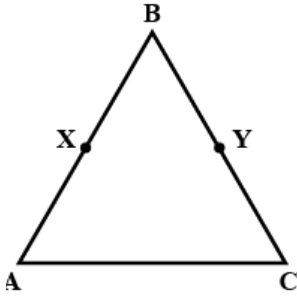
In the given figure, If AB = BC and BX = BY, then show that AX = CY.
5.
Plot the points A(-3 - 3), B(3, - 3), C(3, 3) and D(-3, 3) in the cartesian plane. Also, find the length of line segment AB.
6.
If the polynomial \(p(x)=x^4-2x^3+3x^2-ax+8\)is divided by (x-2), it leaves a remainder 10, Find the value of a.
7.
If \(x=3+2\sqrt { 2 } \) , find the value of \({ x }^{ 2 }+\frac { 1 }{ { x }^{ 2 } } \)
8.
If a + b + c = 9, and ab + bc + ca = 26, find a2 + b2 + c2
9.
Prove that: \(\frac{a^{-1}}{a^{-1}+b^{-1}}+\frac{a^{-1}}{a^{-1}-b^{-1}}=\frac{-(2b^{2})}{a^2-b^2}\)
10.
Represent √9.5 on the number line.
11.
Find k in each case, if x=2, y=1 is a solution of the equations:
(i) 3x+2y=k,
(ii) 2x-ky=6
(iii) \(\frac{x}{4}+\frac{y}{3}=5k\)
12.
(i) Plot the points P(1, 0), Q{4, 0) and S(1, 3). Find the coordinates of the point R such that PQRS is a square.
(ii) Determine the length of line segment SR in figure PORS.
13.
If\({ x }^{ 2 }+\frac { 1 }{ { x }^{ 2 } } =14,\) find \({ x }^{ 3 }+\frac { 1 }{ { x }^{ 3 } } .\)
14.
If x-y=5 and xy=84, find the value of x3-y3.
15.
Factorise \(x^3+13x^2+32x+20\)
16.
If \(x={ \left( 2+\sqrt { 5 } \right) }^{ \frac { 1 }{ 2 } }+{ \left( 2-\sqrt { 5 } \right) }^{ \frac { 1 }{ 2 } }\) and \(y={ \left( 2+\sqrt { 5 } \right) }^{ \frac { 1 }{ 2 } }-{ \left( 2-\sqrt { 5 } \right) }^{ \frac { 1 }{ 2 } }\) , then evaluate \({ x }^{ 2 }+{ y }^{ 2 }\)
17.
Select the wrong statement:
only one line can be pass through a single point.
Only one line can pass through two distinct points.
A terminated line can be produced indefinitely on both the sides.
if two circles are equal, then their radii are equal.
18.
Any point on the line y = 3x is of the form:
(a, 3a)
(3a, a)
\(\left(a,{a\over3}\right)\)
\(\left({a\over3},-a\right)\)
19.
If x is negative and y is positive, then the point (x,y) lies in
II quadrant
III quadrant
IV quadrant
I quadrant
20.
Product of \((x-\frac{1}{x})(x+\frac{1}{x})(x^2+\frac{1}{x^2})\) is:
\(x^4+\frac{1}{x^4}\)
\(x^3+\frac{1}{x^3}-2\)
\(x^4-\frac{1}{x^4}\)
\(x^2+\frac{1}{x^2}+2\)
21.
The coefficient of \(x^2\)in \((3x+x^3)(x+\frac{1}{x })\)
3
1
4
2
22.
If p=17, the degree of the polynomial \(p(x)=(p-x)^3+14\) is:
17
14
0
3
23.
\({ \left( \sqrt { 2 } +1/\sqrt { 2 } \right) }^{ 2 }\) is equal to:
\(4\sqrt { 2 } \)
9/2
\(4/\sqrt { 12 } \)
9
24.
If \(x=\frac { \sqrt { 2 } -1 }{ \sqrt { 2 } +1 } \) and y = \(\frac { \sqrt { 2 } +1 }{ \sqrt { 2 } -1 } \) then find the value of x2+ 5xy + y2
25.
The polynomial p(x) = ax3 - 3x2 + 4 and g(x) = 2x3 - 5x + a when divided by (x - 2) and (x - 3) leave the remainders p and q, respectively. If p - 2q = 4, then find the value of a.
26.
Draw the graph of the following equations on the same graph sheet. x = 4, x = 2, y = 1, y - 3 = 0 Also, find the area enclosed between these lines.
27.
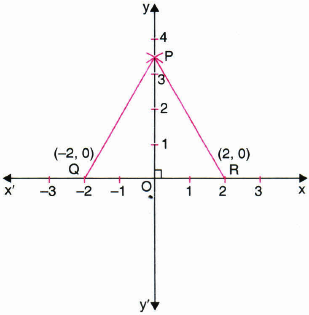
In figure, \(\triangle PQR\) is an equilateral triangle with coordinates of vertices Q and R as (-2,0) and (2,0).Find the coordinates of the vertex P.
28.
Assertion : The point (0, 4) lies on y -axis.
Reason : The x co-ordinate on the point on y -axis is zero.
Codes:
(a) Both assertion (A) and reason (R) are true and reason (R) is the correct explanation of assertion (A).
(b) Both assertion (A) and reason (R) are true but reason (R) is not the correct explanation of assertion (A).
(c) Assertion (A) is true but reason (R) is false.
(d) Assertion (A) is false but reason (R) is true.
29.
On his birthday, Manoj planned that this time he celebrates his birthday in a small orphanage centre. He bought apples to give to children and adults working there. Manoj donated 2 apples to each children and 3 apples to each adult working there along with birthday cake. He distributed 60 total apples.

(a) How to represent the above situation in linear equations in two variables by taking the number of children as 'x' and the number of adults as 'y'?
| (i) 2x + y = 60 | (iii) 2x + 3y =60 |
| (ii) 3x + 2y = 60 | (iv) 3x + y =60 |
(b) If the number of children is 15, then find the number of adults?
| (i) 10 | (iii) 15 |
| (ii) 25 | (iv) 20 |
(c) If the number of adults is 12, then find the number of children?
| (i) 12 | (iii) 15 |
| (ii) 14 | (iv) 18 |
(d) Find the value of b, if x = 5, y = 0 is a solution of the equation 3x + 5y = b.
| (i) 12 | (iii) 15 |
| (ii) 14 | (iv) 18 |
(e) Which is the standard form of linear equations in two variables: y - x = 5?
| (i) 1.y - 1.x - 5 = 0 | (ii) 1.x - 1.y + 5 = 0 |
| (iii) 1.x + 0.y + 5 = 0 | (iv) 1.x - 1.y -5 = 0 |
1.
(2x + 3y + 4z)2
2.
Substituting x=-1 and y=-1 in 9kx+12ky=63, we get
\(\Rightarrow\) 9k(-1)+12k(-1)=63
\(\Rightarrow\) -9k-12k=63
\(\Rightarrow\) -21k=63 k=-3
3.
\(\frac { { 2 }^{ x-1 } }{ { 2 }^{ x-2 } } -\frac { 2^{ -x } }{ 2^{ x+1 } } =0\)
\(\Rightarrow \ { 2 }^{ x-1-x+2 }-2^{ -x-x-1 }=0\)
\(\Rightarrow \ { 2 }^{ 1 }-{ -2 }^{ -2x-1 }=0\)
\(\Rightarrow \ { 2 }^{ -2x-1 }={ 2 }^{ 1 }\)
\(\Rightarrow -2x-1=1\Rightarrow \ x=-1\)
4.
Given, AB = BC
and BX = BY
On subtracting Eq. (ii) from Eq. (i), we get
AB - BX = BC - BY
⇒ AX = CY
5.
Now,length AB = 3+ 3= 6 units
6.
10
7.
34
8.
(a + b + c)2 = (a2 + b2 + c2) + 2 (ab + bc + ca)
⇒ [9]2 = (a2 + b2 + c2) + 2 (26) = (a2 + b2 + c2) + 52
⇒ a2 + b2 + c2 = 92 - 52 = 81- 52 = 29
9.
\(\frac{1}{a}.\frac{ab}{b+a}+\frac{1}{a}\frac{ab}{b-a}=\frac{b^2-ab+b^2+ab}{b^2-a^2}\)
=\(\frac{-2b^{2}}{a^2-b^2}\)
10.
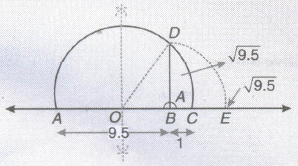
Marks the distance 9.5 units from a fixed point A on a given line to obtain a point B such that AB = 9.5 units from B, marks a distance of 1 unit and mark the new point as C. Find the mid point of AC and mark that point as O. Draw a semi-circle with centre O and radius OC. Draw a line perpendicular to AC passing through B and
intersecting the semi-circle at D.
then BD = √9.5
To represent √9.5 on the number line, let us treat the line BC as the number line, with B as zero (c) as 1 and so on.
Draw an arc with centre B and radius BD which intersect the number line at E.
ஃ E represents √9.5
11.
(i) Given 3x+2y=k
Put x=2, y=1 then
3(2)+2(1)=k \(\Rightarrow\) k=8
(ii) Given, 2x-ky=6
Put x=2, y=1, then
2(2)-k(1)=6
\(\Rightarrow\) 4-k=6\(\Rightarrow\) k=4-6=-2
(iii) Given, \(\frac{x}{4}+\frac{y}{3}=5k\)
Put x=2, y=1, then
\(\frac{2}{4}+\frac{1}{3}=5k\)
\(\Rightarrow 5k=\frac{10}{12}=\frac{5}{6}\)
\(\Rightarrow k=\frac{1}{6}\)
12.
(i) Let us draw mutually perpendicular axes XOX' and YOY' and choose a suitable units of distance on the axes.
Let 1 crn = 1 unit. In point P(1, 0), y-coordinate is zero, so it lies on X-axis at a distance of 1 unit from Y-axis.
In point Q (4, O),y-coordinate is zero, so it lies on X-axis at a distance of 4 units from Y-axis. The point S(1, 3) is at a distance of 1 unit from Y-axis and 3 units from X-axis.
On plotting these points, we get the below graph
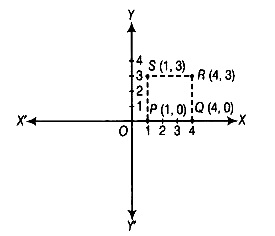
Now, we need to take a point R on the graph such that PQRS is a square. For this, draw a line passing through Q and parallel to PS and draw a line passing through S and parallel to PQ. Both lines intersect each other at a point, say R. Thus, we get a square PQRS. Clearly, abscissa of R will be equal to abscissa of Q, i.e. 4 and ordinate of R will be equal to ordinate of S, i.e. 3. Hence, the coordinates of point R
are (4, 3).
(ii) We have, S (1, 3) and R (4,3)
Here, we see that y-coordinate of both points S and R are same.
\(\therefore\) Length of the line segment SR
= Difference of x-coordinate of both points S and R
= 4 - 1 = 3 units
13.
We know that, \({ \left( x+\frac { 1 }{ x } \right) }^{ 2 }={ x }^{ 2 }+\frac { 1 }{ { x }^{ 2 } } +2\times x\times \frac { 1 }{ x } \ \left[ \because { (a+b) }^{ 2 }={ a }^{ 2 }+{ b }^{ 2 }+2ab \right] \)\(\therefore { \left( x+\frac { 1 }{ x } \right) }^{ 2 }={ x }^{ 2 }+\frac { 1 }{ { x }^{ 2 } } +2\)
\(\Rightarrow { \left( x+\frac { 1 }{ x } \right) }^{ 2 }=14+2=16\ \left[ \because \ { x }^{ 2 }+\frac { 1 }{ { x }^{ 2 } } =14,given \right] \)
\(\Rightarrow x+\frac { 1 }{ x } =\pm \sqrt { 16 } \)
\(\therefore \quad x+\frac { 1 }{ x } =\pm 4\)
Case I When \(x+\frac { 1 }{ x } =4,\) then
\({ \left( x+\frac { 1 }{ x } \right) }^{ 2 }={ x }^{ 3 }+\frac { 1 }{ { x }^{ 3 } } +3\times x\times \frac { 1 }{ x } { \left( x+\frac { 1 }{ x } \right) }\ \left[ \because { (a+b) }^{ 3 }={ a }^{ 3 }+{ b }^{ 3 }+3ab(a+b) \right] \)\(\Rightarrow { \left( x+\frac { 1 }{ x } \right) }^{ 3 }={ x }^{ 3 }+\frac { 1 }{ { x }^{ 3 } } +3{ \left( x+\frac { 1 }{ x } \right) }\)
\(\Rightarrow { (4) }^{ 3 }={ x }^{ 3 }+\frac { 1 }{ { x }^{ 3 } } +3\times 4\)
\(\Rightarrow 64={ x }^{ 3 }+\frac { 1 }{ { x }^{ 3 } } +12\)
\(\therefore { x }^{ 3 }+\frac { 1 }{ { x }^{ 3 } } =64-12=52\)
Case II When \(x+\frac { 1 }{ x } =-4,\) then
\(\Rightarrow { \left( x+\frac { 1 }{ x } \right) }^{ 3 }={ x }^{ 3 }+\frac { 1 }{ { x }^{ 3 } } +3{ \left( x+\frac { 1 }{ x } \right) }\)
\(\Rightarrow { (-4) }^{ 3 }={ x }^{ 3 }+\frac { 1 }{ { x }^{ 3 } } +3\times (-4)\)
\(\therefore { x }^{ 3 }+\frac { 1 }{ { x }^{ 3 } } =-64+12=-52\)
14.
x3-y3=(x-y)(x2+y2+xy)
(x-y)[(x-y)2+8-2xy+xy] [\(\because\)(x-y)2=x2+y2-2xy] [\(\because\)(x-y)2+2xy=x2+y2]
=(x-y)[(x-y)2+3xy]
=5[(5)2+3 x84] [\(\because\)x-y=4 and xy=84]
=5(25+525)=5 x 277=1385
15.
\(x^3+13x^2+32x+20\)
Let \(p(x)={ x }^{ 3 }+13{ x }^{ 2 }+32x+20\)
By trail, we find that
\(p(-1)={ (-1) }^{ 3 }+13{ (-1) }^{ 2 }+32(-1)+20\)
\(=-1+13-32+20=0\)
\(\therefore\) By Factor Theorem, x-(-1), i.e., (x+1) is a factor of p(x).
Now,
\({ x }^{ 3 }+13{ x }^{ 2 }+32x+20={ x }^{ 2 }(x+1)+12x(x+1)+20(x+1)\)
\(=(x+1)({ x }^{ 2 }+12x+20)\)
\(=(x+1)({ x }^{ 2 }+2x+10x+20)\)
\(=(x+1)\{ x(x+2)+10(x+2)\} \)
\(=(x+1)(x+2)(x+10).\)
16.
8
17.
(a)
only one line can be pass through a single point.
18.
(a, 3a) satisfies y=3x
19.
(a)
II quadrant
20.
\((x-\frac{1}{x})(x+\frac{1}{x})(x^2+\frac{1}{x^2})\)
\((x^2-\frac{1}{x^2})(x^2+\frac{1}{x^2})=x^4-\frac{1}{x^4}\)
21.
Coefficient of \(x^2=3+1=4\)
22.
\(p(x)=(p-x)^3+14=(17-x)^3+14\)
\(=(17)^3-x^3-3(17)^2(x)+3.17.x^2+14\)
\(\because\) Degree=3
23.
(b)
9/2
24.
x2 + 5xy + y2 = (x + y)2+ 3xy
\(={ \left[ \frac { \sqrt { 2 } -1 }{ \sqrt { 2 } +1 } +\frac { \sqrt { 2 } +1 }{ \sqrt { 2 } -1 } \right] }^{ 2 }+3\frac { \sqrt { 2 } -1 }{ \sqrt { 2 } +1 } \times \frac { \sqrt { 2 } +1 }{ \sqrt { 2 } -1 } \)
\(={ \left( \frac { 2+1-2\sqrt { 2 } +2+1+2\sqrt { 2 } }{ 2-1 } \right) }^{ 2 }+3\)
= (6)2 + 3
= 36 + 3
= 39
25.
We have, p(x) = ax3 - 3x2 + 4
Since, when p(x) is divided by x-2
leaves remainder p
\(\therefore\) p(2) =p \(\Rightarrow\) a(2)3 = 3(2)2 + 4 = p
\(\Rightarrow\) 8a - 12 + 4 = p
\(\Rightarrow\) 8a - 8 = p ....(i)
and we have, g(x) = 2x3 - 5x +a
Since, when g(x) is divided by x - 3, leaves remainder q.
\(\therefore\) g(3) = q
\(\Rightarrow\) 2(3)3 - 5(3) +a = q
\(\Rightarrow\) 54 - 15 + a = q
\(\Rightarrow\) 39 + a = q .....(ii)
We have, p - 2q = 4
\(\Rightarrow\) 8a - 8 - 2(39+a) = 4 [from Eqs. (i) and (ii)]
\(\Rightarrow\) 8a - 8 - 78 - 2a = 4
\(\Rightarrow\) 6a - 86 - 4\(\Rightarrow\) 6a = 4 + 86 = 90
\(\Rightarrow \quad a=\frac { 90 }{ 6 } =15\)
26.
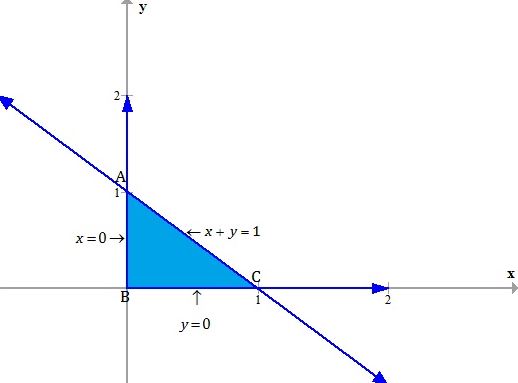
4 sq units
27.
\(\triangle PQR\) is an equilateral triangle
PQ = PR = QR
\(\Rightarrow \) PQ = QR
\(\Rightarrow \) PQ = 4
\(\Rightarrow \) OQ = 2
In right triangle POQ
OP2 + OQ2 = PQ2
\(\Rightarrow \) OP + (2)2 = (4)2 \(\Rightarrow \) OP = \(2\sqrt { 3 } \)
\(P\rightarrow \left( 0,2\sqrt { 3 } \right) \)
28.
We know that the if the point lies on y-axis, its x-coordinate is 0.
So, Reason is correct.
The x co-ordinate of the point (0, 4) is zero.
So, Point (0, 4) lies on y -axis.
So, Assertion is also correct
Correct option is (a) Both assertion (A) and reason (R) are true and reason (R) is the correct explanation of assertion (A).
29.
(a) (iii) 2x + 3y = 60
Let the number of children be x and the number of adults be y then the linear equation in two variable for the given situation is
2x + 3y = 60.
(b) (i) 10
2x + 3y =60 ⇒ 2(15) + 3y = 60
⇒ 3y = 60 - 30 = 30
⇒ y = 10
(c) (i) 12
2x + 3y = 60 ⇒ 2x + 3(12) = 60
⇒ 2x 60 - 36 = 24
⇒ x = 12
(d) (iii) 15
On putting x = 5 and y = 0 in the equation 3x + 5y = b, we have
3 x 5 + 5 x 0 = b
⇒ 15 + 0 = b
⇒ b = 15
(e) (ii) 1.x - 1.y + 5 = 0
y - x = 5 ⇒ y = x + 5
⇒ x - y + 5 = 0
⇒ 1.x - 1.y + 5 = 0

9th Standard CBSE Syllabus & Materials
9th Standard CBSE
CBSE 9th Mathematics Lines and Angles Sample Question Papers Study Material - QB365 Set A
NEW9th Standard CBSE
CBSE 9th Mathematics Introduction to Euclid's Geometry Sample Question Papers Study Material - QB365 Set A
NEW9th Standard CBSE
CBSE 9th Mathematics Linear Equations in Two Variables Sample Question Papers Study Material - QB365 Set A
NEW9th Standard CBSE
CBSE 9th Mathematics Coordinate Geometry Sample Question Papers Study Material - QB365 Set A



NCERT Books

Syllabus

Exam Pattern

Sample Question Papers

Previous year Question Papers

Important Notes

MCQ Practice test

NCERT Exemplers

Case study Questions

Image Based Questions

Passage based Questions

HOT Questions

Value Based Questions

Model Questions Papers
NCERT ( Book Back ) Questions

Assertion and Reason
Important Questions And Answers

CBSE 9th Standard CBSE Subjects
CBSE Standards