100% FREE ACCESS
9th Standard CBSE Syllabus & Materials
9th Standard CBSE
CBSE 9th Science Is matter around us pure? - New Model Questions Papers Study Material - QB365 Set A
NEW9th Standard CBSE
CBSE 9th Science Matter in our surroundings - New Model Questions Papers Study Material - QB365 Set A
NEW9th Standard CBSE
CBSE 9th Mathematics Heron's Formula Sample Question Papers Study Material - QB365 Set A
NEW9th Standard CBSE
CBSE 9th Mathematics Circles Sample Question Papers Study Material - QB365 Set A
NEW9th Standard CBSE
CBSE 9th Mathematics Quadrilaterals Sample Question Papers Study Material - QB365 Set A
NEW9th Standard CBSE
CBSE 9th Mathematics Triangles Sample Question Papers Study Material - QB365 Set A

Published on: 29/10/2025
Download CBSE Class 9th Standard CBSE Mathematics question papers, sample papers, important questions, and previous year solved papers in PDF format. Get free study materials, NCERT solutions, and exam preparation resources for Class 9th Standard CBSE Mathematics
Questions + Answers key
Take MCQ Mathematics Test
1.
Simplify \(\left(3^{\frac{1}{5}}\right)^{4}\)
2.
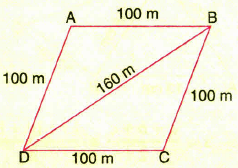
Sanya has a piece of land which is in the shape of a rhombus. She wants her one daughter and one son to work on the land and produce different crops to suffice the needs of their family. She divided the land in two equal parts. If the perimeter of the land is 400 m and one of the diagonals is 160 m, how much area each of them will get?
3.
The sides of a triangular plot are in the ratio 3: 5: 7 and its perimeter is 300 m. Find its area
4.
Find the area of an isosceles triangle, whose equal sides are of length 15 cm each and third side is 12 cm.
5.
Find the area of an equilateral triangle of side 10 cm.
6.
Factorise: \(125x^3-27y^3+z^3+45xyz\)
7.
Factorise: \(16x^3-2y^3\)
8.
Expand \((4a-2b-3c)^2\)
9.
Using long division method, find the remainder obtained on dividing \(p(x)={ x }^{ 3 }+1\ by\ x+1\)
10.
Rationalize the denominator of \(\frac { 1 }{ \sqrt { 2 } } \)
11.
The sides of a triangular park are in the ratio 25: 17: 12 and its perimeter is 540 m. Find the smallest side of the park.
60 m
120 m
90 m
45 m
12.
Find the perimeter of the triangle whose sides are 17 cm, 33 cm, and 20 cm.
70 cm
50 cm
53 cm
37 cm
13.
The area of an equilateral triangle with side Area \(4\sqrt { 3 } \) cm is (\(\sqrt { 3 } \) = 1.732)
20 cm2
20 \(\sqrt { 3 } \) cm2
18.784 cm2
20.784 cm2
14.
The area of a right triangle is 36 cm2 and its base is 9 cm.Find the length of the perpendicular.
8 cm
4 cm
16 cm
32 cm
15.
Product of \((x-\frac{1}{x})(x+\frac{1}{x})(x^2+\frac{1}{x^2})\) is:
\(x^4+\frac{1}{x^4}\)
\(x^3+\frac{1}{x^3}-2\)
\(x^4-\frac{1}{x^4}\)
\(x^2+\frac{1}{x^2}+2\)
16.
\(4a^2+9b^2+c^2+12ab+4ac+6bc\) is:
\((2a+3b+c)^2\)
\((a+2b+3c)^2\)
\((2a+b+3c)^2\)
\((3a+b+2c)^2\)
17.
The zeros of the polynomial \(x^2+2 x+3\) are
real
not real
irrational
rational
18.
The compact form of (x+y)(x-y) is
\((x+y)(x-y)=x^2-y^2\) is an algebraic identity
\(x^2+y^2\)
\(x^2-2xy+y^2\)
\(x^2+2xy+y^2\)
\(x^2-y^2\)
19.
Which of the following numbers is an irrational number?
\(\sqrt { 23 } \)
\(\sqrt { 225 } \)
0.3796
\(7.\overline { 478 } \)
20.
Two rational numbers between \(\frac { 2 }{ 3 } \) and \(\frac { 5 }{ 3 } \)are:
1/6 and 2/6
1/2 and 2/7
5/6 and 7/6
2/3 and 4/3
21.
Factorise:
(i) 4x2 + 9y2 + 16z2 + 12xy - 24yz - 16xz
(ii) 2x2 + y2+ 8z2 - 2 \(\sqrt{2}\)xy + 4\(\sqrt{2}\) yz - 8xz
22.
A rhombus shaped field has green grass for 18 cows to graze. If each side of the rhombus is 30 m and its longer diagonal is 48 m, how much area of grass field will each cow be getting?
23.
If p(x) = x2 - 4x + 3, find the value of p(2) - P(-1) + \(p\left( \frac { 1 }{ 2 } \right) \)
24.
If \(a=\frac { 1 }{ 7-4\sqrt { 3 } } \ and\ b=\frac { 1 }{ 7+4\sqrt { 3 } } ,\) find the values of the following.
(i) a2 + b2
(ii) a3 + b3
25.
Rationalise the denominators of the following:
(i) \(\frac { 1 }{ \sqrt { 7 } } \)
(ii) \(\frac { 1 }{ \sqrt { 7 } -\sqrt { 6 } } \)
(iii) \(\frac { 1 }{ \sqrt { 5 } +\sqrt { 2 } } \)
(iv) \(\frac { 1 }{ \sqrt { 7 } -2 } \)
1.
\(\left(3^{\frac{1}{5}}\right)^{4}=3^{\frac{4}{5}}\)
2.
Let ABCD be the field.
Perimeter = 400 m
So, each side = 400 m ÷ 4 = 100 m.
i.e. AB = AD = 100 m.
Let diagonal BD = 160 m.
Then semi-perimeter s of D ABD is given by
\(s=\frac{100+100+160}{2} \mathrm{~m}=180 \mathrm{~m}\)
Therefore, area of \(\Delta \mathrm{ABD}=\sqrt{180(180-100)(180-100)(180-160)}\)
\(=\sqrt{180 \times 80 \times 80 \times 20} \mathrm{~m}^{2}=4800 \mathrm{~m}^{2}\)
Therefore, each of them will get an area of 4800 m2.
3.
Suppose that the sides, in metres, are 3x, 5x and 7x (see Fig.).
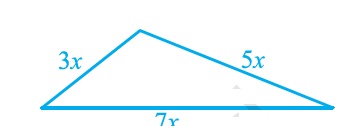
Then, we know that 3x + 5x + 7x = 300 (perimeter of the triangle)
Therefore, 15x = 300, which gives x = 20.
So the sides of the triangle are 3 x 20 m, 5 x 20 m and 7 x 20 m
i.e., 60 m, 100 m and 140 m.
We have s \(=\frac{60+100+140}{2} \mathrm{~m}=150 \mathrm{~m}\)
and area will be \(\sqrt{150(150-60)(150-100)(150-140)} \mathrm{m}^{2}\)
\(=\sqrt{150 \times 90 \times 50 \times 10} \mathrm{~m}^{2}\)
\(=1500 \sqrt{3} \mathrm{~m}^{2}\)
4.
\(18\sqrt { 21 } \) cm2
5.
\(25\sqrt { 3 } \) cm2
6.
\((5x-3y+z)(25x^2+9y^2+z^2+15zy+3yz-5zx)\)
7.
\(2(2x-y)(4x^2+2xy+y^2)\)
8.
Using Identity V, we have
(4a – 2b – 3c)2 = [4a + (–2b) + (–3c)]2
= (4a)2 + (–2b)2 + (–3c)2 + 2(4a)(–2b) + 2(–2b)(–3c) + 2(–3c)(4a)
= 16a2 + 4b2 + 9c2 – 16ab + 12bc – 24ac
9.
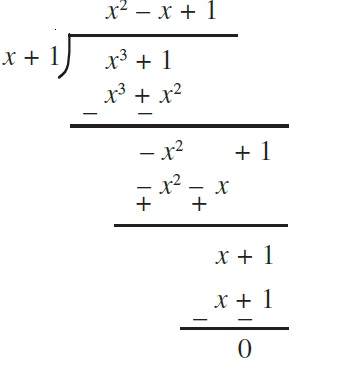
So, we find that the remainder is 0.
Here p(x) = x3 + 1, and the root of x + 1 = 0 is x = –1. We see that
p(–1) = (–1)3 + 1
= –1 + 1
= 0
10.
We want to write \(\frac { 1 }{ \sqrt { 2 } } \)as an equivalent expression in which the denominator is a rational number. We know that \(\sqrt{2} \cdot \sqrt{2} \) is rational. We also know that multiplying \(\frac{1}{\sqrt{2}} \text { by } \frac{\sqrt{2}}{\sqrt{2}}\) will give us an equivalent expression, since \(\frac{\sqrt{2}}{\sqrt{2}}=1\) . So, we put these two facts together to get
\(\frac{1}{\sqrt{2}}=\frac{1}{\sqrt{2}} \times \frac{\sqrt{2}}{\sqrt{2}}=\frac{\sqrt{2}}{2}\)
In this form, it is easy to locate \(\frac{1}{\sqrt{2}}\) on the number line. It is half way between 0 and \(\sqrt{2} \text {. }\)
11.
Smallest side = \(\frac { 12 }{ 25+17+12 } \times 540\) = 120 m.
12.
Perimeter = 17+33+20 = 70 cm
13.
(d)
20.784 cm2
14.
\(36=\frac { 9\times Perpendicular }{ 2 } \)
\(\quad \Rightarrow \) Perpendicular = 8 cm.
15.
\((x-\frac{1}{x})(x+\frac{1}{x})(x^2+\frac{1}{x^2})\)
\((x^2-\frac{1}{x^2})(x^2+\frac{1}{x^2})=x^4-\frac{1}{x^4}\)
16.
\(4a^2+9b^2+c^2+12ab+4ac+6bc\)
\(=(2a)^2+(3b)^2+(c)^2+2(2a)(3b)+2(3c)(c)+2(c)(2a)\)
\((2a+3b+c)^2\)
17.
\(x^2+2 x+3=0\)
\(\Rightarrow\quad x=\frac{-2\pm\sqrt{4-12}}{2}=\frac{-2\pm2\sqrt{2}i}{2}\)
\(=-1\pm\sqrt{2}i\)
18.
(a)
\(x^2+y^2\)
19.
(a)
\(\sqrt { 23 } \)
20.
(c)
5/6 and 7/6
21.
(i) 4x2 + 9y2 + 16z2 + 12xy - 24yz - 16xz
= (2x)2 + (3y)2 + (-4z)2 + 2(2x)(3y) + 2(3y)(-4z) + 2(-4z)(2x)
= (2x + 3y - 4z)2 [Using Identity V]
= (2x + 3y - 4z)(2x + 3y - 4z)
(ii) 2x2 + y2+ 8z2 - 2 \(\sqrt{2}\)xy + 4\(\sqrt{2}\) yz - 8xz
= (-2 \(\sqrt{2}\)x)2 + (y)2 + (2\(\sqrt{2}\)z)2 + 2 (-\(\sqrt{2}\)x)(y) + 2 (2\(\sqrt{2}\)z)(y) + 2 (2\(\sqrt{2}\)z) (-\(\sqrt{2}\)x)
= (-\(\sqrt{2}\)x + y + 2 \(\sqrt{2}\))2
= (-\(\sqrt{2}\)x + y + 2\(\sqrt{2}\)z)( -\(\sqrt{2}\)x + y + 2\(\sqrt{2}\)z)
22.
Let ABCD is a rhombus shaped field whose each side is 30 m and longer diagonal AC is 48 m. Clearly, the diagonal AC divides the rhombus into two triangles, ΔABC and ΔADC which are congruent.
ஃ Area of ΔABC = Area of ΔADC
Also, ΔABC and ΔADC have equal perimeters.
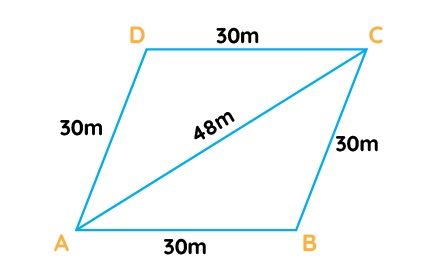
Now, semi-perimeter of ΔABC,
\(s=\frac{a+b+c}{2}=\frac{30+30+48}{2}=\frac{108}{2}=54m\)
ஃ Area of ΔABC
\(=\sqrt{s(s-a)(s-b)(s-c)}\)
\(=\sqrt{54\times(54-30)(54\times30)(54-48)}\)
\(=\sqrt{54\times24\times24\times6}\)
\(=\sqrt{18\times3\times24\times24\times6}\)
\(=18\times27\times=432m^2\)
ஃ Area of rhombus ABCD = 2 x Area of ΔABC
\(=2\times432=864m^2\)
Now, each cow will get =\(\frac{864}{18}=48m^2\) area.
Hence, each cow will get 48 m2 area.
23.
\(-\frac { 31 }{ 4 } \)
24.
Given, \(=\frac { 1 }{ 7-4\sqrt { 3 } } =\frac { 1 }{ 7-4\sqrt { 3 } } \times \frac { 7+4\sqrt { 3 } }{ 7+4\sqrt { 3 } } \)
\(=\frac { 7+4\sqrt { 3 } }{ { (7) }^{ 2 }-{ (4\sqrt { 3 } ) }^{ 2 } } \left[ \because (a+b)(a-b)={ a }^{ 2 }-{ b }^{ 2 } \right] \)
\(=\frac { 7+4\sqrt { 3 } }{ 49-48 } =7+4\sqrt { 3 } \)
\(and\ b=\frac { 1 }{ 7+4\sqrt { 3 } } \frac { 1 }{ 7-4\sqrt { 3 } } \times \frac { 7-4\sqrt { 3 } }{ 7-4\sqrt { 3 } } \)
\(=\frac { 7-4\sqrt { 3 } }{ { (7) }^{ 2 }-{ (4\sqrt { 3 } ) }^{ 2 } } \left[ \because (a+b)(a-b)={ a }^{ 2 }-{ b }^{ 2 } \right] \)
\(=\frac { 74\sqrt { 3 } }{ 49-48 } =7-4\sqrt { 3 } \)
\(\therefore \ a+b=7+4\sqrt { 3 } +7-4\sqrt { 3 } =14\)
and \(ab=(7+4\sqrt { 3 } )(7-4\sqrt { 3 } )\)
\(={ (7) }^{ 2 }-{ (4\sqrt { 3 } ) }^{ 2 }=49-48\quad \left[ \because (a+b)(a-b)={ a }^{ 2 }-{ b }^{ 2 } \right] \)
= 1
(i) \(\because \ { (a+b) }^{ 2 }={ a }^{ 2 }+{ b }^{ 2 }+2ab\)
\(\Rightarrow \ { (14) }^{ 2 }={ a }^{ 2 }+{ b }^{ 2 }+2\)
\(\therefore \ { a }^{ 2 }+{ b }^{ 2 }=196-2\)
= 194
(ii) \(\because \ { (a+b) }^{ 3 }={ a }^{ 3 }+{ b }^{ 3 }+3ab(a+b)\)
\({ a }^{ 3 }+{ b }^{ 3 }={ (a+b) }^{ 3 }-3ab(a+b)\)
\(\Rightarrow ={ (14) }^{ 3 }-3\times 1\times 14\)
= 2744 - 42
= 2702
25.
(i) We have, \(\frac { 1 }{ \sqrt { 7 } } \)
On multiplying both numerator and denominator by \(\sqrt { 7 } \) , we get
\(\frac { 1 }{ \sqrt { 7 } } \times \frac { \sqrt { 7 } }{ \sqrt { 7 } } =\frac { \sqrt { 7 } }{ 7 } \)
(ii) We have,\(\frac { 1 }{ \sqrt { 7 } -\sqrt { 6 } } \)
On multiplying both numerator and denominator by \(\sqrt { 7 } +\sqrt { 6 } ,\) we get
\(\frac { 1 }{ \sqrt { 7 } -\sqrt { 6 } } \times \frac { \left( \sqrt { 7 } +\sqrt { 6 } \right) }{ \left( \sqrt { 7 } +\sqrt { 6 } \right) } \)
\(=\frac { \sqrt { 7 } +\sqrt { 6 } }{ { \left( \sqrt { 7 } \right) }^{ 2 }-{ \left( \sqrt { 6 } \right) }^{ 2 } } [\because (a-b)(a+b)={ a }^{ 2 }-{ b }^{ 2 }]\)
\(=\frac { \sqrt { 7 } +\sqrt { 6 } }{ 7-6 } =\frac { \sqrt { 7 } +\sqrt { 6 } }{ 1 } \)
\(=\sqrt { 7 } +\sqrt { 6 } \)
(iii) \(\left[ \frac { \sqrt { 5 } -\sqrt { 2 } }{ 3 } \right] \)
(iv) \(\left[ \frac { \sqrt { 7 } +1 }{ 3 } \right] \)

9th Standard CBSE Syllabus & Materials
9th Standard CBSE
CBSE 9th Mathematics Lines and Angles Sample Question Papers Study Material - QB365 Set A
NEW9th Standard CBSE
CBSE 9th Mathematics Introduction to Euclid's Geometry Sample Question Papers Study Material - QB365 Set A
NEW9th Standard CBSE
CBSE 9th Mathematics Linear Equations in Two Variables Sample Question Papers Study Material - QB365 Set A
NEW9th Standard CBSE
CBSE 9th Mathematics Coordinate Geometry Sample Question Papers Study Material - QB365 Set A



NCERT Books

Syllabus

Exam Pattern

Sample Question Papers

Previous year Question Papers

Important Notes

MCQ Practice test

NCERT Exemplers

Case study Questions

Image Based Questions

Passage based Questions

HOT Questions

Value Based Questions

Model Questions Papers
NCERT ( Book Back ) Questions

Assertion and Reason
Important Questions And Answers

CBSE 9th Standard CBSE Subjects
CBSE Standards