100% FREE ACCESS
9th Standard CBSE Syllabus & Materials
9th Standard CBSE
CBSE 9th Science Is matter around us pure? - New Model Questions Papers Study Material - QB365 Set A
NEW9th Standard CBSE
CBSE 9th Science Matter in our surroundings - New Model Questions Papers Study Material - QB365 Set A
NEW9th Standard CBSE
CBSE 9th Mathematics Heron's Formula Sample Question Papers Study Material - QB365 Set A
NEW9th Standard CBSE
CBSE 9th Mathematics Circles Sample Question Papers Study Material - QB365 Set A
NEW9th Standard CBSE
CBSE 9th Mathematics Quadrilaterals Sample Question Papers Study Material - QB365 Set A
NEW9th Standard CBSE
CBSE 9th Mathematics Triangles Sample Question Papers Study Material - QB365 Set A

Published on: 29/10/2025
Download CBSE Class 9th Standard CBSE Mathematics question papers, sample papers, important questions, and previous year solved papers in PDF format. Get free study materials, NCERT solutions, and exam preparation resources for Class 9th Standard CBSE Mathematics
Questions + Answers key
Take MCQ Mathematics Test
1.
ABCD is a kite with AB = AD and CD = CB. Prove that the figure formed by joining the mid - points of the consecutive sides is a rectangle.
2.
In the adjoining figure, PQRS is a rhombus, SQ and PR are the diagonals of the rhombus intersecting at point O. If \(\angle OPQ=35°\) , then find the value of \(\angle ORS+\angle OQP\) .
3.
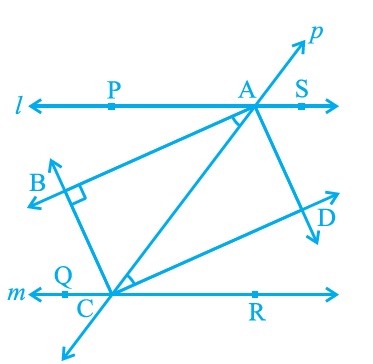
Two parallel lines 1 and m are intersected by a transversal t. Show that the quadrilateral formed by the bisectors of interior angles is a rectangle.
4.
In quadrilateral ABCD, \(\angle\)A + \(\angle\)C = 140\(°\), \(\angle\)A : \(\angle\)c = 1 : 3 and \(\angle\)B :\(\angle\)D = 5 : 6. Find the \(\angle\)A,\(\angle\)B, \(\angle\)c and \(\angle\)D.
5.
Show that if the diagonals of a quadrilateral are equal and bisect each other at right angles, then it is a square.
6.
ABCD is a rectangle in which diagonal AC bisects \(\angle\)A as well as \(\angle\)C. Show that
(i) ABCD is a square.
(ii) diagonal BD bisects \(\angle\)B as well as \(\angle\)D.
7.
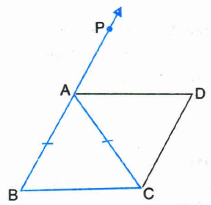
ABC is an isosceles triangle in which AB = AC AD bisects \(\angle \) PAC and CD II AB. Show that
(i) \(\angle \) DAC =\(\angle \) BCA
(ii) ABCD is a parallelogram
8.
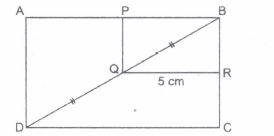
In the adjoining figure, ABCD and PQRB are rectangles where Q is the mid point of BD. If QR = 5 cm, then find the length of AB.
9.
The angles of a quadrilateral are (4x°),(7x°),(15x°) and (10x°).Find the smallest and largest angles of the quadrilateral.
10.
ABCD is a rhombus in which altitude from D to side AB bisects AB. Find the angles of the rhombus.
11.
In the adjacent figure, ABCD is a square. A line segment DX cuts the side BC at X and the diagonal AC at O, such that \(\angle COD={ 105 }^{ ° }\). Find the value of x.
12.
P and Q are points on opposite sides AD and BC of a parallelogram ABCD, such that PQ passes through the point of intersection O of its diagonals AC and BD. Show that PQ is bisected at O.
13.
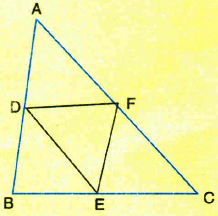
In \(\Delta \) ABC, D, E and F are midpoints of sides AB, BC and CA. If AB = 6 cm,BC = 7.2 cm and AC = 7.8 crn find the perimeter of \(\Delta \)DEF.
14.
If both the diagonals of a parallelogram are equal, then it will be a
kite
rectangle
rhombus
trapezium.
15.
Which of the following is not true?
A rectangle is not a square
A rhombus is not a square
A trapezium is a parallelogram
A kite is not a parallelogram.
16.
If in a quadrilateral, two pairs of adjacent sides are equal, then it is called a
kite
trapezium
rhombus
square
17.
The angle between the diagonal of a rhombus is
450
900
300
600
18.
The sum of all the angles of a quadrilateral is
3600
1800
5400
7200
19.
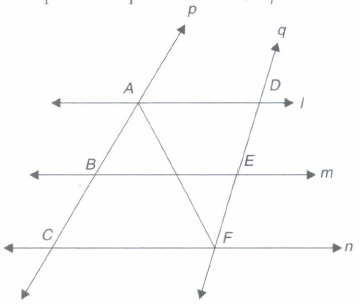
l, m and n are three parallel lines intersected by transversals p and q such that l, m and n cut off equal intercepts AB and BC on p (see Fig.). Show that l, m and n cut off equal intercepts DE and EF on q also.
20.
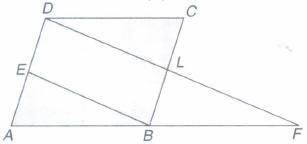
In the given figure ABCD is a parallelogram and E is the mid-point of AD. A line through D, drawn parallel to EB, meets AB produced at F and BC at L Prove that
(i) AF = 2DC
(ii) DF = 2DL
1.
We draw the figure as shown below.
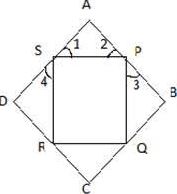
Let P, Q, R, and S be the mid-points of the sides AB, BC, CD, and DA respectively. Join AC and BD.Which intersects each other at O.
Now, in \(\Delta ABC, PQ\parallel AC\ and\ PQ=\frac { 1 }{ 2 } AC \ ...........(i)\)
[ by mid-point theorem ]
and in \(\Delta ACD,\ RS\parallel AC\ and \ RS=\frac { 1 }{ 2 } AC \ .........(ii)\)
From Eqs. (i) and (ii) we get, [by mid-point theorem]
\(PQ\parallel RS\ and\ PQ\ =\ RS\)
[since a pair of opposite sides equal and parallel]
So, PQRS is a parallelogram
Also, AB = AD [given] ...(i)
So, A lies on the perpendicular bisector of BD further
CB = CD [given]....(ii)
So, C lies on the perpendicular bisector of BD......(iii)
From Eqs. (ii) and (iii), AC is the perpendicular bisector of BD.
i.e. AC\(\bot \)BD \(\Rightarrow \angle AOD=90°\)
Now, clearly HS\(\parallel \)OE and SE\(\parallel \) OH
So, SEOH is a parallelogram.
Hence, \(\angle ESH=\angle EOH=90°\)
So, parallelogram PQRS is a rectangle.
Hence proved.
2.
Given, PQRS is a rhombus \(\)\(\Rightarrow\) PQRS is a parallelogram
Since, PQ\(\)\(\parallel \) SR and PR is a transversal.
\(\therefore\) \(\angle ORS=\angle OPQ=35°\) [alternate interior angles]....(i)
Also, the diagonals of a rhombus bisect each other at a right angle.
\(\therefore \angle SOR=90°\) .....(ii)
Now, in \(\Delta SOR,\angle RSO+\angle SOR+\angle ORS=180°\)
[angle sum property of triangles]
\(\Rightarrow\angle RSO=180°-\angle SOR-\angle ORS\)
\(\Rightarrow \angle RSO=180°-90°-35°\) [using Eqs. (i) and (ii)]
\(\Rightarrow \angle RSO=55°\)
\(\Rightarrow \angle OQP=55°\)
[alternate interior angles, Since PQ\(\parallel \) SR and QS is transversal]
From Eqs. (i) and (iii), we get
\(\angle ORS+\angle OQP=35°+55°=90°\)
3.
Lines l and m are parallel, i.e. PS\(\parallel \)QR and transversal t intersects PS and QR at points A and C, respectively. The bisectors of \(\angle\)PAC and \(\angle\)ACQ intersect each other at B and bisectors of \(\angle\)ACR and \(\angle\)SAC intersect each other at D. We have to show that, quadrilateral ABCD is a rectangle.
Since PS\(\parallel \)CR and t is transversal.
\(\therefore\) \(\angle\)PAC =\(\angle\)ACR [alternate angles]
\(\Rightarrow \frac { 1 }{ 2 } \angle PAC=\frac { 1 }{ 2 } \angle ACR\)
\(\Rightarrow \angle BAC=\angle ACD\)
These form a pair of alternate angles for lines AB and CD with AC as transversal.
So, AB\(\parallel \)DC
Similarly, BC\(\parallel \) AD
Therefore, quadrilateral ABCD is a parallelogram.
Now, PS is a straight line.
So, \(\angle\)PAC + \(\angle\)SAC = 180\(°\)
[linear pair axiom]
\(\Rightarrow \frac { 1 }{ 2 } \angle PAC+\frac { 1 }{ 2 } \angle SAC=\frac { 1 }{ 2 } \times 180°\)
\(\left[ multiply\ by\frac { 1 }{ 2 } on\ both\ sides \right] \)
\(\Rightarrow \angle BAC+\angle DAC=90°\)
\(\Rightarrow \angle BAD=90°\)
Thus, one angle of parallelogram ABCD is a right angle.
Hence, ABCD is a rectangle.
Hence Proved.
4.
In quadrilateral ABCD,
\(\angle A+\angle C=140° \ .....(i)\)
\(\angle A:\angle C=1:3\quad \ ....(ii)\)
and \(\angle B:\angle D=5:6\ ....(iii)\)
Let \(\angle\)A=x and \(\angle\)C = 3x
Then, from Eq. (i), we get
x + 3x = 140\(°\)
\(\Rightarrow\) 4x = 140\(°\)
\(\Rightarrow\) x = \(\frac { 140° }{ 4 } =35°\)
\(\therefore\) \(\angle\)A = 35 \(°\)
and \(\angle\)C = 3 \(\times \)35\(°\) =105\(°\)
We know that, sum of angles of a quadrilateral = 360\(°\)
\(\therefore\) \(\angle\)A + \(\angle\)B + \(\angle\)C + \(\angle\)D = 360\(°\)
\(\Rightarrow\)\(\angle\)B + \(\angle\)D = 360\(°\) -( \(\angle\)A + \(\angle\)C)
\(\Rightarrow\)\(\angle\)B + \(\angle\)D = 360\(°\) - (35\(°\) + 105\(°\)) = 220\(°\)
Since, \(\angle\)B : \(\angle\)D = 5: 6
\(\therefore\angle B=\frac { 5 }{ 5+6 } \times 220°=\frac { 5 }{ 11 } \times 220°=100°\)
\(and\ \angle D=\frac { 6 }{ 5+6 } \times 220°\)
\(=\frac { 6 }{ 11 } \times 220°\)
\(=120°\)
Hence, \(\angle A=35°,\angle B=100°,\angle C=105°\quad and\quad \angle D=120°\)
5.
Given: The diagonals AC and BD of a quadrilateral ABCD are equal and bisect each other at right angles.
To Prove: Quadrilateral ABCD is a square.
Proof: In \(\Delta\)OAD and \(\Delta\)OCB,
OA = OC I Given
OD = OB I Given
\(\therefore \Delta OAD\cong \Delta OCB\) I SAS Congruence Rule
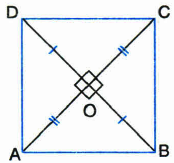
\(\therefore \) AD = CB I C.P.C.T.
\(\angle ODA=\angle OBC\) |C.P.C.T
\(\angle BDA=\angle DBC\)
Now, \(\because\) AD = CB and AD II CB
\(\therefore \) Quadrilateral ABCD is a II gm. I A quadrilateral is a parallelogram if a pair of opposite sides are parallel and equal.
In \(\therefore \) \(\Delta\) AOB and \(\Delta\)AOD,
AO = AO I Common
OB = OD I Given
\(\angle \)AOB = \(\angle \)AOD |Each=\(90°\)
\(\therefore \) \(\Delta\)AOB \(\cong \) \(\Delta\) AOD I SAS Congruence Rule
AB = AD I C.P.C.T.
Now, \(\because\) ABCD is a parallelogram and
AB=AD
\(\because\) ABCD is a rhombus.
Again, in \(\Delta\) ABC and \(\Delta\) BAD,
AC = BD I Given
BC = AD I \(\because\) ABCD is a rhombus
AB = BA I Common
\(\therefore \) \(\Delta\) ABC \(\cong \) \(\Delta\) BAD I SSS Congruence Rule
\(\therefore \) \(\angle \) ABC = \(\angle\) BAD I C.P.C.T.
\(\because\) AD II BC I Opp. sides of IIgm ABCD and transversal AB intersects them.
\(\therefore \) \(\angle ABC+\angle BAD=180°\)
ABC = \(\angle\)BAD = \(90°\)
Similarly,\(\angle\)BCD =\(\angle\)ADC =\(90°\)
\(\therefore \) ABCD is a square.
6.
Given ABCD is a rectangle.
\(\therefore\) AB = DC and BC = AD ... (i)
To prove
(i) ABCD is a square.
i.e. AB = BC= CD = DA
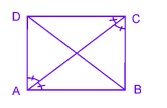
(ii) Diagonal BD bisects \(\angle\)B as well as \(\angle\)D.
Proof
(i) In \(\Delta \)CDA and \(\Delta \)ABC,
\(\angle\)DAC = \(\angle\)BCA
[Since, BC II AD andACis a transversal]
\(\angle\)DCA = \(\angle\)BAC
[Since, AB II DC and AC is a transversal]
and AC = CA [common side]
\(\therefore\)\(\Delta \)CDA \(\cong \) \(\Delta \)ABC [by ASA congruence rule]
Then, AD = AB [by CPCT]
and CD = BC ... (ii)
From Eqs. (i) and (ii), we get
AB = BC = AD = CD
So, ABCD is a square.
(ii) In \(\Delta \)AOB and \(\Delta \)COB, we have
AB=BC [sides of a square]
BO=OB [common side]
OA=OC
[Since, diagonals of a square bisect each other]
\(\therefore\) \(\Delta \)AOB \(\cong \) \(\Delta \)COB [by SSS congruence rule]
Then,\(\angle\)OBA = \(\angle\)OBC [byCPCT]
This shows that BO or BD bisects \(\angle\)B.
Similarly, in \(\Delta \)AOD and \(\Delta \)COD, we have
AD = CD [sides of a square]
OD = DO [common side]
and OA = OC
[Since, diagonals of square bisect each other]
\(\therefore\) \(\Delta \)AOD \(\cong \) \(\Delta \)COD [by SSS congruence rule]
Then, \(\angle\)ADO = \(\angle\)CDO [by CPCT]
This shows that DO or DB bisect \(\angle\)D.
Hence, BD bisects \(\angle\)B as well as \(\angle\)D. Hence proved.
7.
Given: ABC is an isosceles triangle in which AB = AC. AD bisects L PAC and CD IIAB.
To Prove:
(i) \(\angle \)DAC =\(\angle \)BCA
Proof:
(i) In \(\Delta \) ABC,
\(\because\) AB = AC
\(\therefore\) \(\angle \)B =\(\angle \)C .......(1) I Angles opposite to equal sides of a triangle are equal
Also, Ext. \(\angle \)PAC =\(\angle \)B +\(\angle \)C
⇒
⇒ 2\(\angle \)CAD = 2\(\angle \)C
⇒ \(\angle \)CAD =\(\angle \)C
\(\therefore\) AD II BC
Also, CD II AB I Given
\(\therefore\) ABCD is a parallelogram IA quadrilateral is a parallelogram if its both the pairs of opposite sides are parallel.
8.
AB = 10 cm
9.
Sum of the angles of a quadrilateral is 360°.
ஃ 4x° + 7x° + 15x° + 10x° = 360°
[Angle sum property of quadrilateral]
⇒ 36x°= 360°
⇒ x=10°
ஃ Smallest angle = 4x° = 40°
Largest angle = 15x°= 150°
10.
\(\angle A={ 60 }^{ ° },\angle B={ 120 }^{ ° },\angle C={ 60 }^{ ° },\angle D={ 120 }^{ ° }\)
11.
Given ABCD is a square and \(\angle COD={ 105 }^{ ° }\)
We know that, the diagonal AC of square ABCD will bisect the \(\angle C\).
\(\therefore\angle OCX=\frac { 1 }{ 2 } \angle C=\frac { 1 }{ 2 } \times { 90 }^{ ° }={ 45 }^{ ° }\)........... (i)
Now, we have
\(\angle COD+\angle COX={ 180 }^{ ° }\)[linear pair axioms]
\(\Rightarrow { 105 }^{ ° }+\angle COX={ 180 }^{ ° }\)
\(\Rightarrow \angle COX={ 180 }^{ ° }-{ 105 }^{ ° }\)
\(\Rightarrow \quad \angle COX={ 75 }^{ ° }\) .... (ii)
Now, in \(\triangle COX\),
\(\angle COX+\angle OXC+\angle OCX={ 180 }^{ ° }\)
[angle sum property of a triangle]
\(\Rightarrow { 75 }^{ ° }+x+{ 45 }^{ ° }={ 180 }^{ ° }\) [using Eqs.(i) and (ii)]
\(\Rightarrow { x= }{ 180 }^{ ° }-{ 120 }^{ ° }\)
\(\therefore{ x= }{ 60 }^{ ° }\)
12.
Given ABCD is a parallelogram, whose diagonals bisect each other at O, i.e. OB = OD and OC = OA.
To prove PQ is bisected at O.
Proof In \(\triangle ODP\ and\ triangle \ OBQ\) ,
\(\angle POD=\angle BOQ\)
[vertically opposite angles]
\(\angle ODP=\angle OBQ\)
[since, \(AD\parallel BC\) and BD is transversal]
and OD = OB
\(\therefore \triangle OBQ\cong \triangle ODP\) [by ASA congruence rule]
Then, OQ = OP [by CPCT]
Hence, O bisects PQ.
13.
10.5 cm
14.
Theorm
15.
In a trapezium, only one pair of opposite sides is parallel.
16.
(a)
kite
17.
(b)
900
18.
(a)
3600
19.
We are given that AB = BC and have to prove that
DE = EF.
Let us join A to E intersecting m at G.
Let trapezium ACFD is divided into two triangles, namely ΔACF and ΔAFD.
In ΔACF, it is given that B is the mid-point of AC(AB = BC) and BG II CF (Since m || n)
So, G is the mid-point of AF (By the converse of midpoint theorem)
Now in ΔAFD, we can apply the sam argument as G is the mid-point of AF, GE IIAD so E is the mid-point of DF
i.e., DE = EF
In otherwords l, m and n cut off equal intercepts on q also.
20.
(i) As EB II DL and ED II BL.
Therefore EBLD is a parallelogram.
ஃ BL = ED
=\(\frac{1}{2}\)BC=CL ...(i)
Now in triangles DCL and FBL, we have
CL=BL from (i)
ㄥDLC= ㄥFLB
ㄥCDL=ㄥBFL
ΔCDL≡ΔBFL
CD= BF
and DL= FL
Now, BF = DC = AB
⇒ 2AB = 2DC
⇒ AF = 2DC
(ii) ∵ DL=FL
⇒ DF = 2DL

9th Standard CBSE Syllabus & Materials
9th Standard CBSE
CBSE 9th Mathematics Lines and Angles Sample Question Papers Study Material - QB365 Set A
NEW9th Standard CBSE
CBSE 9th Mathematics Introduction to Euclid's Geometry Sample Question Papers Study Material - QB365 Set A
NEW9th Standard CBSE
CBSE 9th Mathematics Linear Equations in Two Variables Sample Question Papers Study Material - QB365 Set A
NEW9th Standard CBSE
CBSE 9th Mathematics Coordinate Geometry Sample Question Papers Study Material - QB365 Set A



NCERT Books

Syllabus

Exam Pattern

Sample Question Papers

Previous year Question Papers

Important Notes

MCQ Practice test

NCERT Exemplers

Case study Questions

Image Based Questions

Passage based Questions

HOT Questions

Value Based Questions

Model Questions Papers
NCERT ( Book Back ) Questions

Assertion and Reason
Important Questions And Answers

CBSE 9th Standard CBSE Subjects
CBSE Standards