100% FREE ACCESS
9th Standard CBSE Syllabus & Materials
9th Standard CBSE
CBSE 9th Science Is matter around us pure? - New Model Questions Papers Study Material - QB365 Set A
NEW9th Standard CBSE
CBSE 9th Science Matter in our surroundings - New Model Questions Papers Study Material - QB365 Set A
NEW9th Standard CBSE
CBSE 9th Mathematics Heron's Formula Sample Question Papers Study Material - QB365 Set A
NEW9th Standard CBSE
CBSE 9th Mathematics Circles Sample Question Papers Study Material - QB365 Set A
NEW9th Standard CBSE
CBSE 9th Mathematics Quadrilaterals Sample Question Papers Study Material - QB365 Set A
NEW9th Standard CBSE
CBSE 9th Mathematics Triangles Sample Question Papers Study Material - QB365 Set A

Published on: 29/10/2025
Download CBSE Class 9th Standard CBSE Mathematics question papers, sample papers, important questions, and previous year solved papers in PDF format. Get free study materials, NCERT solutions, and exam preparation resources for Class 9th Standard CBSE Mathematics
Questions + Answers key
Take MCQ Mathematics Test
1.
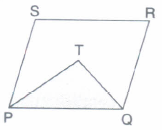
In the given figure, PQRS is a parallelogram in which PT and QT are angle bisectors of ㄥP and ㄥQ respectively. Find the value of ㄥPTQ.
2.
PQRS is a parallelogram and PL and RM are perpendiculars drawn from the vertices P and R of the parallelogram on diagonal SQ. Show that
(i) ΔPQL ≡ ΔRMS
(ii) PL = RM
3.
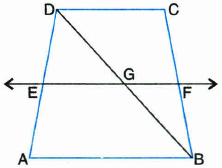
ABCD is a trapezium in which AB II DC, BD is a diagonal and E is the mid-point of AD. A line is drawn through E parallel to AB intersecting BC at F (see figure). Show that F is the midpoint of B.
4.
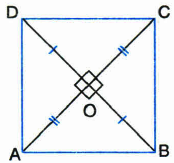
Show that if the diagonals of a quadrilateral are equal and bisect each other at right angles, then it is a square.
5.
Show that the bisectors of angles of a parallelogram form a rectangle
6.
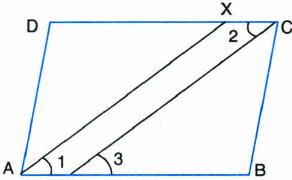
ABCD is a parallelogram and line segments AX, CY bisects the angles A and C respectively. Show that AX II CY.
7.
In a quadrilateral ABCD, the line segments bisecting \(\angle \)C and \(\angle \) D meet at E. Prove that \(\angle \)A+\(\angle \)B=2\(\angle \)CED
8.
The angle between the two altitudes of a parallelogram through the vertex of an obtuse angle is 50°. Find the angles of a parallelogram
9.
Two parallel lines I and m are intersected by a transversal ' t'.Show that the quadrilateral formed by bisectors of interior angles is a rectangle.
10.
If angles of a quadrilateral are in ratio 1 : 2 : 3 : 4. Find the measure of all the angles of a quadrilateral.
11.
If an angle of a parallelogram in two-third of its adjacent angle then find the measure of all the angles,
12.
In a parallelogram PQRS, if \(\angle \)QRS=2x, \(\angle \)PQS=4x, and \(\angle \)PSQ=4x, find the angles of the parallelogram.
13.
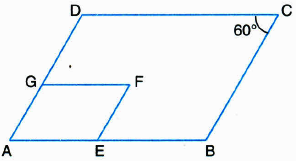
In the following figure the measure of \(\angle \)DAB is
60°
30°
45°
90°
14.
If in a quadrilateral, two pairs of adjacent sides are equal, then it is called a
kite
trapezium
rhombus
square
15.
Each angle of a rectangle is
900
600
450
300
16.
Two consecutive angles of a parallelogram are in the ratio 1 : 3, then what will be the smaller angles?
17.
The angles of a quadrilateral are in the ratio 2 : 3 : 6 : 7. The largest angle of the quadrilateral is
18.
There was four plants in Suraj's fields. Suraj named their bases of P, Q, R, S. He joined PQ, QR, RS and SP. His teacher told him that the quadrilateral PQRS was a parallelogram. He asked him to find the measure of all the angles of the parallelogram,
provided that the measure of anyone interior angle of PQRS. To obtain a technique and hence to solve the problem, he worked hard and spent much time.
(i) Obtain all the angles of the paralellogram PQRS if ㄥR=80°.
(ii) Which mathematical concept is used in the above problem?
(iii) Which value was depicted by Suraj on such a problem
19.
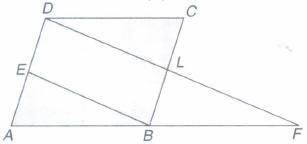
In the given figure ABCD is a parallelogram and E is the mid-point of AD. A line through D, drawn parallel to EB, meets AB produced at F and BC at L Prove that
(i) AF = 2DC
(ii) DF = 2DL
1.
Given, PQRS is a parallelogram.
ㄥP+ㄥQ=180°
\(\frac{1}{2}\)ㄥP+\(\frac{1}{2}\)ㄥQ=\(\frac{180}{2}\)=90°
ㄥPTQ=180°-{\(\frac{1}{2}\)(ㄥP+ㄥQ)}
=180°-90°
ㄥPTQ=90°
2.
In Δs RSM and PQL,
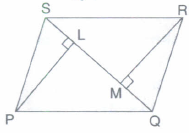
ㄥRSM=ㄥPQL
ㄥM=ㄥL=90°
SR=PQ
By AAS, ΔRSM≡ΔPQL
(ii) PL=RM(c.p.c.t)
3.
Given: ABCD is a trapezium in which AB II DC, BD is a diagonal and E is the mid-point of AD. A line is drawn through E parallel to AB intersecting BC at F.
To Prove: F is the mid-point of Be.
Proof: Let DB intersect EF at G.
In \(\Delta \)DAB,
\(\because\) E is the mid-point of DA and EG II AB
\(\therefore\) G is the mid-point of DB | By converse of mid-point theorem
Again, in \(\Delta \)BDC,
\(\because\) G is the mid-point of BD and GF II AB II DC
\(\therefore\) F is the mid-point of BC. | By converse of mid-point theorem
4.
Given: The diagonals AC and BD of a quadrilateral ABCD are equal and bisect each other at right angles.
To Prove: Quadrilateral ABCD is a square.
Proof: In \(\Delta\)OAD and \(\Delta\)OCB,
OA = OC I Given
OD = OB I Given
\(\therefore \Delta OAD\cong \Delta OCB\) I SAS Congruence Rule
\(\therefore \) AD = CB I C.P.C.T.
\(\angle ODA=\angle OBC\) |C.P.C.T
\(\angle BDA=\angle DBC\)
Now, \(\because\) AD = CB and AD II CB
\(\therefore \) Quadrilateral ABCD is a II gm. I A quadrilateral is a parallelogram if a pair of opposite sides are parallel and equal.
In \(\therefore \) \(\Delta\) AOB and \(\Delta\)AOD,
AO = AO I Common
OB = OD I Given
\(\angle \)AOB = \(\angle \)AOD |Each=\(90°\)
\(\therefore \) \(\Delta\)AOB \(\cong \) \(\Delta\) AOD I SAS Congruence Rule
AB = AD I C.P.C.T.
Now, \(\because\) ABCD is a parallelogram and
AB=AD
\(\because\) ABCD is a rhombus.
Again, in \(\Delta\) ABC and \(\Delta\) BAD,
AC = BD I Given
BC = AD I \(\because\) ABCD is a rhombus
AB = BA I Common
\(\therefore \) \(\Delta\) ABC \(\cong \) \(\Delta\) BAD I SSS Congruence Rule
\(\therefore \) \(\angle \) ABC = \(\angle\) BAD I C.P.C.T.
\(\because\) AD II BC I Opp. sides of IIgm ABCD and transversal AB intersects them.
\(\therefore \) \(\angle ABC+\angle BAD=180°\)
ABC = \(\angle\)BAD = \(90°\)
Similarly,\(\angle\)BCD =\(\angle\)ADC =\(90°\)
\(\therefore \) ABCD is a square.
5.
Let ABCD is a parallelogram
To show LMNO is a rectangle,
ㄥA+ㄥD=180°
\(\frac{1}{2}\)ㄥA+\(\frac{1}{2}\)ㄥD=90°
ㄥOAD+ㄥODA=90°
In ΔOAD,
ㄥOAD+ㄥADO+ㄥDOA=180°
⇒ ㄥDOA = 90°
⇒ ㄥLON = 90°
Similarly, ㄥOLM =ㄥLMN =ㄥMNO = 90°
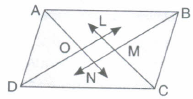
ஃ A quadrilateral with all angles 90° is a rectangle. Also opposite angles are equal. It is rectangle.
6.
Given: ABCD is a parallelogram and line segments AX, CY bisect the angles A and C respectively.
To Prove: AX IICY.
Proof: \(\because\) ABCD is a parallelogram.
\(\therefore\) \(\angle \)A = \(\angle \)C I Opposite \(\angle \)s of a parallelogram are equal
⇒ \(1\over 2\)\(\angle \)A=\(1\over 2\)
⇒ \(\angle \)1 = \(\angle \)2 ...(1) I \(\because\) AX is the bisector of \(\angle \)A and CY is the bisector of \(\angle \)C
\(\therefore\) \(\angle \)2 =\(\angle \)3 ....(2) I Alternate interior \(\angle \) s
From (1) and (2), we get
\(\angle \)1 = \(\angle \)3
But these form a pair of equal corresponding angles
\(\therefore\) AX II CY.
7.
Given: In a quadrilateral ABCD, the line segments bisecting \(\angle \)C and \(\angle \)D meet at E.
In \(\Delta \) CED,
\(\angle \)CED +\(\angle \)EDC+\(\angle \)ECD = \(180°\) | Angle sum property of a triangle
2\(\angle \)CED+\(\angle \)D+C=A+B+C+D
8.
AM丄DC, AN丄BC
In quadrilateral AMCN,
ㄥA+ㄥM+ㄥC+ㄥN=360°
ㄥA+ㄥC=180°
⇒ 50°+ㄥC=180° ⇒ ㄥC=130°
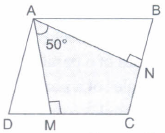
In parallelogram, ㄥA=ㄥC=130°
ㄥB=ㄥD=180°-130°
=50°
9.
∠APR=ㄥDRP
or ㄥ1=ㄥ2
But these are alternate interior angles
SP II RQ, SR II PQ
PQRS is a parallelogram
∠APR+ㄥBPR=180°,(linear pair)
⇒ \(\frac{1}{2}\) ∠APR+\(\frac{1}{2}\)ㄥBPR=\(\frac{1}{2}\)x180°
⇒ ∠1+ㄥ3=90°
⇒ ∠SPQ=90°
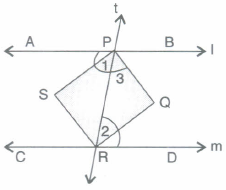
PQRS is a rectangle
10.
Let the measure of the angles be x, 2.x, 3x and 4x then,
x + 2x + 3x + 4x = 360°
⇒ x = 36°
ஃ Angles of quadrilateral are 36°, 72°, 108°,144°
11.
72°, 108°, 72°, 108°
12.
\(36°\),\(144°\),\(36°\), \(144°\)
13.
14.
(a)
kite
15.
(a)
900
16.
()
Let the consecutive angles be x° and (3x)°
x°+3x°=180°
4x°=180°
x°=45°
ஃ Smaller angle=x°
=45°
17.
()
Let the angles of the quadrilateral be 2x°, 3x°, 6x°,7x°.
2x°+ 3x°+ 6x°+7x°=360°
[Angle sum property of quadrilateral]
⇒ 18x = 360°
⇒ x=20°
ஃ Largest angle = 7x°= 140°
18.
ㄥR=80° (Given)
SR II PQ and RQ is a transversal
ஃ ㄥR+ㄥQ=180°
ㄥQ=180°-80°
= 100°
Similarly, ㄥQ+ㄥP=180°
⇒ ㄥP=180°-100°=80°
and ㄥS+ㄥR=180°
⇒ ㄥS=180°-80°=100°
Hence, ㄥP=80°, ㄥQ=100°, ㄥR=80°, ㄥS=100°
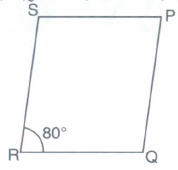
(ii) Property of co-interior angles when a pair of straight lines intersected by another straight line (Geometry)
(iii) Diligence i.e., dedication, determination, and hard work.
19.
(i) As EB II DL and ED II BL.
Therefore EBLD is a parallelogram.
ஃ BL = ED
=\(\frac{1}{2}\)BC=CL ...(i)
Now in triangles DCL and FBL, we have
CL=BL from (i)
ㄥDLC= ㄥFLB
ㄥCDL=ㄥBFL
ΔCDL≡ΔBFL
CD= BF
and DL= FL
Now, BF = DC = AB
⇒ 2AB = 2DC
⇒ AF = 2DC
(ii) ∵ DL=FL
⇒ DF = 2DL

9th Standard CBSE Syllabus & Materials
9th Standard CBSE
CBSE 9th Mathematics Lines and Angles Sample Question Papers Study Material - QB365 Set A
NEW9th Standard CBSE
CBSE 9th Mathematics Introduction to Euclid's Geometry Sample Question Papers Study Material - QB365 Set A
NEW9th Standard CBSE
CBSE 9th Mathematics Linear Equations in Two Variables Sample Question Papers Study Material - QB365 Set A
NEW9th Standard CBSE
CBSE 9th Mathematics Coordinate Geometry Sample Question Papers Study Material - QB365 Set A



NCERT Books

Syllabus

Exam Pattern

Sample Question Papers

Previous year Question Papers

Important Notes

MCQ Practice test

NCERT Exemplers

Case study Questions

Image Based Questions

Passage based Questions

HOT Questions

Value Based Questions

Model Questions Papers
NCERT ( Book Back ) Questions

Assertion and Reason
Important Questions And Answers

CBSE 9th Standard CBSE Subjects
CBSE Standards