100% FREE ACCESS
9th Standard CBSE Syllabus & Materials
9th Standard CBSE
CBSE 9th Science Is matter around us pure? - New Model Questions Papers Study Material - QB365 Set A
NEW9th Standard CBSE
CBSE 9th Science Matter in our surroundings - New Model Questions Papers Study Material - QB365 Set A
NEW9th Standard CBSE
CBSE 9th Mathematics Heron's Formula Sample Question Papers Study Material - QB365 Set A
NEW9th Standard CBSE
CBSE 9th Mathematics Circles Sample Question Papers Study Material - QB365 Set A
NEW9th Standard CBSE
CBSE 9th Mathematics Quadrilaterals Sample Question Papers Study Material - QB365 Set A
NEW9th Standard CBSE
CBSE 9th Mathematics Triangles Sample Question Papers Study Material - QB365 Set A

Published on: 29/10/2025
Download CBSE Class 9th Standard CBSE Mathematics question papers, sample papers, important questions, and previous year solved papers in PDF format. Get free study materials, NCERT solutions, and exam preparation resources for Class 9th Standard CBSE Mathematics
Questions + Answers key
Take MCQ Mathematics Test
1.
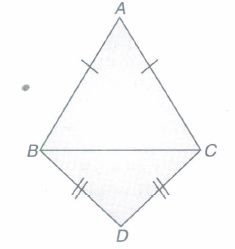
In the figure, \(\triangle\)ABC and \(\triangle\)DBC are two isosceles triangles on the same base BC Prove that \(\angle\) ABD = \(\angle\)ACD.
2.
Expand using suitable identity (2x-3y+z)2
3.
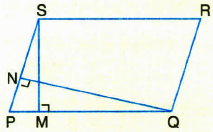
In the figure, PQRS is a parallelogram with PQ = 12 cm, altitudes corresponding to PQ and SP are respectively 8 cm and 10 cm. Find SP.
4.
The angles A, B, C and D of a quadrilateral have measures in the ratio 2 : 4 : 5 : 7. Find the measures of these angles. What type of quadrilateral is it? Give reasons.
5.
In \(\triangle \) ABC if \(\angle A=(2Xx-5)^{ 0 },\angle B=(5X+5)^{ 0 }\) \(\angle C=(3Xx-50)^{ 0 }\) then find the values of x,\(\angle \) A ,\(\angle B\) and \(\angle C.\)
6.
Find an irrational number between 1/7 and 2/7.
7.
In the given figure, in a parallelogram ABCD, two points P and Q are taken on the diagonal BD such that DP = BQ. Show that:
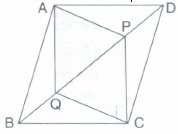
(i) ΔAPD≡ΔCQB
(ii) ΔAQB≡ΔCPD
(iii) APCQ is a parallelogram.
8.
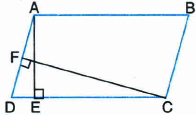
In figure, ABCD is a parallelogram, \(AE\bot DC\)and \(CF\bot AD\). If AB = 16cm, AE = 8 cm and CF = 10 cm, find AD.
9.
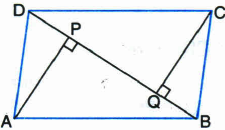
ABCD is a parallelogram and APand CQ are perpendiculars from vertices A and C on diagonal BD respectively. Show that:
\((i)\Delta APB\cong \Delta CQD\)
\(\\ (ii)AP=CQ\)
10.
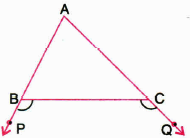
In Fig. sides AB and AC of D ABC are extended to points P and Q respectively. Also, \(\angle\) PBC < \(\)QCB. Show that AC > AB.
11.
AD is an altitude of an isosceles triangle ABC in which AB = AC Show that
(i) AD bisects BC (ii) AD bisects \(\angle A\)
12.
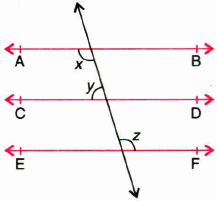
In figure if \(AB\parallel CD\parallel ,CD\parallel EF\) and y:z=3:7, find x
13.
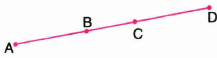
In figure, if AC = BD, then prove that AB = CD.
14.
Factorise \(x^3+13x^2+32x+20\)
15.
You know that \(\frac { 1 }{ 7 } =0.\overline { 142857 } \) . Can you predict what the decimal expansions of \(\frac { 2 }{ 7 } ,\frac { 3 }{ 7 } ,\frac { 4 }{ 7 } ,\frac { 5 }{ 7 } ,\frac { 6 }{ 7 } \) are, without actually doing the long division? If so how?
16.
The areas of a parallelogram and a triangle are equal and they lie on the same base. If the altitude of the parallelogram is 2 cm, then the altitude of triangle is
4cm
1cm
2 cm
3 cm
17.
Which of the following is not true?
A rectangle is not a square
A rhombus is not a square
A trapezium is a parallelogram
A kite is not a parallelogram.
18.
The point which lies on y-axis at a distance of 6 units in the negative direction of y-axis is:
(0,6)
(6,0)
(0,-6)
(-6,0)
19.
Where do the II and IV quadrants meet?
at O
in y - axis
in x -axis
do not intersect
20.
Select the correct statement from the following:
Degree of a zero polynomial is zero.
Degree of a zero polynomial is not defined.
Degree of a constant polynomial is not defined
Zero of the polynomial is not defined
21.
Every rational number is:
a natural number
an integer
a real number
a whole number
22.
ABCD is a quadrilateral in which AB and CD are smallest and longest sides respectively. Prove that \(\angle\)A >\(\angle\)C and \(\angle\)B > \(\angle\)D.
23.
Factorize: \(\frac { 1 }{ 64 } { x }^{ 3 }-{ 8y }^{ 3 }+\frac { 3 }{ 16 } { x }^{ 2 }y-\frac { 3 }{ 2 } { xy }^{ 2 }\)
24.
If ΔABC and ΔDEF are two triangles such that AB, BC are respectively equal and parallel to DE, EF then show that:
(i) quadrilateral ABED is a parallelogram
(ii) quadrilateral BCEF is a parallelogram.
(iii) AC = DF
(iv) ΔABC≡ΔDEF
25.
If \(x=\frac { \sqrt { 5 } +1 }{ \sqrt { 5 } -1 } \) and \(y=\frac { \sqrt { 5 } -1 }{ \sqrt { 5 } +1 } \) than find the value of x2 +y2
26.
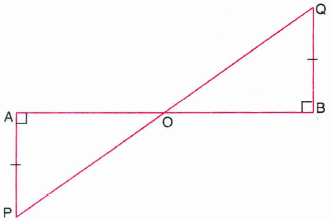
In figure, AP and BQ are perpendiculars to the line-segment AB and AP = BQ. Prove that O is the mid-point of line segments AB and PQ.
27.
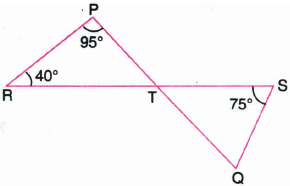
In figure if lines PQ and RS intersect at point T, such that \(\angle \) PRT=\(40^{ 0 }\) \(\angle \)RPT=\(95^{ 0 }\) and \(\angle \)TSQ=\(75^{ 0 }\) find \(\angle \)SQT
28.
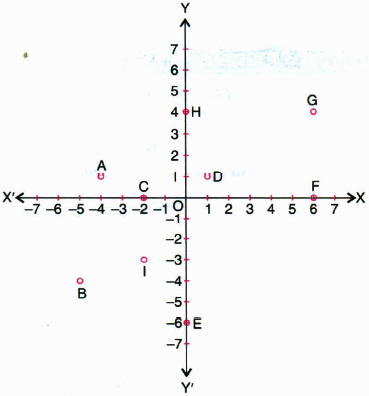
From the given figure, write
(i) The coordinates of the points B and F
(ii) The abscissae of points A and C
(iii) The ordinates of the points A and C.
(iv) The perpendicular distance of the point G from the x-axis.
29.
Prove that \((a+b)^3+(b+c)^3+(c+a)^3-3(a+b)(b+c)(c+a)\) = \(2(a^3+b^3+c^3-3abc)\)
1.
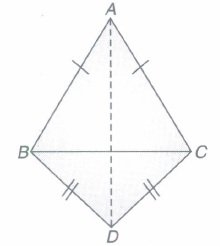
Join AD.
In \(\triangle\)ABC and \(\triangle\)ACD,
AB = AC (Given)
BD = CD (Given)
AD = AD (Common)
By using SSS Congruency Rule,
\(\triangle ABD\cong \triangle ACD\)
\(\therefore \angle ABD=\angle ACD (By c.p.c.t)\)
2.
(2x-3y+z)2=[2x+(-3y)+z]2
=(2x)2+(-3y)2+z2+2\(\times\) 2x\(\times\)(-3y)+2\(\times\)(-3y)\(\times\)z+2\(\times\)2x\(\times\)z
= 4x2+9y2+z2-12xy-6yz+4xz.
3.
9.6 cm
4.
40°, 80°, 100°, 140°; Trapezium
5.
\(13;21^{ 0 },70^{ 0 },89^{ 0 }\)
6.
\(\frac{1}{7}=0.142857142857 \ldots=0 . \overline{142857}\) and \(\frac{2}{7}=0.28571428571428 \ldots=0 . \overline{285714}\)
Here, the two decimal expansions are non-terminating recurring.
Hence, 1/7 and 2/7 are two rational numbers.
We know, between any two rational numbers, there are infinitely many irrational numbers.
An irrational number has non-terminating non-recurring decimal expansions.
Then an irrational number between \(\frac{1}{7} \text { and } \frac{2}{7}\) is 0.15015001500015.
Similarly, 0.21020020002... is another irrational number between \(\frac{1}{7} \text { and } \frac{2}{7}\)
7.
In Δs APD and CQB
AD = BC (Opp. sides of a parallelogram)
PD = BQ (Given)
∠ADP=∠QBC
⇒ ΔAPD≡ΔCQB
⇒ AP = CQ (c.p.c.t)
In Δs AQB and CPD
AB = DC, BQ = DP
and ∠AQB=∠PDC
ஃ ΔAQB≡ΔCPB ⇒ AQ=CP
(iii) In quad. APCQ,
AP = CQ and AQ = CP
⇒ APCQ is a parallelogram.
8.
ar(parallelogram ABCD) = AB x AE
= 16 x 8 cm2
= 128 cm2 ...(1)
ar(parallelogram ABCD) = AD x CF
= AD x 10 cm2 .......(2)
From (1) and (2), we get
AD x 10 = 128
AD = \(\frac { 128 }{ 10 } \)
AD = 12.8 cm.
9.
Given: ABCD is a parallelogram and AP and CQ are perpendiculars from vertices A and C on diagonal BD respectively.
To Prove:
\((i)\Delta APB\cong \Delta CQD\)
\(\\ (ii)AP=CQ\)
Proof: (i) In \(\Delta APB\ \) and \( \Delta CQD\)
AB = CD I Opp. sides of || gm ABCD
\(\angle ABP=\angle CDQ\) |Each=\(90°\)
(ii) \(\Delta APB\cong \Delta CQD\) I Proved above in (i)
\(\therefore \) AP = CQ. I C.P.C.T.
10.
Given: Sides AB and AC of ΔABC are extended to points P and Q respectively.Also, ㄥPBC < ㄥQCB.
To Prove: AC > AB.
Proof: ㄥPBC < ㄥQCB
- ㄥPBC > -ㄥQCB
1800 - ㄥ PBC > 1800- ㄥQCB
ㄥABC > ㄥACB
AC > AB.
11.
Given: AD is an altitude of an isosceles triangle ABC in which AB = AC.
To prove: (i) AD bisects BC (ii) AD bisects \(\angle A\)
Proof: (i) In right \(\triangle ADB\) and right \(\triangle ADC\)
Hyp.AB = Hyp. AC
Side AD = Side AD
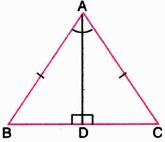
\(\triangle ADB\cong \triangle ADC\) | RHS rule
BD = CD | C.P.C.T
AD bisects BC
(ii) \(\triangle ADB\cong \triangle ADC\)
\(\angle BAD=\angle CAD\)
AD bisects \(\angle A\)
12.
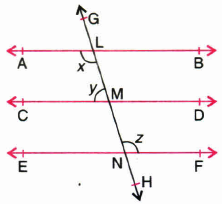
and \(\because AB\parallel CD\)
\( CD\parallel EF\)
\(\because AB\parallel EF\)
Lines parallel to the same line are parallel to each other
\(\therefore x=z\)
Alternate Interior Angles
X+y=\(180^{ 0 }\)
Consecutive interior angles on the same side of a transversal GH to parallel lines AB and CD
From (1) and (2)
z+y=\(180^{ 0 }\)
y:z=3:7
Sum of the ratios=3+7=10
\(\therefore y=\frac { 3 }{ 10 } X180^{ 0 }=54^{ 0 }\)
and \(z=\frac { 7 }{ 10 } x180^{ 0 }=126^{ 0 }\)
\(\therefore x=z=126^{ 0 }\)
13.
We have
AC = BD
\(\Rightarrow \) AC - BC= BD - BC
If equals are subtracted from equals, the remainders are equal (Euclid's Axiom (iii))
\(\Rightarrow \) AB = CD
AC - BC coincides with AB; BD - BC coincides with CD [Things which coincide with one another are equal to one another (Euclid's Axiom (iv))]
14.
\(x^3+13x^2+32x+20\)
Let \(p(x)={ x }^{ 3 }+13{ x }^{ 2 }+32x+20\)
By trail, we find that
\(p(-1)={ (-1) }^{ 3 }+13{ (-1) }^{ 2 }+32(-1)+20\)
\(=-1+13-32+20=0\)
\(\therefore\) By Factor Theorem, x-(-1), i.e., (x+1) is a factor of p(x).
Now,
\({ x }^{ 3 }+13{ x }^{ 2 }+32x+20={ x }^{ 2 }(x+1)+12x(x+1)+20(x+1)\)
\(=(x+1)({ x }^{ 2 }+12x+20)\)
\(=(x+1)({ x }^{ 2 }+2x+10x+20)\)
\(=(x+1)\{ x(x+2)+10(x+2)\} \)
\(=(x+1)(x+2)(x+10).\)
15.
Yes! We can predict the decimal expansions of \(\frac { 2 }{ 7 } ,\frac { 3 }{ 7 } ,\frac { 4 }{ 7 } ,\frac { 5 }{ 7 } ,\frac { 6 }{ 7 } \) without actually doing the long division as follows:
To predict the decimal expansion of 2/7, locate when the remainder becomes 2 and respective quotient.Then write the new quotient beginning from there using the repeating digits 1,4,2,8,5,7.
\(\frac { 1 }{ 7 } =0.\overline { 142857 } \)
Similarly,
\(\frac { 2 }{ 7 } =0.\overline { 285714 }\)
\( \\ \frac { 3 }{ 7 } =0.\overline { 428571 }\)
\( \\ \frac { 4 }{ 7 } =0.\overline { 571428 } \)
\(\\ \frac { 5 }{ 7 } =0.\overline { 714285 } \)
\(\\ \frac { 6 }{ 7 } =0.\overline { 857142 } \)
16.
(a)
4cm
17.
In a trapezium, only one pair of opposite sides is parallel.
18.
(c)
(0,-6)
19.
(a)
at O
20.
Convention
21.
(c)
a real number
22.
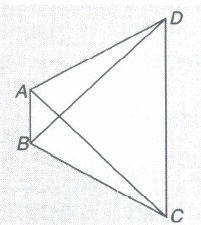
Proof: In \(\triangle\)ABC, BC > AB (.: AB smallest side)
\(\angle\)BAC > \(\angle\)BCA ...(i)
In ACD, CD > AD
(\(\therefore\) CD greatest side)
\(\angle\)CAD > \(\angle\)ACD ...(ii)
Adding (i) and (ii), we get
\(\angle\)BAC + \(\angle\)CAD > \(\angle\)BCA + \(\angle\)ACD
\(\Rightarrow\) \(\angle\)BAD > \(\angle\)BCA
\(\angle\)A> \(\angle\)C
In \(\triangle\)ABD, AD > AB
\(\therefore\) \(\angle\)ABD > \(\angle\)ADB ...(iii)
In MC;D, CD > BC
\(\therefore\) \(\angle\)DBC > \(\angle\)BDC ...(iv)
Adding (iii) and (iv), we get
\(\angle\)ABD + \(\angle\)DBC > \(\angle\)ADB +\(\angle\)BDC
\(\Rightarrow\) \(\angle\)ABC > \(\angle\)ADC
\(\Rightarrow\) \(\angle\)B > \(\angle\)D
Hence, \(\angle\)A > \(\angle\)C and \(\angle\)B > \(\angle\)D.
23.
\(p(x)={ \left( \frac { 1 }{ 4 } x \right) }^{ 3 }-{ (2y) }^{ 3 }+\frac { 3 }{ 4 } xy\left[ \frac { 1 }{ 4 } x-2y \right] \)
\(=\left( \frac { 1 }{ 4 } x-2y \right) \left[ { \left( \frac { 1 }{ 4 } x \right) }^{ 2 }+{ (2y) }^{ 2 }+\frac { 1 }{ 4 } x\times 2y \right] +\frac { 3 }{ 4 } xy\left[ \frac { 1 }{ 4 } x-2y \right] \)
\(=\left( \frac { 1 }{ 4 } x-2y \right) \left( \frac { 1 }{ 16 } { x }^{ 2 }+4{ y }^{ 2 }+\frac { 1 }{ 2 } xy+\frac { 3 }{ 4 } xy \right) \)
\(=\left( \frac { 1 }{ 4 } x-2y \right) \left( \frac { { x }^{ 2 } }{ 16 } +{ 4y }^{ 2 }+\frac { 5 }{ 4 } xy \right) \)
\(=\left( \frac { x }{ 4 } -2y \right) \left( \frac { { x }^{ 2 } }{ 16 } +\frac { 1 }{ 4 } xy+xy+4y^{ 2 } \right) \)
\(=\left( \frac { x }{ 4 } -2y \right) \left[ \frac { x }{ 4 } \left( \frac { x }{ 4 } +y \right) +4y\left( \frac { x }{ 4 } +y \right) \right] \)
\(=\left( \frac { x }{ 4 } -2y \right) \left( \frac { x }{ 4 } +y \right) \left( \frac { x }{ 4 } +4y \right) \)
24.
Two triangles ABC and DEF, such that
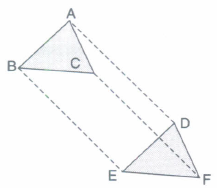
AB = DE and AB II DE
Also BC = EF and BC II EF
Proof: (i) In a quadrilateral ABED,
AB = DE and AB II DE
⇒ One pair of opposite sides are equal and parallel.
ABED is a parallelogram
⇒ AD = BE and AD II BE....(i)
(ii) In quadrilateral BCFE,
BC = EF and BC II EF
⇒ One pair of opposite sides are equal and parallel.
BCFE is a parallelogram
CF = BE and CF II BE ...(ii)
(iii) From equations (i) and (ii), we get
AD = CF and AD II CF
⇒ ACFD is a parallelogram
AC = DF andAC II DF
(iv) In ∆ABC and ∆DEF
AB = DE (Given)
BC = EF (Given)
and AC = DF (Proved above in part (c))
So by S.S.s.,ΔABC≅ΔDEF.
25.
\(x=\frac { \sqrt { 5 } +1 }{ \sqrt { 5 } -1 } \)
\({ x }^{ 2 }={ \left[ \frac { \sqrt { 5 } +1 }{ \sqrt { 5 } -1 } \right] }^{ 2 }=\frac { 6+2\sqrt { 5 } }{ 6-2\sqrt { 5 } } =\frac { 3+\sqrt { 5 } }{ 3-\sqrt { 5 } } \)
\(y=\frac { \sqrt { 5 } -1 }{ \sqrt { 5 } +1 } \)
\({ y }^{ 2 }={ \left[ \frac { \sqrt { 5 } -1 }{ \sqrt { 5 } +1 } \right] }^{ 2 }=\frac { 6-2\sqrt { 5 } }{ 6+2\sqrt { 5 } } =\frac { 3-\sqrt { 5 } }{ 3+\sqrt { 5 } } \)
\({ x }^{ 2 }+{ y }^{ 2 }=\frac { { \left( 3+\sqrt { 5 } \right) }^{ 2 }+{ \left( 3-\sqrt { 5 } \right) }^{ 2 } }{ \left( 3-\sqrt { 5 } \right) \left( 3+\sqrt { 5 } \right) } \)
\(=\frac { 9+5+6\sqrt { 5 } +9+5-6\sqrt { 5 } }{ 9-5 } \)
\(=\frac { 28 }{ 4 } \)
\({ x }^{ 2 }+{ y }^{ 2 }=7\)
26.
In \(\triangle OAP\) and \(\triangle OBQ\)
AP = BQ
\(\angle OAP=\angle OBQ\)
\(\angle AOB=\angle BOQ\) | Vertically opposite angles
\(\triangle OAP\cong \triangle OBQ\) | AAS Rule
OA = OB | C.P.C.T
OP = OQ | C.P.C.T
O is the mid-point of line segments AB and PQ.
27.
In \(\triangle \) PRT
\(\angle PTR\angle PRT+\angle RPT=180^{ 0 }\)
The sum of all angles of a triangle is \(180^{ 0 }\)
\(\Rightarrow \angle PTR+40^{ 0 }+95^{ 0 }=180^{ 0 }\)
\(\Rightarrow \angle PTR+135^{ 0 }=180^{ 0 }\)
\(\Rightarrow \angle PTR+45^{ 0 }\)
\(\Rightarrow \angle QTS=\angle PTR=45^{ 0 }\)
|Vertically Opposite Angles
In TSQ
\(\Rightarrow \angle QTS+\angle TSQ+\angle SQT=180^{ 0 }\)
The sum of all the angles of a triangle is \(180^{ 0 }\)
\(\Rightarrow 45^{ 0 }+75^{ 0 }+\angle SQT=180^{ 0 }\)
\(\Rightarrow 120^{ 0 }+\angle SQT=180^{ 0 }\)
=\(60^{ 0 }\)
28.
(i) The coordinates of the points B and F are (-5,-4) and (6,0) respectively.
(ii) The abscissae of points D and H are 1 and 0 respectively.
(iv) The ordinates of the points A and C are 1 and 0 respectively.
(iv) The perpendicular distance of the point G from the x-axis is 4 units.
29.
L.H.S=\((a+b)^3+(b+c)^3+(c+a)^3-3(a+b)(b+c)(c+a)\)
\(=\left\{ (a+b)+(b+c)+(c+a) \right\} [(a+b)^2+(b+c)^2+(c+a)^2-(a+b)(b+c-(b_c)(c+a)-(c+a)(a+b)]\)
\(=2(a+b+c)[a^2+2ab+b^2+b^2+2bc+c^2+c^2+2ca+c^2-ab-ac-b^2-bc-bc-ba-c^2-ca-ca-cb-a^2-ab]\)
Using Identity I
\(=2(a+b+c)(a^2+b^2+c^2-ab-bc-ca)\)
\(=2(a^3+b^3+c^3-3abc)\)Using Identity VIII

9th Standard CBSE Syllabus & Materials
9th Standard CBSE
CBSE 9th Mathematics Lines and Angles Sample Question Papers Study Material - QB365 Set A
NEW9th Standard CBSE
CBSE 9th Mathematics Introduction to Euclid's Geometry Sample Question Papers Study Material - QB365 Set A
NEW9th Standard CBSE
CBSE 9th Mathematics Linear Equations in Two Variables Sample Question Papers Study Material - QB365 Set A
NEW9th Standard CBSE
CBSE 9th Mathematics Coordinate Geometry Sample Question Papers Study Material - QB365 Set A



NCERT Books

Syllabus

Exam Pattern

Sample Question Papers

Previous year Question Papers

Important Notes

MCQ Practice test

NCERT Exemplers

Case study Questions

Image Based Questions

Passage based Questions

HOT Questions

Value Based Questions

Model Questions Papers
NCERT ( Book Back ) Questions

Assertion and Reason
Important Questions And Answers

CBSE 9th Standard CBSE Subjects
CBSE Standards