100% FREE ACCESS
9th Standard CBSE Syllabus & Materials
9th Standard CBSE
CBSE 9th Science Is matter around us pure? - New Model Questions Papers Study Material - QB365 Set A
NEW9th Standard CBSE
CBSE 9th Science Matter in our surroundings - New Model Questions Papers Study Material - QB365 Set A
NEW9th Standard CBSE
CBSE 9th Mathematics Heron's Formula Sample Question Papers Study Material - QB365 Set A
NEW9th Standard CBSE
CBSE 9th Mathematics Circles Sample Question Papers Study Material - QB365 Set A
NEW9th Standard CBSE
CBSE 9th Mathematics Quadrilaterals Sample Question Papers Study Material - QB365 Set A
NEW9th Standard CBSE
CBSE 9th Mathematics Triangles Sample Question Papers Study Material - QB365 Set A

Published on: 29/10/2025
Download CBSE Class 9th Standard CBSE Mathematics question papers, sample papers, important questions, and previous year solved papers in PDF format. Get free study materials, NCERT solutions, and exam preparation resources for Class 9th Standard CBSE Mathematics
Questions + Answers key
Take MCQ Mathematics Test
1.
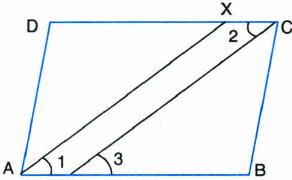
ABCD is a parallelogram and line segments AX, CY bisects the angles A and C respectively. Show that AX II CY.
2.
In a quadrilateral ABCD, the line segments bisecting \(\angle \)C and \(\angle \) D meet at E. Prove that \(\angle \)A+\(\angle \)B=2\(\angle \)CED
3.
"A diagonal of a parallelogram divides it into two congruent triangles:" Prove it.
4.
Show that each angle of a rectangle is a right angle.
5.
The angle between the two altitudes of a parallelogram through the vertex of an obtuse angle is 50°. Find the angles of a parallelogram
6.
In a parallelogram, show that the angle bisectors of two adjacent angles intersect at right angle.
7.
Two parallel lines I and m are intersected by a transversal ' t'.Show that the quadrilateral formed by bisectors of interior angles is a rectangle.
8.
If angles of a quadrilateral are in ratio 1 : 2 : 3 : 4. Find the measure of all the angles of a quadrilateral.
9.
Two opposite angles of a parallelogram are (3x - 2)° and (63 - 2x)° Find all the angles of a parallelogram.
10.
The angles of a quadrilateral are (4x°),(7x°),(15x°) and (10x°).Find the smallest and largest angles of the quadrilateral.
11.
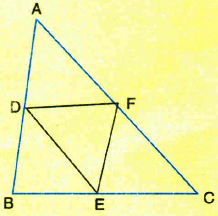
In \(\Delta \) ABC, D, E and F are midpoints of sides AB, BC and CA. If AB = 6 cm,BC = 7.2 cm and AC = 7.8 crn find the perimeter of \(\Delta \)DEF.
12.
If an angle of a parallelogram in two-third of its adjacent angle then find the measure of all the angles,
13.
In a parallelogram PQRS, if \(\angle \)QRS=2x, \(\angle \)PQS=4x, and \(\angle \)PSQ=4x, find the angles of the parallelogram.
14.
The angles A, B, C and D of a quadrilateral have measures in the ratio 2 : 4 : 5 : 7. Find the measures of these angles. What type of quadrilateral is it? Give reasons.
15.
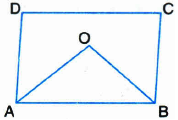
In the following figure, ABCD is a parallelogram. The bisectors of angles A and B intersect at O. Then, the angle AGB is
a right angle
an acute angle
an obtuse angle
a straight angle.a straight angle.
16.
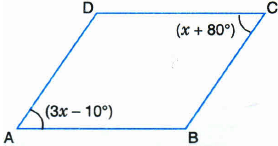
In the following figure, ABCD is a parallelogram. Find the value of x
25°
60°
75°
45°
17.
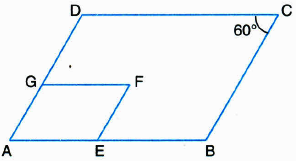
Find the measure of \(\angle \)AGF.
60°
120°
30°
90°
18.
A quadrilateral, whose all the four sides are equal yet all the four angles are not equal, is called
square
rhombus
rectangle
parallelogram.
19.
A blackboard is
a parallelogram
a rhombus
a trapezium
kite.
20.
A rhombus is
a rectangle
a square
a kite
not a square.
21.
If in a quadrilateral, two pairs of adjacent sides are equal, then it is called a
kite
trapezium
rhombus
square
22.
If one angle of a parallelogram is 900 and all sides are equal, then it is called a
rectangle
square
rhombus
kite
23.
If one of a parallelogram is 900 and all sides are equal , then it is called a
kite
rectangle
rhombus
square
24.
How many sides does a quadrilateral have?
3
5
6
4
1.
Given: ABCD is a parallelogram and line segments AX, CY bisect the angles A and C respectively.
To Prove: AX IICY.
Proof: \(\because\) ABCD is a parallelogram.
\(\therefore\) \(\angle \)A = \(\angle \)C I Opposite \(\angle \)s of a parallelogram are equal
⇒ \(1\over 2\)\(\angle \)A=\(1\over 2\)
⇒ \(\angle \)1 = \(\angle \)2 ...(1) I \(\because\) AX is the bisector of \(\angle \)A and CY is the bisector of \(\angle \)C
\(\therefore\) \(\angle \)2 =\(\angle \)3 ....(2) I Alternate interior \(\angle \) s
From (1) and (2), we get
\(\angle \)1 = \(\angle \)3
But these form a pair of equal corresponding angles
\(\therefore\) AX II CY.
2.
Given: In a quadrilateral ABCD, the line segments bisecting \(\angle \)C and \(\angle \)D meet at E.
In \(\Delta \) CED,
\(\angle \)CED +\(\angle \)EDC+\(\angle \)ECD = \(180°\) | Angle sum property of a triangle
2\(\angle \)CED+\(\angle \)D+C=A+B+C+D
3.
Given: ABCD is a parallelogram. AC is a diagonal of parallelogram ABCD which divides it into two triangles, namely, \(\Delta \) ABC and \(\Delta \)CDA
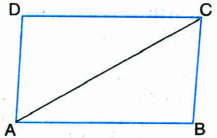
To Prove: \(\Delta \)ABC \(\cong \) \(\Delta \)CDA
Proof: BC IIDA IOpposite sides of a parallelogram are parallel and AC is a transversal
\(\angle \) BCA=\(\angle \)DAC ...(1)
Also, AB IIDC IOpposite sides of a parallelogram are parallel and AC is a transversal
\(\therefore \) \(\angle \)BAC = \(\angle \)DCA ......(2)
AC = CA ...(3) I Common
In view of (1), (2) and (3),
\(\Delta \) ABC \(\cong \) \(\Delta \) CDA I ASA congruence criterion
4.
Let us recall what a rectangle is.
A rectangle is a parallelogram in which one angle is a right angle.
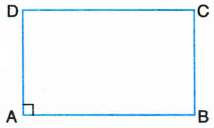
Let ABCD be a rectangle in which \(\angle\) A = 90°.
We have to show that \(\angle\) B = Ð C = \(\angle\) D = 90°
We have, AD || BC and AB is a transversal
(see Fig.).
So, \(\angle\) A + \(\angle\) B = 180° (Interior angles on the same
side of the transversal)
But, \(\angle\) A = 90°
So, \(\angle\) B = 180° – \(\angle\) A = 180° – 90° = 90°
Now, \(\angle\) C = Ð A and \(\angle\) D = \(\angle\) B
(Opposite angles of the parallellogram)
So, \(\angle\) C = 90° and \(\angle\) D = 90°.
Therefore, each of the angles of a rectangle is a right angle.
5.
AM丄DC, AN丄BC
In quadrilateral AMCN,
ㄥA+ㄥM+ㄥC+ㄥN=360°
ㄥA+ㄥC=180°
⇒ 50°+ㄥC=180° ⇒ ㄥC=130°
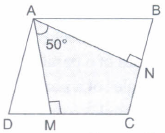
In parallelogram, ㄥA=ㄥC=130°
ㄥB=ㄥD=180°-130°
=50°
6.
ㄥADC+ㄥBCD=180°
⇒ \(\frac{1}{2}\)ㄥADC+\(\frac{1}{2}\)ㄥBCD=90°
or ㄥ1+ㄥ2=90°
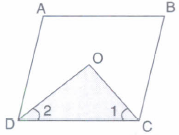
In ΔODC,
ㄥ1+ㄥ2+ㄥDOC=180°
ㄥDOC=90°
7.
∠APR=ㄥDRP
or ㄥ1=ㄥ2
But these are alternate interior angles
SP II RQ, SR II PQ
PQRS is a parallelogram
∠APR+ㄥBPR=180°,(linear pair)
⇒ \(\frac{1}{2}\) ∠APR+\(\frac{1}{2}\)ㄥBPR=\(\frac{1}{2}\)x180°
⇒ ∠1+ㄥ3=90°
⇒ ∠SPQ=90°
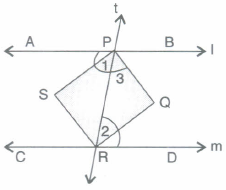
PQRS is a rectangle
8.
Let the measure of the angles be x, 2.x, 3x and 4x then,
x + 2x + 3x + 4x = 360°
⇒ x = 36°
ஃ Angles of quadrilateral are 36°, 72°, 108°,144°
9.
Since opposite angles of a parallelogram are equal
3x - 2 = 63 - 2x
⇒ x=13°
Angles of a parallelogram :
(39 - 2)°, (180- 37)°, (63 - 26)°, (180- 37)°
i.e., 37°,143°,37°,143°.
10.
Sum of the angles of a quadrilateral is 360°.
ஃ 4x° + 7x° + 15x° + 10x° = 360°
[Angle sum property of quadrilateral]
⇒ 36x°= 360°
⇒ x=10°
ஃ Smallest angle = 4x° = 40°
Largest angle = 15x°= 150°
11.
10.5 cm
12.
72°, 108°, 72°, 108°
13.
\(36°\),\(144°\),\(36°\), \(144°\)
14.
40°, 80°, 100°, 140°; Trapezium
16.
x+\(80°\)=3x- \(1 0°\)\(\Rightarrow \) x=\(45°\)
17.
\(\angle \)AGF +\(\angle \) GAE = \(180°\)
\(\Rightarrow \) \(\angle \)AGF+\(60°\)=\(180°\)
\(\Rightarrow \)\(\angle \)AGF=\(120°\)
18.
See a rhombus
19.
See a blackboard
20.
no of angle of a rhombus is 900
21.
(a)
kite
22.
(b)
square
23.
(b)
rectangle
24.
(d)
4

9th Standard CBSE Syllabus & Materials
9th Standard CBSE
CBSE 9th Mathematics Lines and Angles Sample Question Papers Study Material - QB365 Set A
NEW9th Standard CBSE
CBSE 9th Mathematics Introduction to Euclid's Geometry Sample Question Papers Study Material - QB365 Set A
NEW9th Standard CBSE
CBSE 9th Mathematics Linear Equations in Two Variables Sample Question Papers Study Material - QB365 Set A
NEW9th Standard CBSE
CBSE 9th Mathematics Coordinate Geometry Sample Question Papers Study Material - QB365 Set A



NCERT Books

Syllabus

Exam Pattern

Sample Question Papers

Previous year Question Papers

Important Notes

MCQ Practice test

NCERT Exemplers

Case study Questions

Image Based Questions

Passage based Questions

HOT Questions

Value Based Questions

Model Questions Papers
NCERT ( Book Back ) Questions

Assertion and Reason
Important Questions And Answers

CBSE 9th Standard CBSE Subjects
CBSE Standards