100% FREE ACCESS
9th Standard CBSE Syllabus & Materials
9th Standard CBSE
CBSE 9th Science Is matter around us pure? - New Model Questions Papers Study Material - QB365 Set A
NEW9th Standard CBSE
CBSE 9th Science Matter in our surroundings - New Model Questions Papers Study Material - QB365 Set A
NEW9th Standard CBSE
CBSE 9th Mathematics Heron's Formula Sample Question Papers Study Material - QB365 Set A
NEW9th Standard CBSE
CBSE 9th Mathematics Circles Sample Question Papers Study Material - QB365 Set A
NEW9th Standard CBSE
CBSE 9th Mathematics Quadrilaterals Sample Question Papers Study Material - QB365 Set A
NEW9th Standard CBSE
CBSE 9th Mathematics Triangles Sample Question Papers Study Material - QB365 Set A

Published on: 29/10/2025
Download CBSE Class 9th Standard CBSE Mathematics question papers, sample papers, important questions, and previous year solved papers in PDF format. Get free study materials, NCERT solutions, and exam preparation resources for Class 9th Standard CBSE Mathematics
Questions + Answers key
Take MCQ Mathematics Test
1.
PQRS is a parallelogram and PL and RM are perpendiculars drawn from the vertices P and R of the parallelogram on diagonal SQ. Show that
(i) ΔPQL ≡ ΔRMS
(ii) PL = RM
2.
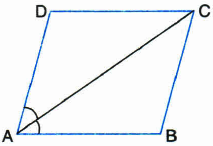
Diagonal AC of a parallelogram ABCD bisects \(\angle A\) (see figure). Show that:
(i) it bisects \(\angle C\) also
3.
ABCD is a square and on the side DC, an equilateral triangle is constructed. Prove that:
(i) AE = BE
(ii) ㄥDAE=15°
4.
In a quadrilateral ABCD, the line segments bisecting \(\angle \)C and \(\angle \) D meet at E. Prove that \(\angle \)A+\(\angle \)B=2\(\angle \)CED
5.
Show that each angle of a rectangle is a right angle.
6.
The angle between the two altitudes of a parallelogram through the vertex of an obtuse angle is 50°. Find the angles of a parallelogram
7.
If angles of a quadrilateral are in ratio 1 : 2 : 3 : 4. Find the measure of all the angles of a quadrilateral.
8.
The angles of a quadrilateral are (4x°),(7x°),(15x°) and (10x°).Find the smallest and largest angles of the quadrilateral.
9.
If an angle of a parallelogram in two-third of its adjacent angle then find the measure of all the angles,
10.
The quadrilateral formed by joining the mid-points of the sides of the rhombus taken in order is a
rectangle
square
trapezium
kite
11.
If a pair of opposite sides of a quadrilateral is equal and parallel, then the quadrilateral is a
parallelogram
rectangle
rhombus
square
12.
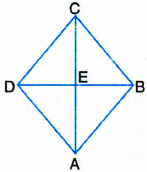
In the following figure, ABCD is a rhombus. If AC = 8 cm and DB = 6 cm, then the length of BC is
5 cm
4 cm
7 cm
3.5 cm.
13.
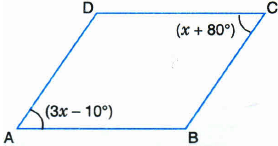
In the following figure, ABCD is a parallelogram. Find the value of x
25°
60°
75°
45°
14.
A rhombus is
a rectangle
a square
a kite
not a square.
15.
If one of a parallelogram is 900 and all sides are equal , then it is called a
kite
rectangle
rhombus
square
16.
The sum of all the angles of a quadrilateral is
3600
1800
5400
7200
17.
How many sides does a quadrilateral have?
3
5
6
4
18.
D, E, F are the mid-points of sides BC, CA and AB of ΔABC. If perimeter of ΔABC is 12·8 cm, then perimeter of ΔDEF is: .....
19.
Two consecutive angles of a parallelogram are in the ratio 1 : 3, then what will be the smaller angles?
20.
If in quadrilateral ABCD; ∠A=90° and AB=BC=CD=DA, then ABCD is a square.
21.
Rani has a photo-frame without a photo in the shape of a triangle with sides a, b, c in length. She wants to find the perimeter of a triangle formed by joining the mid-points of the sides of the photoframe. She could not understand how to overcome this problem. She shares this problem with her classmate Renu. Renu helps her and the required perimeter is computed.
(i) Find the perimeter of the triangle formed by joining the mid-points of the frame.
(ii) Which mathemetical concept is used in the above problem?
(iii) Which value is depicted between Rani and Renu?
22.
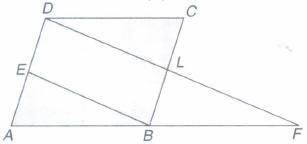
In the given figure ABCD is a parallelogram and E is the mid-point of AD. A line through D, drawn parallel to EB, meets AB produced at F and BC at L Prove that
(i) AF = 2DC
(ii) DF = 2DL
1.
In Δs RSM and PQL,
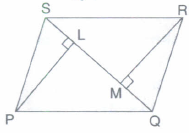
ㄥRSM=ㄥPQL
ㄥM=ㄥL=90°
SR=PQ
By AAS, ΔRSM≡ΔPQL
(ii) PL=RM(c.p.c.t)
2.
Given: Diagonal AC of a parallelogram ABCD bisects \(\angle A\)
(i) It bisects \(\angle C\) also
Proof: (i) In \(\Delta\)ADC and \(\Delta\)CBA,
AD = CB I Opp. sides of IIgm ABCD
CA = AC I Common
DC = BA I Opp. sides of II gm ABCD
\(\therefore \) \(\Delta\)ADC \(\cong \) \(\Delta\)CBA I SSS Congruence Rule
\(\angle ACD=\angle CAB\) |C.P.C.T
\(\angle DAC=\angle BCA\) |C.P.C.T
but \(\angle CAB=\angle DAC\) |Given
\(\therefore \ \angle ACD=\angle BCA\)
\(\therefore \) AC bisects \(\angle C\) also
(ii) From above,
AD = CD I Sides opposite to equal angles of a triangle are equal
\(\therefore \) AB = BC = CD = DA I \(\therefore \) ABCD is a II gm
\(\therefore \) ABCD is a rhombus.
3.
(i) Since ABCD is a square and ΔDCE is an equilateral triangle.
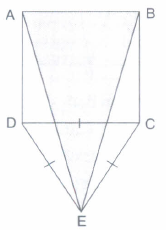
ㄥADC=90°
and ㄥEDC=60°
ㄥADC+ㄥEDC=90°+60°
⇒ ㄥADE=150°
Similarly, we have
ㄥBCE=150°
Thus in ∆ADE and ΔBCE, we have
AD= BC
ㄥADE=ㄥBCE=150°
and DE = CE
So by SAS congruence criterion, we have
Δ ADE≡Δ BCE
⇒ AE = BE Proved.
(ii) In ΔEAD, we have
AD= DE
⇒ ㄥEAD=ㄥAED=x(say)
Now, ㄥADE+ㄥAED+ㄥDAE=180°
150° + x + x = 180°
2x = 180°- 150° = 30°
x=ㄥDAE=15° Proved.
4.
Given: In a quadrilateral ABCD, the line segments bisecting \(\angle \)C and \(\angle \)D meet at E.
In \(\Delta \) CED,
\(\angle \)CED +\(\angle \)EDC+\(\angle \)ECD = \(180°\) | Angle sum property of a triangle
2\(\angle \)CED+\(\angle \)D+C=A+B+C+D
5.
Let us recall what a rectangle is.
A rectangle is a parallelogram in which one angle is a right angle.
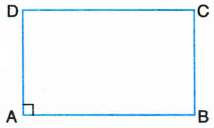
Let ABCD be a rectangle in which \(\angle\) A = 90°.
We have to show that \(\angle\) B = Ð C = \(\angle\) D = 90°
We have, AD || BC and AB is a transversal
(see Fig.).
So, \(\angle\) A + \(\angle\) B = 180° (Interior angles on the same
side of the transversal)
But, \(\angle\) A = 90°
So, \(\angle\) B = 180° – \(\angle\) A = 180° – 90° = 90°
Now, \(\angle\) C = Ð A and \(\angle\) D = \(\angle\) B
(Opposite angles of the parallellogram)
So, \(\angle\) C = 90° and \(\angle\) D = 90°.
Therefore, each of the angles of a rectangle is a right angle.
6.
AM丄DC, AN丄BC
In quadrilateral AMCN,
ㄥA+ㄥM+ㄥC+ㄥN=360°
ㄥA+ㄥC=180°
⇒ 50°+ㄥC=180° ⇒ ㄥC=130°
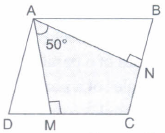
In parallelogram, ㄥA=ㄥC=130°
ㄥB=ㄥD=180°-130°
=50°
7.
Let the measure of the angles be x, 2.x, 3x and 4x then,
x + 2x + 3x + 4x = 360°
⇒ x = 36°
ஃ Angles of quadrilateral are 36°, 72°, 108°,144°
8.
Sum of the angles of a quadrilateral is 360°.
ஃ 4x° + 7x° + 15x° + 10x° = 360°
[Angle sum property of quadrilateral]
⇒ 36x°= 360°
⇒ x=10°
ஃ Smallest angle = 4x° = 40°
Largest angle = 15x°= 150°
9.
72°, 108°, 72°, 108°
10.
11.
Theorem
12.
\(BC=\sqrt { { BE }^{ 2 }+{ CE }^{ 2 } } =\sqrt { { \left( \frac { BD }{ 2 } \right) }^{ 2 }+{ \left( \frac { CA }{ 2 } \right) }^{ 2 } } \)\(=\frac { 1 }{ 2 } \sqrt { { BD }^{ 2 }+{ CA }^{ 2 } } =\frac { 1 }{ 2 } \sqrt { { 6 }^{ 2 }+{ 8 }^{ 2 } } =5\quad c.m\)
13.
x+\(80°\)=3x- \(1 0°\)\(\Rightarrow \) x=\(45°\)
14.
no of angle of a rhombus is 900
15.
(b)
rectangle
16.
(a)
3600
17.
(d)
4
18.
()
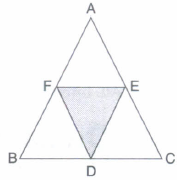
Given, perimeter of ΔABC=12.8 cm
ஃ Perimeter of ΔDEF=\(\frac{12.8}{2}\)=6.4cm
19.
()
Let the consecutive angles be x° and (3x)°
x°+3x°=180°
4x°=180°
x°=45°
ஃ Smaller angle=x°
=45°
20.
()
True
21.
(i) Let the photo-frame be ABC such that BC = a, CA = band AB = c and the mid-points of AB, BC and CA are respectively D, E and F.
We have to determine the perimeter of ΔDEF
In ΔABC, DF is the line-segment joining the mid-points of sides AB and AC.
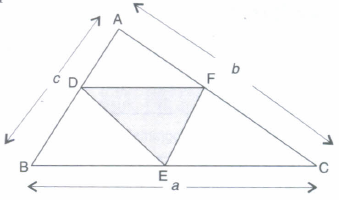
So, DF is parallel to BC and half of it.
i.e., DF=\(\frac{BC}{2}\)=\(\frac{a}{2}\)
Similarly, DE=\(\frac{AC}{2}=\frac{b}{2}\)
and EF=\(\frac{AB}{2}=\frac{c}{2}\)
DF + DE + EF=\(\frac{a}{2}+\frac{b}{2}+\frac{c}{2}\)=\(\frac{a+b+c}{2}\)
Hence required perimeter=\(\frac{1}{2}\)(a+b+c)
(ii) Mid-point theorem.
(iii) Unity and cooperation or Mutual understanding.
22.
(i) As EB II DL and ED II BL.
Therefore EBLD is a parallelogram.
ஃ BL = ED
=\(\frac{1}{2}\)BC=CL ...(i)
Now in triangles DCL and FBL, we have
CL=BL from (i)
ㄥDLC= ㄥFLB
ㄥCDL=ㄥBFL
ΔCDL≡ΔBFL
CD= BF
and DL= FL
Now, BF = DC = AB
⇒ 2AB = 2DC
⇒ AF = 2DC
(ii) ∵ DL=FL
⇒ DF = 2DL

9th Standard CBSE Syllabus & Materials
9th Standard CBSE
CBSE 9th Mathematics Lines and Angles Sample Question Papers Study Material - QB365 Set A
NEW9th Standard CBSE
CBSE 9th Mathematics Introduction to Euclid's Geometry Sample Question Papers Study Material - QB365 Set A
NEW9th Standard CBSE
CBSE 9th Mathematics Linear Equations in Two Variables Sample Question Papers Study Material - QB365 Set A
NEW9th Standard CBSE
CBSE 9th Mathematics Coordinate Geometry Sample Question Papers Study Material - QB365 Set A



NCERT Books

Syllabus

Exam Pattern

Sample Question Papers

Previous year Question Papers

Important Notes

MCQ Practice test

NCERT Exemplers

Case study Questions

Image Based Questions

Passage based Questions

HOT Questions

Value Based Questions

Model Questions Papers
NCERT ( Book Back ) Questions

Assertion and Reason
Important Questions And Answers

CBSE 9th Standard CBSE Subjects
CBSE Standards