100% FREE ACCESS
9th Standard CBSE Syllabus & Materials
9th Standard CBSE
CBSE 9th Science Is matter around us pure? - New Model Questions Papers Study Material - QB365 Set A
NEW9th Standard CBSE
CBSE 9th Science Matter in our surroundings - New Model Questions Papers Study Material - QB365 Set A
NEW9th Standard CBSE
CBSE 9th Mathematics Heron's Formula Sample Question Papers Study Material - QB365 Set A
NEW9th Standard CBSE
CBSE 9th Mathematics Circles Sample Question Papers Study Material - QB365 Set A
NEW9th Standard CBSE
CBSE 9th Mathematics Quadrilaterals Sample Question Papers Study Material - QB365 Set A
NEW9th Standard CBSE
CBSE 9th Mathematics Triangles Sample Question Papers Study Material - QB365 Set A

Published on: 29/10/2025
Download CBSE Class 9th Standard CBSE Mathematics question papers, sample papers, important questions, and previous year solved papers in PDF format. Get free study materials, NCERT solutions, and exam preparation resources for Class 9th Standard CBSE Mathematics
Questions + Answers key
Take MCQ Mathematics Test
1.
Draw any exterior angle of a triangle using compass, bisect it.
2.
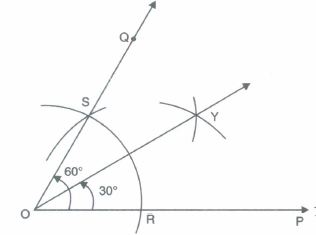
Draw an angle of an equilateral triangle,using protrator. Bisect it using compass
3.
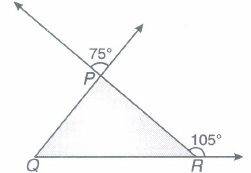
In the given figure, calculate the value of \(\angle PQR\)
4.
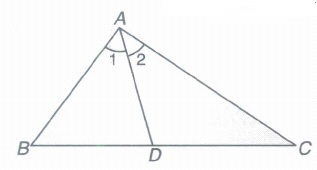
In the figure, given AC > AB and AD is the bisector of \(\angle\)A. Show that \(\angle\)ADC > \(\angle\)ADB.
5.
Two parallel lines I and m are intersected by a transversal ' t'.Show that the quadrilateral formed by bisectors of interior angles is a rectangle.
6.
Two opposite angles of a parallelogram are (3x - 2)° and (63 - 2x)° Find all the angles of a parallelogram.
7.
Factorize: 9x2+6xy+y2
8.
In the given figure, if AB = CD, then prove that AC = BD. Also write the Euclid's axiom used for proving it.

9.
In a triangle PQR, X and Y are the points on PQ are QR respectively. If PQ = QR and QX = QY, Show that PX = RY.
10.
State any two Euclid's axioms.
11.
In a ΔDEF, if ㄥD = 30°, ㄥE = 60° then which side of the triangle is longest and which side is shortest?
12.
(a) In the figure , what value of x will make POQ a straight line:
.png)
(b)In the given figure find the value of x,If AOB is a line
.png)
13.
Factorise: \(x^3-8x^2+17x-10\)
14.
Write the coefficient of x3 of the following polynomials:
\({ 2x }^{ 3 }-7x+{ x }^{ 2 }+{ 3x }^{ 4 }\)
15.
Find the value of x if \({ 2 }^{ 4 }\times { 2 }^{ 5 }={ \left( { 2 }^{ 5 } \right) }^{ x }\)
16.
If \(x=3+2\sqrt { 2 } \) , find the value of \({ x }^{ 2 }+\frac { 1 }{ { x }^{ 2 } } \)
17.
Find five rational numbers between 1 and 2.
18.
In a triangle ABC, X and Y are the points On AB and BC such that BX = BY and AB = BC. Show that AX = CY. State the Euclid's Axiom used.
19.
Show that if the diagonals of a quadrilateral are equal and bisect each other at right angles, then it is a square.
20.
Write the coefficients of x2 in the following:
\(\sqrt { 2x } -1\)
21.
Write the following in decimal form and say what kind of decimal expansion each has:
\(\frac { 2 }{ 11 } \)
22.
The quadrilateral formed by joining the mid-point of a quadrilateral taken in order is a
kite
parallelogram
rectangle
square
23.
If one of a parallelogram is 900 and all sides are equal , then it is called a
kite
rectangle
rhombus
square
24.
The side of an equilateral triangle is 4cm.An equilateral triangle, congruent to it, has the side length
1 cm
2 cm
3 cm
4 cm
25.
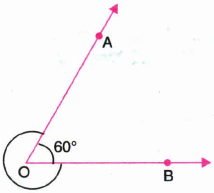
In the following figure, the reflex angle AOB is equal to
\(60^{ 0 },\)
\(120^{ 0 },\)
\(300^{ 0 },\)
\(360^{ 0 },\)
26.
The angle supplementary to \(180^{ 0 }\)-\(9^{ 0 }\) is
\(9^{ 0 }\)
\(180^{ 0 }\)
\(180^{ 0 }\) + \(9^{ 0 }\)
\(90^{ 0 }\) + \(9^{ 0 }\)
27.
Euclid stated that all right angles are equal to each other in the form of
an axiom
a definition
a postulate
a proof
28.
The compact form of (x+y)(x-y) is
\((x+y)(x-y)=x^2-y^2\) is an algebraic identity
\(x^2+y^2\)
\(x^2-2xy+y^2\)
\(x^2+2xy+y^2\)
\(x^2-y^2\)
29.
If \(\sqrt { x } \) is an irrational number, then x is:
rational
irrational
0
real
30.
Draw a line segment AB = 5 cm. From the point A draw a line segment AD = 6 cm making an angle of 60°. Draw perpendicular bisector of AD.
31.
Prove that if one triangle is equal to the sum of the other two angles the triangle is right angled.
32.
How many terms are there in the following polynomials?
3x2 - 5x + 7
33.
If a 60o angle is bisected twice,what will be measure of each that is constructed?
34.
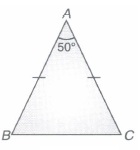
In the given figure, ABC is an isosceles triangle with AB=AC and \(\angle A=50^o.\) Calculate \(\angle B\)
35.
Two consecutive angles of a parallelogram are in the ratio 1 : 3, then what will be the smaller angles?
36.
What is a straight line?
37.
Find two rational numbers between 4 and 5
38.
If p(x) = x2 - 3x + 2, then what is the value of p(0) + p(2)?
1.
Steps of construction:
i) Construct a triangle ABC.
ii) Mark an exterior angle outside the triangle ABC,and name the point as E.
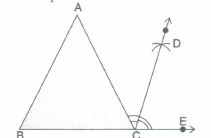
iii) Now, ACE is the exterior angle.
iv) Draw a bisecter of ㄥACE
2.
We know that each angle of equilateral triangle is 60o,So have to draw an angle 60oand bisect it.
Construction:
i) Draw any line OP.
ii) With 0 as centre and any suitable radius, draw an arc to meet OP at R.
iii) With R as centre and same radius draw an arc to meet the previous arc at S.
iv) Join OS and Produce it to Q, then ㄥPOQ=60o
v) With R as centre and any suitable radius (not necessarily)equal to radius of step 1 (but >\(\frac { 1 }{ 2 } \)RS),draw an arc. Also, with 5 as centre and radius draw another arc to meet the previous arc at Y
vi) Join OY and produced it, the OY is the required bisector of ㄥPOQ(i.e,ㄥPOY=30o)
3.
\(\angle QPR=75^o\) (Vertically opposite angles)
Again, \(\angle PQR+\angle QPR=105^o\) (Exterior angle)
\(\Rightarrow \angle PQR+75^o=105^o\)
\(\Rightarrow PQR=30^o\)
4.
In \(\triangle\)ABC, AC >AB
\(\therefore\) \(\angle\) ABC > \(\angle\)ACB
(Angles opposite to larger side is greater)
\(\therefore\) \(\angle\)ABC + \(\angle\)1 > \(\angle\)ACB + \(\angle\)1
(Adding \(\angle 1\)on both sides) Y.
\(\therefore\) \(\angle\)ABC + \(\angle\)1 > \(\angle\)ACB + \(\angle\)2
(AD bisects \(\angle\)A, \(\angle\)1 = \(\angle\)2)
\(\therefore\) \(\angle\)ADC > \(\angle\)ADB.
(Exterior angle property of triangle)
5.
∠APR=ㄥDRP
or ㄥ1=ㄥ2
But these are alternate interior angles
SP II RQ, SR II PQ
PQRS is a parallelogram
∠APR+ㄥBPR=180°,(linear pair)
⇒ \(\frac{1}{2}\) ∠APR+\(\frac{1}{2}\)ㄥBPR=\(\frac{1}{2}\)x180°
⇒ ∠1+ㄥ3=90°
⇒ ∠SPQ=90°
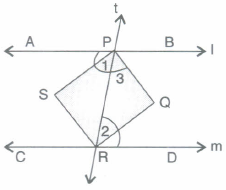
PQRS is a rectangle
6.
Since opposite angles of a parallelogram are equal
3x - 2 = 63 - 2x
⇒ x=13°
Angles of a parallelogram :
(39 - 2)°, (180- 37)°, (63 - 26)°, (180- 37)°
i.e., 37°,143°,37°,143°.
7.
9x2+6xy+y2 = (3x)2+2\(\times\)(3x)\(\times\)y+y2
=(3x+y)2
[\(\because\) a2+2ab+b2=(a+b)2]
8.
AB = CD(Given)
\(\Rightarrow\)AB + BC = BC + CD
\(\Rightarrow\)AC = BD
Euclid's axiom used: If equals are added to equals, the wholes are equal.
9.
PQ = QR
QX = QY
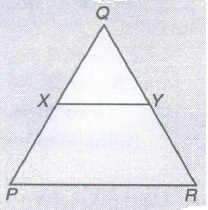
If equals are subtracted from equals, the remainders are also equal.
We have PQ - QX = QR - QY
PX = RY
10.
Euclid's axioms
(i) Things which are equal to the same thing are equal to one another.
(ii) If equals are added to equals, the wholes are equal.
11.
DE, EF
12.
(a) 28
(b) 26
13.
(x-1)(x-3)(x-4)
14.
2
15.
3
16.
34
17.
7/6,4/3,3/2,5/3 and 11/6
18.
AB = BC (given)
BX = BY (given)
If equals are subtracted from equals, then remains are also equal.
AB - BX = BC - BY
\(\Rightarrow\) AX = CY
19.
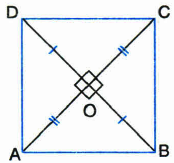
Given: The diagonals AC and BD of a quadrilateral ABCD are equal and bisect each other at right angles.
To Prove: Quadrilateral ABCD is a square.
Proof: In \(\Delta\)OAD and \(\Delta\)OCB,
OA = OC I Given
OD = OB I Given
\(\therefore \Delta OAD\cong \Delta OCB\) I SAS Congruence Rule
\(\therefore \) AD = CB I C.P.C.T.
\(\angle ODA=\angle OBC\) |C.P.C.T
\(\angle BDA=\angle DBC\)
Now, \(\because\) AD = CB and AD II CB
\(\therefore \) Quadrilateral ABCD is a II gm. I A quadrilateral is a parallelogram if a pair of opposite sides are parallel and equal.
In \(\therefore \) \(\Delta\) AOB and \(\Delta\)AOD,
AO = AO I Common
OB = OD I Given
\(\angle \)AOB = \(\angle \)AOD |Each=\(90°\)
\(\therefore \) \(\Delta\)AOB \(\cong \) \(\Delta\) AOD I SAS Congruence Rule
AB = AD I C.P.C.T.
Now, \(\because\) ABCD is a parallelogram and
AB=AD
\(\because\) ABCD is a rhombus.
Again, in \(\Delta\) ABC and \(\Delta\) BAD,
AC = BD I Given
BC = AD I \(\because\) ABCD is a rhombus
AB = BA I Common
\(\therefore \) \(\Delta\) ABC \(\cong \) \(\Delta\) BAD I SSS Congruence Rule
\(\therefore \) \(\angle \) ABC = \(\angle\) BAD I C.P.C.T.
\(\because\) AD II BC I Opp. sides of IIgm ABCD and transversal AB intersects them.
\(\therefore \) \(\angle ABC+\angle BAD=180°\)
ABC = \(\angle\)BAD = \(90°\)
Similarly,\(\angle\)BCD =\(\angle\)ADC =\(90°\)
\(\therefore \) ABCD is a square.
20.
Coefficient of x2 = 0
21.
\(\frac { 2 }{ 11 } \)= 0.1818...= \(0.\overline { 18 } \)
22.
PQ II DB, SR II DB
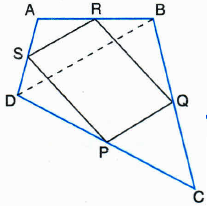
\(\therefore\) PQ II SR
Similarly, PS IIQR
\(\therefore\) PQRS is a parallelogram.
23.
(b)
rectangle
24.
Two equilateral triangles of the same side length are congruent
25.
Required angle = \(360^{ 0 },\) - \(60^{ 0 },\)=\(300^{ 0 },\)
26.
Required angle=\(180^{ 0 }\)-(\(180^{ 0 }\)+\(9^{ 0 }\)) =\(9^{ 0 }\)
27.
(a)
an axiom
28.
(a)
\(x^2+y^2\)
29.
(d)
real
30.
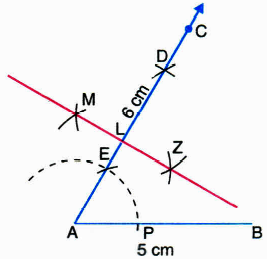
Steps of Construction
1. Draw a line segment AB = 5 cm.
2. Taking A as centre and some radius, draw an arc of a circle, which intersects AB, say at a point P.
3. Taking P as centre and with the same radius as before, draw an arc intersecting the previously draw arc, say at a point E.
4. Draw the ray AC passing through E.
5. From ray AC, cut off AD = 6 cm. Then, \(\angle DAB\) is the required angle of 60° such that AD = 6 cm.
6. Now, taking A and D as centres and radius 1 more than \(\frac { 1 }{ 2 } \) AD, draw arcs on both sides of the line segment AD (to intersect each other).
31.
Let in \(\triangle \)ABC \(\angle A=\angle B+\angle C\)
We know that \(\angle A=\angle B+\angle C=180^{ 0 }\)
The sum of the three angles of a triangle is \(180^{ 0 }\)
\(\Rightarrow \angle A+\angle A=180^{ 0 }\)
\(\Rightarrow 2\angle A=180^{ 0 }\)
\(\Rightarrow \angle A=\frac { 180^{ 0 } }{ 2 } =90^{ 0 }\)
Hence Triangle ABC is a right-angled triangle.
32.
Number of terms = 3
Terms: 3x2, -5x, 7
33.
()
Since bisector of an angle divides it in two equal parts,so,when it is bisected twice,measure of each angle is 15o
34.
()
AB=AC
\(\therefore \angle C=\angle B\)
Then,
\(\angle A+\angle B+\angle C=180^o\) (Prop. of isosceles \(\triangle)\)
\(\Rightarrow 50^o+\angle B+\angle B=180^o\)
\(\Rightarrow 2\angle B=130^o\)
\(\Rightarrow \angle B=65^o\)
35.
()
Let the consecutive angles be x° and (3x)°
x°+3x°=180°
4x°=180°
x°=45°
ஃ Smaller angle=x°
=45°
36.
()
Two planes intersect each other to form a straight line.
37.
()
4 = \(\frac{4}{5}\) x 5 and 5=\(\frac{5}{5}\) x 5
4 = \(\frac{20}{5}\) and 5 = \(\frac{25}{5}\)
The numbers are \(\frac{21}{5}\) and \(\frac{22}{5}\)
38.
()
Putting, x = 0
p(0) = 0 - 3 \(\times\) 0 + 2 = 2
Putting, x = 2
p(2) = 22 - 3 \(\times\) 2 + 2
= 4 - 6 + 2 = 0
Thus, p(0) + p(2) = 2 + 0 = 2.

9th Standard CBSE Syllabus & Materials
9th Standard CBSE
CBSE 9th Mathematics Lines and Angles Sample Question Papers Study Material - QB365 Set A
NEW9th Standard CBSE
CBSE 9th Mathematics Introduction to Euclid's Geometry Sample Question Papers Study Material - QB365 Set A
NEW9th Standard CBSE
CBSE 9th Mathematics Linear Equations in Two Variables Sample Question Papers Study Material - QB365 Set A
NEW9th Standard CBSE
CBSE 9th Mathematics Coordinate Geometry Sample Question Papers Study Material - QB365 Set A



NCERT Books

Syllabus

Exam Pattern

Sample Question Papers

Previous year Question Papers

Important Notes

MCQ Practice test

NCERT Exemplers

Case study Questions

Image Based Questions

Passage based Questions

HOT Questions

Value Based Questions

Model Questions Papers
NCERT ( Book Back ) Questions

Assertion and Reason
Important Questions And Answers

CBSE 9th Standard CBSE Subjects
CBSE Standards