100% FREE ACCESS
9th Standard CBSE Syllabus & Materials
9th Standard CBSE
CBSE 9th Science Is matter around us pure? - New Model Questions Papers Study Material - QB365 Set A
NEW9th Standard CBSE
CBSE 9th Science Matter in our surroundings - New Model Questions Papers Study Material - QB365 Set A
NEW9th Standard CBSE
CBSE 9th Mathematics Heron's Formula Sample Question Papers Study Material - QB365 Set A
NEW9th Standard CBSE
CBSE 9th Mathematics Circles Sample Question Papers Study Material - QB365 Set A
NEW9th Standard CBSE
CBSE 9th Mathematics Quadrilaterals Sample Question Papers Study Material - QB365 Set A
NEW9th Standard CBSE
CBSE 9th Mathematics Triangles Sample Question Papers Study Material - QB365 Set A

Published on: 29/10/2025
Download CBSE Class 9th Standard CBSE Mathematics question papers, sample papers, important questions, and previous year solved papers in PDF format. Get free study materials, NCERT solutions, and exam preparation resources for Class 9th Standard CBSE Mathematics
Questions + Answers key
Take MCQ Mathematics Test
1.
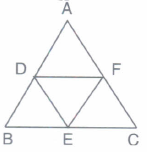
In D ABC, D, E and F are respectively the mid-points of sides AB, BC and CA (see Fig.). Show that Δ ABC is divided into four congruent triangles by joining D, E and F.
2.
In given fig., AD is the median of ΔABC. E is the mid-point of AD. DG || BF. Prove that AC = 3AF.
3.
Show that the bisectors of angles of a parallelogram form a rectangle
4.
Show that the bisectors of angles of a parallelogram enclose a rectangle.
5.
ABCD is a quadrilateral in which the bisectors of ㄥA and ㄥC meet DC produced at Y and BA produced at X respectively. Prove that ㄥX+ㄥY=\(\frac{1}{2}\)(ㄥA+ㄥC)
6.
ABCD is a square and on the side DC, an equilateral triangle is constructed. Prove that:
(i) AE = BE
(ii) ㄥDAE=15°
7.
In triangle, ABC points M and N on sides AB and AC respectively are taken so that AM = \(1\over2\) AB and AN = \(1\over4\) AC Prove that MN= \(1\over4\)BC
8.
"A diagonal of a parallelogram divides it into two congruent triangles:" Prove it.
9.
Show that each angle of a rectangle is a right angle.
1.
D and E are the mid-points of AB and BC respectively.
ஃ DE II AC
Similarly, DF II BC and EF II AB
ஃ ADEF, BDFE, and DFCE are all parallelograms
DE is the diagonal of parallelogram BDFE
ஃ ΔBDE ≡ ΔFED
ΔDAF ≡ ΔFED
ΔEFC ≡ ΔFED
ஃ All the four triangles are congruent.
2.
In ΔADG, E is the mid-point of AD and EF || DG.
⇒ F is the mid-point of AC (converse of mid-point theorem)
⇒ AF=FG...(i)
In ΔCBF, BF II DG, D is the mid-point of BC
⇒ G is the mid-point of FC
FG = GC...(ii)
From (i) and (ii), AF = FG = GC
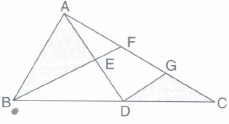
AC = AF + FG + GC
= 3AF.
3.
Let ABCD is a parallelogram
To show LMNO is a rectangle,
ㄥA+ㄥD=180°
\(\frac{1}{2}\)ㄥA+\(\frac{1}{2}\)ㄥD=90°
ㄥOAD+ㄥODA=90°
In ΔOAD,
ㄥOAD+ㄥADO+ㄥDOA=180°
⇒ ㄥDOA = 90°
⇒ ㄥLON = 90°
Similarly, ㄥOLM =ㄥLMN =ㄥMNO = 90°
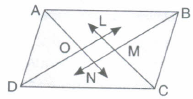
ஃ A quadrilateral with all angles 90° is a rectangle. Also opposite angles are equal. It is rectangle.
4.
Let ABCD is a parallelogram
To show LMNO is a rectangle,
ㄥA+ㄥD=180°
\(\frac{1}{2}\)ㄥA+\(\frac{1}{2}\)ㄥD=90°
ㄥOAD+ㄥODA=90°
In ΔOAD,
ㄥOAD+ㄥADO+ㄥDOA=180°
⇒ ㄥDOA=90°
⇒ ㄥLON=90°
Similarly, ㄥOLM=ㄥLMN=ㄥMNO=90°
ஃ A quadrilateral with all angles, 90° is a rectangle. Also, opposite angles are equal. It is a rectangle.
5.
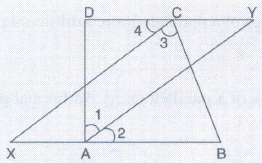
ㄥ1=ㄥ2=\(\frac{1}{2}\)ㄥA
ㄥ3=ㄥ4=\(\frac{1}{2}\)ㄥC
In ΔCXB,
ㄥ3+ㄥX+ㄥB=180° ...(i)
(By Angle sum property of a Δ)
In ΔDAY,
ㄥ1+ㄥY+ㄥD=180° ...(ii)
(By Angle sum property of a Δ)
Adding (i) and (ii),
ㄥ3+ㄥX+ㄥB+ㄥ1+ㄥY+ㄥD=180°+180°
i.e., ㄥX+ㄥY+ㄥ3+ㄥ1+ㄥB+ㄥD=180
i.e., ㄥX+ㄥY+\(\frac{1}{2}\)ㄥC+\(\frac{1}{2}\)ㄥA+ㄥB+ㄥD=360...(iii)
But, ㄥA+ㄥB+ㄥC+ㄥD=360...(iv)
(Angle sum property of a quadrilateral)
From (iii) and (iv),
∠X+ㄥY+\(\frac{1}{2}\)ㄥC+\(\frac{1}{2}\)ㄥA+ㄥB+ㄥD=ㄥA+ㄥB+ㄥC+ㄥD
i.e., ㄥX+ㄥY=ㄥA-\(\frac{1}{2}\)ㄥA+ㄥC-\(\frac{1}{2}\)ㄥC
=\(\frac{1}{2}\)ㄥA+\(\frac{1}{2}\)ㄥC
ㄥX+ㄥY=\(\frac{1}{2}\)(ㄥA+ㄥC)
Hence Proved.
6.
(i) Since ABCD is a square and ΔDCE is an equilateral triangle.
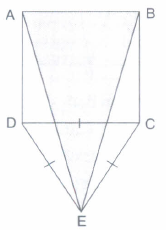
ㄥADC=90°
and ㄥEDC=60°
ㄥADC+ㄥEDC=90°+60°
⇒ ㄥADE=150°
Similarly, we have
ㄥBCE=150°
Thus in ∆ADE and ΔBCE, we have
AD= BC
ㄥADE=ㄥBCE=150°
and DE = CE
So by SAS congruence criterion, we have
Δ ADE≡Δ BCE
⇒ AE = BE Proved.
(ii) In ΔEAD, we have
AD= DE
⇒ ㄥEAD=ㄥAED=x(say)
Now, ㄥADE+ㄥAED+ㄥDAE=180°
150° + x + x = 180°
2x = 180°- 150° = 30°
x=ㄥDAE=15° Proved.
7.
Given: In a triangle, ABC, points M and N on the sides AB and AC respectively are taken so that AM
= \(1\over4\) AB and AN = \(1\over4\)AC
To prove:
MN = \(1\over4\) BC.
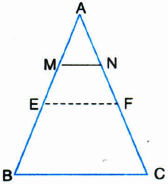
Construction: Join EF where E and F are the mid-points of AB and AC respectively.
Proof: \(\therefore\) E is the mid-point of AB and F is the mid-point of AC.
\(\because\) EF IIBC and EF = \(1\over2\)BC ...........(1)
Now AE = \(1\over2\) AB and AM = \(1\over4\) AB AM = \(1\over2\)AE
Similarly, AN = \(1\over2\)AF
⇒ M and N are the mid-points of AE and AF respectively.
\(\therefore\) MN II EFand MN= \(1\over2\)EF= \(1\over2\) (\(1\over2\)BC) I From (1)
⇒ = \(1\over4\)BC
8.
Given: ABCD is a parallelogram. AC is a diagonal of parallelogram ABCD which divides it into two triangles, namely, \(\Delta \) ABC and \(\Delta \)CDA
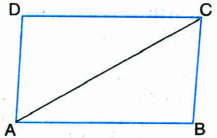
To Prove: \(\Delta \)ABC \(\cong \) \(\Delta \)CDA
Proof: BC IIDA IOpposite sides of a parallelogram are parallel and AC is a transversal
\(\angle \) BCA=\(\angle \)DAC ...(1)
Also, AB IIDC IOpposite sides of a parallelogram are parallel and AC is a transversal
\(\therefore \) \(\angle \)BAC = \(\angle \)DCA ......(2)
AC = CA ...(3) I Common
In view of (1), (2) and (3),
\(\Delta \) ABC \(\cong \) \(\Delta \) CDA I ASA congruence criterion
9.
Let us recall what a rectangle is.
A rectangle is a parallelogram in which one angle is a right angle.
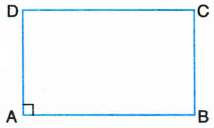
Let ABCD be a rectangle in which \(\angle\) A = 90°.
We have to show that \(\angle\) B = Ð C = \(\angle\) D = 90°
We have, AD || BC and AB is a transversal
(see Fig.).
So, \(\angle\) A + \(\angle\) B = 180° (Interior angles on the same
side of the transversal)
But, \(\angle\) A = 90°
So, \(\angle\) B = 180° – \(\angle\) A = 180° – 90° = 90°
Now, \(\angle\) C = Ð A and \(\angle\) D = \(\angle\) B
(Opposite angles of the parallellogram)
So, \(\angle\) C = 90° and \(\angle\) D = 90°.
Therefore, each of the angles of a rectangle is a right angle.

9th Standard CBSE Syllabus & Materials
9th Standard CBSE
CBSE 9th Mathematics Lines and Angles Sample Question Papers Study Material - QB365 Set A
NEW9th Standard CBSE
CBSE 9th Mathematics Introduction to Euclid's Geometry Sample Question Papers Study Material - QB365 Set A
NEW9th Standard CBSE
CBSE 9th Mathematics Linear Equations in Two Variables Sample Question Papers Study Material - QB365 Set A
NEW9th Standard CBSE
CBSE 9th Mathematics Coordinate Geometry Sample Question Papers Study Material - QB365 Set A



NCERT Books

Syllabus

Exam Pattern

Sample Question Papers

Previous year Question Papers

Important Notes

MCQ Practice test

NCERT Exemplers

Case study Questions

Image Based Questions

Passage based Questions

HOT Questions

Value Based Questions

Model Questions Papers
NCERT ( Book Back ) Questions

Assertion and Reason
Important Questions And Answers

CBSE 9th Standard CBSE Subjects
CBSE Standards