100% FREE ACCESS
9th Standard CBSE Syllabus & Materials
9th Standard CBSE
CBSE 9th Science Is matter around us pure? - New Model Questions Papers Study Material - QB365 Set A
NEW9th Standard CBSE
CBSE 9th Science Matter in our surroundings - New Model Questions Papers Study Material - QB365 Set A
NEW9th Standard CBSE
CBSE 9th Mathematics Heron's Formula Sample Question Papers Study Material - QB365 Set A
NEW9th Standard CBSE
CBSE 9th Mathematics Circles Sample Question Papers Study Material - QB365 Set A
NEW9th Standard CBSE
CBSE 9th Mathematics Quadrilaterals Sample Question Papers Study Material - QB365 Set A
NEW9th Standard CBSE
CBSE 9th Mathematics Triangles Sample Question Papers Study Material - QB365 Set A

Published on: 29/10/2025
Download CBSE Class 9th Standard CBSE Mathematics question papers, sample papers, important questions, and previous year solved papers in PDF format. Get free study materials, NCERT solutions, and exam preparation resources for Class 9th Standard CBSE Mathematics
Questions + Answers key
Take MCQ Mathematics Test
1.
ABCD is a parallelogram. If E is mid-point of BC and AE is the bisector of ㄥA, prove that AB=\(\frac{1}{2}\) AD.
2.
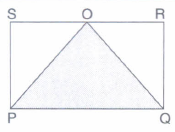
In a parallelogram PQRS of the given figure, the bisectors of ㄥP and ㄥQ meet SR at O. Show that ㄥPOQ=90°
3.
In the given figure, in a parallelogram ABCD, two points P and Q are taken on the diagonal BD such that DP = BQ. Show that:
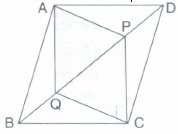
(i) ΔAPD≡ΔCQB
(ii) ΔAQB≡ΔCPD
(iii) APCQ is a parallelogram.
4.
PQRS is a quadrilateral with SQ as one of its diagonals. If SR = PQ = 4 cm, SQ = 5 cm and SQ is perpendicular to both SR and PQ, show that ar (ΔPSQ) = ar(ΔSRQ)
5.
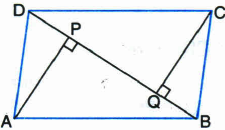
ABCD is a parallelogram and APand CQ are perpendiculars from vertices A and C on diagonal BD respectively. Show that:
\((i)\Delta APB\cong \Delta CQD\)
\(\\ (ii)AP=CQ\)
6.
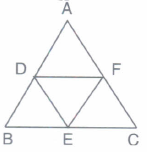
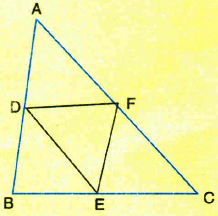
In D ABC, D, E and F are respectively the mid-points of sides AB, BC and CA (see Fig.). Show that Δ ABC is divided into four congruent triangles by joining D, E and F.
7.
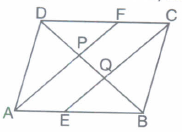
In the figure, ABCD is a parallelogram. E and F are the mid-points of sides AB and CD respectively. Show that the line segments AF and EC trisect the diagonal BD.
8.
If ΔABC and ΔDEF are two triangles such that AB, BC are respectively equal and parallel to DE, EF then show that:
(i) quadrilateral ABED is a parallelogram
(ii) quadrilateral BCEF is a parallelogram.
(iii) AC = DF
(iv) ΔABC≡ΔDEF
9.
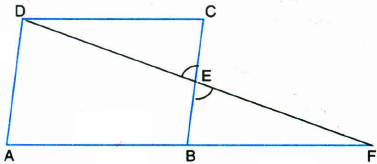
In the figure ABCD is a parallelogram and E is the midpoint of side BC DE and AB on producing meet at F. Prove that AF = 2AB.
10.
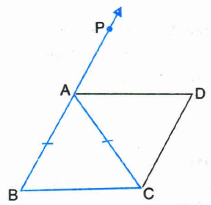
ABC is an isosceles triangle in which AB = AC AD bisects \(\angle \) PAC and CD II AB. Show that
(i) \(\angle \) DAC =\(\angle \) BCA
(ii) ABCD is a parallelogram
11.
The angle between the two altitudes of a parallelogram through the vertex of an obtuse angle is 50°. Find the angles of a parallelogram
12.
Two parallel lines I and m are intersected by a transversal ' t'.Show that the quadrilateral formed by bisectors of interior angles is a rectangle.
13.
The angles of a quadrilateral are (4x°),(7x°),(15x°) and (10x°).Find the smallest and largest angles of the quadrilateral.
14.
In \(\Delta \) ABC, D, E and F are midpoints of sides AB, BC and CA. If AB = 6 cm,BC = 7.2 cm and AC = 7.8 crn find the perimeter of \(\Delta \)DEF.
15.
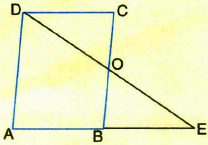
In the figure, ABCD is a parallelogram in which AB is produced to E so that AB = BE
(a) Prove that ED bisects BC
(b) If AD = 10 cm, find OB.
16.
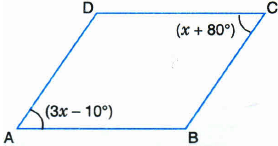
In the following figure, ABCD is a parallelogram. Find the value of x
25°
60°
75°
45°
17.
If both the diagonals of a parallelogram are equal, then it will be a
kite
rectangle
rhombus
trapezium.
18.
A rhombus is
a rectangle
a square
a kite
not a square.
19.
Which of the following is false?
A square is a rectangle
A square is a rhombus
A parallelogram is a trapezium
A kite is a parallelogram.
20.
The sum of all the angles of a quadrilateral is
3600
1800
5400
7200
1.
Here ㄥ1=ㄥ2 (AE is the angle bisector)
But ㄥ1=ㄥ3 (alternate angles as AD||BC)
ㄥ3=ㄥ2
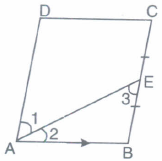
Hence BE=AB (sides opposite to equal angles)
But BE=\(\frac{1}{2}\) BC, (E is the mid-point of BC)
AB=\(\frac{1}{2}\)BC
and BC=AD (opposite sides of a parallelogram)
AB=\(\frac{1}{2}\)AD
Hence Proved.
2.
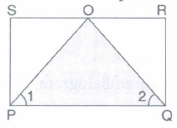
A parallelogram PQRS in which the bisectors of LP and LQ meet SR at O.
To Prove: ㄥPOQ=90°
Now, since PQRS is a parallelogram. Therefore,
PSIIQR
Now, PS II QR and transversal PQ intersects them.
ㄥP+ㄥQ=180°
(∵ Sum of consecutive interior angles is 180°)
\(\frac{1}{2}\)ㄥP+\(\frac{1}{2}\)ㄥQ=90°
⇒ ㄥ1+ㄥ2=90° ( OP is bisector of ㄥP...(i) and OQ is bisector of ㄥQ.
ㄥ1=\(\frac{1}{2}\) ㄥP and ㄥ2=\(\frac{1}{2}\) ㄥQ)
Now, in ΔPOQ
ㄥ1+ㄥPOQ+ㄥ2=180°
⇒ 90°+ㄥPOQ=180°
⇒ ㄥPOQ=90°
3.
In Δs APD and CQB
AD = BC (Opp. sides of a parallelogram)
PD = BQ (Given)
∠ADP=∠QBC
⇒ ΔAPD≡ΔCQB
⇒ AP = CQ (c.p.c.t)
In Δs AQB and CPD
AB = DC, BQ = DP
and ∠AQB=∠PDC
ஃ ΔAQB≡ΔCPB ⇒ AQ=CP
(iii) In quad. APCQ,
AP = CQ and AQ = CP
⇒ APCQ is a parallelogram.
4.
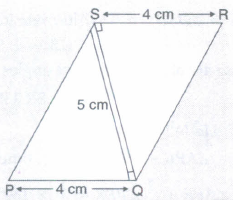
In ΔPSQ and ΔRQS
PQ = SR (= 4cm)
SQ = SQ (common)
ㄥSQP =∠QSR (Each 90°)
ΔPSQ ≡ ΔRQS by SAS rule.
Thus, ar (ΔPSQ) = ar(ΔSRQ)
[∵ Areas of congruent figures are equal.]
5.
Given: ABCD is a parallelogram and AP and CQ are perpendiculars from vertices A and C on diagonal BD respectively.
To Prove:
\((i)\Delta APB\cong \Delta CQD\)
\(\\ (ii)AP=CQ\)
Proof: (i) In \(\Delta APB\ \) and \( \Delta CQD\)
AB = CD I Opp. sides of || gm ABCD
\(\angle ABP=\angle CDQ\) |Each=\(90°\)
(ii) \(\Delta APB\cong \Delta CQD\) I Proved above in (i)
\(\therefore \) AP = CQ. I C.P.C.T.
6.
D and E are the mid-points of AB and BC respectively.
ஃ DE II AC
Similarly, DF II BC and EF II AB
ஃ ADEF, BDFE, and DFCE are all parallelograms
DE is the diagonal of parallelogram BDFE
ஃ ΔBDE ≡ ΔFED
ΔDAF ≡ ΔFED
ΔEFC ≡ ΔFED
ஃ All the four triangles are congruent.
7.
According to the question, E and F are the midpoints of sides AB and CD.
ஃ AE=\(\frac{1}{2}\)AB
CF=\(\frac{1}{2}\)CD
ஃ In the parallelogram opposite sides are equal, so AB=CD
ஃ AE=CF
Again, AB||CD
So, AE||FC
Hence AECF is a parallelogram.
In ΔABP,
E is the mid-point of AB.EQ || AP
ஃ Q is the mid-point of BP
Similarly, P is the mid-point of DQ
DP= PQ= QB
ஃ Line segments AF and EC trisect the diagonal BD.
8.
Two triangles ABC and DEF, such that
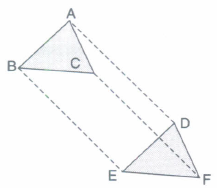
AB = DE and AB II DE
Also BC = EF and BC II EF
Proof: (i) In a quadrilateral ABED,
AB = DE and AB II DE
⇒ One pair of opposite sides are equal and parallel.
ABED is a parallelogram
⇒ AD = BE and AD II BE....(i)
(ii) In quadrilateral BCFE,
BC = EF and BC II EF
⇒ One pair of opposite sides are equal and parallel.
BCFE is a parallelogram
CF = BE and CF II BE ...(ii)
(iii) From equations (i) and (ii), we get
AD = CF and AD II CF
⇒ ACFD is a parallelogram
AC = DF andAC II DF
(iv) In ∆ABC and ∆DEF
AB = DE (Given)
BC = EF (Given)
and AC = DF (Proved above in part (c))
So by S.S.s.,ΔABC≅ΔDEF.
9.
Given: ABCD is a parallelogram and E is the mid-point of side BC. DE and AB on producing meet at F.
To Prove: AF = 2AB
Proof: In \(\Delta \)FAD,
\(\therefore\) E is the mid-point of BC I Given
and EB II DA | Opposite sides of a parallelogram are parallel
\(\therefore\) B is the mid-point of AF I By converse of mid-point theorem
AB = BF = \(1\over2\) AF ⇒ AF = 2AB
10.
Given: ABC is an isosceles triangle in which AB = AC. AD bisects L PAC and CD IIAB.
To Prove:
(i) \(\angle \)DAC =\(\angle \)BCA
Proof:
(i) In \(\Delta \) ABC,
\(\because\) AB = AC
\(\therefore\) \(\angle \)B =\(\angle \)C .......(1) I Angles opposite to equal sides of a triangle are equal
Also, Ext. \(\angle \)PAC =\(\angle \)B +\(\angle \)C
⇒
⇒ 2\(\angle \)CAD = 2\(\angle \)C
⇒ \(\angle \)CAD =\(\angle \)C
\(\therefore\) AD II BC
Also, CD II AB I Given
\(\therefore\) ABCD is a parallelogram IA quadrilateral is a parallelogram if its both the pairs of opposite sides are parallel.
11.
AM丄DC, AN丄BC
In quadrilateral AMCN,
ㄥA+ㄥM+ㄥC+ㄥN=360°
ㄥA+ㄥC=180°
⇒ 50°+ㄥC=180° ⇒ ㄥC=130°
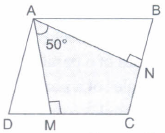
In parallelogram, ㄥA=ㄥC=130°
ㄥB=ㄥD=180°-130°
=50°
12.
∠APR=ㄥDRP
or ㄥ1=ㄥ2
But these are alternate interior angles
SP II RQ, SR II PQ
PQRS is a parallelogram
∠APR+ㄥBPR=180°,(linear pair)
⇒ \(\frac{1}{2}\) ∠APR+\(\frac{1}{2}\)ㄥBPR=\(\frac{1}{2}\)x180°
⇒ ∠1+ㄥ3=90°
⇒ ∠SPQ=90°
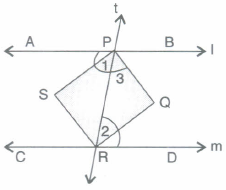
PQRS is a rectangle
13.
Sum of the angles of a quadrilateral is 360°.
ஃ 4x° + 7x° + 15x° + 10x° = 360°
[Angle sum property of quadrilateral]
⇒ 36x°= 360°
⇒ x=10°
ஃ Smallest angle = 4x° = 40°
Largest angle = 15x°= 150°
14.
10.5 cm
15.
5 cm
16.
x+\(80°\)=3x- \(1 0°\)\(\Rightarrow \) x=\(45°\)
17.
Theorm
18.
no of angle of a rhombus is 900
19.
opposite sides are not equal in a kite
20.
(a)
3600

9th Standard CBSE Syllabus & Materials
9th Standard CBSE
CBSE 9th Mathematics Lines and Angles Sample Question Papers Study Material - QB365 Set A
NEW9th Standard CBSE
CBSE 9th Mathematics Introduction to Euclid's Geometry Sample Question Papers Study Material - QB365 Set A
NEW9th Standard CBSE
CBSE 9th Mathematics Linear Equations in Two Variables Sample Question Papers Study Material - QB365 Set A
NEW9th Standard CBSE
CBSE 9th Mathematics Coordinate Geometry Sample Question Papers Study Material - QB365 Set A



NCERT Books

Syllabus

Exam Pattern

Sample Question Papers

Previous year Question Papers

Important Notes

MCQ Practice test

NCERT Exemplers

Case study Questions

Image Based Questions

Passage based Questions

HOT Questions

Value Based Questions

Model Questions Papers
NCERT ( Book Back ) Questions

Assertion and Reason
Important Questions And Answers

CBSE 9th Standard CBSE Subjects
CBSE Standards