9th Standard CBSE Syllabus & Materials
9th Standard CBSE
CBSE 9th Science Is matter around us pure? - New Model Questions Papers Study Material - QB365 Set A
NEW9th Standard CBSE
CBSE 9th Science Matter in our surroundings - New Model Questions Papers Study Material - QB365 Set A
NEW9th Standard CBSE
CBSE 9th Mathematics Heron's Formula Sample Question Papers Study Material - QB365 Set A
NEW9th Standard CBSE
CBSE 9th Mathematics Circles Sample Question Papers Study Material - QB365 Set A
NEW9th Standard CBSE
CBSE 9th Mathematics Quadrilaterals Sample Question Papers Study Material - QB365 Set A
NEW9th Standard CBSE
CBSE 9th Mathematics Triangles Sample Question Papers Study Material - QB365 Set A

Published on: 14/08/2026
Download CBSE Class 9th Standard CBSE Mathematics question papers, sample papers, important questions, and previous year solved papers in PDF format. Get free study materials, NCERT solutions, and exam preparation resources for Class 9th Standard CBSE Mathematics
Questions + Answers key
Take MCQ Mathematics Test
1.
Find the hypotenuses of all right triangles in the square root spiral.
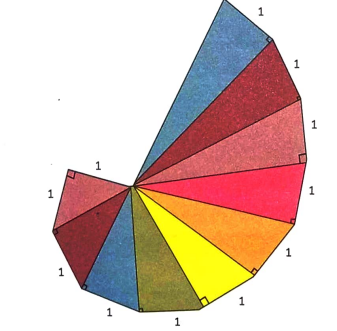
For each, state whether rational or irrational. Also describe step-by-step how to construct and locate \(\sqrt{5}\) on the number line.
2.
(A) State the hierarchy of number systems. Give one example at each stage which does not belong to the previous stage.
(B) Show that between any two rational numbers, an irrational number exists.
(C) Are irrational numbers always closed under addition? Give a counter-example.
3.
(A) Prove that \(\sqrt{10}\) is irrational.
(B) Explain the exact step where the proof method fails for \(\sqrt{4} \text { and } \sqrt{9} \text {. }\)Why does it fail?
4.
Perform long division for \(\frac{1}{13}\) ldentify the repeating block and the cyclic property.
5.
Three rational numbers x, y, z satisfy x+y+z= 0 and Xy + yz + X=0. Prove that x = y=z= 0.
6.
Convert to \(\frac{p}{q} \text { form: (A) } 12.6 \text { (B) } 0.0120 \text { (C) } 2 . \overline{1625}\),\(\text { (D) } 1.2 \overline{35}\)
7.
Find five rational numbers between \(\frac{3}{5} \text { and } \frac{4}{5} \text {. }\)
8.
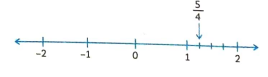
Represent \(\frac{5}{4}\)
on number line.
1.
By using Baudhãyana-Pythagoras Theorem at every step,we get
\(\text { T1: } \sqrt{(1+1}=\sqrt{2} \text { (irrational) }\)
\(\text { T2: } \sqrt{(2+1}=\sqrt{3} \text { (irrational) }\)
\(\text { T3: } \sqrt{(3+1}=\sqrt{4}=2 \text { (rational) }\)
\(\text { T4: } \sqrt{(4+1}=\sqrt{5} \text { (irrational) }\)
\(\text { T5: } \sqrt{(5+1}=\sqrt{6} \text { (irrational) }\)
\(\text { T6: } \sqrt{(6+1}=\sqrt{7} \text { (irrational) }\)
\(\text { T7: } \sqrt{(7+1}=\sqrt{8}=2 \sqrt{2} \text { (irrational) }\)
\(\text { T8: } \sqrt{(8+1}=\sqrt{9}=3 \text { (rational) }\)
\(\text { T9: } \sqrt{(9+1}=\sqrt{10} \text { (irrational) }\)
\(\text { T10: } \sqrt{(10+1}=\sqrt{11} \text { (irrational) }\)
Construction of \(\sqrt{5}\) on the Number Line
1. On the number line, mark O(0) and A(2) (since OA = 2).
2.At A,draw a perpendicular AB of length 1 unit.
3.Join O to B. Then OB \(=\sqrt{2^2+1^2}=\sqrt{5}\) by Pythagoras theorem
4. With centre O and radius OB,cut the number line at P.
Then OP = \(\sqrt{5}\)
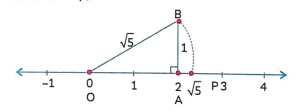
Hence, the point P on the number line represents \(\sqrt{5}\)
2.
(A) Natural Numbers → Integers → Rational Numbers → Real Numbers
Examples:
Integer but not a natural number: -3
Rational number but not an integer\(\frac{1}{2}\)
Real number but not a rational number: \(\sqrt{2}\)
(B) r1 and r2 be two rational numbers such that r1 < r2
Consider:
\(m=r_1+\frac{\left(r_2-r_1\right) \sqrt{2}}{2}\)
Since \(\sqrt{2}\) is irrational, m is also irrational.
Also,
\(0<\frac{\sqrt{2}}{2}\)
Therefore, r1 < m < r2
Hence, an irrational number lies between r1 and r2.
(C) Irrational numbers are not closed under addition. C counter-example\(\sqrt{2}+(-\sqrt{2})=0 \in Q .\)
Both addends are irrational, but their sum is rational.
3.
(A) Prove that \(\sqrt{10}\) is irrational.
Assume that \(\sqrt{10}=\frac{p}{q}\)
where p and q are co-prime integers and q ≠ 0.
Squaring both sides, p2 =10q2
Since 10 = 2 x 5, both 2 and 5 divide p2.
Therefore, 2 divides p and 5 also divides p. Hence, 10 divides p.
Let p = 10m
Substituting in the equation:
(10m)2 = 10q2
100m2 = 10q2
q2 = 10m2
Thus, 10 also divides q.
So both p and q are divisible by 10, which contradicts the assumption that p and q are co-prime.
Hence, \(\sqrt{10}\) is irrational.
(B) For \(\sqrt{4}: p^2=4 q^2\)
Taking p = 2k,
(2k)2 = 4q2
4K2 = 4q2
k = q
Therefore,
\(\sqrt{4}\) = 2 which is rational,
Similarly, for \(\sqrt{9}:\)
p2 = 9q2
Taking p = 3k,
9k² = 9q2
So k = q, giving
\(\sqrt{9}=3\)
which is also rational.
The proof by contradiction works only when the number is not a perfect square. For perfect squares such as and 9, the steps simplify to a rational number instead of producing a contradiction.
4.
On dividing \(\frac{1}{13}=0.07 \overline{6923}\)
This is a 6-digit repeating block
Other multiples \(\frac{2}{13}=0 . \overline{153846}, \frac{3}{13}=0 . \overline{230769}\)
\(\frac{4}{13}=0 . \overline{307692}, \text { etc. }\)
All fractions of the form \(\frac{k}{13}, k=1 \text { to } 12\) share the same digits, but in rotated (cyclic) order.
This happens because \(\frac{k}{13}\) generates a cyclic repeating
decimal of period 6, and its multiples rearrange these digits
Two cyclic groups
Group 1: Cyclic form of 0769 23
\(\frac{1}{13}, \frac{3}{13}, \frac{4}{13}, \frac{9}{13}, \frac{10}{13}, \frac{12}{13}\)
Group 2: Cyclic form of 153846
\(\frac{2}{13}, \frac{5}{13}, \frac{6}{13}, \frac{7}{13}, \frac{8}{13}, \frac{11}{13}\)
5.
Given:
X+y+z=0, xy + yz + zx = 0.........(i)
Use identity
Substitute values in eq. (i)
\(\begin{aligned} 0^2 & =x^2+y^2+z^2+2(0) \\ 0 & =x^2+y^2+z^2 \end{aligned}\)
Since \(x^2, y^2, z^2 \geqq 0\) for all real (rational) numbers, their sum can be zero only when each term is zero:
\(\begin{gathered} x^2=0, y^2=0, z^2=0 \\ x=0, y=0, z=0 \end{gathered}\)
Hence, proved.
6.
(A) Convert 12.6 into a rational number
\(12.6=\frac{126}{10}\)
Simplify:
\(\frac{126}{10}=\frac{63}{5}\)
(B) Convert 0.01120 into a rational number
\(0.0120=\frac{120}{10000}\)
Simplify:
\(\frac{120}{10000}=\frac{3}{250}\)
(C) Let, X= 2.16251625...
10000 x= 21625.1625...
On subtracting, we have
10000 x -X=21625.1625. -2.1625.
9999 x = 21623
\(\begin{aligned} &\text { So, }\\ &x=\frac{21623}{9999} \end{aligned}\)
(D) Let,X= 1.23535...
Multiply by 10 and 1000, we have
10x = 12.3535.. 1000x = 1235.3535..
Subtract:
1000x - 10x = 1235.3535.. - 12.3535..
\(\begin{aligned} &990 x=1223\\ &\text { So, }\\ &x=\frac{1223}{990} \end{aligned}\)
7.
Given, rational numbers are \(\frac{3}{5} \text { and } \frac{4}{5} \text {. }\)
Write the equivalent fractions of the given fractions, by multiplying numerator and denominator with (5 + 1), we get,
\(\begin{aligned} & \frac{3}{5} \times \frac{6}{6}=\frac{18}{30} \\ & \frac{4}{5} \times \frac{6}{6}=\frac{24}{30} \end{aligned}\)
Thus, the five required rational numbers between
\(\frac{3}{5} \text { and }\) \(\frac{4}{5} \text { are } \frac{19}{30}, \frac{20}{30}, \frac{21}{30}, \frac{22}{30}, \frac{23}{30} .\)
8.
To represent \(\frac{5}{4}\) on the number line, we will follow the following steps:
Step 1: Draw a number line - First, draw a horizontal line with zero (0) at the centre.

Step 2: Locate 1 and 2 on the number line - Since \(\frac{5}{4}\) is greater than 1, mark the numbers 1 and 2 on the number line.
Step 3: Divide the unit between 1 and 2 into 4 parts Since \(\frac{5}{4}\) a fraction with a denominator of 4, divide \(\frac{1}{4} .\)

Step 4: Mark the points - The points between 1 and 2 will be
\(1 \frac{1}{4}\) (after the first division)
\(1 \frac{2}{4} \text { or } 1 \frac{1}{2}\) (after second division)
\(1 \frac{3}{4}\) (after the third division)
2 (at the end of the unit)
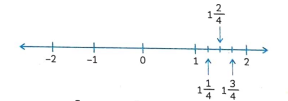
Step 5: Find \(\frac{5}{4}-\text { Since } \frac{5}{4}\) is same as \(1 \frac{1}{4}\) mark this point as \(\frac{5}{4} .\)

9th Standard CBSE Syllabus & Materials
9th Standard CBSE
CBSE 9th Mathematics Lines and Angles Sample Question Papers Study Material - QB365 Set A
NEW9th Standard CBSE
CBSE 9th Mathematics Introduction to Euclid's Geometry Sample Question Papers Study Material - QB365 Set A
NEW9th Standard CBSE
CBSE 9th Mathematics Linear Equations in Two Variables Sample Question Papers Study Material - QB365 Set A
NEW9th Standard CBSE
CBSE 9th Mathematics Coordinate Geometry Sample Question Papers Study Material - QB365 Set A



NCERT Books

Syllabus

Exam Pattern

Sample Question Papers

Previous year Question Papers

Important Notes

MCQ Practice test

NCERT Exemplers

Case study Questions

Image Based Questions

Passage based Questions

HOT Questions

Value Based Questions

Model Questions Papers
NCERT ( Book Back ) Questions

Assertion and Reason
Important Questions And Answers

CBSE 9th Standard CBSE Subjects
CBSE Standards