100% FREE ACCESS
9th Standard CBSE Syllabus & Materials
9th Standard CBSE
CBSE 9th Science Is matter around us pure? - New Model Questions Papers Study Material - QB365 Set A
NEW9th Standard CBSE
CBSE 9th Science Matter in our surroundings - New Model Questions Papers Study Material - QB365 Set A
NEW9th Standard CBSE
CBSE 9th Mathematics Heron's Formula Sample Question Papers Study Material - QB365 Set A
NEW9th Standard CBSE
CBSE 9th Mathematics Circles Sample Question Papers Study Material - QB365 Set A
NEW9th Standard CBSE
CBSE 9th Mathematics Quadrilaterals Sample Question Papers Study Material - QB365 Set A
NEW9th Standard CBSE
CBSE 9th Mathematics Triangles Sample Question Papers Study Material - QB365 Set A

Published on: 29/10/2025
Download CBSE Class 9th Standard CBSE Mathematics question papers, sample papers, important questions, and previous year solved papers in PDF format. Get free study materials, NCERT solutions, and exam preparation resources for Class 9th Standard CBSE Mathematics
Questions + Answers key
Take MCQ Mathematics Test
1.
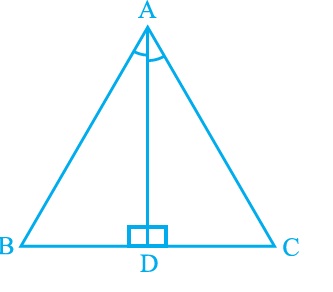
In D ABC, the bisector AD of \(\angle\) A is perpendicular to side BC (see Fig.). Show that AB = AC and \(\angle\) ABC is isosceles
2.
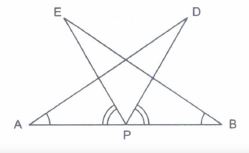
AB is a line segment and P is its mid-point. D and E are points on the same side of AB such that ∠BAD = ∠ABE and ∠EPA = ∠DPB (see figure). Show that
(i) ΔDAP ≅ ΔEBP
(ii) AD = BE
3.
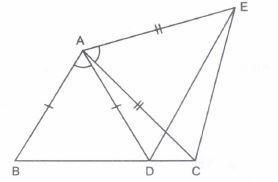
In the figure, AC = AE, AB = AD and ∠BAD = ∠EAC. Show that BC = DE.
4.
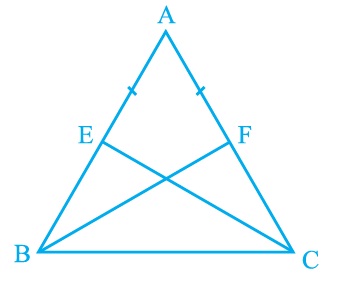
E and F are respectively the mid-points of equal sides AB and AC of D ABC (see Fig). Show that BF = CE.
5.
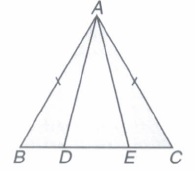
In an isosceles triangle ABC with AB = AC, D and E are points on BC such that BE = CD (see Fig). Show that AD = AE.
6.
Prove that each angle of an equilateral triangle is 60°.
7.
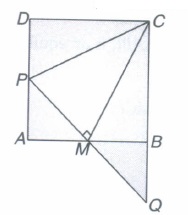
In the given figure, ABCD is a square and M is the mid-point of AB. PQ 1.CM meets AD at P and CB produced at Q. Prove that PA = BQ.
8.
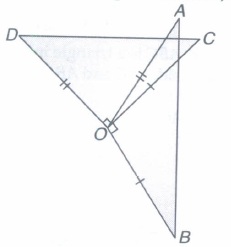
In figure, OA\(\bot \)OD, OC\(\bot \)OB, OD = OA and OC = OB. Prove that AB = CD.
9.
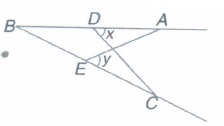
In the given figure, if \(\angle\)ADC = \(\angle\)AEC and AB = BC, then prove that AE = CD.
10.
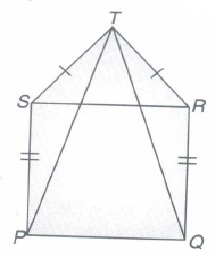
In figure, PQRS is a square and SRT is an equilateral triangle. Prove that:
(i) PT = QT
(ii) \(\angle\) TQR = 15°
11.
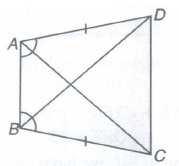
ABCD is a quadrilateral in which AD = BC and \(\angle\)DAB = \(\angle\)CBA. Prove that BD = AC.
12.
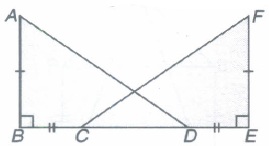
In figure, AB = EF, BC = ED, AB \(\bot \) BD, FE \(\bot \)EC Prove that \(\triangle ABD\cong \triangle FEC\)
13.
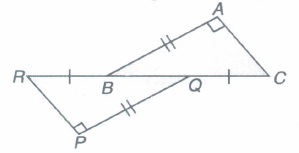
In the given figure, BA\(\bot \) CA, RP\(\bot \)QP, AB = PQ and BR = CQ. Prove that AC = PR.
14.
In the given figure, AB = CD and \(\angle\)ABC = \(\angle\)DCB.
Prove that:
(i) \(\triangle ABC\cong \triangle DCB\)
(ii) AC = DB.
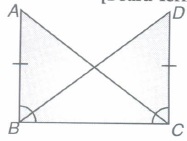
15.
In the given figure AB = CD, \(\angle\)ABD = \(\angle\)CDB. Prove that AD = CB.
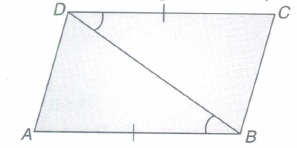
16.
In the given figure, D is the mid-point of the side BC of a ΔABC and ㄥABD = 50°. If AD = BD = CD, then find the measure of ㄥACD.
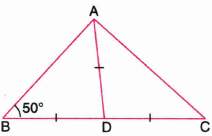
17.
Show that in a right angled triangle, the hypotenuse is the longest side.
18.
Two sides AB and BC and median AM of one triangle ABC are respectively equal to sides PQ and QR and median PN of \(\angle PQR\) (see figure). Show that:
(i) \(\triangle ABM\cong \triangle PQN\) (ii) \(\triangle ABC\cong \triangle PQR\)
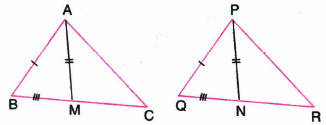
19.
AD is an altitude of an isosceles triangle ABC in which AB = AC Show that
(i) AD bisects BC (ii) AD bisects \(\angle A\)
20.
Show that the angles of an equilateral triangle are 60° each.
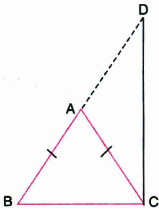
21.
In the given figure, AB = AC and AB = AD. Prove that \(\angle BCD={ 90 }^{ 0 }\)
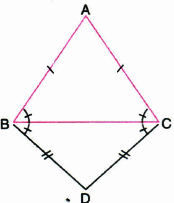
22.
ABC and DBC are two isosceles triangles on the same base BC (see figure). Show that \(\angle ABD=\angle ACD\)
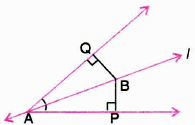
23.
Line l is the bisector of an angle\(\angle A\) and \(\angle B\) is any point on I.BP and BQ are perpendiculars from B to the arms of \(\angle A\) (see figure). Show that:
(i) \(\triangle APB\cong \triangle AQB\)
(ii) BP = BQ or B is equidistant from the arms of \(\angle A\)
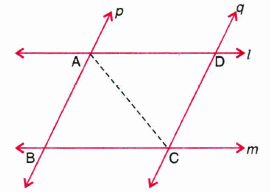
24.
l and m are two parallel lines intersected by another pair of parallel lines p and q (see figure). Show that \(\triangle ABC\cong \triangle CDA\)
25.
ABCD is a quadrilateral in which AD = BC and \(\angle DAB=\angle CBA\) (see fihure).Prove that:
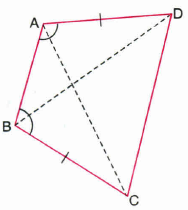
(i) \(\triangle ABD\cong \triangle BAC\)
(ii) BD = AC
(iii) \(\angle ABD=\angle BAC\)
1.
In \(\angle\)ABD and \(\angle\)ACD,
\(\angle\) BAD = \(\angle\)CAD (Given)
AD = AD (Common)
\(\angle\) ADB = \(\angle\)ADC = 90° (Given)
So, \(\angle\) ABD \(\angle\) ACD (ASA rule)
So, AB = AC (CPCT)
or, \(\angle\) ABC is an isosceles triangle.
2.
We have, P is the mid-point of AB.
∴ AP = BP
∠EPA = ∠DPB [Given]
Adding ∠EPD on both sides, we get
∠EPA + ∠EPD = ∠DPB + ∠EPD
⇒ APD = ∠BPE
(i) Now, in ΔDAP ≅ ΔEBP, we have
AP= BP [Proved]
∠PAD = ∠PBE [.: It is given that LBAD = LABE]
∠DPA = ∠EPB [Proved]
∴ Using ASA criteria, we have
ΔDAP ≅ ΔEBP
(ii) Since, ΔDAP ≅ ΔEBP
∴ Their corresponding parts are equal.
⇒ AD = BE.
3.
We have ∠BAD = ∠EAC
Adding ∠DAC on both sides, we have
∠BAD + ∠DAC = ∠EAC + ∠DAC
⇒ ∠BAC = ∠DAE
Now, in ΔABC and ΔADE, we have
∠BAC = ∠DAE [Proved]
AB = AD [Given]
AC = AE [Given]
∴ ΔBC ≅ ΔADE [Using SAS criteria]
SinceΔABC ≅ ΔADE, therefore, their corresponding parts are equal.
⇒ BC = DE.
4.
Proof: In \(\triangle\)ABF and \(\triangle\)ACE,
AB =AC
\(\angle\)A=\(\angle\)A
AF =AE
\(\therefore\) \(\triangle\)ABF = \(\triangle\)ACE (by SAS cong.)
\(\therefore\) By c.p.c.t BF = CE.
Alternative Method:
AB = AC\(\Rightarrow \frac { AB }{ 2 } =\frac { AC }{ 2 } \)
\(\Rightarrow \) AE=AF,
sice E and F are the mid-points of AB and AC
In \(\triangle\)ABF and \(\triangle\)ACE,
AB = AC (Given)
\(\angle\)A = \(\angle\)A (Common)
AF = AE (Proved)
\(\therefore \triangle ABF\cong \triangle ACE\) (By SAS cong.)
\(\therefore\) BF = CE. (By c.p.c.t)
5.
In \(\triangle\)ABE and \(\triangle\)ACD
AB =AC (Given)
\(\angle\)C = \(\angle\)B
(Angle opp. to equal sides)
BE = CD (Given)
\(\therefore \ \triangle ABE\cong \triangle ACD\) (By SAS)
AO = AE. (By c.p.c.t.)
6.
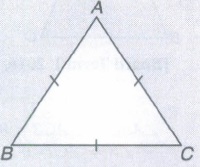
AB =AC
\(\therefore\) \(\angle\)B = \(\angle\)C = x
BA =BC
\(\therefore\) \(\angle\)A = \(\angle\)C = x
AC =BC
\(\angle\)A = \(\angle\)B = x
But, \(\angle\)A + \(\angle\)B + \(\angle\)C = 180°
Also,
3x = 1800
\(\angle\)A = \(\angle\)B = \(\angle\)C = 60°.
Alternative Method:
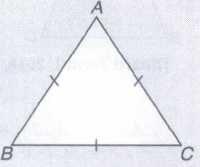
Let \(\triangle\)ABC be an equilateral triangle, so that AB = AC = BC
Now, AB = AC
\(\Rightarrow\) \(\angle\)B = \(\angle\)C ....(1)
(\(\because\)Angles opp. to equal sides are equal)
CB = CA
\(\Rightarrow\) \(\angle\)A = \(\angle\)B ....(2)
(\(\because\) Angles opp. to equal sides are equal)
From (1) and (2), we have
\(\angle\)A = \(\angle\)B = \(\angle\)C
Also, \(\angle\)A +\(\angle\).B +\(\angle\)C = 180°,(Angle sum property)
\(\therefore\) \(\angle\)A + \(\angle\)A + \(\angle\)A = 180°
\(\Rightarrow\) 3\(\angle\)A = 180° \(\Rightarrow\) \(\angle\)A = 60°.
\(\therefore\) \(\angle\)A = \(\angle\)B = \(\angle\)C = 60°.
Thus, each angle of an equilateral triangle is 60°.
7.
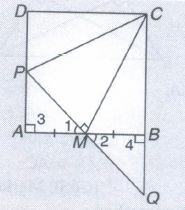
In \(\triangle\)PAM and \(\triangle\)QBM,
As M is the mid-point,
\(\Rightarrow\) AM = BM
\(\angle\)1 = \(\angle\)2
\(\angle\)3 = \(\angle\)4 = 90°
\(\therefore\) \(\triangle PAM\cong \triangle QBM\) (By ASA Cong.)
\(\therefore\) PA = BQ. (By c.p.c.t.) Proved.
8.
\(\angle\)DOC = \(\angle\)AOB
Proving \(\triangle COD\cong \triangle BOA\) (SAS)
CD = AB. (c.p.c.t.)
Alternative Method:
In \(\triangle\)COD and \(\triangle\)BOA,
OD =OA (Given)
OC =OB (Given)
\(\angle\)DOA = \(\angle\)COB = 90°
\(\therefore\) \(\angle\)DOA + \(\angle\)AOC = \(\angle\)COB + \(\angle\)AOC
i.e., \(\angle\)DOC = \(\angle\)AOB
\(\therefore\) \(\triangle COD\cong \triangle BOA\) (By SAS)
\(\Rightarrow\) CD =AB. (By c.p.c.t.)
9.
\(\angle\)BDC + \(\angle\)CDA = 180° (Linear Pair)
\(\angle\)BDC + x = 180°
\(\angle\)BDC = 180° - x
Similarly, \(\angle\)BEA = 180° - y
x = Y (Given)
\(\angle\)BDC = \(\angle\)BEA
\(\angle\)B = \(\angle\)B (Common)
AB = BC
\(\triangle BAE\cong \triangle BCD\) (ASA)
\(\therefore\) AE = CD (c.p.c.t.)
10.
PQRS is a square. (given)
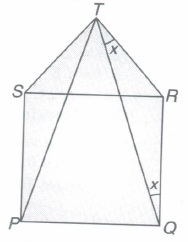
(i) SRT is an equilateral triangle. (given)
\(\therefore\) \(\angle\)PSR = 90°, \(\angle\)TSR = 60°
\(\Rightarrow\) \(\angle\)PSR + \(\angle\)TSR = 150°.
Similarly, \(\angle\)QRT = 150°
In \(\triangle\)PST and \(\triangle\)QRT, we have PS = QR (S)
\(\angle\)PST =\(\angle\)QRT = 150° (A)
and ST = RT (5) Y,
By SAS, \(\triangle PST\cong \triangle QRT\)
\(\Rightarrow\) PT = QT (By c.p.c.t.) Proved.
(ii) In \(\triangle\)TQR, QR = RT
(Square and equilateral 6 on same base) Yz
\(\Rightarrow\) \(\angle\)TQR = \(\angle\)QTR = x
\(\therefore\) x + x + \(\angle\)QRT = 180°
\(\Rightarrow\) 2x + 150° = 180° ~ 2x = 30°
\(\therefore\) x = 15° Proved.
11.
In \(\triangle\)ABC and \(\triangle\)BAD,
BC =AD (Given)
\(\angle\)CBA = \(\angle\)BAD (Given)
AB =AB (Common)
\(\triangle\)ABC \(\cong \) \(\triangle\)BAD (By SAS cong.)
BD = AC (By c.p.c.t.)
12.
BC = DE
Adding CD to both sides
BC + CD = DE + CD
\(\Rightarrow\)BD =CE
In \(\triangle\)ABD and \(\triangle\)FEC,
AB = EF (Given)
\(\angle\)B = \(\angle\)E = (90°)
BD = CE (proved)
\(\triangle ABD\cong \triangle FEC\) (by SAS)
13.
BR + BQ = CQ + BQ \(\Rightarrow\) QR = BC
\(\triangle ABC\cong \triangle PQR\) by RHS\(\cong\)condn
\(\therefore\) AC = PR (By c.p.c.t.)
14.
In \(\triangle\)sABC and DCB,
AB = DC
\(\angle\)ABC = \(\angle\)DCB {(Given)}
BC = CB (Common)
\(\triangle ABC\cong \triangle DCB\) (SAS)
AC = DB. (By c.p.c.t.)
15.
In \(\triangle\)ABD and \(\triangle\)CDB,
AB = CD (Given)
\(\angle\)ABD = \(\angle\)CDB (Given)
BD = BD (Common)
\(\Rightarrow\) \(\triangle ABD\cong \triangle CDB\) (By SAS)
\(\Rightarrow\) AD = CB. (By c.p.c.t.)
16.
400
17.
Let ABC be a right angled triangle in which ㄥB = 90°.
Then, ㄥA +ㄥC = 90°
|Sum of all the angles of a triangle is 180°
ㄥB=ㄥA+ㄥC
ㄥB>ㄥA and ㄥB>ㄥC
AC>BC
| Side opposite to greater angle is longer
and AC> AB
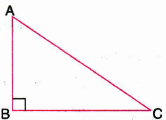
AC is the longest side, i.e., hypotenuse is the longest side.
18.
Given: Two sides AB and BC and median AM of one triangle ABC are respectively equal to sides PQ and QR and median PN of \(\angle PQR\)
To prove: (i) \(\triangle ABM\cong \triangle PQN\) (ii) \(\triangle ABC\cong \triangle PQR\)
Proof: In \(\triangle ABM\) and \(\triangle PQN\)
AB = PQ
AM = PN
BC = QR
2BM = 2QN | M and Nare the mid-points of BC and QR respectively
BM = QN
In view of (1), (2) and (3)
\(\triangle ABM\cong \triangle PQN\) | SSS rule
(ii) \(\triangle ABM\cong \triangle PQN\)
\(\angle ABM=\angle PQN\) | C.P.C.T
\(\angle ABC=\angle PQR\)
In \(\triangle ABC\) and \(\triangle PQR\)
AB = PQ
BC = QR
\(\angle ABC=\angle PQR\)
\(\triangle ABC=\triangle PQR\) | SAS rule
19.
Given: AD is an altitude of an isosceles triangle ABC in which AB = AC.
To prove: (i) AD bisects BC (ii) AD bisects \(\angle A\)
Proof: (i) In right \(\triangle ADB\) and right \(\triangle ADC\)
Hyp.AB = Hyp. AC
Side AD = Side AD
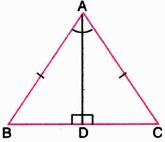
\(\triangle ADB\cong \triangle ADC\) | RHS rule
BD = CD | C.P.C.T
AD bisects BC
(ii) \(\triangle ADB\cong \triangle ADC\)
\(\angle BAD=\angle CAD\)
AD bisects \(\angle A\)
20.
Given: An equilateral triangle ABC
To prove: \(\angle A+\angle B+\angle C={ 60 }^{ 0 }\)
Proof: ABC is an equilateral triangle
AB = BC = CA ....... (1) |
AB = BC
\(\angle A=\angle C\) .......... (2) | Angles opposite to equal sides of a triangle are equal
BC = CA
\(\angle A=\angle B\) ......... (3) | Angles opposite to equal sides of a triangle are equal
From (2) and (3), we obtain
\(\angle A=\angle B=\angle C\) ........ (4)
In \(\triangle ABC\)
\(\angle A+\angle B+\angle C={ 180 }^{ 0 }\) ...... (5) | Sum of all the angles of a triangle is 180°
Let \(\angle A={ x }^{ 0 }\) then, \(\angle B=\angle C={ x }^{ 0 }\)
From (5)
\({ x }^{ 0 }+{ x }^{ 0 }+{ x }^{ 0 }={ 180 }^{ 0 }\)
\(3{ x }^{ 0 }={ 180 }^{ 0 }\)
\({ x }^{ 0 }={ 60 }^{ 0 }\)
\(\angle A=\angle B=\angle C={ 60 }^{ 0 }\)
21.
Given: \(\triangle ABC\) is an isosceles triangle in which AB = AC. Side BA is produced to D such that AD = AB
To prove: \(\angle BCD\) a right angle.
Proof: ABC is an isosceles triangle
\(\angle ABC=\angle ACB\)
AB = AC AND AD = AB
AC = AD
In \(\triangle ACD\)
\(\angle CDA=\angle ACD\) | Angles opposite to equal sides of a triangle are equal
\(\angle CDB=\angle ACD\)
Adding the corresponding sides of (1) and (2) we get
\(\angle ABC+\angle CDB=\angle ACB+\angle ACD\)
\(\angle ABC+\angle CDB=\angle BCD\)
In \(\triangle BCD\)
\(\angle BCD+\angle ABC+\angle CDB={ 180 }^{ 0 }\)
\(\angle BCD+\angle BCD={ 180 }^{ 0 }\)
\(2\angle BCD={ 180 }^{ 0 }\)
\(\angle BCD={ 90 }^{ 0 }\)
\(\angle BCD\) is a right angle.
22.
Given: ABC and DBC are two isosceles triangles on the same base BC
To prove: \(\angle ABD=\angle ACD\)
Proof: ABC is an isosceles triangle on the base BC
\(\angle ABC=\angle ACB\)
DBC is an isosceles triangle on the base BC
\(\angle DBC=\angle DCB\)
Adding the corresponding sides of (1) and (2) we get
\(\angle ABC+\angle DBC=\angle ACB+\angle DCB\)
\(\angle ABD=\angle ACD\)
23.
Given: Line l is the bisector of an angle\(\angle A\) and \(\angle B\) is any point on I.BP and BQ are perpendiculars from B to the arms of \(\angle A\)
To Prove: (i) \(\triangle APB\cong \triangle AQB\)
(ii) BP = BQ or B is equidistant from the arms of \(\angle A\)
Proof: (i) In \(\triangle APB\) and \(\triangle AQB\)
\(\angle BAP=\angle BAQ \) | l is the bisector of \(\angle A\)
AB = AB | Common
\(\angle BAP=\angle BAQ \) | Each = 900
BP = BQ or B is equidistant from the arms of \(\angle A\)
\(\triangle APB\cong \triangle AQB\) | SAS Rule
(ii) \(\triangle APB\cong \triangle AQB\) | Proved in (i) above
BP = BQ | C.P.C.T
24.
Given: l and m are two parallel lines intersected by another pair of parallel lines p and q
To Prove: \(\triangle ABC\cong \triangle CDA\)
Proof: \(AB\parallel DC\) and \(AD\parallel BC\)
Quadrilateral ABCD is a parallelogram.
| A quadrilateral is a parallelogram if both the pairs of opposite sides are parallel
BC = AD ........... (1) | Opposite sides of a \(\parallel \) gm are equal
AB = CD .............(2) | Opposite sides of a \(\parallel \) gm are equal
\( \angle ABC=\angle CDA\)......(3) | Opposite angles of a \(\parallel \) gm are equal
In \(\triangle ABC\) and \(\triangle CDA\),
AB = CD | From (2)
BC = DA | From (1)
\( \angle ABC=\angle CDA\) | From (3)
\(\triangle ABC\cong \triangle CDA\) | SAS Rule
25.
Given ABCD is a quadrilateral in which AD=BC and \(\angle DAB=\angle CBA\)
To prove: (i) \(\triangle ABD\cong \triangle BAC\)
(ii) BD = AC
(iii) \(\angle ABD=\angle BAC\)
Proof: (i) In \(\triangle ABD\) and \(\triangle BAC\)
AD = BC
AB = BA
\(\angle DAB=\angle CBA\)
\(\triangle ABD\cong \triangle BAC\) |SAS Rule
(ii) \(\triangle ADB\cong \triangle BAC\) |Proved in (i)
BD = AC | C.P.C.T
(iii) \(\triangle ABD\cong \triangle BAC\) |Proved in (i)
\(\angle ABD=\angle BAC\) | C.P.C.T

9th Standard CBSE Syllabus & Materials
9th Standard CBSE
CBSE 9th Mathematics Lines and Angles Sample Question Papers Study Material - QB365 Set A
NEW9th Standard CBSE
CBSE 9th Mathematics Introduction to Euclid's Geometry Sample Question Papers Study Material - QB365 Set A
NEW9th Standard CBSE
CBSE 9th Mathematics Linear Equations in Two Variables Sample Question Papers Study Material - QB365 Set A
NEW9th Standard CBSE
CBSE 9th Mathematics Coordinate Geometry Sample Question Papers Study Material - QB365 Set A



NCERT Books

Syllabus

Exam Pattern

Sample Question Papers

Previous year Question Papers

Important Notes

MCQ Practice test

NCERT Exemplers

Case study Questions

Image Based Questions

Passage based Questions

HOT Questions

Value Based Questions

Model Questions Papers
NCERT ( Book Back ) Questions

Assertion and Reason
Important Questions And Answers

CBSE 9th Standard CBSE Subjects
CBSE Standards