100% FREE ACCESS
9th Standard CBSE Syllabus & Materials
9th Standard CBSE
CBSE 9th Science Is matter around us pure? - New Model Questions Papers Study Material - QB365 Set A
NEW9th Standard CBSE
CBSE 9th Science Matter in our surroundings - New Model Questions Papers Study Material - QB365 Set A
NEW9th Standard CBSE
CBSE 9th Mathematics Heron's Formula Sample Question Papers Study Material - QB365 Set A
NEW9th Standard CBSE
CBSE 9th Mathematics Circles Sample Question Papers Study Material - QB365 Set A
NEW9th Standard CBSE
CBSE 9th Mathematics Quadrilaterals Sample Question Papers Study Material - QB365 Set A
NEW9th Standard CBSE
CBSE 9th Mathematics Triangles Sample Question Papers Study Material - QB365 Set A

Published on: 29/10/2025
Download CBSE Class 9th Standard CBSE Mathematics question papers, sample papers, important questions, and previous year solved papers in PDF format. Get free study materials, NCERT solutions, and exam preparation resources for Class 9th Standard CBSE Mathematics
Questions + Answers key
Take MCQ Mathematics Test
1.
Show that in a right angled triangle, the hypotenuse is the longest side.
2.
Show that the angles of an equilateral triangle are 60° each.
3.
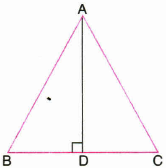
In \(\triangle ABC\) , AD is the perpendicular bisector of BC (see figure).Show that \(\triangle ABC\) is isosceles triangle in which AB = AC.
4.
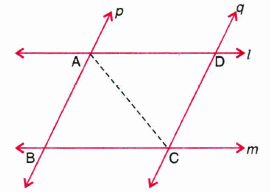
l and m are two parallel lines intersected by another pair of parallel lines p and q (see figure). Show that \(\triangle ABC\cong \triangle CDA\)
5.
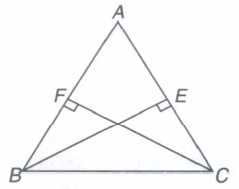
In figure, ABC is a triangle in which altitudes BE and CF to sides AC and AB respectively are equal.
Show that:
(i) \(\triangle ABE\cong \triangle ACF\)
(ii) AB = AC.
6.
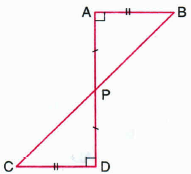
In the given figure, AB and CD are perpendicular to the line segment AD. AD and BC intersect at P such that PA = PD. Prove that:
(i) AB = CD
(ii) P is the mid-point of BC.
7.
ABC is an isosceles triangle with AB = AC. Draw AP⊥ BC show that ∠B = ∠C.
8.
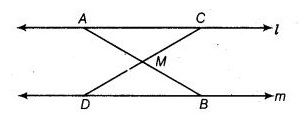
In the given figure, l ∥m and M is the mid-point of a line segment AB. Show that M is also the mid-point of any line segment CD having its end points on l and m, respectively.
9.
In \(\Delta\)PQR, if \(\angle\)P, QR=4cm and PR=5cm, then find the length of PQ.
10.
In a ΔDEF, if ㄥD = 30°, ㄥE = 60° then which side of the triangle is longest and which side is shortest?
11.
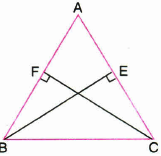
ABC is an isosceles triangle in which altitudes BE and CF are drawn to equal sides AC and AB respectively (see figure). Show that these altitudes are equal.
12.
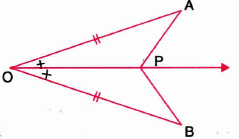
Given ΔOAP ≌ ΔOBP in figure, the criteria by which the triangles are congruent:
SAS
SSS
RHS
ASA
13.
In the given figure, OA = OB, OD = OC, then ΔAOD ≌ BOC by congruency rule:
SAS
ASA
SAS
RHS
14.
If the side of a square is a cm, what is the side of a congruent square?
1 cm
2 cm
a cm
2a cm
15.
Two circles are congruent.If the radius of one circle is 1cm, then the diameter of the other circle is
1 cm
2 cm
4 cm
0.5 cm
16.
The side of an equilateral triangle is 4cm.An equilateral triangle, congruent to it, has the side length
1 cm
2 cm
3 cm
4 cm
17.
In the given figure, ABCD is a square ΔDEC an equilateral triangle. Prove that
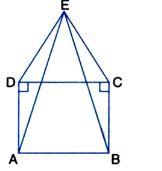
(i) ΔAD E≅ ΔBCE
(ii) AE = BE
(iii) ㄥDA = 150
18.
ABC is the land of a school. Students thought of a planting trees ill and around the school to reduce air pollution. What value are they showing by doing so? If AB = AC, Dis the point in the interior of MBC such that LDBC = LDCB, then prove that AD bisects .
19.
In the given figure, AC = AE, AB = AD and\(\angle BAD=\angle EAC\). Show that BC = DE.
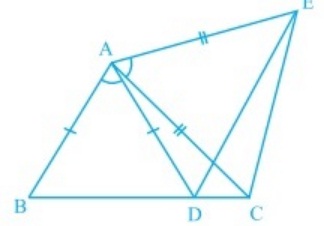
First, show that \(\triangle ABC\cong \triangle ADE\) by using SAS rule and then use CPCT to show given result
1.
Let ABC be a right angled triangle in which ㄥB = 90°.
Then, ㄥA +ㄥC = 90°
|Sum of all the angles of a triangle is 180°
ㄥB=ㄥA+ㄥC
ㄥB>ㄥA and ㄥB>ㄥC
AC>BC
| Side opposite to greater angle is longer
and AC> AB
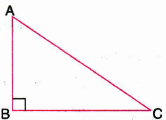
AC is the longest side, i.e., hypotenuse is the longest side.
2.
Given: An equilateral triangle ABC
To prove: \(\angle A+\angle B+\angle C={ 60 }^{ 0 }\)
Proof: ABC is an equilateral triangle
AB = BC = CA ....... (1) |
AB = BC
\(\angle A=\angle C\) .......... (2) | Angles opposite to equal sides of a triangle are equal
BC = CA
\(\angle A=\angle B\) ......... (3) | Angles opposite to equal sides of a triangle are equal
From (2) and (3), we obtain
\(\angle A=\angle B=\angle C\) ........ (4)
In \(\triangle ABC\)
\(\angle A+\angle B+\angle C={ 180 }^{ 0 }\) ...... (5) | Sum of all the angles of a triangle is 180°
Let \(\angle A={ x }^{ 0 }\) then, \(\angle B=\angle C={ x }^{ 0 }\)
From (5)
\({ x }^{ 0 }+{ x }^{ 0 }+{ x }^{ 0 }={ 180 }^{ 0 }\)
\(3{ x }^{ 0 }={ 180 }^{ 0 }\)
\({ x }^{ 0 }={ 60 }^{ 0 }\)
\(\angle A=\angle B=\angle C={ 60 }^{ 0 }\)
3.
Given: In \(\triangle ABC\) , AD is the perpendicular bisector of BC
To Prove: \(\triangle ABC\) is isosceles triangle in which AB = AC.
Proof: In \(\angle ADB=\angle ADC\)
DB = DC | AD is the perpendicular bisector of BC
AD = AD
\(\triangle ADB\cong \triangle ADC\) |By SAS rule
AB = AC | C.P.C.T
\(\triangle ABC\) is an isosceles triangle in which
AB = AC
4.
Given: l and m are two parallel lines intersected by another pair of parallel lines p and q
To Prove: \(\triangle ABC\cong \triangle CDA\)
Proof: \(AB\parallel DC\) and \(AD\parallel BC\)
Quadrilateral ABCD is a parallelogram.
| A quadrilateral is a parallelogram if both the pairs of opposite sides are parallel
BC = AD ........... (1) | Opposite sides of a \(\parallel \) gm are equal
AB = CD .............(2) | Opposite sides of a \(\parallel \) gm are equal
\( \angle ABC=\angle CDA\)......(3) | Opposite angles of a \(\parallel \) gm are equal
In \(\triangle ABC\) and \(\triangle CDA\),
AB = CD | From (2)
BC = DA | From (1)
\( \angle ABC=\angle CDA\) | From (3)
\(\triangle ABC\cong \triangle CDA\) | SAS Rule
5.
Let, BE\(\bot \)AC and CF\(\bot \)AB
In \(\triangle\)s ABE and ACF, we have
\(\angle\)AEB = \(\angle\)AFC (.: Each = 90°)
\(\angle\)A = \(\angle\)A (Common)
and BE = CF (Given)
\(\therefore\) By AAS criterion at congruence, we have
\(\triangle ABE\cong \triangle ACF\)
\(\Rightarrow\) AB = AC.
(\(\therefore\) Corresponding parts of congruent triangles are equal)
6.
Given: AB and CD are perpendicular to the line segment AD. AD and BC intersect at P such that PA = PD.
To Prove: (i) AB = CD
(ii) P is the mid-point of BC.
Proof: (i) In \(\triangle ABD\) and \(\triangle PDC\)
PA = PD
\(\angle APB=\angle DPC\) | Vertically opposite angles
\(\angle PAB=\angle PDC\) | Each 900
\(\triangle PAB\cong \triangle PDC\) | ASA congruence rule
AB = DC | C.P.C.T
AB = CD | C.P.C.T
(ii) Also, PB = PC
P is the mid-point of BC.
7.
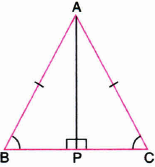
We have AP ⊥ BC [Given]
∴ ∠APB = 90०and APC = 90०
In ΔABP and ΔACP, we have
∠APB = ∠APC [each = 90०]
AB = AC [Given]
AP = AP [Common]
∴ Using RHS criteria. ΔABP ≅ ΔACP
∴ Their corresponding parts are congruent.
⇒ ∠B = ∠C
8.
Only to prove that ΔANC≅ΔDMB by SAS congruence rule.
9.
In \(\Delta\)PQR, \(\angle\) P=\(\angle\)R
PQ=QR
[sides opposite to equal angle are equal]
\(\Rightarrow \) PQ=4cm [\(\because \) QR=4cm]
10.
DE, EF
11.
Given: ABC is an isosceles triangle in which altitudes BE and CF are drawn to equal sides AC and AB respectively.
To Prove: BE = CF
Proof: ABC is an isosceles triangle
AB = AC
\(\angle ABC=\angle ACB\) | Angles opposite to equal sides of a triangle are equal
In \(\triangle BEC\) and \(\triangle CFB\)
\(\angle BEC=\angle CFB\) | Each = 900
BC = CB
\(\angle ECB=\angle FBC\)
\(\triangle BEC\cong \triangle CFB\) | By AAS Rule
BE = CF | C.P.C.T
12.
(a)
SAS
13.
In ΔAOD and ΔBOC
OA=OB
OD=OC
ㄥAOD=ㄥBOC
∴ ΔAOD≅ΔBOC
14.
Two squares of the same side length ar congruent
15.
Two circles of the same radii are congruent
16.
Two equilateral triangles of the same side length are congruent
17.
Given ABCD is a square and ΔDEC is an equilateral triangle.
To prove (i) ΔADE ≅ ΔBCE
(ii) AE = BE
(iii) ㄥDAE = 150
Proof From figure, we have
ㄥADE = ㄥADC + ㄥCDE
= 900 + 600 = 1500 ...(i)
[since, each angle of a square is 90° and each angle of an equilateral triangle is 60°]
Similarly ㄥBCE=ㄥBCD+ㄥDCE
= 900 + 600 = 1500 ...(ii)
[since, each angle of a square is 90° and each angle of an equilateral triangle is 60°]
(i) In ΔADE and ΔBCE,
AD = BC [sides of a square]
DE = CE [sides of an equilateral tiangle]
and ㄥADE = ㄥBCE = 1500 [from Eqs. (i) and (ii)]
∴ ΔADE ≅ ΔBCE [by SAS congruence rule]
(ii) From part (i) ΔADE ≅ ΔBCE
Then, AE = BE [by CPCT]
(iii) In ΔADE,
AD = BE [∵ AD = DC = DE]
⇒ ㄥAED = ㄥDAE ...(iii)
[since, angles opposite to equal sides of a triangle are equal]
Now, ㄥDAE + ㄥAED + ㄥADE = 1800
[by angle sum property of a triangle]
⇒ ㄥDAE + ㄥDAE + 1500=1800
[from Eqs. (i) and (iii)]
⇒ 2ㄥDAE = 300
∴ ㄥDAE = 150
18.
Given \(\triangle ABC\) is an isosceles triangle with
AB = AC
OB and OC are the bisectors of LB and LC respectively and intersect each other at O.
i.e.
(ii) AO bisects
AB = AC [given)
\(\Rightarrow \angle B=\angle C\)
[since, angles opposite to equal sides are equal)
\(\Rightarrow \frac { 1 }{ 2 } \angle B=\frac { 1 }{ 2 } \angle C\)
\(\Rightarrow \angle OBC=\angle OCB\)
\(\angle OBA=\angle OCA\)
[since sides opposite to equal angles of a triangle are equal]
(iii) In \(\triangle ABO\ \triangle ACO\) [given]
AB = BC[given]
\(\angle OBA=\angle OCA\)
and OB = OC
\(\therefore \triangle ABO\equiv ACO\)
[by SAS congruence rule]
Then \(\angle BAO=\angle CAO\) [by CPCT[]
So AO is the bisector of \(\angle BAC\)
Hence proved
19.
Given AC = AE, AB = AD and \(\angle BAD=\angle EAC\)
To prove BC=DE
proof We have \(\angle BAD=\angle EAC\)
On adding \(\angle DAC\) to both sides, we get
\(\angle BAD+\angle DAC=\angle EAC+\angle DAC\)
\(\\ \angle BAC=\angle DAE\)
In \(\triangle ABC\quad \triangle ADE,AC=AE\)
AB = BD
and \(\angle BAC=\angle DAE\)
\(\therefore \triangle ABC\cong \triangle ADE\) [by SAS congruence rule]
Then , BC = DE [by CPCT]
Hence Proved.

9th Standard CBSE Syllabus & Materials
9th Standard CBSE
CBSE 9th Mathematics Lines and Angles Sample Question Papers Study Material - QB365 Set A
NEW9th Standard CBSE
CBSE 9th Mathematics Introduction to Euclid's Geometry Sample Question Papers Study Material - QB365 Set A
NEW9th Standard CBSE
CBSE 9th Mathematics Linear Equations in Two Variables Sample Question Papers Study Material - QB365 Set A
NEW9th Standard CBSE
CBSE 9th Mathematics Coordinate Geometry Sample Question Papers Study Material - QB365 Set A



NCERT Books

Syllabus

Exam Pattern

Sample Question Papers

Previous year Question Papers

Important Notes

MCQ Practice test

NCERT Exemplers

Case study Questions

Image Based Questions

Passage based Questions

HOT Questions

Value Based Questions

Model Questions Papers
NCERT ( Book Back ) Questions

Assertion and Reason
Important Questions And Answers

CBSE 9th Standard CBSE Subjects
CBSE Standards